2006 SUZUKI SX4 300
[x] Cancel search: 300Page 272 of 1556

Downloaded from www.Manualslib.com manuals search engine 1C-4 Engine Electrical Devices:
Throttle Position Sensor Performance Check
1) Remove air cleaner outlet hose.
2) Turn OFF ignition switch.
3) Disconnect connector from electric throttle body
assembly.
4) Check throttle position sensor (main and sub) output
voltage as following steps.
a) For throttle position sensor (main), arrange 3
new 1.5 V batteries (1) in series (check that total
voltage is 4.5 – 5.0 V) and connect its positive
terminal to “Vin” terminal (2) and negative
terminal to “Ground” terminal (3) of sensor. Then
using voltmeter, connect positive terminal to
“Vout 1” terminal (4) of sensor and negative
terminal to battery.
b) For throttle position sensor (sub), arrange 3 new
1.5 V batteries (1) in series (check that total
voltage is 4.5 – 5.0 V) and connect its positive
terminal to “Vin” terminal (2) and negative
terminal to “Ground” terminal (3) of sensor. Then
using voltmeter, connect positive terminal to
“Vout 2” terminal (4) of sensor and negative
terminal to battery.
c) Measure output voltage variation while throttle
valve is opened and closed as following
specification.If sensor voltage is out of specified value and linear
variation as the following graph, replace electric throttle
body assembly.
TP sensor output voltage
TP sensor (main) [A]: 0.45 – 4.88 V, varying
according to throttle valve opening by finger
(Voltage should vary by 0.04 V for each 1° valve
opening)
TP sensor (sub) [B]: 1.33 – 5.007 V, varying
according to throttle valve opening by finger
(Voltage should vary by about 0.032 V for each 1°
valve opening)
1 42 3
I4RS0B130007-02
1
3
24
I4RS0B130008-01
[C]: TP sensor (main) output voltage
[D]: TP sensor (sub) output voltage
[E]: Throttle valve opening
[F]: Position where throttle valve is open by 7° from completely closed
position (default position)
[G]: Angel obtained when accelerator pedal is depressed fully (84°)
[H]: Angle obtained when throttle valve is fully opened with finger (96°)
[B]
[A][D]
(V) [C]
(V)
[F]
[G][E] 0.45 - 0.75 0.724 - 1.036 3.675 - 4.245 4.000 - 4.880
1.33 - 1.63 1.604 - 1.9163.883 - 4.453 4.097 - 5.007
[H]
I7RW01130019-05
Page 273 of 1556

Downloaded from www.Manualslib.com manuals search engine Engine Electrical Devices: 1C-5
Electric Throttle Body System CalibrationS6RW0D1306004
NOTE
If the service described under the
“Precautions of Electric Throttle Body
System Calibration in Section 1A” is
performed, calibrate electric throttle body
system as follows.
1) If electric throttle body assembly and/or accelerator
pedal position (APP) sensor assembly are replaced,
perform following steps.
a) Disconnect negative cable at battery for 20
seconds or more for the purpose of clearing
calibration data of closed throttle position from
memory in ECM.
b) Connect negative cable to battery.
2) Keep ignition switch at ON position for 5 seconds or
more without running engine.
Accelerator Pedal Position (APP) Sensor
Assembly On-Vehicle Inspection
S6RW0D1306005
1) Check that APP sensor assembly has been mounted
to vehicle body properly (no pinched floor carpet,
etc.).
If mounting is not properly, reinstall APP sensor
assembly properly referring to “Accelerator Pedal
Position (APP) Sensor Assembly Removal and
Installation”.
2) Connect scan tool to DLC with ignition switch turned
OFF.
3) Turn ON ignition switch and select “Data List” mode
on scan tool.4) Check that accelerator pedal position sensor voltage
varies as the following graph.
If sensor voltage is out of specified value or does not
vary linearly as the following graph, check APP
sensor assembly referring to “Accelerator Pedal
Position (APP) Sensor Assembly Inspection”.
Accelerator Pedal Position (APP) Sensor
Assembly Removal and Installation
S6RW0D1306006
CAUTION!
• Do not expose APP sensor assembly to
excessive shock like a dropping it. If APP
sensor assembly has been exposed to
excessive shock, it should be replaced.
• Be careful not to expose sensor section of
APP sensor assembly to water.
NOTE
After replacing APP sensor assembly,
perform calibration of throttle valve referring
to “Electric Throttle Body System
Calibration”.
[A]: APP sensor (main) voltage
[B]: APP sensor (sub) voltage
[C]: Voltage
[D]: Idle position of accelerator pedal
[E]: Full depressed position of accelerator pedal
[C]
[D] [E]
3.50 - 4.27 V
1.74 - 2.17 V
0.65 - 0.82 V
0.30 - 0.44 V
[A]
[B]
I7RW01130020-01
Page 274 of 1556
Downloaded from www.Manualslib.com manuals search engine 1C-6 Engine Electrical Devices:
Removal
1) Disconnect negative cable at battery.
2) Disconnect connector from APP sensor assembly.
3) Remove APP sensor assembly from its bracket.
Installation
Reverse removal procedure for installation noting the
following.
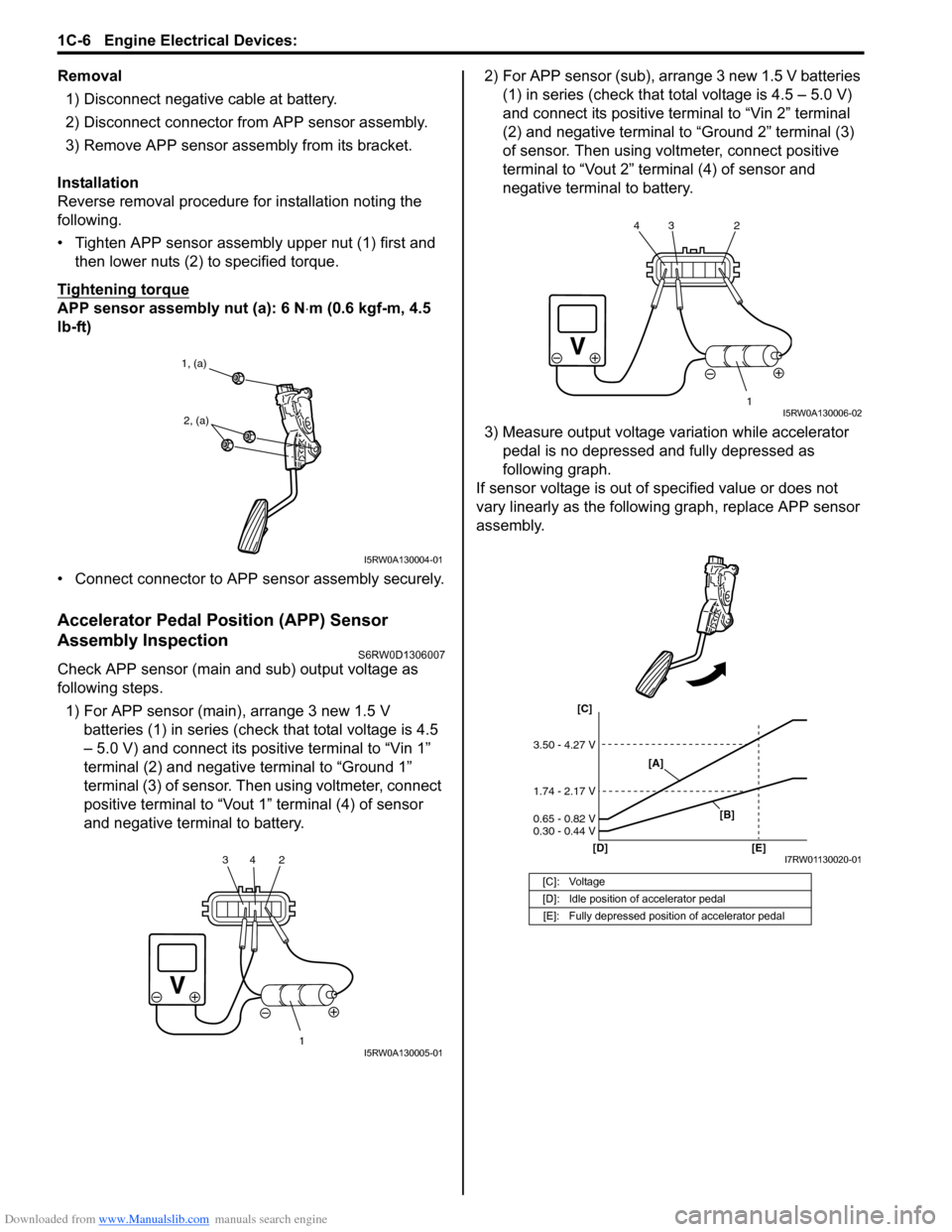
• Tighten APP sensor assembly upper nut (1) first and
then lower nuts (2) to specified torque.
Tightening torque
APP sensor assembly nut (a): 6 N⋅m (0.6 kgf-m, 4.5
lb-ft)
• Connect connector to APP sensor assembly securely.
Accelerator Pedal Position (APP) Sensor
Assembly Inspection
S6RW0D1306007
Check APP sensor (main and sub) output voltage as
following steps.
1) For APP sensor (main), arrange 3 new 1.5 V
batteries (1) in series (check that total voltage is 4.5
– 5.0 V) and connect its positive terminal to “Vin 1”
terminal (2) and negative terminal to “Ground 1”
terminal (3) of sensor. Then using voltmeter, connect
positive terminal to “Vout 1” terminal (4) of sensor
and negative terminal to battery.2) For APP sensor (sub), arrange 3 new 1.5 V batteries
(1) in series (check that total voltage is 4.5 – 5.0 V)
and connect its positive terminal to “Vin 2” terminal
(2) and negative terminal to “Ground 2” terminal (3)
of sensor. Then using voltmeter, connect positive
terminal to “Vout 2” terminal (4) of sensor and
negative terminal to battery.
3) Measure output voltage variation while accelerator
pedal is no depressed and fully depressed as
following graph.
If sensor voltage is out of specified value or does not
vary linearly as the following graph, replace APP sensor
assembly.
1, (a)
2, (a)
I5RW0A130004-01
1 2 34I5RW0A130005-01
[C]: Voltage
[D]: Idle position of accelerator pedal
[E]: Fully depressed position of accelerator pedal
1 2 3 4I5RW0A130006-02
[C]
[D] [E]
3.50 - 4.27 V
1.74 - 2.17 V
0.65 - 0.82 V
0.30 - 0.44 V
[A]
[B]
I7RW01130020-01
Page 275 of 1556

Downloaded from www.Manualslib.com manuals search engine Engine Electrical Devices: 1C-7
Engine Coolant Temperature (ECT) Sensor
Removal and Installation
S6RW0D1306008
Removal
1) Disconnect negative cable at battery.
2) Drain coolant referring to “Cooling System Draining
in Section 1F”.
WARNING!
To avoid danger of being burned, do not
remove radiator cap while engine and
radiator are still hot.
Scalding fluid and steam can be blown out
under pressure if cap is taken off too soon.
3) Remove air intake pipe.
4) Disconnect connector from ECT sensor (1).
5) Remove ECT sensor from water outlet.
Installation
Reverse removal procedure noting the following.
• Clean mating surfaces of ECT sensor and water
outlet.
• Check O-ring for damage and replace, if necessary.
• Tighten ECT sensor (1) to specified torque.
Tightening torque
ECT sensor (a): 15 N·m (1.5 kgf-m, 11.0 lb-ft)
• Connect connector to ECT sensor securely.
• Refill coolant referring to “Cooling System Flush and
Refill in Section 1F”.
Engine Coolant Temperature (ECT) Sensor
Inspection
S6RW0D1306009
Immerse temperature sensing part of ECT sensor (1) in
water (or ice) and measure resistance between sensor
terminals while heating water gradually.
If measured resistance doesn’t show such characteristic
as shown, replace ECT sensor.
1
I2RH0B130008-01
1,(a)
I2RH0B130009-01
I5RW0A130007-01
Page 276 of 1556

Downloaded from www.Manualslib.com manuals search engine 1C-8 Engine Electrical Devices:
Heated Oxygen Sensor (HO2S-1 and HO2S-2)
Heater On-Vehicle Inspection (If Equipped)
S6RW0D1306010
1) Disconnect sensor connector.
2) Using ohmmeter, measure resistance between
terminals “V
B” and “GND” of sensor connector.
If found faulty, replace oxygen sensor.
NOTE
Temperature of sensor affects resistance
value largely. Make sure that sensor heater is
at correct temperature.
Resistance of oxygen sensor heater
HO2S-1: 5.0 – 6.4 Ω at 20 °C (68 °F)
HO2S-2: 11.7 – 14.5 Ω at 20 °C (68 °F)
Viewed from terminal side
3) Connect sensor connector securely.
Heated Oxygen Sensor (HO2S-1 and HO2S-2)
Removal and Installation (If Equipped)
S6RW0D1306011
Removal
WARNING!
To avoid danger of being burned, do not
touch exhaust system when system is hot.
Oxygen sensor removal should be performed
when system is cool.
1) Disconnect negative cable at battery.
2) Disconnect connector of heated oxygen sensor and
release its wire harness from clamps.
3) Perform following items before removing heated
oxygen sensor.
a) For HO2S-1, remove exhaust manifold referring
to “Exhaust Manifold Removal and Installation in
Section 1K”, if necessary.
b) For HO2S-2, hoist vehicle.
4) Remove heated oxygen sensor from exhaust pipe or
exhaust manifold.Installation
Reverse removal procedure noting the following.
• Tighten heated oxygen sensor (1) to specified torque.
Tightening torque
Heated oxygen sensor (a): 45 N·m (4.5 kgf-m,
32.5 lb-ft)
• Install exhaust manifold referring to “Exhaust Manifold
Removal and Installation in Section 1K”, if removed.
• Connect connector of heated oxygen sensor (1) and
clamp wire harness securely.
• After installing heated oxygen sensor, start engine
and check that no exhaust gas leakage exists.
[A]: HO2S-1 [B]: HO2S-2
I4RS0A130006-01
[A]: HO2S-1 [B]: HO2S-2
[A]
[B]
1, (a)
1, (a)
I3RM0A130007-01
Page 277 of 1556

Downloaded from www.Manualslib.com manuals search engine Engine Electrical Devices: 1C-9
Camshaft Position (CMP) Sensor Removal and
Installation
S6RW0D1306012
Removal
1) Disconnect negative cable at battery.
2) Disconnect connector from CMP sensor.
3) Remove camshaft position sensor from timing chain
cover (non-VVT model) or cylinder head (VVT
model).
Installation
1) Install camshaft position sensor to timing chain cover
(non-VVT model) or cylinder head (VVT model).
Tightening torque
CMP sensor bolt (non-VVT model) (a): 10 N·m (
1.0 kgf-m, 7.5 lb-ft)
CMP sensor bolt (VVT model) (b): 11 N·m (1.1
kgf-m, 8.0 lb-ft)
2) Connect connector to CMP sensor securely.
3) Connect negative cable to battery.
Camshaft Position (CMP) Sensor InspectionS6RW0D1306013
Visual check
• Check that O-ring is free from damage.
• Check that end face of sensor and signal rotor tooth
are free from any metal particles and damage.
[A]: Non-VVT model [B]: VVT model
I6RW0D130002-02
I4RS0B130015-01
Page 278 of 1556
Downloaded from www.Manualslib.com manuals search engine 1C-10 Engine Electrical Devices:
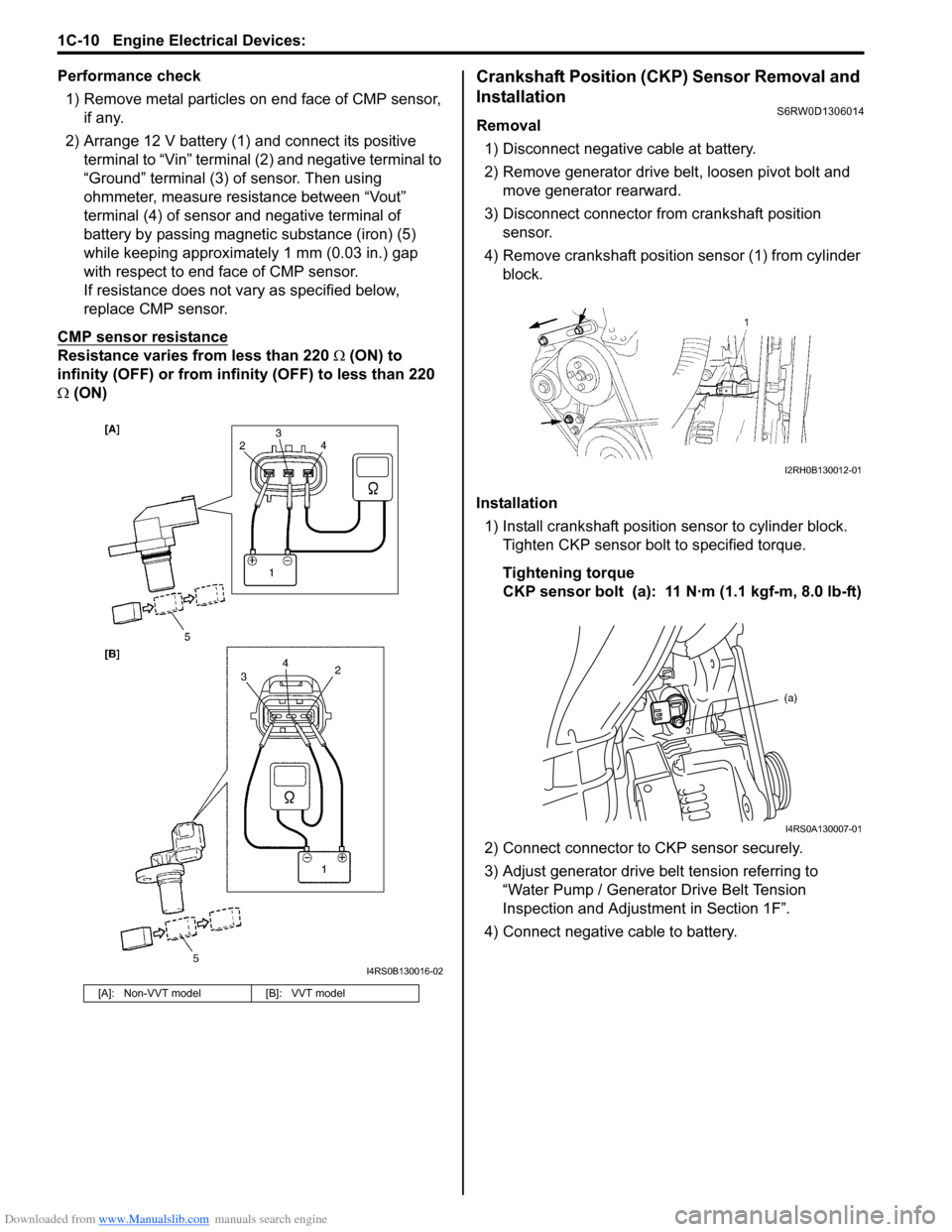
Performance check
1) Remove metal particles on end face of CMP sensor,
if any.
2) Arrange 12 V battery (1) and connect its positive
terminal to “Vin” terminal (2) and negative terminal to
“Ground” terminal (3) of sensor. Then using
ohmmeter, measure resistance between “Vout”
terminal (4) of sensor and negative terminal of
battery by passing magnetic substance (iron) (5)
while keeping approximately 1 mm (0.03 in.) gap
with respect to end face of CMP sensor.
If resistance does not vary as specified below,
replace CMP sensor.
CMP sensor resistance
Resistance varies from less than 220 Ω (ON) to
infinity (OFF) or from infinity (OFF) to less than 220
Ω (ON)
Crankshaft Position (CKP) Sensor Removal and
Installation
S6RW0D1306014
Removal
1) Disconnect negative cable at battery.
2) Remove generator drive belt, loosen pivot bolt and
move generator rearward.
3) Disconnect connector from crankshaft position
sensor.
4) Remove crankshaft position sensor (1) from cylinder
block.
Installation
1) Install crankshaft position sensor to cylinder block.
Tighten CKP sensor bolt to specified torque.
Tightening torque
CKP sensor bolt (a): 11 N·m (1.1 kgf-m, 8.0 lb-ft)
2) Connect connector to CKP sensor securely.
3) Adjust generator drive belt tension referring to
“Water Pump / Generator Drive Belt Tension
Inspection and Adjustment in Section 1F”.
4) Connect negative cable to battery.
[A]: Non-VVT model [B]: VVT model
I4RS0B130016-02
I2RH0B130012-01
(a)
I4RS0A130007-01
Page 279 of 1556
Downloaded from www.Manualslib.com manuals search engine Engine Electrical Devices: 1C-11
Crankshaft Position (CKP) Sensor InspectionS6RW0D1306015
Visual check
• Check that O-ring is free from damage.
• Check that end face of sensor and signal pulley tooth
are free from any metal particles and damage.
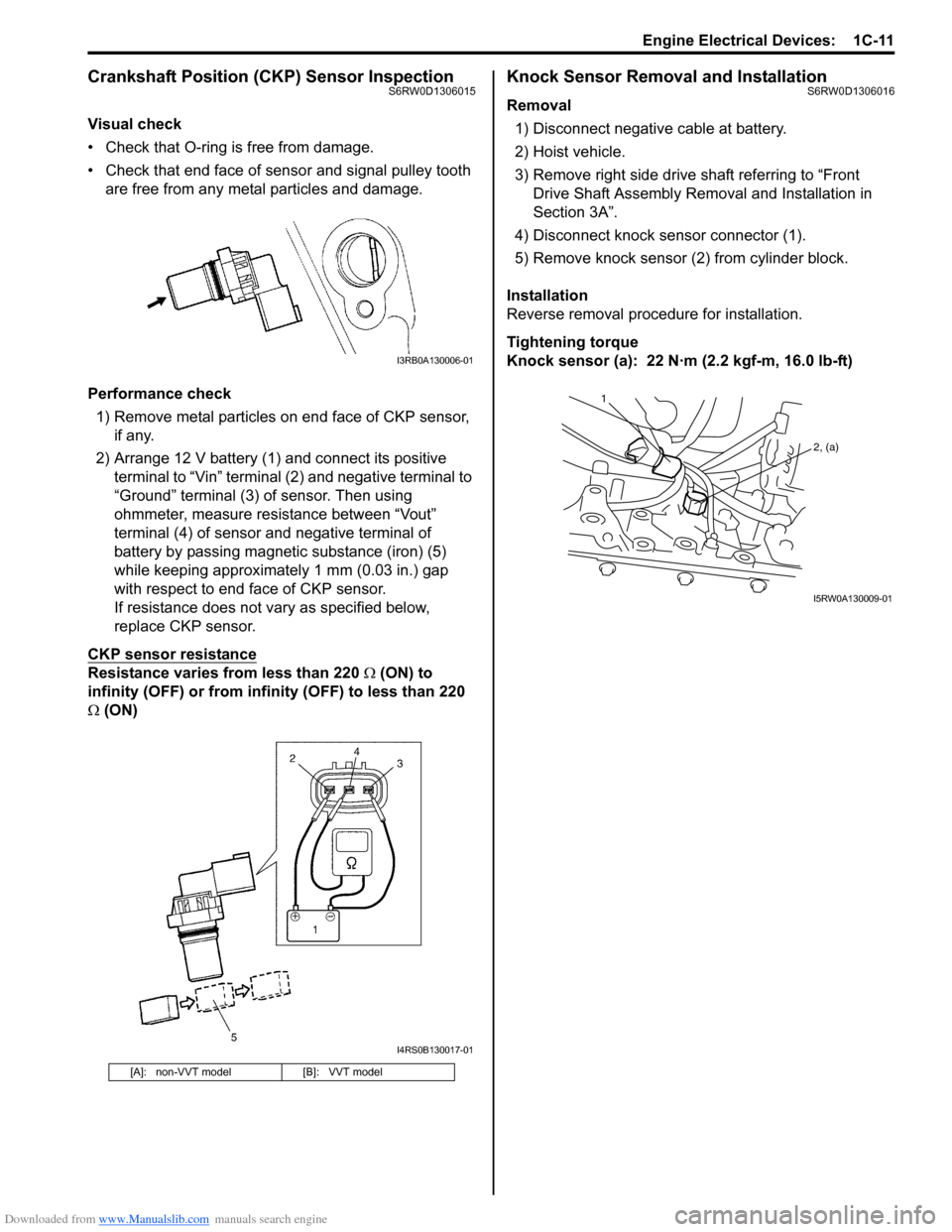
Performance check
1) Remove metal particles on end face of CKP sensor,
if any.
2) Arrange 12 V battery (1) and connect its positive
terminal to “Vin” terminal (2) and negative terminal to
“Ground” terminal (3) of sensor. Then using
ohmmeter, measure resistance between “Vout”
terminal (4) of sensor and negative terminal of
battery by passing magnetic substance (iron) (5)
while keeping approximately 1 mm (0.03 in.) gap
with respect to end face of CKP sensor.
If resistance does not vary as specified below,
replace CKP sensor.
CKP sensor resistance
Resistance varies from less than 220 Ω (ON) to
infinity (OFF) or from infinity (OFF) to less than 220
Ω (ON)
Knock Sensor Removal and InstallationS6RW0D1306016
Removal
1) Disconnect negative cable at battery.
2) Hoist vehicle.
3) Remove right side drive shaft referring to “Front
Drive Shaft Assembly Removal and Installation in
Section 3A”.
4) Disconnect knock sensor connector (1).
5) Remove knock sensor (2) from cylinder block.
Installation
Reverse removal procedure for installation.
Tightening torque
Knock sensor (a): 22 N·m (2.2 kgf-m, 16.0 lb-ft)
[A]: non-VVT model [B]: VVT model
I3RB0A130006-01
I4RS0B130017-01
1
2, (a)
I5RW0A130009-01