2006 SUZUKI SX4 Ecm
[x] Cancel search: EcmPage 264 of 1556

Downloaded from www.Manualslib.com manuals search engine 1B-1 Aux. Emission Control Devices:
Engine
Aux. Emission Control Devices
Diagnostic Information and Procedures
EGR System Inspection (If Equipped)S6RW0D1204001
1) Connect SUZUKI scan tool to data link connector
(DLC) (1) with ignition switch turned OFF.
2) Turn ON ignition switch and erase DTC using
“Delete” in “DTC” menu of scan tool.
3) Start engine and warm it up to normal operating
temperature, then select “Data List” mode on scan
tool.
4) Make sure that vehicle condition is as follows.
• Vehicle speed = 0 km/h (0 KPH)
• Engine speed ≤ 900 rpm
• Engine coolant temp. ≥ 90 °C, 164 °F5) With engine idling (without depressing accelerator
pedal), open EGR valve by using “Step EGR
Control” mode in “Engine / Active Test” menu. In this
state, as EGR valve opening increases engine idle
speed drops. If not, possible cause is clogged EGR
gas passage, stuck or faulty EGR valve.
Special tool
(A): SUZUKI scan tool (SUZUKI-SDT)
Repair Instructions
EVAP Canister Purge InspectionS6RW0D1206001
NOTE
Before inspection, check to make sure that
gear shift lever is in neutral position and that
parking brake lever is pulled all the way up.
1) Disconnect purge hose (1) from purge pipe.
2) Place finger against the end of disconnected hose
and check that vacuum is not felt there when engine
is cool and running at idle speed. If check result is
not satisfactory, check EVAP canister purge valve,
wire harness and ECM.
EVAP Canister Purge Valve and Its Circuit
Inspection
S6RW0D1206002
WARNING!
Do not apply vacuum by mouth; otherwise
harmful fuel vapor can be breathed in.
CAUTION!
Do not apply vacuum more than –86 kPa (–
12.47 psi); otherwise EVAP canister purge
valve could be damaged.
(A) 1I5RW0C110011-01
1
I5RW0A120006-01
Page 265 of 1556

Downloaded from www.Manualslib.com manuals search engine Aux. Emission Control Devices: 1B-2
1) Prepare to operate EVAP canister purge valve as
follows.
a) When using SUZUKI scan tool:
i) Connect SUZUKI scan tool to DLC (1) with
ignition switch turned OFF and disconnect
purge valve vacuum hoses from intake
manifold and EVAP canister.
ii) Turn ON ignition switch, clear DTC and
select “Engine / Active Test” mode on
SUZUKI scan tool.
Special tool
(A): SUZUKI scan tool (SUZUKI-SDT)
b) When not using SUZUKI scan tool:
NOTE
Before performed this check, be sure to read
the “Precautions of ECM Circuit Inspection in
Section 1A”.
i) Disconnect purge valve vacuum hoses from
intake manifold and purge pipe.
ii) Remove ECM from its bracket referring to
“Engine Control Module (ECM) Removal and
Installation in Section 1C”.
iii) Connect special tool between ECM and ECM
connector referring to “Inspection of ECM
and Its Circuits in Section 1A”.
iv) Turn ON ignition switch.
Using service wire, ground “C01-29” terminal
circuit of special tool (valve ON: “B”) and
unground it (valve OFF: “A”).2) Check purge valve for operation and vacuum
passage for clog when valve is switched ON and
OFF by using SUZUKI scan tool or service wire.
If check result is not satisfactory, check vacuum
hoses, EVAP canister purge valve, wire harness and
connections.
EVAP canister purge valve specification
[A] Valve OFF: When vacuum (–60 kPa (–8.7 psi))
is applied to hose (1), vacuum can be applied.
[B] Valve ON: When vacuum is applied to hose
(1), vacuum can not be applied.
Special tool
(A): 09917–47011
Vacuum Passage InspectionS6RW0D1206003
Start engine and run it at idle speed. Disconnect vacuum
hose (1) from EVAP canister purge valve (2). With finger
placed against disconnected hose, check that vacuum is
applied.
If it is not applied, clean vacuum passage by blowing
compressed air.
(A) 1I5RW0C110011-01
“C01-29”
“A”
“B”
I6RW0D120001-01
[A]
1 (A)
[B]
1 (A)
I5RW0A120008-01
1
2
I5RW0A120003-01
Page 269 of 1556
Downloaded from www.Manualslib.com manuals search engine Engine Electrical Devices: 1C-1
Engine
Engine Electrical Devices
Repair Instructions
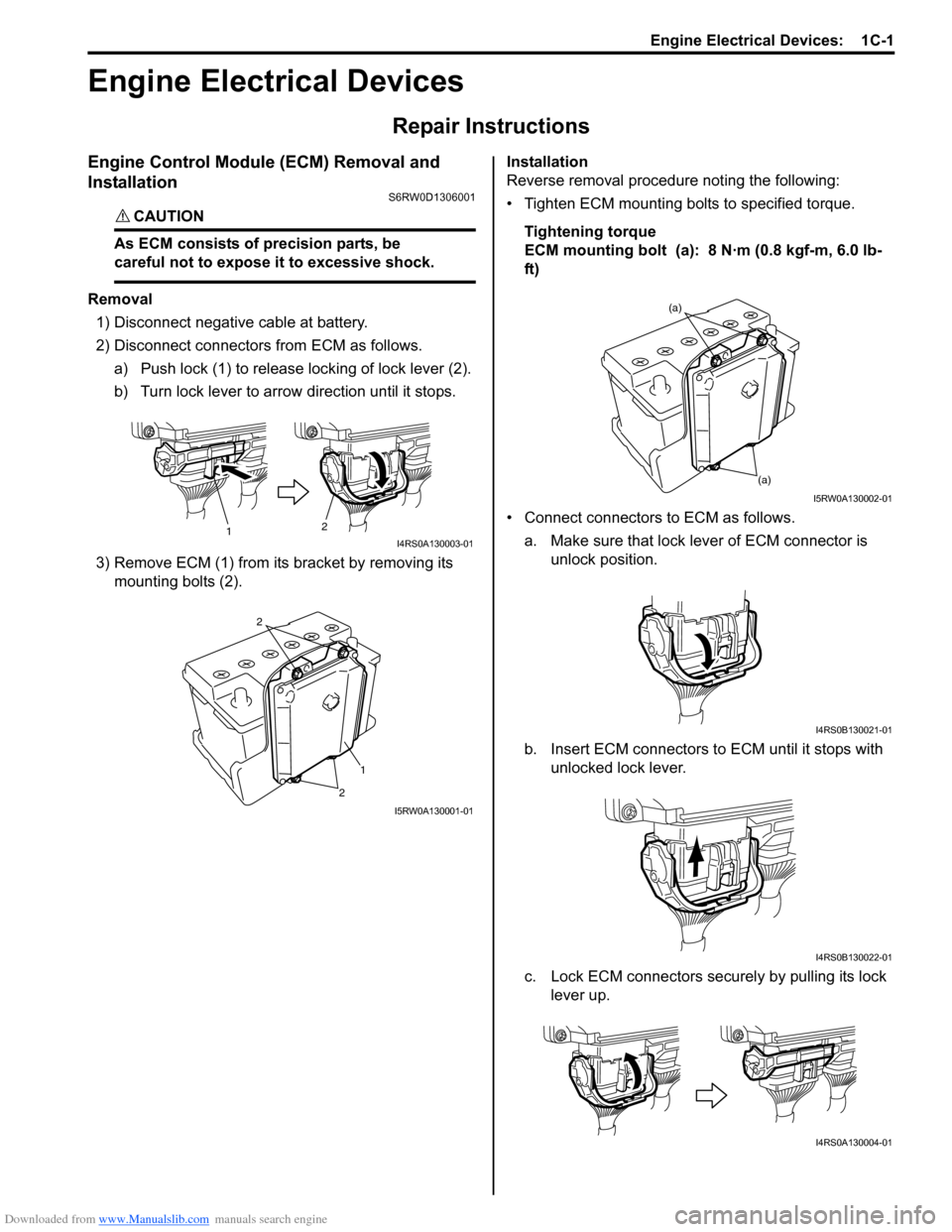
Engine Control Module (ECM) Removal and
Installation
S6RW0D1306001
CAUTION!
As ECM consists of precision parts, be
careful not to expose it to excessive shock.
Removal
1) Disconnect negative cable at battery.
2) Disconnect connectors from ECM as follows.
a) Push lock (1) to release locking of lock lever (2).
b) Turn lock lever to arrow direction until it stops.
3) Remove ECM (1) from its bracket by removing its
mounting bolts (2).Installation
Reverse removal procedure noting the following:
• Tighten ECM mounting bolts to specified torque.
Tightening torque
ECM mounting bolt (a): 8 N·m (0.8 kgf-m, 6.0 lb-
ft)
• Connect connectors to ECM as follows.
a. Make sure that lock lever of ECM connector is
unlock position.
b. Insert ECM connectors to ECM until it stops with
unlocked lock lever.
c. Lock ECM connectors securely by pulling its lock
lever up.
12I4RS0A130003-01
1
2 2
I5RW0A130001-01
(a) (a)
I5RW0A130002-01
I4RS0B130021-01
I4RS0B130022-01
I4RS0A130004-01
Page 271 of 1556

Downloaded from www.Manualslib.com manuals search engine Engine Electrical Devices: 1C-3
Throttle Valve Visual Check
1) Remove air cleaner outlet hose.
2) Check that there isn’t any foreign matter caught
between throttle valve and throttle body housing. If
there is, take it out after removing throttle body
referring to “Electric Throttle Body Assembly
Removal and Installation in Section 1D” and clean
inside of throttle body thoroughly.
Throttle Valve Operation Check
1) Remove air cleaner outlet hose.
2) Turn OFF ignition switch.
3) Move throttle valve with finger to its full open position
and check that it moves smoothly.
4) Take off finger from opened throttle valve (1) which is
at full open position and check that it moves
smoothly by its return spring and open spring force
back to default position (position where throttle valve
is open by 7° (2) from completely closed position).
5) Move throttle valve with finger to its completely
closed position and check that it moves smoothly.
6) Take off finger from closed throttle valve (1) which is
at completely closed position and check that it
moves smoothly by its return spring and open spring
force back to default position.
If check result is not satisfactory, replace electric
throttle body assembly.Electric Throttle Body Assembly Operation Check
1) Remove air cleaner outlet hose.
2) Turn ON ignition switch.
3) Depress accelerator pedal gradually and check that
throttle valve moves smoothly until it opens fully.
4) Release accelerator pedal depressed in Step 3) and
check that throttle valve (1) moves back to default
position (position where throttle valve is open by 7°
(2) from its completely closed position).
If check result is satisfactory, electric throttle body
system is in good condition.If check result is not
satisfactory, proceed to next step.
5) Perform “Accelerator Pedal Position (APP) Sensor
Assembly On-Vehicle Inspection”, “Throttle Actuator
(Motor) Check” and “Throttle Position Sensor
Performance Check”.
If check results are not satisfactory, replace electric
throttle body assembly.
If check results are satisfactory, wire circuit and/or
ECM are faulty.
Throttle Actuator (Motor) Check
1) Turn OFF ignition switch.
2) Disconnect connector from electric throttle body
assembly.
3) Measure resistance between “M1” terminal (1) and
“M2” terminal (2) of electric throttle body assembly.
If measured resistance is out of specified value,
replace electric throttle body assembly.
Throttle actuator (motor) resistance
0.3 – 100 Ω at 20 °C (68 °F)
I4RS0B130004-01
1
2
I4RS0B130005-01
1
2
I4RS0B130005-01
21
I4RS0B130023-01
Page 273 of 1556

Downloaded from www.Manualslib.com manuals search engine Engine Electrical Devices: 1C-5
Electric Throttle Body System CalibrationS6RW0D1306004
NOTE
If the service described under the
“Precautions of Electric Throttle Body
System Calibration in Section 1A” is
performed, calibrate electric throttle body
system as follows.
1) If electric throttle body assembly and/or accelerator
pedal position (APP) sensor assembly are replaced,
perform following steps.
a) Disconnect negative cable at battery for 20
seconds or more for the purpose of clearing
calibration data of closed throttle position from
memory in ECM.
b) Connect negative cable to battery.
2) Keep ignition switch at ON position for 5 seconds or
more without running engine.
Accelerator Pedal Position (APP) Sensor
Assembly On-Vehicle Inspection
S6RW0D1306005
1) Check that APP sensor assembly has been mounted
to vehicle body properly (no pinched floor carpet,
etc.).
If mounting is not properly, reinstall APP sensor
assembly properly referring to “Accelerator Pedal
Position (APP) Sensor Assembly Removal and
Installation”.
2) Connect scan tool to DLC with ignition switch turned
OFF.
3) Turn ON ignition switch and select “Data List” mode
on scan tool.4) Check that accelerator pedal position sensor voltage
varies as the following graph.
If sensor voltage is out of specified value or does not
vary linearly as the following graph, check APP
sensor assembly referring to “Accelerator Pedal
Position (APP) Sensor Assembly Inspection”.
Accelerator Pedal Position (APP) Sensor
Assembly Removal and Installation
S6RW0D1306006
CAUTION!
• Do not expose APP sensor assembly to
excessive shock like a dropping it. If APP
sensor assembly has been exposed to
excessive shock, it should be replaced.
• Be careful not to expose sensor section of
APP sensor assembly to water.
NOTE
After replacing APP sensor assembly,
perform calibration of throttle valve referring
to “Electric Throttle Body System
Calibration”.
[A]: APP sensor (main) voltage
[B]: APP sensor (sub) voltage
[C]: Voltage
[D]: Idle position of accelerator pedal
[E]: Full depressed position of accelerator pedal
[C]
[D] [E]
3.50 - 4.27 V
1.74 - 2.17 V
0.65 - 0.82 V
0.30 - 0.44 V
[A]
[B]
I7RW01130020-01
Page 280 of 1556
Downloaded from www.Manualslib.com manuals search engine 1C-12 Engine Electrical Devices:
Main Relay, Fuel Pump Relay, Starting Motor
Control Relay, Throttle Actuator Control Relay
and Radiator Cooling Fan Relay Inspection
S6RW0D1306017
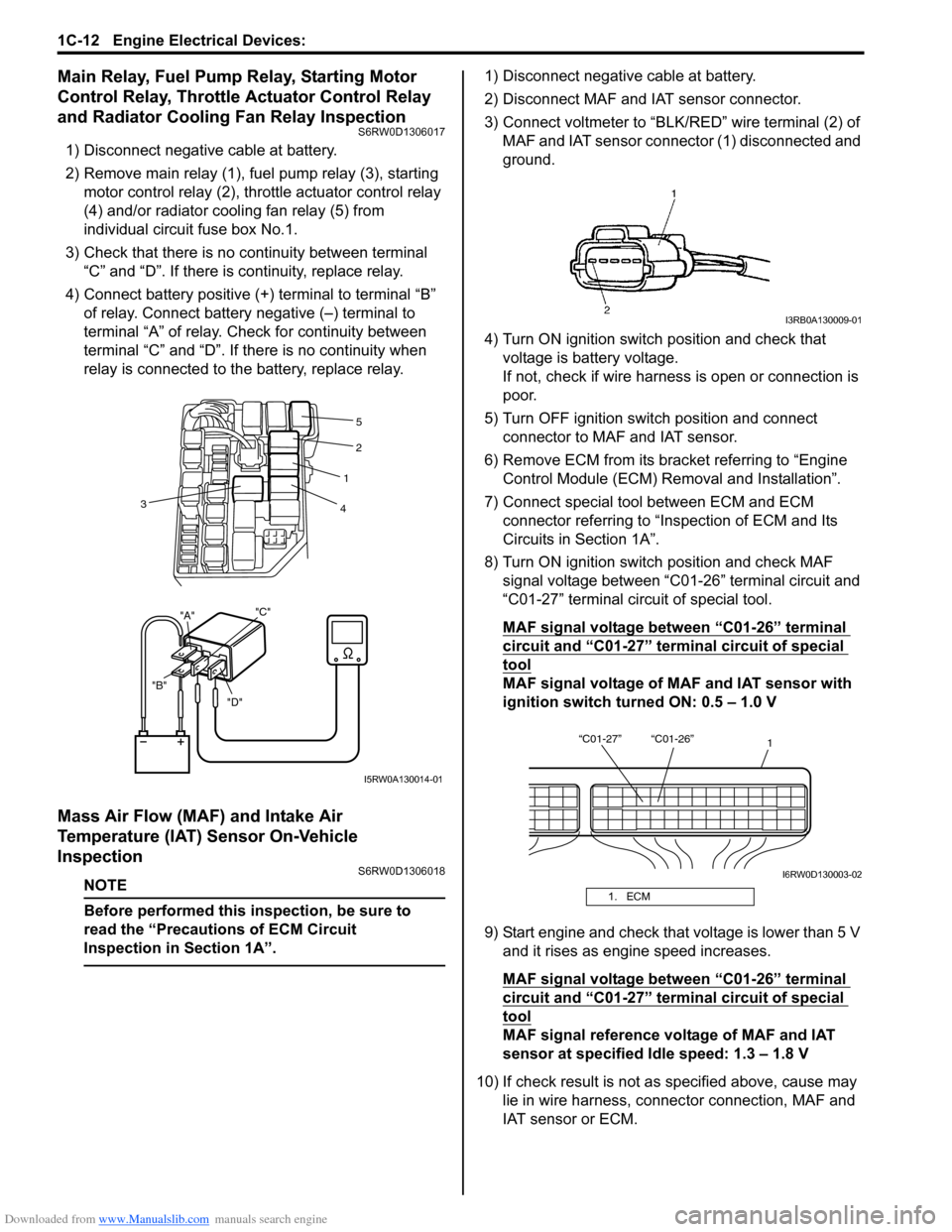
1) Disconnect negative cable at battery.
2) Remove main relay (1), fuel pump relay (3), starting
motor control relay (2), throttle actuator control relay
(4) and/or radiator cooling fan relay (5) from
individual circuit fuse box No.1.
3) Check that there is no continuity between terminal
“C” and “D”. If there is continuity, replace relay.
4) Connect battery positive (+) terminal to terminal “B”
of relay. Connect battery negative (–) terminal to
terminal “A” of relay. Check for continuity between
terminal “C” and “D”. If there is no continuity when
relay is connected to the battery, replace relay.
Mass Air Flow (MAF) and Intake Air
Temperature (IAT) Sensor On-Vehicle
Inspection
S6RW0D1306018
NOTE
Before performed this inspection, be sure to
read the “Precautions of ECM Circuit
Inspection in Section 1A”.
1) Disconnect negative cable at battery.
2) Disconnect MAF and IAT sensor connector.
3) Connect voltmeter to “BLK/RED” wire terminal (2) of
MAF and IAT sensor connector (1) disconnected and
ground.
4) Turn ON ignition switch position and check that
voltage is battery voltage.
If not, check if wire harness is open or connection is
poor.
5) Turn OFF ignition switch position and connect
connector to MAF and IAT sensor.
6) Remove ECM from its bracket referring to “Engine
Control Module (ECM) Removal and Installation”.
7) Connect special tool between ECM and ECM
connector referring to “Inspection of ECM and Its
Circuits in Section 1A”.
8) Turn ON ignition switch position and check MAF
signal voltage between “C01-26” terminal circuit and
“C01-27” terminal circuit of special tool.
MAF signal voltage between “C01-26” terminal
circuit and “C01-27” terminal circuit of special
tool
MAF signal voltage of MAF and IAT sensor with
ignition switch turned ON: 0.5 – 1.0 V
9) Start engine and check that voltage is lower than 5 V
and it rises as engine speed increases.
MAF signal voltage between “C01-26” terminal
circuit and “C01-27” terminal circuit of special
tool
MAF signal reference voltage of MAF and IAT
sensor at specified Idle speed: 1.3 – 1.8 V
10) If check result is not as specified above, cause may
lie in wire harness, connector connection, MAF and
IAT sensor or ECM.
"D" "B""A""C"
2
1
4 3
5
I5RW0A130014-01
1. ECM
I3RB0A130009-01
“C01-27” “C01-26”
1
I6RW0D130003-02
Page 282 of 1556

Downloaded from www.Manualslib.com manuals search engine 1C-14 Engine Electrical Devices:
Specifications
Tightening Torque SpecificationsS6RW0D1307001
Reference:
For the tightening torque of fastener not specified in this section, refer to “Fasteners Information in Section 0A”. Fastening partTightening torque
Note
N⋅mkgf-mlb-ft
ECM mounting bolt 8 0.8 6.0)
ECT sensor 15 1.5 11.0)
Heated oxygen sensor 45 4.5 32.5)
CMP sensor bolt (non-VVT model) 10 1.0 7.5)
CMP sensor bolt (VVT model) 11 1.1 8.0)
CKP sensor bolt 11 1.1 8.0)
Knock sensor 22 2.2 16.0)
MAF and IAT sensor screw 1.5 0.15 1.1)
Page 285 of 1556

Downloaded from www.Manualslib.com manuals search engine Engine Mechanical: 1D-3
Camshaft Position Control (VVT Variable Valve Timing) System DescriptionS6RW0D1401002
System Description
The VVT system is an electronic control system which continuously vary and optimize the intake valve timing in
response to the engine operating condition.
The optimized intake valve timing produce such an air intake with high efficiency that both the higher power generation
and lower fuel consumption can be attained in the whole engine speed range from low to high. In the area of the
average engine load, low emission of nitrogen oxides (NOx) and high fuel efficiency can also be attained by making
the valve opening overlap between the intake and exhaust valves longer.
For the brief of the system operation, the intake valve timing is varied by the cam timing sprocket (1) which varies the
rotational phase between the intake camshaft (3) and sprocket. The rotor (2) in the cam timing sprocket is actuated by
switching or adjusting the hydraulic pressure applied to the chambers for the timing advancing (7) and/or retarding (6).
To switch or adjust the hydraulic pressure appropriately, ECM operates the oil control valve (12) with detecting the
engine speed, intake air value, throttle opening, engine coolant temperature and camshaft position (angle).
1
4
5
10
8
9
2
7
6
12
11
3
60˚ (variable angle)
Most retarded timing Most advanced timing
Exhaust valveIntake valve
Crank angle
Overlap of valves
Valve lift
I5RW0C140002-01
4. Oil passage to chamber for timing retarding 8. Oil filter 10. Oil pan
5. Oil passage to chamber for timing advancing 9. Oil pump 11. Control signal from ECM