2006 SUZUKI SX4 Transmission valve body
[x] Cancel search: Transmission valve bodyPage 651 of 1556

Downloaded from www.Manualslib.com manuals search engine Automatic Transmission/Transaxle: 5A-3
General Description
A/T DescriptionS6RW0D5101001
This automatic transaxle is electronic control full automatic transaxle with forward 3-speed plus overdrive (O/D) and
reverse 1-speed.
The torque converter is a 3-element, 1-step and 2-phase type and is equipped with an automatically controlled lock-up
mechanism.
The gear change device consists of a ravigneau type planetary gear unit, 3 multiple disc type clutches, 3 multiple disc
type brakes and 2 one-way clutches.
The hydraulic pressure control device consists of a valve body assembly, pressure control solenoid valve (linear
solenoid), 2 shift solenoid valves, TCC solenoid valve (TCC pressure control solenoid valve) (linear solenoid) and a
timing solenoid valve. Optimum line pressure complying with engine torque is produced by the pressure control
solenoid valve in dependence upon control signal from transmission control module (TCM). This makes it possible to
control the line pressure with high accuracy in accordance with the engine power and running conditions to achieve
smooth shifting characteristics and high efficiency.
A clutch-to-clutch control system is provided for shifting between 3rd gear and 4th gear. This clutch-to-clutch control
system is made to function optimally, so that hydraulic pressure controls such as shown below are conducted.
• When upshifting from 3rd gear to 4th gear, to adjust the drain hydraulic pressure at releasing the forward clutch, a
timing solenoid valve is used to switch a hydraulic passage with an orifice to another during shifting.
• When downshifting from 4th gear to 3rd gear, to adjust the line pressure applied to the forward clutch at engaging
the forward clutch, a timing solenoid valve is used to switch a hydraulic passage with an orifice to another during
shifting.
• When upshifting from 3rd gear to 4th gear with engine throttle opened, to optimize the line pressure applied to the
forward clutch at releasing the forward clutch, the learning control is processed to compensate the switching timing
of the timing solenoid at every shifting.
• When downshifting from 4th gear to 3rd gear with engine throttle opened, to optimize the line pressure applied to
the forward clutch at engaging the forward clutch, the learning control is processed to compensate the line pressure
at every shifting.
Employing the ravigneau type planetary gear unit and this clutch-to-clutch control system greatly simplifies the
construction to make possible a lightweight and compact transaxle.
A line pressure learning control is conducted to provide optimum shifting time at every upshifting with engine throttle
opened. If long upshifting time is detected, the subsequent line pressure applied during upshifting is intensified. On the
contrary, if short upshifting time is detected, the subsequent line pressure applied during upshifting is weakened.
Page 663 of 1556

Downloaded from www.Manualslib.com manuals search engine Automatic Transmission/Transaxle: 5A-15
6. Output shaft speed sensor (VSS) 14. Transmission range sensor
EngineTorque converter with
torque converter clutch
Oil pumpRegulator valves
in valve body
Planetary gear
unit
Clutches and
brakes
Control valves
in valve body
Shift solenoid valves,
TCC solenoid valve and
Timing solenoid valve Pressure control
solenoid valve
Final gear
reduction unit
Engine control module (ECM)
Body control module (BCM)
Combination meter
· Engine torque signal
· Engine speed signal
Transmission control module (TCM)
· Torque request signal
· Throttle position signal
· Accelerator pedal position signal
· Engine coolant temperature signal
· Brake pedal switch signal
· Driving cycle active
· Warm up cycle active
Accelerator pedal
position sensor
Crank shaft
position sensor
Engine coolant
temperature sensor
Input shaft speed sensor
Brake light switch
“3” position switch
Transmission range sensor
Transmission fluid
temperature sensor
Output shaft speed
sensor (VSS)
Power transmission
Fluid pressure circuit
Electric signal
Data link connector
· Transmission diagnostic trouble code (DTC) · Vehicle speed pulse signal
· Transmission warning light signal
· A/T select lever position signal
· Transmission actual gear position signal
· Transmission oil temperature signal · MIL control signal
ABS control module
· A/C compressor clutch signal
I6RW0D510005-01
Page 674 of 1556

Downloaded from www.Manualslib.com manuals search engine 5A-26 Automatic Transmission/Transaxle:
Scan Tool Data Definitions:
GEAR POSITION
Current gear position computed by throttle position
coming from ECM and vehicle speed.
ENGINE SPEED (RPM)
Engine speed computed by reference pulses from
crankshaft position sensor.
INPUT SHAFT REVOLUTION (RPM)
Input shaft revolution computed by reference pulses
coming from input shaft speed sensor on transaxle case.
OUTPUT SHAFT REVOLUTION (RPM)
Output shaft revolution computed by reference pulses
coming from output shaft speed sensor (VSS) on
transaxle case.
BATTERY VOLTAGE (V)
Battery voltage read by TCM as analog input signal by
TCM.
ATF TEMPERATURE (°C, °F)
ATF temperature decided by signal from transmission
fluid temperature sensor installed on valve body.
SHIFT SOLENOID-A COMMAND
ON: ON command being outputted to shift solenoid
valve-A (No.1)
OFF: ON command not being outputted to shift solenoid
valve-A (No.1)
SHIFT SOLENOID-A MONITOR
ON: Electricity being passed to shift solenoid valve-A
(No.1)
OFF: Electricity not being passed to shift solenoid valve-
A (No.1)
SHIFT SOLENOID-B COMMAND
ON: ON command being outputted to shift solenoid
valve-B (No.2)
OFF: ON command not being outputted to shift solenoid
valve-B (No.2)
SHIFT SOLENOID-B MONITOR
ON: Electricity being passed to shift solenoid valve-B
(No.2)
OFF: Electricity not being passed to shift solenoid valve-
B (No.2)
TIMING SOLENOID COMMAND
ON: ON command being outputted to timing solenoid
valve
OFF: ON command not being outputted to timing
solenoid valve
TIMING SOLENOID MONITOR
ON: Electricity being passed to timing solenoid valve
OFF: Electricity not being passed to timing solenoid
valveTCC SOLENOID
Electric current value ratio between electric current value
being outputted from TCM to solenoid and maximum
value can be outputted by TCM.
PRESSURE CONTROL SOLENOID
Electric current value ratio between electric current value
being outputted from TCM to solenoid and maximum
value can be outputted by TCM.
VEHICLE SPEED (KPH/MPH)
Vehicle speed computed by reference pulse signals
coming from vehicle speed sensor on transaxle case.
“3” POSITION SWITCH
Inputted signal from “3” position switch in select lever
assembly.
ON: Shift select lever to “3” or “2” range
OFF: Shift select lever to other above range
TRANSAXLE RANGE
Transaxle range detected by signal fed from
transmission range sensor.
D RANGE SIGNAL
ON: Signal which TCM require ECM to increase idle
speed
OFF: Signal which TCM does not require ECM to
increase idle speed
THROTTLE POSITION (%)
Throttle opening ratio computed by duty signal from
ECM.
BRAKE SWITCH
Inputted signal from brake light switch on pedal bracket.
ON: Brake pedal depressed
OFF: Brake pedal released
TORQUE REDUCTION SIGNAL
ON: Signal which TCM require ECM to reduce output
torque at shifting gear
OFF: Signal which TCM does not require ECM to reduce
output torque
ENGINE COOLANT TEMPERATURE (°C, °F)
Engine coolant temperature computed by duty signal
from ECM.
AIR CONDITIONER SIGNAL
ON: Signal which inform that air conditioner compressor
is turned ON.
OFF: Signal which inform that air conditioner
compressor is not turned ON.
SLIP RPM (RPM)
This parameter indicates slipping rotation in the torque
converter (difference between input shaft rotation and
engine rotation)
Page 676 of 1556

Downloaded from www.Manualslib.com manuals search engine 5A-28 Automatic Transmission/Transaxle:
Troubleshooting
Condition Possible cause Correction / Reference Item
Unable to run in all rangeFaulty valve body componentReplace valve body assembly.
Faulty oil pumpInspect. If NG, replace.
Seized or broken planetary gearInspect. If NG, replace.
Faulty one-way No.2 clutchInspect. If NG, replace.
Faulty forward clutchInspect. If NG, replace.
Faulty reverse clutchInspect. If NG, replace.
Faulty 1st and reverse brakeInspect. If NG, replace.
Damaged drive plateInspect. If NG, replace.
Faulty torque converterReplace.
No gear shift as 3rd gearMalfunction of shift solenoid valve-A
and/or -BInspect. If NG, replace.
Malfunction of timing solenoid valveInspect. If NG, replace.
Malfunction of pressure control solenoid
valveInspect. If NG, replace valve body assembly.
1
→ 2 upshift fails to
occurMalfunction of shift solenoid valve-BInspect. If NG, replace.
Malfunction of output shaft speed
sensor (VSS)Inspect. If NG, replace.
Malfunction of throttle position sensorInspect. If NG, replace.
Malfunction of transmission range
sensorInspect. If NG, replace.
Faulty valve body componentReplace valve body assembly.
Faulty 2nd brakeInspect. If NG, replace.
Faulty one-way No.1 clutchInspect. If NG, replace.
2
→ 3 upshift fails to
occurMalfunction of shift solenoid valve-AInspect. If NG, replace.
Malfunction of output shaft speed
sensor (VSS)Inspect. If NG, replace.
Malfunction of throttle position sensorInspect. If NG, replace.
Malfunction of transmission range
sensorInspect. If NG, replace.
Faulty valve body componentReplace valve body assembly.
Faulty direct clutchInspect. If NG, replace.
3
→ 4 upshift fails to
occurMalfunction of shift solenoid valve-BInspect. If NG, replace.
Malfunction of “3” position switchInspect. If NG, replace.
Malfunction of engine coolant
temperature sensorInspect. If NG, replace.
Malfunction of output shaft speed
sensor (VSS)Inspect. If NG, replace.
Malfunction of input shaft speed sensorInspect. If NG, replace.
Malfunction of throttle position sensorInspect. If NG, replace.
Malfunction of transmission range
sensorInspect. If NG, replace.
Malfunction of crankshaft position
sensorInspect. If NG, replace.
Malfunction of timing solenoid valveInspect. If NG, replace.
Malfunction of transmission fluid
temperature sensorInspect. If NG, replace.
Malfunction of pressure control solenoid
valveInspect. If NG, replace valve body assembly.
Faulty valve body componentReplace valve body assembly.
Faulty O/D and 2nd coast brakeInspect. If NG, replace.
Gear shift point is
incorrectAbnormal engine conditionInspect and repair engine.
Malfunction of output shaft speed
sensor (VSS)Inspect. If NG, replace.
Malfunction of throttle position sensorInspect. If NG, replace.
Malfunction of pressure control solenoid
valveInspect. If NG, replace valve body assembly.
Page 677 of 1556
Downloaded from www.Manualslib.com manuals search engine Automatic Transmission/Transaxle: 5A-29
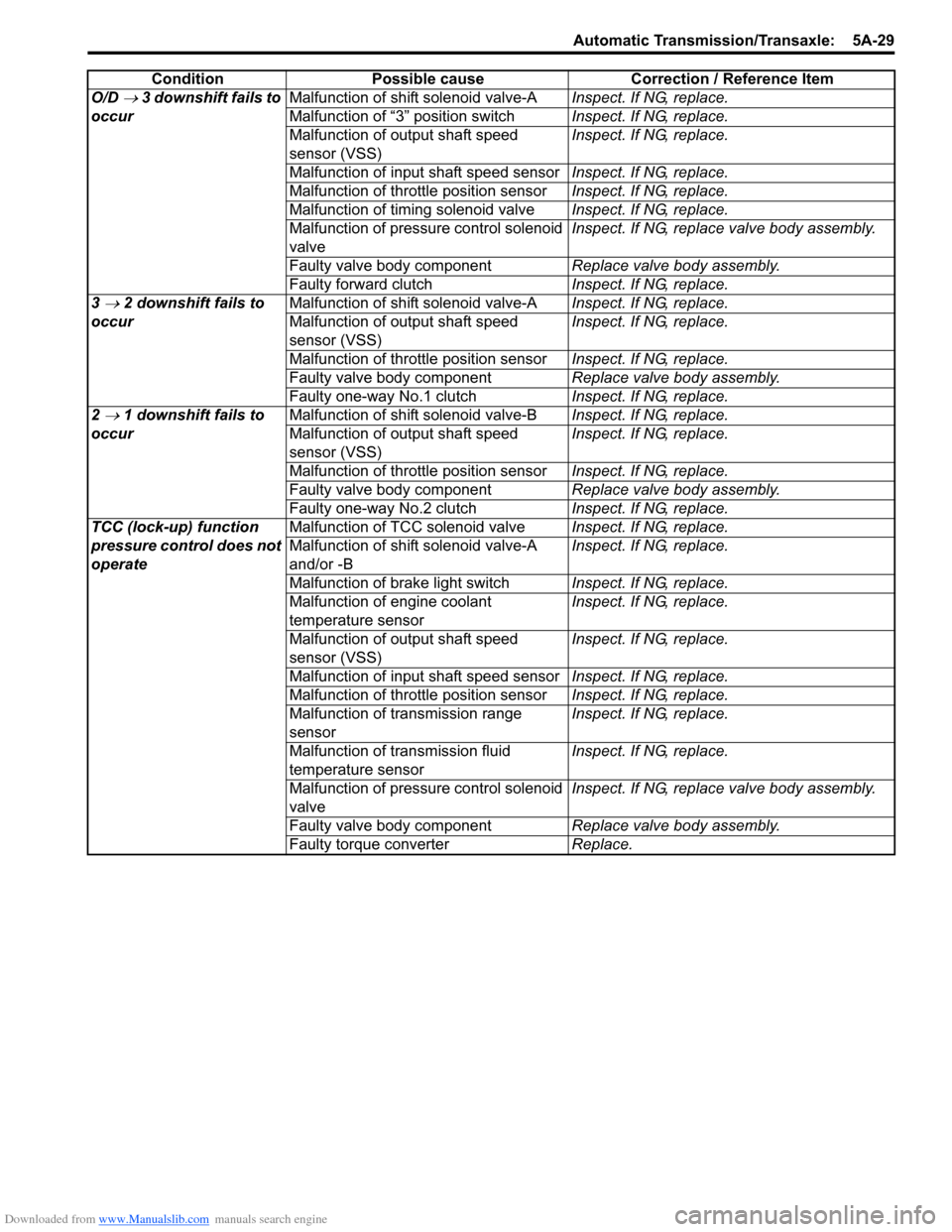
O/D → 3 downshift fails to
occurMalfunction of shift solenoid valve-AInspect. If NG, replace.
Malfunction of “3” position switchInspect. If NG, replace.
Malfunction of output shaft speed
sensor (VSS)Inspect. If NG, replace.
Malfunction of input shaft speed sensorInspect. If NG, replace.
Malfunction of throttle position sensorInspect. If NG, replace.
Malfunction of timing solenoid valveInspect. If NG, replace.
Malfunction of pressure control solenoid
valveInspect. If NG, replace valve body assembly.
Faulty valve body componentReplace valve body assembly.
Faulty forward clutchInspect. If NG, replace.
3
→ 2 downshift fails to
occurMalfunction of shift solenoid valve-AInspect. If NG, replace.
Malfunction of output shaft speed
sensor (VSS)Inspect. If NG, replace.
Malfunction of throttle position sensorInspect. If NG, replace.
Faulty valve body componentReplace valve body assembly.
Faulty one-way No.1 clutchInspect. If NG, replace.
2
→ 1 downshift fails to
occurMalfunction of shift solenoid valve-BInspect. If NG, replace.
Malfunction of output shaft speed
sensor (VSS)Inspect. If NG, replace.
Malfunction of throttle position sensorInspect. If NG, replace.
Faulty valve body componentReplace valve body assembly.
Faulty one-way No.2 clutchInspect. If NG, replace.
TCC (lock-up) function
pressure control does not
operateMalfunction of TCC solenoid valveInspect. If NG, replace.
Malfunction of shift solenoid valve-A
and/or -BInspect. If NG, replace.
Malfunction of brake light switchInspect. If NG, replace.
Malfunction of engine coolant
temperature sensorInspect. If NG, replace.
Malfunction of output shaft speed
sensor (VSS)Inspect. If NG, replace.
Malfunction of input shaft speed sensorInspect. If NG, replace.
Malfunction of throttle position sensorInspect. If NG, replace.
Malfunction of transmission range
sensorInspect. If NG, replace.
Malfunction of transmission fluid
temperature sensorInspect. If NG, replace.
Malfunction of pressure control solenoid
valveInspect. If NG, replace valve body assembly.
Faulty valve body componentReplace valve body assembly.
Faulty torque converterReplace. Condition Possible cause Correction / Reference Item
Page 678 of 1556

Downloaded from www.Manualslib.com manuals search engine 5A-30 Automatic Transmission/Transaxle:
Manual Road TestS6RW0D5104011
WARNING!
Carry out test in very little traffic area to prevent an accident.
Test requires 2 persons, a driver and a tester.
The purpose of this test is to judge whether causal factor of trouble which occurred in automatic transaxle is electrical
or mechanical by disconnecting valve body harness connector (1) and fixing automatic transaxle gear position.
1) Start engine and warm it up to normal operating temperature.
2) Turn ignition switch to OFF position and disconnect valve body harness connector (1).
3) Turn OFF all electrical loads.
With select lever shifted to each range (“L”, “2”, “3” and “D”), drive vehicle at 1,000 rpm engine speed and then
check vehicle speed by referring to “Fixed gear position”.
If vehicle speed is not as specified in “Fixed gear position” table, go to troubleshooting.
4) Connect valve body harness connector and clear DTC.
Fixed gear position
Troubleshooting
Engine Brake TestS6RW0D5104012
WARNING!
Before test, make sure that there is no vehicle behind so as to prevent rear-end collision.
1) While driving vehicle in 3rd gear of “D” range, shift select lever down to “2” range and check if engine brake
operates.
2) In the same way as in Step 1), check engine brake for operation when select lever is shifted down to “L” range.
3) Engine brake should operate in the test.
TroubleshootingSelect lever position Fixed gear position Vehicle speed
L range
3rd gear Approx. 25.0 km/h (15.5 mile/h) 2 range
3 range
D range
R range Reverse gear Approx. 10.9 km/h (6.8 mile/h)
1
I5RW0C510010-01
Condition Possible cause Correction / Reference Item
Operated gear is not
correctFaulty valve body componentReplace valve body assembly.
Faulty clutch or brakeInspect clutch and brake. If any parts are faulty,
replace them.
Condition Possible cause Correction / Reference Item
Failure to operate when
shifted down to “2” rangeFaulty valve body componentReplace valve body assembly.
Faulty O/D and 2nd coast brakeInspect. If NG, replace.
Failure to operate when
shifted down to “L” rangeFaulty valve body componentReplace valve body assembly.
Faulty 1st and reverse brakeInspect. If NG, replace.
Page 679 of 1556

Downloaded from www.Manualslib.com manuals search engine Automatic Transmission/Transaxle: 5A-31
Stall TestS6RW0D5104013
This test is to check overall performance of automatic transaxle and engine by measuring stall speed at “D” and “R”
ranges. Be sure to perform this test only when transaxle fluid is at normal operating temperature and its level is
between FULL and LOW marks.
CAUTION!
• Do not run engine at stall more than 5 seconds continuously, or fluid temperature may rise
excessively high.
• After performing stall test, be sure to leave engine running at idle for longer than 1 minute before
another stall test.
1) Apply parking brake and block wheels.
2) Install tachometer.
3) Start engine with select lever shifted to “P” range.
4) Depress brake pedal fully.
5) Shift select lever to “D” range and depress accelerator pedal fully while watching tachometer. Read engine rpm
quickly when it has become constant (stall speed).
6) Release accelerator pedal immediately after stall speed is checked.
7) In the same way, check stall speed in “R” range.
8) Stall speed should be within the following specification.
Engine stall speed
Standard: 2,200 – 2,600 rpm
Troubleshooting
Condition Possible cause Correction / Reference Item
Lower than standard level
in both “D” and “R” rangeEngine output torque failureInspect and repair engine.
Faulty one-way clutch of torque
converterReplace torque converter.
Higher than standard
level in “D” rangeMalfunction of pressure control solenoid
valve (Low line pressure)Inspect. If NG, replace valve body assembly.
Faulty valve body componentReplace valve body assembly.
Slippery forward clutchInspect. If NG, replace.
Faulty one-way No.2 clutchInspect. If NG, replace.
Leakage from “D” range fluid pressure
circuitOverhaul or replace valve body assembly.
Higher than standard
level in “R” rangeMalfunction of pressure control solenoid
valve (Low line pressure)Inspect. If NG, replace valve body assembly.
Faulty valve body componentReplace valve body assembly.
Slippery reverse clutchInspect. If NG, replace.
Slippery 1st and reverse brakeInspect. If NG, replace.
Leakage from “R” range fluid pressure
circuitOverhaul or replace valve body assembly.
Higher than standard
level in both “D” and “R”
rangeMalfunction of pressure control solenoid
valve (Low line pressure)Inspect. If NG, replace valve body assembly.
Faulty valve body componentReplace valve body assembly.
Clogged oil strainerReplace.
Faulty oil pumpInspect. If NG, replace.
Leakage from both “D” and “R” range
fluid pressure circuitOverhaul or replace valve body assembly.
Page 680 of 1556
Downloaded from www.Manualslib.com manuals search engine 5A-32 Automatic Transmission/Transaxle:
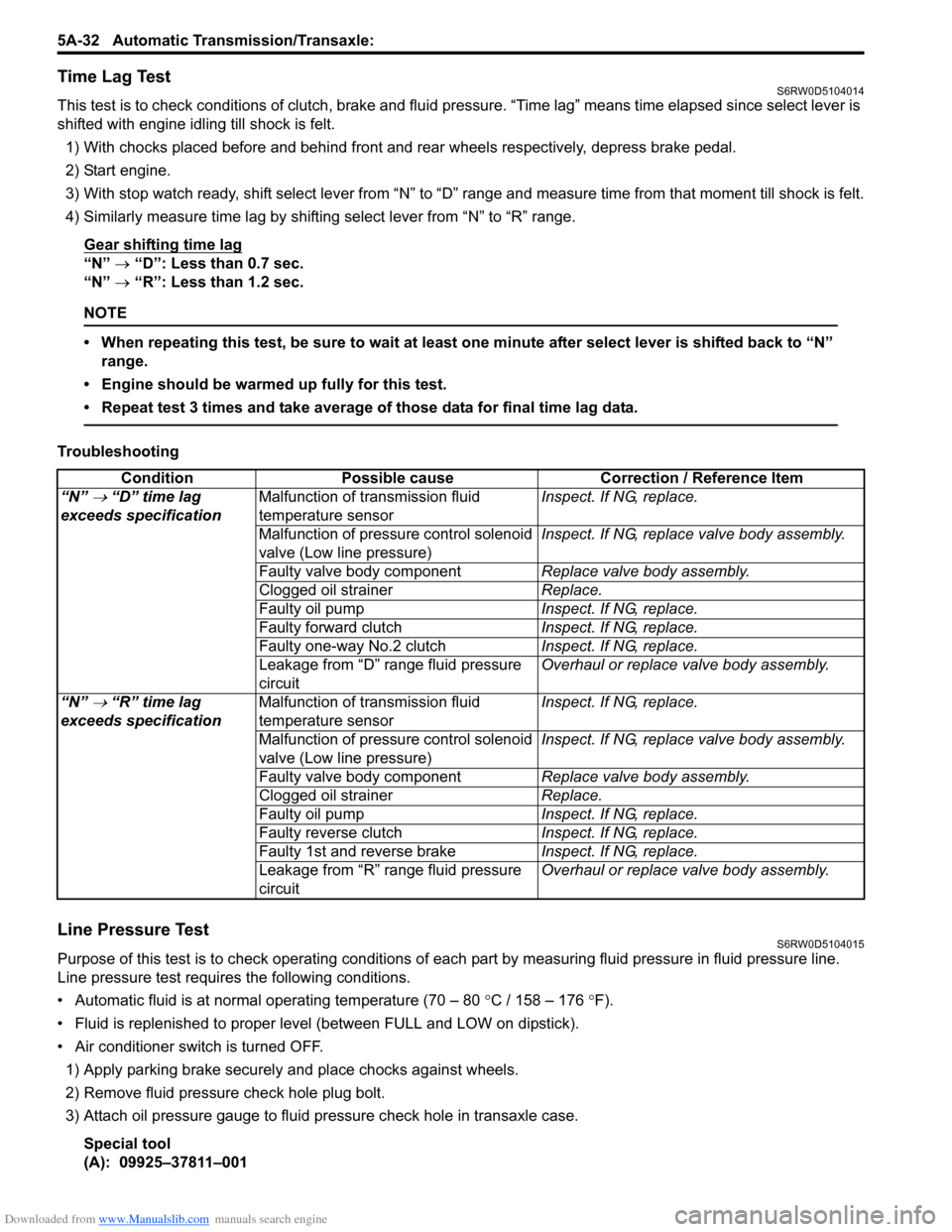
Time Lag TestS6RW0D5104014
This test is to check conditions of clutch, brake and fluid pressure. “Time lag” means time elapsed since select lever is
shifted with engine idling till shock is felt.
1) With chocks placed before and behind front and rear wheels respectively, depress brake pedal.
2) Start engine.
3) With stop watch ready, shift select lever from “N” to “D” range and measure time from that moment till shock is felt.
4) Similarly measure time lag by shifting select lever from “N” to “R” range.
Gear shifting time lag
“N” → “D”: Less than 0.7 sec.
“N” → “R”: Less than 1.2 sec.
NOTE
• When repeating this test, be sure to wait at least one minute after select lever is shifted back to “N”
range.
• Engine should be warmed up fully for this test.
• Repeat test 3 times and take average of those data for final time lag data.
Troubleshooting
Line Pressure TestS6RW0D5104015
Purpose of this test is to check operating conditions of each part by measuring fluid pressure in fluid pressure line.
Line pressure test requires the following conditions.
• Automatic fluid is at normal operating temperature (70 – 80 °C / 158 – 176 °F).
• Fluid is replenished to proper level (between FULL and LOW on dipstick).
• Air conditioner switch is turned OFF.
1) Apply parking brake securely and place chocks against wheels.
2) Remove fluid pressure check hole plug bolt.
3) Attach oil pressure gauge to fluid pressure check hole in transaxle case.
Special tool
(A): 09925–37811–001Condition Possible cause Correction / Reference Item
“N”
→ “D” time lag
exceeds specificationMalfunction of transmission fluid
temperature sensorInspect. If NG, replace.
Malfunction of pressure control solenoid
valve (Low line pressure)Inspect. If NG, replace valve body assembly.
Faulty valve body componentReplace valve body assembly.
Clogged oil strainerReplace.
Faulty oil pumpInspect. If NG, replace.
Faulty forward clutchInspect. If NG, replace.
Faulty one-way No.2 clutchInspect. If NG, replace.
Leakage from “D” range fluid pressure
circuitOverhaul or replace valve body assembly.
“N”
→ “R” time lag
exceeds specificationMalfunction of transmission fluid
temperature sensorInspect. If NG, replace.
Malfunction of pressure control solenoid
valve (Low line pressure)Inspect. If NG, replace valve body assembly.
Faulty valve body componentReplace valve body assembly.
Clogged oil strainerReplace.
Faulty oil pumpInspect. If NG, replace.
Faulty reverse clutchInspect. If NG, replace.
Faulty 1st and reverse brakeInspect. If NG, replace.
Leakage from “R” range fluid pressure
circuitOverhaul or replace valve body assembly.