2006 SUBARU IMPREZA roof
[x] Cancel search: roofPage 241 of 365
8-14 Driving tips
placard attached to the driver s side door
pillar. It includes the total weight of the
driver and all passengers and their be-
longings, any optional equipment such as
a trailer hitch, roof rack or bike carrier,
etc., and the tongue load of a trailer.
GVWR and GAWR (Gross Ve-
hicle Weight Rating and
Gross Axle Weight Rating)
The certification plate attached to the driv-
er s side door jamb shows GVWR (Gross
Vehicle Weight Rating) and GAWR
(Gross Axle Weight Rating).
The GVW (Gross Vehicle Weight) must
never exceed the GVWR. GVW is the
combined total of weight of the vehicle, fu-
el, driver, all passengers, luggage, any optional equipment and trailer tongue
load. Therefore, the GVW changes de-
pending on the situation. The GVWR
equals Curb Weight (actual weight of your
vehicle
including standard equipment,
fluids, emergency tools and spare tire as-
sembly) plus the vehicle capacity weight.
In addition, the total weight applied to
each axle (GAW) must never exceed the
GAWR. The front and rear GAWs can be
adjusted by relocating luggage inside the
vehicle.
Even if the total weight of your luggage is
lower than the vehicle capacity weight, ei-
ther front or rear GAW may exceed the
GAWR, depending on the distribution of
the luggage.
When possible, the load should be evenly
distributed throughout the vehicle.
If you carry heavy loads in the vehicle, you
should confirm that GVW and front and
rear GAWs are within the GVWR and
GAWR by putting your vehicle on a vehi-
cle scale, found at a commercial weighing
station.
Do not use replacement tires with a lower
load range than the originals because
they may lower the GVWR and GAWR
limitations. Replacement tires with a high-
er load range than the originals do not in-
crease the GVWR and GAWR limitations.
Roof rail and crossbar (if
equipped)
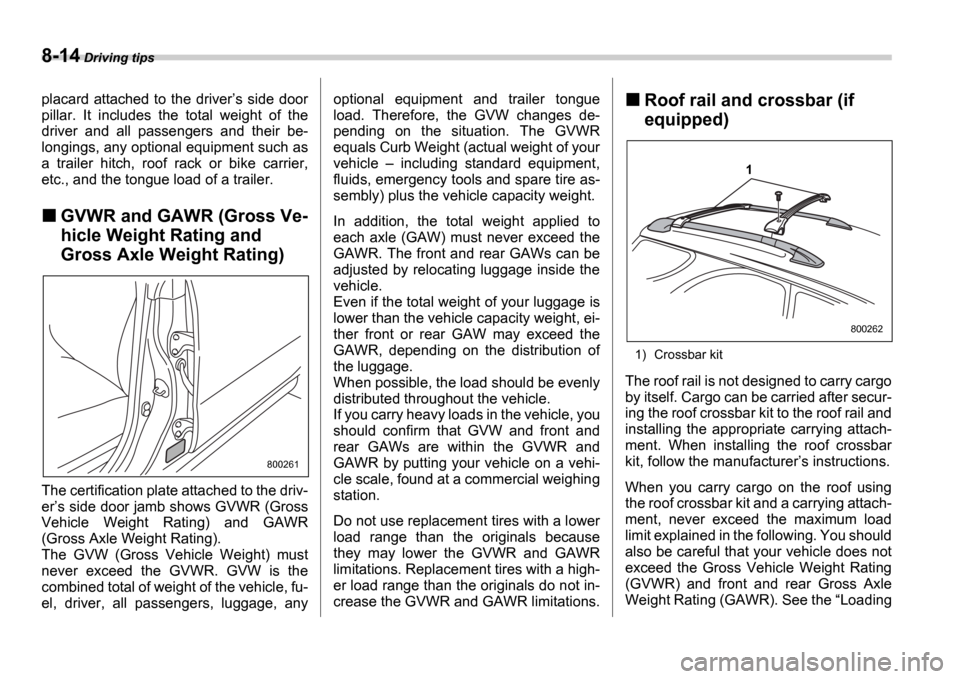
1) Crossbar kit
The roof rail is not designed to carry cargo
by itself. Cargo can be carried after secur-
ing the roof crossbar kit to the roof rail and
installing the appropriate carrying attach-
ment. When installing the roof crossbar
kit, follow the manufacturer s instructions.
When you carry cargo on the roof using
the roof crossbar kit and a carrying attach-
ment, never exceed the maximum load
limit explained in the following. You should
also be careful that your vehicle does not
exceed the Gross Vehicle Weight Rating
(GVWR) and front and rear Gross Axle
Weight Rating (GAWR). See the Loading
800261
1
800262
Page 242 of 365
Driving tips 8-15
CONTINUED
your vehicle
section in this chapter for in-
formation on loading cargo into or onto
your vehicle. The maximum load limit of
the cargo, crossbars and carrying attach-
ment must not exceed 100 lbs (45 kg).
Place the heaviest load at the bottom,
nearest the roof, and evenly distribute the
cargo. Always properly secure all cargo.
Installing carrying attachments on
the crossbars
When installing any carrying attachment
such as a bike carrier, ski carrier, kayak carrier, cargo basket, etc. on the cross-
bars, follow the manufacturer
s instruc-
tions and make sure that the attachment is
securely fixed to the crossbars. Use only
attachments designed specifically for the
crossbars. A set of the crossbars is de-
signed to carry loads (cargo and attach-
ment) of not more than 100 lbs (45 kg).
Before operating the vehicle, make sure
that the cargo is properly secured on the
attachment.
NOTE
Remember that the vehicle s center of
gravity is altered with the weight of the
load on the roof, thus affecting the
driving characteristics.
Drive carefully. Avoid rapid starts, hard
cornering and abrupt stops. Crosswind
effects will be increased.
Removal and installation of the
crossbars
The crossbars can be removed when you
do not use the roof to carry cargo.
To remove the crossbar
1. Loosen and remove the T-30 torx Æ
head screw from the top of each crossbar
end support.
2. Rotate the lower clamp on the bottom
of each end support downward approxi-
mately 90 . 3. Carefully raise the crossbar from roof
rails.
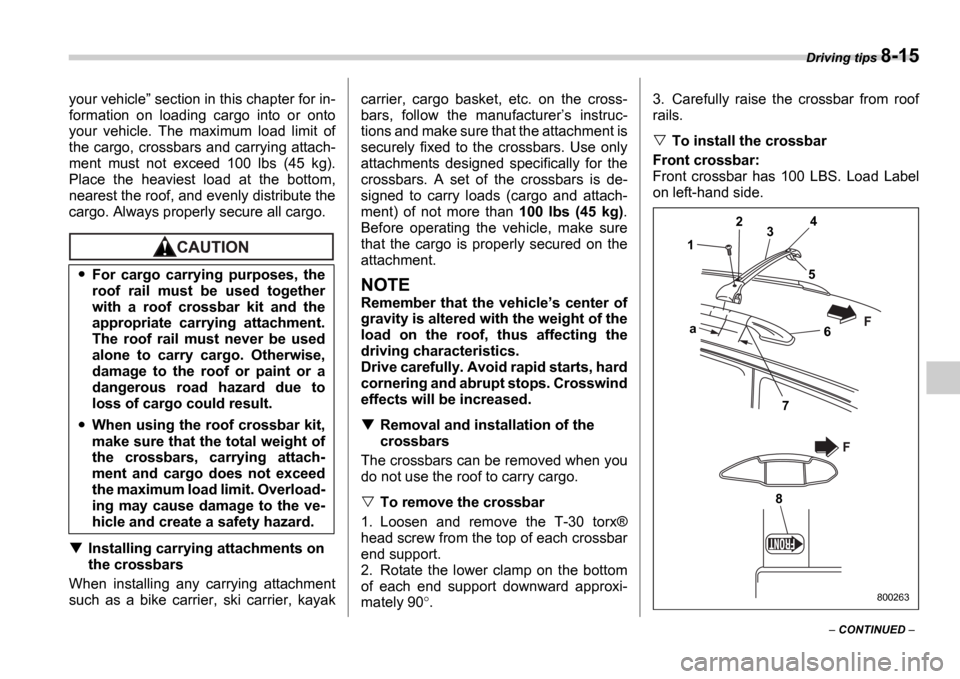
To install the crossbar
Front crossbar:
Front crossbar has 100 LBS. Load Label
on left-hand side.
For cargo carrying purposes, the
roof rail must be used together
with a roof crossbar kit and the
appropriate carrying attachment.
The roof rail must never be used
alone to carry cargo. Otherwise,
damage to the roof or paint or a
dangerous road hazard due to
loss of cargo could result.
When using the roof crossbar kit,
make sure that the total weight of
the crossbars, carrying attach-
ment and cargo does not exceed
the maximum load limit. Overload-
ing may cause damage to the ve-
hicle and create a safety hazard.
1 2
3 4
5
6
7
a
8
F
F
800263
Page 243 of 365
8-16 Driving tips
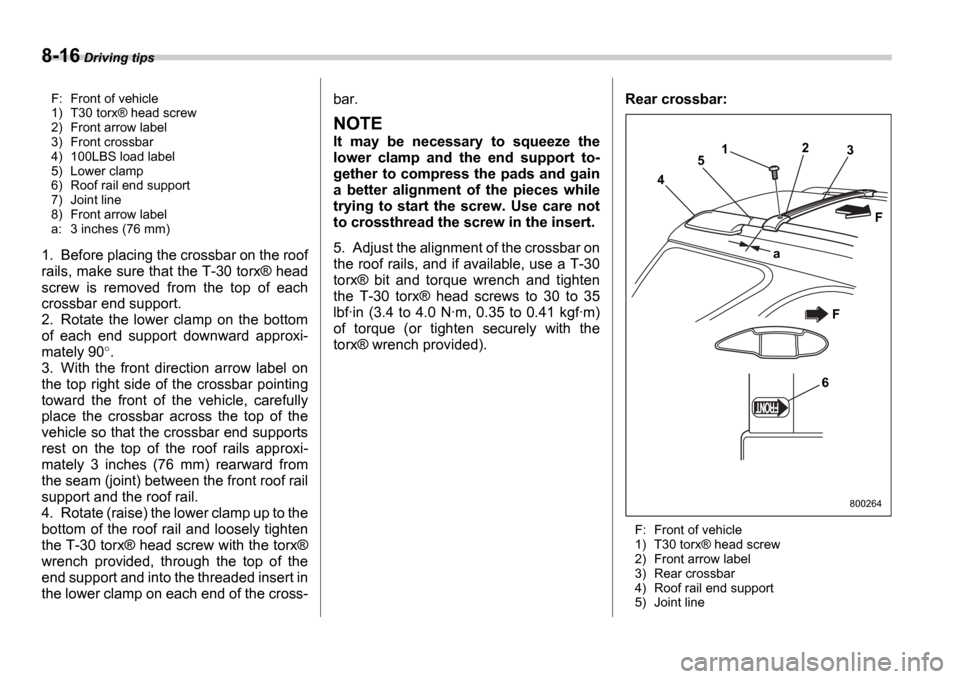
F: Front of vehicle
1) T30 torx Æ head screw
2) Front arrow label
3) Front crossbar
4) 100LBS load label
5) Lower clamp
6) Roof rail end support
7) Joint line
8) Front arrow label
a: 3 inches (76 mm)
1. Before placing the crossbar on the roof
rails, make sure that the T-30 torx Æ head
screw is removed from the top of each
crossbar end support.
2. Rotate the lower clamp on the bottom
of each end support downward approxi-
mately 90 .
3. With the front direction arrow label on
the top right side of the crossbar pointing
toward the front of the vehicle, carefully
place the crossbar across the top of the
vehicle so that the crossbar end supports
rest on the top of the roof rails approxi-
mately 3 inches (76 mm) rearward from
the seam (joint) between the front roof rail
support and the roof rail.
4. Rotate (raise) the lower clamp up to the
bottom of the roof rail and loosely tighten
the T-30 torx Æ head screw with the torx Æ
wrench provided, through the top of the
end support and into the threaded insert in
the lower clamp on each end of the cross- bar.
NOTE
It may be necessary to squeeze the
lower clamp and the end support to-
gether to compress the pads and gain
a better alignment of the pieces while
trying to start the screw. Use care not
to crossthread the screw in the insert.
5. Adjust the alignment of the crossbar on
the roof rails, and if available, use a T-30
torx
Æ bit and torque wrench and tighten
the T-30 torx Æ head screws to 30 to 35
lbf ∑in (3.4 to 4.0 N ∑m, 0.35 to 0.41 kgf ∑m)
of torque (or tighten securely with the
torx Æ wrench provided). Rear crossbar:
F: Front of vehicle
1) T30 torx
Æ head screw
2) Front arrow label
3) Rear crossbar
4) Roof rail end support
5) Joint line
6 3
F
2
1
5
a
4
F
800264
Page 244 of 365
Driving tips 8-17
CONTINUED
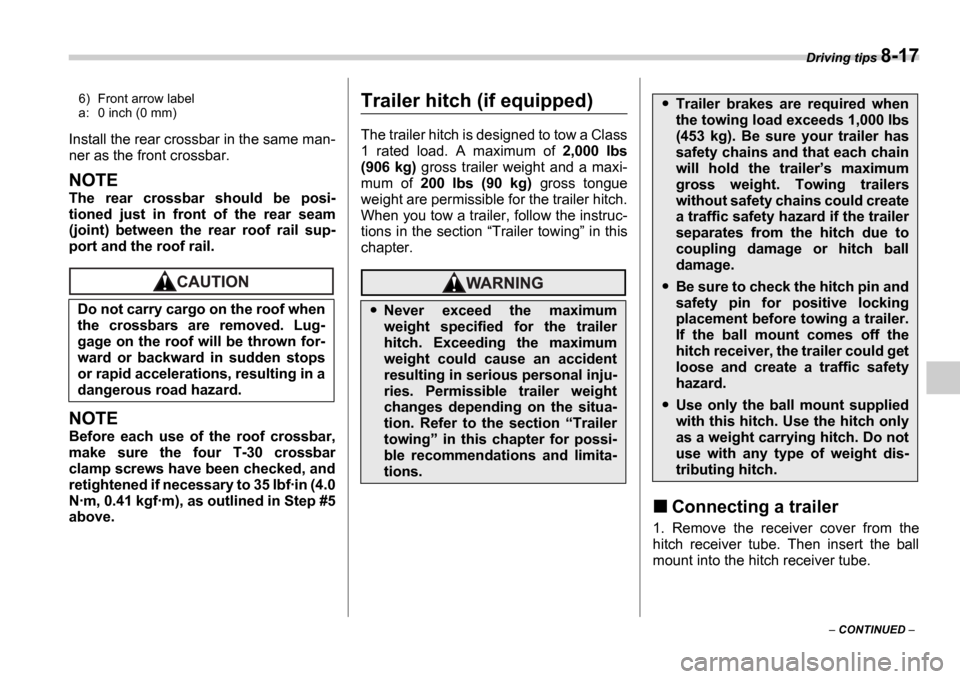
6) Front arrow label
a: 0 inch (0 mm)
Install the rear crossbar in the same man-
ner as the front crossbar.
NOTE
The rear crossbar should be posi-
tioned just in front of the rear seam
(joint) between the rear roof rail sup-
port and the roof rail.
NOTE
Before each use of the roof crossbar,
make sure the four T-30 crossbar
clamp screws have been checked, and
retightened if necessary to 35 lbf ∑in (4.0
N ∑m, 0.41 kgf ∑m), as outlined in Step #5
above.
Trailer hitch (if equipped)
The trailer hitch is designed to tow a Class
1 rated load. A maximum of 2,000 lbs
(906 kg) gross trailer weight and a maxi-
mum of 200 lbs (90 kg) gross tongue
weight are permissible for the trailer hitch.
When you tow a trailer, follow the instruc-
tions in the section Trailer towing in this
chapter.
Connecting a trailer
1. Remove the receiver cover from the
hitch receiver tube. Then insert the ball
mount into the hitch receiver tube.
Do not carry cargo on the roof when
the crossbars are removed. Lug-
gage on the roof will be thrown for-
ward or backward in sudden stops
or rapid accelerations, resulting in a
dangerous road hazard.
Never exceed the maximum
weight specified for the trailer
hitch. Exceeding the maximum
weight could cause an accident
resulting in serious personal inju-
ries. Permissible trailer weight
changes depending on the situa-
tion. Refer to the section
Trailer
towing in this chapter for possi-
ble recommendations and limita-
tions.
Trailer brakes are required when
the towing load exceeds 1,000 lbs
(453 kg). Be sure your trailer has
safety chains and that each chain
will hold the trailer s maximum
gross weight. Towing trailers
without safety chains could create
a traffic safety hazard if the trailer
separates from the hitch due to
coupling damage or hitch ball
damage.
Be sure to check the hitch pin and
safety pin for positive locking
placement before towing a trailer.
If the ball mount comes off the
hitch receiver, the trailer could get
loose and create a traffic safety
hazard.
Use only the ball mount supplied
with this hitch. Use the hitch only
as a weight carrying hitch. Do not
use with any type of weight dis-
tributing hitch.
Page 256 of 365

9
In case of emergency
If you park your vehicle in case of an emergency ......................................... .............. 9-2
Temporary spare tire .............................. ............ 9-2
Flat tires ........................................ ...................... 9-4
Changing a flat tire .............................. ................... 9-4
Jump starting ..................................... ................. 9-9
How to jump start ................................. .................. 9-9
Engine overheating ................................ ............ 9-11
If steam is coming from the engine compartment ....................................... .................. 9-11
If no steam is coming from the engine
compartment ....................................... .................. 9-11
Towing ............................................ ..................... 9-11
Towing and tie-down hooks ......................... ......... 9-12
Using a flat-bed truck ............................ ................. 9-13
Towing with all wheels on the ground .............. .... 9-14
Rear gate if the rear gate cannot be
unlocked .......................................... ................ 9-15
Moonroof if the moonroof cannot be
closed ............................................ ................... 9-15
Maintenance tools ................................. ............. 9-16
Jack and jack handle .............................. ................ 9-16
Page 270 of 365
In case of emergency 9-15
CONTINUED
Rear gate if the rear gate
cannot be unlocked
In the event that you cannot unlock the
rear gate by operating the power door
locking switches or the remote keyless en-
try system, you can unlock it from inside
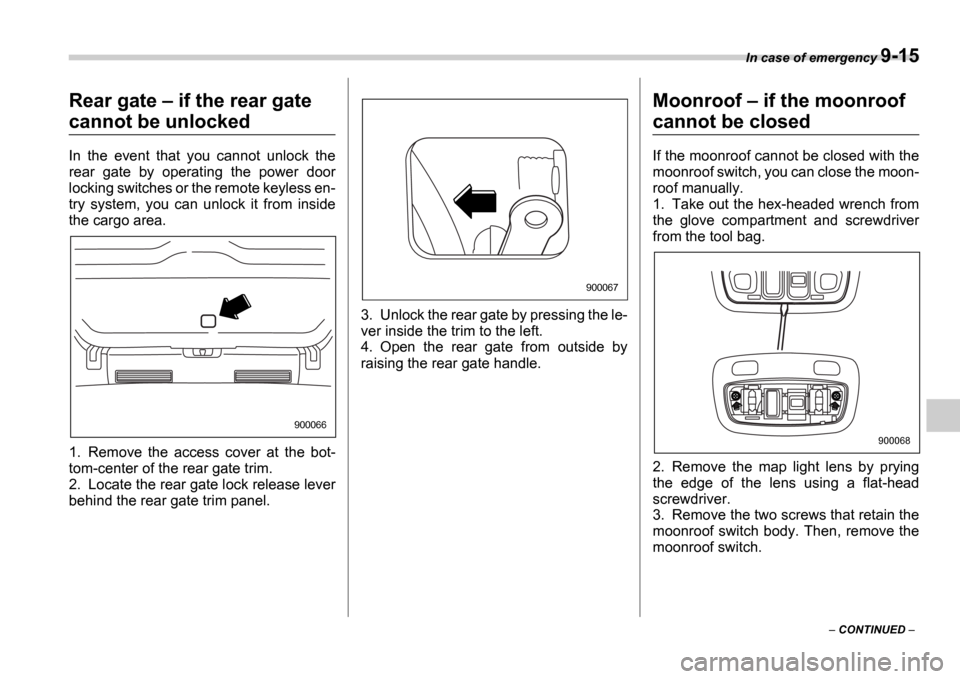
the cargo area.
0
1. Remove the access cover at the bot-
tom-center of the rear gate trim.
2. Locate the rear gate lock release lever
behind the rear gate trim panel. 3. Unlock the rear gate by pressing the le-
ver inside the trim to the left.
4. Open the rear gate from outside by
raising the rear gate handle.
Moonroof
if the moonroof
cannot be closed
If the moonroof cannot be closed with the
moonroof switch, you can close the moon-
roof manually.
1. Take out the hex-headed wrench from
the glove compartment and screwdriver
from the tool bag.
2. Remove the map light lens by prying
the edge of the lens using a flat-head
screwdriver.
3. Remove the two screws that retain the
moonroof switch body. Then, remove the
moonroof switch.
900066
900067
900068
Page 271 of 365
9-16 In case of emergency
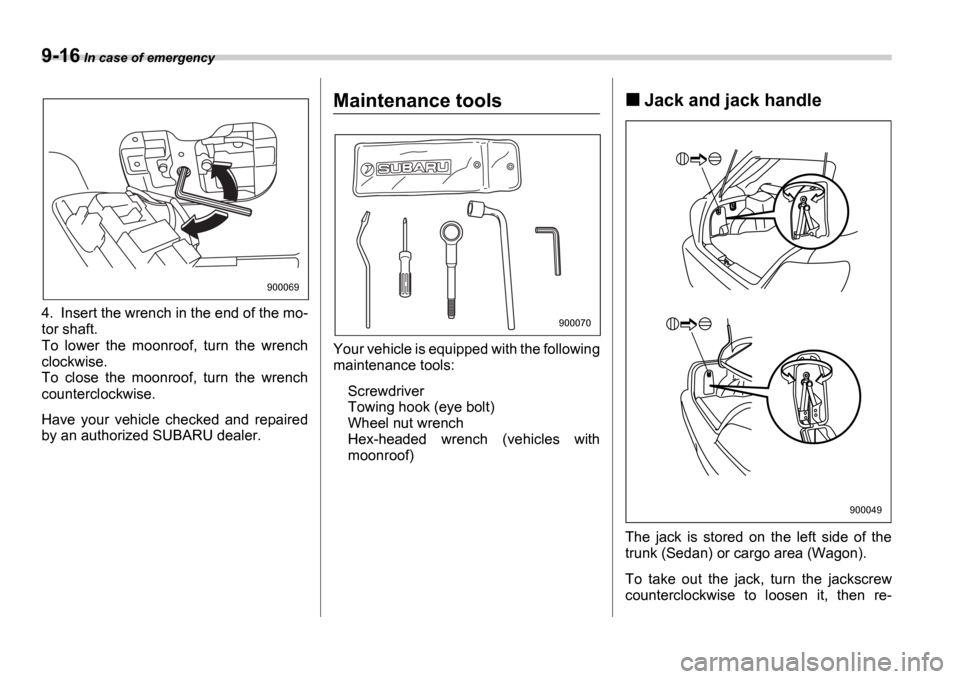
4. Insert the wrench in the end of the mo-
tor shaft.
To lower the moonroof, turn the wrench
clockwise.
To close the moonroof, turn the wrench
counterclockwise.
Have your vehicle checked and repaired
by an authorized SUBARU dealer.
Maintenance tools
Your vehicle is equipped with the following
maintenance tools:
Screwdriver
Towing hook (eye bolt)
Wheel nut wrench
Hex-headed wrench (vehicles with
moonroof)
Jack and jack handle
The jack is stored on the left side of the
trunk (Sedan) or cargo area (Wagon).
To take out the jack, turn the jackscrew
counterclockwise to loosen it, then re-
900069
900070
900049
Page 275 of 365
10-2 Appearance care
Appearance careExterior care
Washing
NOTE
When having your vehicle washed in
an automatic car wash, make sure be-
forehand that the car wash is of suit-
able type.
The best way to preserve your vehicle s
beauty is frequent washing. Wash the ve-
hicle at least once a month to avoid con-
tamination by road grime.
Wash dirt off with a wet sponge and plenty
of lukewarm or cold water. Do not wash
the vehicle with hot water and in direct
sunlight.
Salt, chemicals, insects, tar, soot, tree
sap, and bird droppings should be washed
off by using a light detergent, as required.
If you use a light detergent, make certain
that it is a neutral detergent. Do not use
strong soap or chemical detergents. All
cleaning agents should be promptly
flushed from the surface and not allowed
to dry there. Rinse the vehicle thoroughly
When washing the vehicle, the
brakes may get wet. As a result,
the brake stopping distance will
be longer. To dry the brakes, drive
the vehicle at a safe speed while
lightly pressing the brake pedal to
heat up the brakes.
Do not wash the engine compart-
ment and area adjacent to it. If wa-
ter enters the engine air intake,
electrical parts or the power steer-
ing fluid reservoir, it will cause en-
gine trouble or faulty power steer-
ing respectively.
Since your vehicle is equipped
with a rear wiper, automatic car-
wash brushes could become tan-
gled around it, damaging the wip-
er arm and other components.
Ask the automatic car-wash oper-
ator not to let the brushes touch
the wiper arm or to fix the wiper
arm on the rear window glass with
adhesive tape before operating
the machine (Wagon models
only).
800278
(WRX-STI)
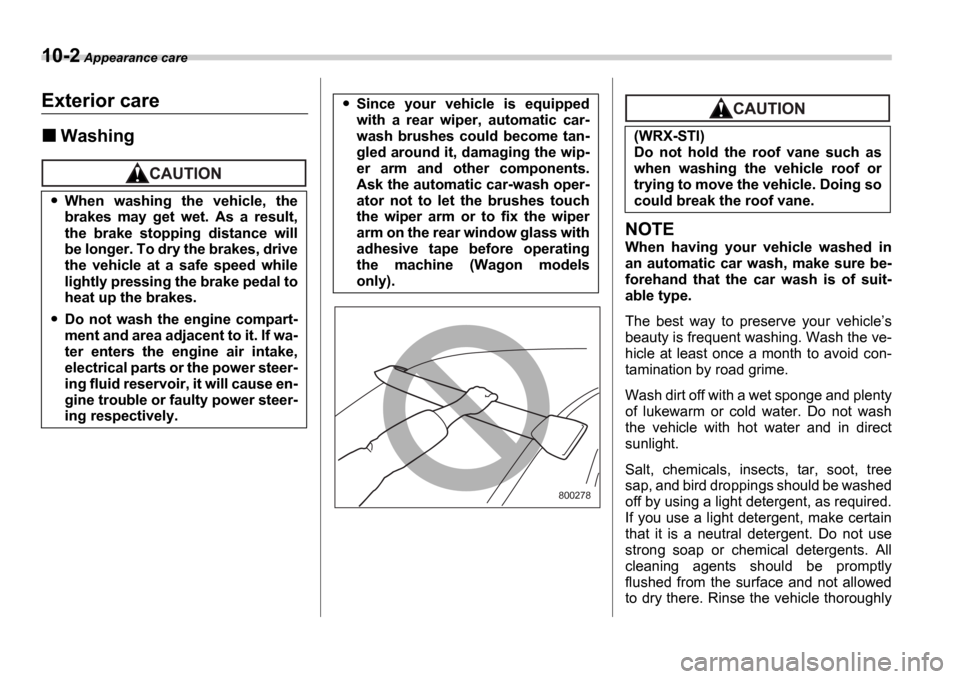
Do not hold the roof vane such as
when washing the vehicle roof or
trying to move the vehicle. Doing so
could break the roof vane.