2006 SUBARU IMPREZA seats
[x] Cancel search: seatsPage 52 of 365
Seat, seatbelt and SRS airbags 1-25
CONTINUED
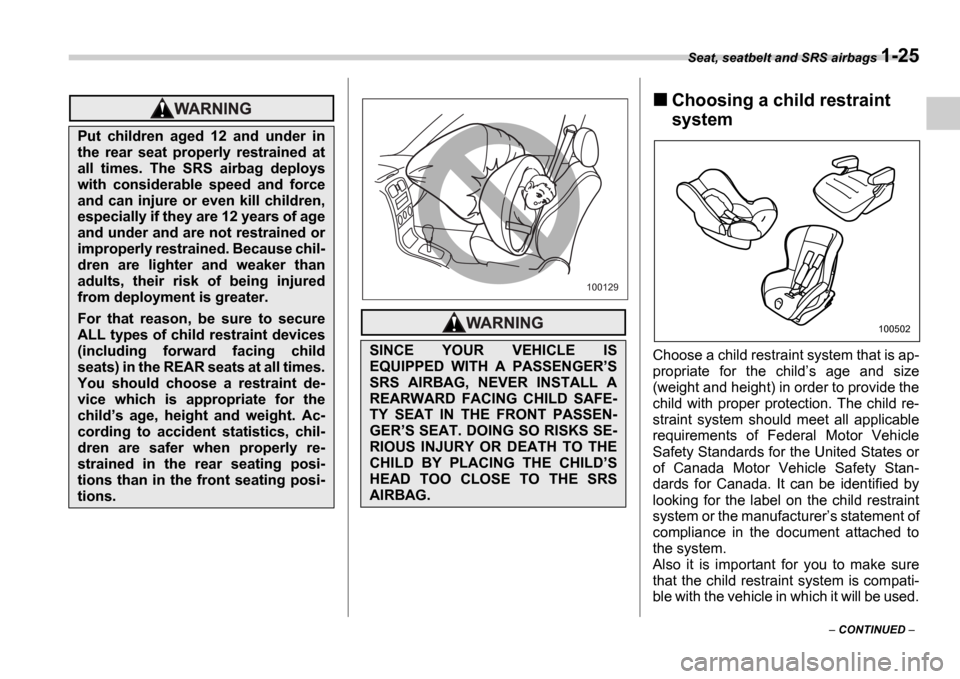
Choosing a child restraint
system
Choose a child restraint system that is ap-
propriate for the child s age and size
(weight and height) in order to provide the
child with proper protection. The child re-
straint system should meet all applicable
requirements of Federal Motor Vehicle
Safety Standards for the United States or
of Canada Motor Vehicle Safety Stan-
dards for Canada. It can be identified by
looking for the label on the child restraint
system or the manufacturer s statement of
compliance in the document attached to
the system.
Also it is important for you to make sure
that the child restraint system is compati-
ble with the vehicle in which it will be used.
Put children aged 12 and under in
the rear seat properly restrained at
all times. The SRS airbag deploys
with considerable speed and force
and can injure or even kill children,
especially if they are 12 years of age
and under and are not restrained or
improperly restrained. Because chil-
dren are lighter and weaker than
adults, their risk of being injured
from deployment is greater.
For that reason, be sure to secure
ALL types of child restraint devices
(including forward facing child
seats) in the REAR seats at all times.
You should choose a restraint de-
vice which is appropriate for the
child s age, height and weight. Ac-
cording to accident statistics, chil-
dren are safer when properly re-
strained in the rear seating posi-
tions than in the front seating posi-
tions.
SINCE YOUR VEHICLE IS
EQUIPPED WITH A PASSENGER S
SRS AIRBAG, NEVER INSTALL A
REARWARD FACING CHILD SAFE-
TY SEAT IN THE FRONT PASSEN-
GER S SEAT. DOING SO RISKS SE-
RIOUS INJURY OR DEATH TO THE
CHILD BY PLACING THE CHILD S
HEAD TOO CLOSE TO THE SRS
AIRBAG.
100129
100502
Page 64 of 365

Seat, seatbelt and SRS airbags 1-37
CONTINUED
NOTE
When you sell your vehicle, we urge
you to explain to the buyer that it is
equipped with SRS airbags by alerting
him or her to the applicable section in
this owners manual.
Put children aged 12 and under in
the rear seat properly restrained
at all times. The SRS airbag de-
ploys with considerable speed
and force and can injure or even
kill children, especially if they are
12 years of age and under and are
not restrained or improperly re-
strained. Because children are
lighter and weaker than adults,
their risk of being injured from de-
ployment is greater.
100082
For that reason, we strongly rec-
ommend that ALL children (in-
cluding those in child seats and
those that have outgrown child re-
straint devices) sit in the REAR
seat properly restrained at all
times in a child restraint device or
in a seatbelt, whichever is appro-
priate for the child s age, height
and weight.
Secure ALL types of child re-
straint devices (including forward
facing child seats) in the REAR
seats at all times.
According to accident statistics,
children are safer when properly
restrained in the rear seating posi-
tions than in the front seating po-
sitions.
For instructions and precautions
concerning the child restraint sys-
tem, see the Child restraint sys-
tems section in this chapter.
NEVER INSTALL A REARWARD
FACING CHILD SEAT IN THE
FRONT SEAT. DOING SO RISKS
SERIOUS INJURY OR DEATH TO
THE CHILD BY PLACING THE
CHILD S HEAD TOO CLOSE TO
THE SRS AIRBAG.
Never allow a child to stand up, or
to kneel on the front passenger s
seat, or never hold a child on your
lap or in your arms. The SRS air-
bag deploys with considerable
force and can injure or even kill
the child.
When the SRS airbag deploys,
some smoke will be released. This
smoke could cause breathing
problems for people with a history
of asthma or other breathing trou-
ble. If you or your passengers
have breathing problems after
SRS airbag deploys, get fresh air
promptly.
A deploying SRS airbag releases
hot gas. Occupants could get
burned if they come into direct
contact with the hot gas.
Page 69 of 365
1-42 Seat, seatbelt and SRS airbags
Do not apply any strong impact to the
front passenger s seat such as by kicking.
Do not spill liquid on the front passen-
ger s seat. If liquid is spilled, wipe it off im-
mediately.
Do not disassemble the front passen-
ger s seat.
Do not install any accessory (such as
an audio amplifier) other than a genuine
SUBARU accessory under the front pas-
senger s seat.
Do not place anything (shoes, umbrella,
etc.) under the front passenger s seat.
The front passenger s seat must not be
used with the head restraint removed.
Do not leave any article including a child
restraint system on the front passenger s
seat or the seatbelt tongue and buckle en-
gaged when you leave your vehicle.
Do not place a magnet near the seatbelt
buckle and the seatbelt retractor.
Do not use front seats with their back-
ward-forward position and seatback not
being locked into place securely. If any of
them are not locked securely, adjust them
again. For adjusting procedure, refer to
the Front seats section in this chapter.
If you use an optional seatbelt extender,
remove it after each use. (Refer to the Seatbelt extender section in this chap-
ter.)
If the seatbelt buckle switch and/or front passenger
s occupant detection system
have failed, the SRS airbag system warn-
ing light will illuminate. Have the system
inspected by your SUBARU dealer imme-
diately if the SRS airbag system warning
light comes on.
If your vehicle has sustained impact, this
may affect the proper function of the
Subaru advanced frontal airbag system.
Have your vehicle inspected at your
SUBARU dealer.
NOTE
The front passenger s SRS side airbag
and seatbelt pretensioner are not con-
trolled by the Subaru advanced frontal
airbag system.
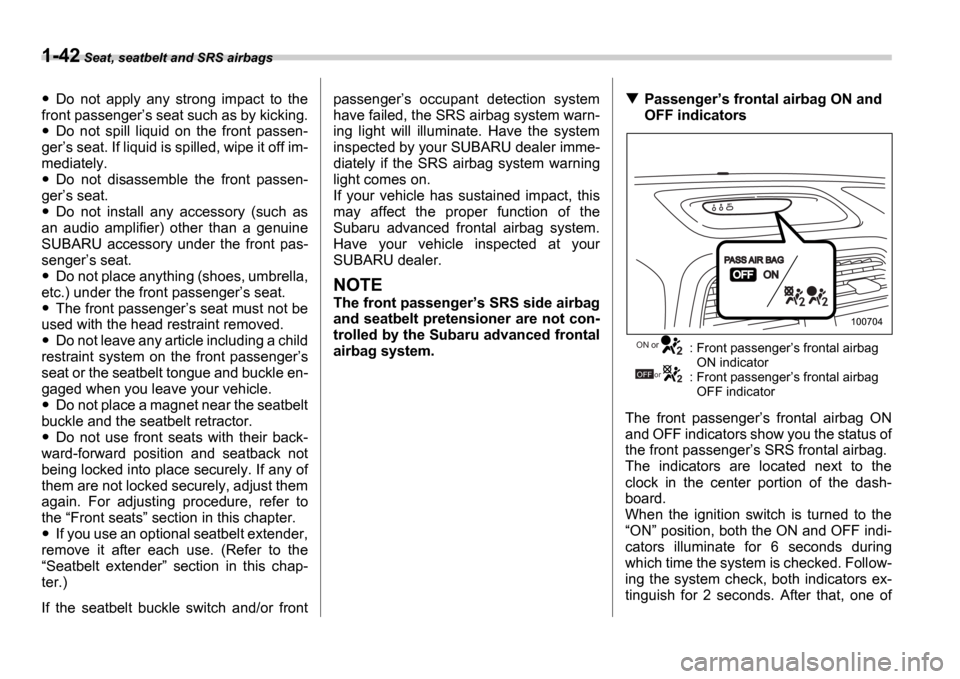
Passenger s frontal airbag ON and
OFF indicators
: Front passenger s frontal airbag
ON indicator
: Front passenger s frontal airbag
OFF indicator
The front passenger s frontal airbag ON
and OFF indicators show you the status of
the front passenger s SRS frontal airbag.
The indicators are located next to the
clock in the center portion of the dash-
board.
When the ignition switch is turned to the ON position, both the ON and OFF indi-
cators illuminate for 6 seconds during
which time the system is checked. Follow-
ing the system check, both indicators ex-
tinguish for 2 seconds. After that, one of
100704
ON or
OFF or
Page 70 of 365
Seat, seatbelt and SRS airbags 1-43
CONTINUED
the indicators illuminates depending on
the status of the front passenger
s SRS
frontal airbag determined by the Subaru
advanced frontal airbag system monitor-
ing.
If the front passenger s SRS frontal airbag
is activated, the passenger s frontal airbag
ON indicator will illuminate while the OFF
indicator will remain extinguished.
If the front passenger s SRS frontal airbag
is deactivated, the passenger s frontal air-
bag ON indicator will remain extinguished
while the OFF indicator will illuminate.
With the ignition switch turned to the ON
position, if both the ON and OFF indica-
tors remain lit or extinguished simulta-
neously even after the system check peri-
od, the system is faulty. Contact your
SUBARU dealer immediately for an in-
spection.
Conditions in which front passen-
ger s SRS frontal airbag is not acti-
vated
The front passenger s SRS frontal airbag
will not be activated when any of the fol-
lowing conditions are met regarding the
front passenger s seat:
The seat is empty.
The seat is equipped with a rearward
facing child restraint system and an infant
is restrained with it. (See WARNING that follows.)
The seat is equipped with a forward fac-
ing child restraint system and a small child
is restrained with it. (See WARNING that
follows.)
The seat is equipped with a booster
seat and a small child is in the booster
seat. (See WARNING that follows.)
The seat is relieved of the occupant
load for a time exceeding the predeter-
mined monitoring time period.
The seat is occupied by a child who has
outgrown a child restraint system (See
WARNING that follows.) or by a small
adult.
The front passenger s occupant detec-
tion system is faulty.
When the front passenger s seat is occu-
pied by a child, observe the following pre-
cautions. Failure to do so may increase
the load on the front passenger s seat, ac-
tivating the front passenger s SRS frontal
airbag even though that seat is occupied
by a child.
Do not place any article on the seat oth-
er than the child occupant and a child re-
straint system.
NEVER INSTALL A REARWARD
FACING CHILD SEAT IN THE FRONT
PASSENGER S SEAT EVEN IF THE
FRONT PASSENGER S SRS FRON-
TAL AIRBAG IS DEACTIVATED. Be
sure to install it in the REAR seat in
a correct manner. Also, it is strongly
recommended that any forward fac-
ing child seat or booster seat be in-
stalled in the REAR seat, and that
even children who have outgrown a
child restraint system be also seat-
ed in the REAR seat. This is because
children sitting in the front passen-
ger s seat may be killed or severely
injured should the front passenger s
SRS frontal airbag deploy. REAR
seats are the safest place for chil-
dren.
Page 72 of 365

Seat, seatbelt and SRS airbags 1-45
CONTINUED
When a heavy article is placed on the
seat.
When the front passenger s seat is occu-
pied by an adult, observe the following
precautions. Failure to do so may lessen
the load on the front passenger s seat, de-
activating the front passenger s SRS fron-
tal airbag despite the fact that the seat is
occupied by an adult.
Do not allow the rear seat occupant to
lift the front passenger s seat cushion us-
ing his/her feet.
Do not place any article under the front
passenger s seat, or squeeze any article
from behind and under the seat. This may
lift the seat cushion.
Do not squeeze any article between the
front passenger s seat and side trim/pillar,
door or center console box. This may lift
the seat cushion.
If the passenger s frontal airbag
OFF indicator illuminates and the
ON indicator extinguishes even
when the front passenger s seat is
occupied by an adult
This can be caused by the adult incorrect-
ly sitting in the front passenger s seat.
Turn the ignition switch to the OFF posi-
tion. Ask the front passenger to set the
seatback to the upright position, sit up
straight in the center of the seat cushion, correctly fasten the seatbelt, position his/
her legs out forward, and adjust the seat
to the rearmost position. Turn the ignition
switch to the
ON position. If the OFF in-
dicator remains illuminated while the ON
indicator remains extinguished, take the
following actions.
Turn the ignition switch to the OFF po-
sition.
Ensure that there is no article, book,
shoe, or other object trapped under the
seat, at the rear of the seat, or on the side
of the seat.
Ensure that the backward-forward posi-
tion and seatback of front passenger s
seat are locked into place securely by
moving the seat back and forth.
Next, turn the ignition switch to the ON
position and wait 6 seconds to allow the
system to complete self-checking. Follow-
ing the system check, both indicators ex-
tinguish for 2 seconds. Now, the ON indi-
cator should illuminate while the OFF indi-
cator remains extinguished.
If the OFF indicator still illuminates while
the ON indicator remains extinguished,
ask the occupant to move to the rear seat
and immediately contact your SUBARU
dealer for an inspection.
Effect vehicle modifications made
for persons with disabilities may
have on Subaru advanced frontal
airbag system operation (U.S. only)
Changing or moving any parts of the front
seats, seat belts, front bumper, front side
frame, instrument panel, combination
meter, steering wheel, steering column,
tire, suspension or floor panel can affect
the operation of the Subaru advanced air-
bag system. If you have any questions,
you may contact the following Subaru dis-
tributors:
Subaru of America, Inc.
Customer Dealer Services Department
P.O. Box 6000
Cherry Hill, NJ 08034-6000
1-800-SUBARU3 (1-800-782-2783)
Schuman Carriage Motors, Inc.
1234 South Beretania Street, Honolulu, HI
96814
808-592-4497
Triple J Enterprises, Inc.
P.O. Box 6066, Tamuning, Guam 96931
671-646-9126
Page 85 of 365
1-58 Seat, seatbelt and SRS airbags
In the event that the SRS airbag is de-
ployed, replacement of the system
should be performed only by an autho-
rized SUBARU dealer. When the com-
ponents of the SRS airbag system are
replaced, use only genuine SUBARU
parts.
To ensure their long-term reliability, the
SRS airbags must be inspected by a
SUBARU dealer ten years after the date
of manufacture, which is shown on the
certification plate attached to the driver s door jamb.
NOTE
In the following cases, contact your
SUBARU dealer as soon as possible.
The front part of the vehicle was in-
volved in an accident in which only the
driver s SRS frontal airbag or both driv-
er s and front passenger s SRS frontal
airbags did not deploy.
The pad section of the steering
wheel or front passenger s frontal air-
bag cover is scratched, cracked, or
otherwise damaged.
In addition, if your vehicle is equipped
with SRS side airbags, contact your
SUBARU dealer as soon as possible in
the following cases.
Either center pillar or a nearby area
of the vehicle was involved in an acci-
dent in which the SRS side airbag did
not deploy.
The fabric or leather of either front
seatback is cut, frayed, or otherwise
damaged.
Precautions against vehicle
modification
If you need service or repair in areas
listed in the following, have an au-
thorized SUBARU dealer perform
the work. The SRS airbag control
module, impact sensors and airbag
modules are stored in these areas.
Under the center console
Inside each front fender
Steering wheel and column and
nearby areas
Top of the dashboard on front
passenger s side and nearby ar-
eas
Each front seat and nearby area
Inside each center pillar
To avoid accidental activation of
the system or rendering the sys-
tem inoperative, which may result
in serious injury, no modifications
should be made to any compo-
nents or wiring of the SRS airbag
system.
This includes following modifica-
tions:
Installation of custom steering
wheels
Attachment of additional trim
materials to the dashboard
Installation of custom seats
Replacement of seat fabric or
leather
Installation of additional fabric
or leather on the front seat
Page 148 of 365
Instruments and controls 3-35
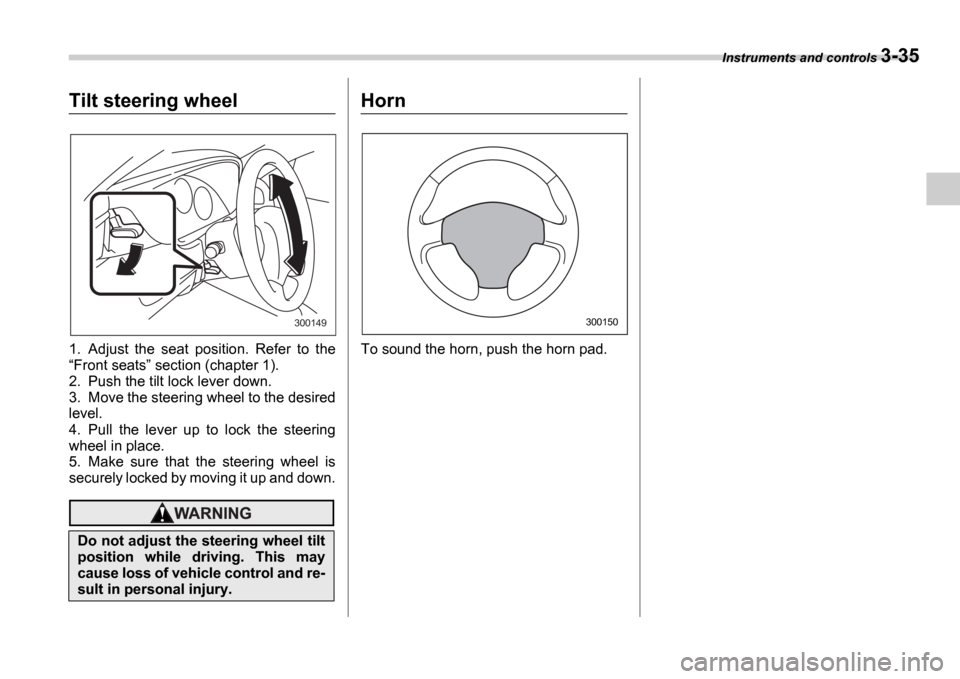
Tilt steering wheel
1. Adjust the seat position. Refer to the Front seats section (chapter 1).
2. Push the tilt lock lever down.
3. Move the steering wheel to the desired
level.
4. Pull the lever up to lock the steering
wheel in place.
5. Make sure that the steering wheel is
securely locked by moving it up and down.
Horn
To sound the horn, push the horn pad.
Do not adjust the steering wheel tilt
position while driving. This may
cause loss of vehicle control and re-
sult in personal injury.
300149300150
Page 278 of 365

Appearance care 10-5
CONTINUED
soon as you find them.
Check the interior of the vehicle for water
and dirt accumulation under the floor mats
because that could cause corrosion. Oc-
casionally check under the mats to make
sure the area is dry.
Keep your garage dry. Do not park your
vehicle in a damp, poorly ventilated ga-
rage. In such a garage, corrosion can be
caused by dampness. If you wash the ve-
hicle in the garage or put the vehicle into
the garage when wet or covered with
snow, that can cause dampness.
If your vehicle is operated in cold weather
and/or in areas where road salts and other
corrosive materials are used, the door
hinges and locks, trunk lid lock, and hood
latch should be inspected and lubricated
periodically.
Cleaning the interior
Use a soft, damp cloth to clean the climate
control panel, audio equipment, instru-
ment panel, center console, combination
meter panel, and switches. (Do not use or-
ganic solvents.)
Seat fabric
Remove loose dirt, dust or debris with a
vacuum cleaner. If the dirt is caked on the
fabric or hard to remove with a vacuum
cleaner, use a soft blush then vacuum it.
Wipe the fabric surface with a tightly
wrung cloth and dry the seat fabric thor-
oughly. If the fabric is still dirty, wipe using
a solution of mild soap and lukewarm wa-
ter then dry thoroughly.
If the stain does not come out, try a com-
mercially-available fabric cleaner. Use the
cleaner on a hidden place and make sure
it does not affect the fabric adversely. Use
the cleaner according to its instructions.
NOTE
When cleaning the seat, do not use
benzine, paint thinner, or any similar
materials.
Leather seat materials
The leather used by SUBARU is a high
quality natural product which will retain its
distinctive appearance and feel for many
years with proper care.
Allowing dust or road dirt to build up on the
surface can cause the material to become
brittle and to wear prematurely. Regular
cleaning with a soft, moist, natural fiber
cloth should be performed monthly, taking
care not to soak the leather or allow water
to penetrate the stitched seams.
A mild detergent suitable for cleaning
woolen fabrics may be used to remove dif-
ficult dirt spots, rubbing with a soft, dry
cloth afterwards to restore the luster. If
your SUBARU is to be parked for a long
time in bright sunlight, it is recommended
that the seats and headrests be covered,
or the windows shaded, to prevent fading
or shrinkage.
Minor surface blemishes or bald patches
may be treated with a commercial leather
spray lacquer. You will discover that each
leather seat section will develop soft folds
or wrinkles, which is characteristic of gen-
uine leather.
Synthetic leather upholstery
The synthetic leather material used on the
SUBARU may be cleaned using mild soap
or detergent and water, after first vacuum-
ing or brushing away loose dirt. Allow the
soap to soak in for a few minutes and wipe