2006 SUBARU BAJA brake
[x] Cancel search: brakePage 324 of 487
8-31
Driving tips
– CONTINUED –
mended. A genuine SUBARU hitch is available from
your SUBARU dealer.
If use of a non-genuine hitch is unavoidable, be sure
the hitch is suited to your vehicle and trailer. Consult
with a professional hitch supplier to assist you in
choosing an appropriate hitch for your vehicle. Be sure
to follow all of the hitch manufacturer’s instructions for
installation and use.
Never use a hitch that mounts only to the rear bumper.
The bumper is not designed to handle that type of
load.
For all types of hitches, r egularly check that the hitch
mounting bolts and nuts are tight. „ Connecting a trailer
T Trailer brakes
yAdequate size trailer brakes are required
when the trailer and its cargo exceed 1,000 lbs
(453 kg) total weight.y Do not directly connect your trailer’s hydrau-
lic brake system to the hydraulic brake system
in your vehicle. Direct connection would cause
the vehicle’s brake performance to deteriorate
and could lead to an accident.
If your trailer’s total weight (trailer weight plus its cargo
weight) exceeds 1,000 lbs (453 kg), the trailer is re-
quired to be equipped with its own brake system. Elec-
tric brakes or surge brakes are recommended, and
must be installed properly. Check that your trailer’s
brakes conform with Feder al, state/province and/or
other applicable regulations. Your SUBARU’s brake
system is not designed to be tapped into the trailer’s
hydraulic brake system. Please ask your SUBARU
dealer and professional trailer supplier for more infor-
mation about the trailer’s brake system. T Trailer safety chains
Always use safety chains between your vehicle
and the trailer. Towing trailer without safety
chains could create a traffic safety hazard if the
trailer separates from th e hitch due to coupling
damage or hitch ball damage.
In case the trailer hitch connector or hitch ball should
break or become disconnect ed, the trailer could get
Page 325 of 487
8-32
Driving tips
loose and create a traffic safety hazard.
For safety, always connect the towing vehicle and
trailer with trailer safety chains. Pass the chains cross-
ing each other under the trailer tongue to prevent the
trailer from dropping onto t
he ground in case the trailer
tongue should disconnect from the hitch ball. Allow
sufficient slack in the chains taking tight-turn situations
into account; however, be careful not to let them drag
on the ground.
For more information about the safety chain connec-
tion, refer to the instructions for your hitch and trailer.
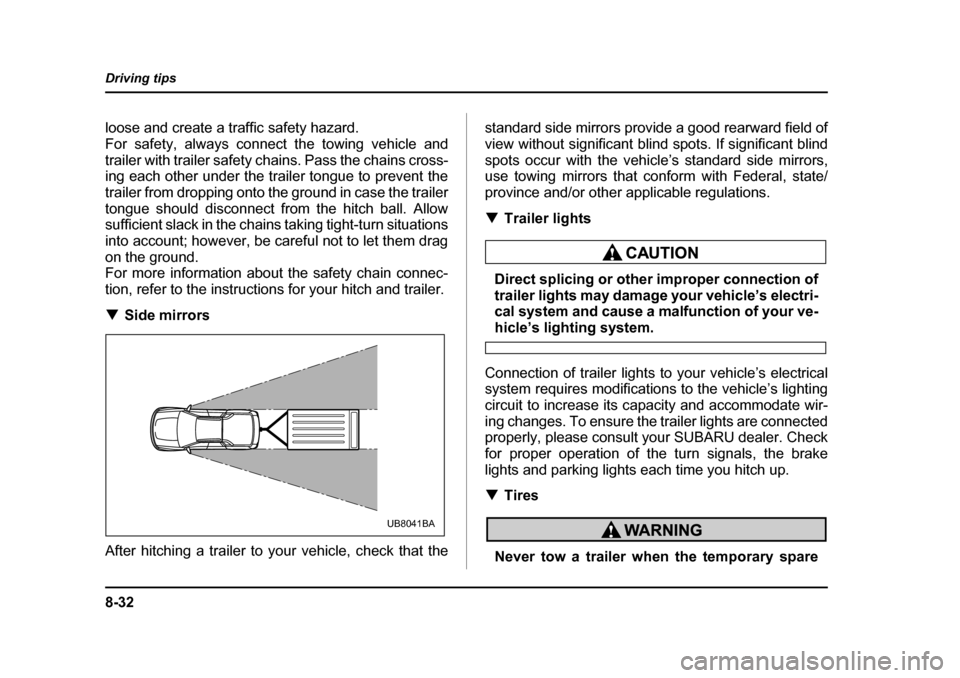
T Side mirrors
After hitching a trailer to your vehicle, check that the standard side mirrors provide a good rearward field of
view without significant blind spots. If significant blind
spots occur with the vehicl
e’s standard side mirrors,
use towing mirrors that co nform with Federal, state/
province and/or other applicable regulations. T Trailer lights
Direct splicing or other improper connection of
trailer lights may damage your vehicle’s electri-
cal system and cause a malfunction of your ve-
hicle’s lighting system.
Connection of trailer lights to your vehicle’s electrical system requires modification s to the vehicle’s lighting
circuit to increase its ca pacity and accommodate wir-
ing changes. To ensure the trailer lights are connected
properly, please consult your SUBARU dealer. Check
for proper operation of the turn signals, the brake
lights and parking lights each time you hitch up. T Tires
Never tow a trailer when the temporary spare
UB8041BA
Page 327 of 487
8-34
Driving tips
– the trailer tongue is connected properly to the
hitch ball.
– the trailer lights connector is connected properly
and trailer’s brake lights illuminate when the vehi-
cle’s brake pedal is pressed, and that the trailer’s
turn signal lights flash when the vehicle’s turn signal
lever is operated.
– the safety chains are connected properly.
– all cargo in the trailer is secured safety in position.
– the side mirrors provide a good rearward field of
view without a significant blind spot.
y Sufficient time should be taken to learn the “feel” of
the vehicle/trailer combination before starting out on a
trip. In an area free of traffic, practice turning, stopping
and backing up. T Driving with a trailer
y You should allow for considerably more stopping
distance when towing a trailer. Avoid sudden braking
because it may result in skidding or jackknifing and
loss of control. y Avoid abrupt starts and sudden accelerations. If
your vehicle has a manual transmission, always start
out in first gear and release the clutch at moderate en-
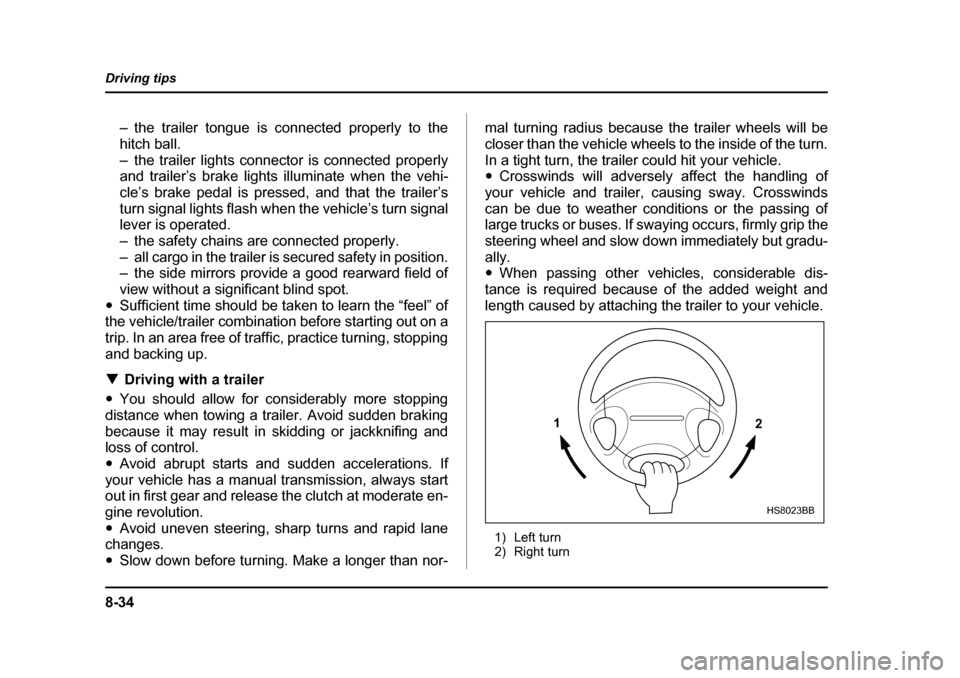
gine revolution.y Avoid uneven steering, sharp turns and rapid lane
changes.y Slow down before turning. Make a longer than nor- mal turning radius because the trailer wheels will be
closer than the vehicle wheels to the inside of the turn.
In a tight turn, the trailer could hit your vehicle. y
Crosswinds will adversely affect the handling of
your vehicle and trailer, causing sway. Crosswinds
can be due to weather conditions or the passing of large trucks or buses. If sway ing occurs, firmly grip the
steering wheel and slow down immediately but gradu-
ally. y When passing other vehicles, considerable dis-
tance is required because of the added weight and
length caused by attaching the trailer to your vehicle.
1) Left turn
2) Right turn
1 2
HS8023BB
Page 328 of 487

8-35
Driving tips
– CONTINUED –
yBacking up with a trailer is difficult and takes prac-
tice. When backing up with a trailer, never accelerate
or steer rapidly. When turning back, grip the bottom of
the steering wheel with one hand and turn it to the left
for a left turn, and turn it to the right for a right turn.
y If the ABS warning li ght illuminates while the vehicle
is in motion, stop towing the trailer and have repairs
performed immediately by the nearest SUBARU deal-er. T Driving on grades
y Before going down a steep hill, slow down and shift
into lower gear (if necessary, use 1st gear) in order to
utilize the engine braking ef fect and prevent overheat-
ing of your vehicle’s brakes. Do not make sudden
downshifts.y When driving uphill in hot weather, the air condition-
er may turn off automatically to protect the engine from
overheating.y When driving uphill in hot weather, pay attention to
the water temperature gauge pointer (for all vehicles)
and AT OIL TEMP warning light (for AT vehicles) since
the engine and transmission are relatively prone to
overheating under these conditions. If the water tem-
perature gauge pointer approaches the OVERHEAT
zone or the AT OIL TEMP warning light illuminates,
immediately switch off the ai r conditioner and stop the
vehicle at the nearest safe place. Refer to the “Engine overheating” section in chapter 9, and “Warning and indicator lights” se
ction in chapter 3.
NOTE (Turbo models only)
In a vehicle that has an automatic transmission,
the engine is less likely to overheat with the “D”
range selected than it is with the manual mode se-
lected. y If your vehicle has an autom atic transmission, avoid
using the accelerator pedal to stay stationary on an
uphill slope instead of using the parking brake or foot
brake. That may cause the transmission fluid to over-
heat. y Non-turbo models only: If your vehicle has an auto-
matic transmission, place the selector lever as follows:
Uphill slopes: “D” position
Downhill slopes: A low-speed gear position to use en-
gine braking T Parking on a grade
Always block the wheels under both vehicle and trailer
when parking. Apply the parking brake firmly. You
should not park on a hill or slope. But if parking on a
hill or slope cannot be avoided, you should take the
following steps:
1. Apply the brakes and hold the pedal down.
2. Have someone place wheel blocks under both the
Page 329 of 487
8-36
Driving tips
vehicle and trailer wheels.
3. When the wheel blocks are in place, release theregular brakes slowly until
the blocks absorb the load.
4. Apply the regular brakes and then apply the park-
ing brake; slowly release the regular brakes.
5. Shift into 1st or reverse gear (manual transmission)
or “P” (automatic transmission) and shut off the en-
gine.
Page 341 of 487

9-12
In case of emergency
Flat tires
If you get a flat tire while driving, never brake sudden-
ly; keep driving straight ahead while gradually reduc-
ing speed. Then slowly pull off the road to a safe place. „
Changing a flat tire
yDo not jack up the vehicle on an incline or a
loose road surface. The jack can come out of
the jacking point or sink into the ground and
this can result in a serious accident. y Use only the jack provided with your vehicle.
The jack supplied with the vehicle is designed
only for changing a tire. Never get under the ve-
hicle while supporting the vehicle with thisjack. y Always turn off the engi ne before raising the
flat tire off the grou nd using the jack. Never
swing or push the vehicle supported with the
jack. The jack can come out of the jacking point
due to a jolt and this can result in a serious ac-
cident. y Never place a tire or tire changing tools in the
passenger compartment after changing wheels. In a sudden stop or collision, loose
equipment could strike occupants and cause
injury. Store the tire and all tools in the proper
place.
1. Park on a hard, level surface, whenever possible,
then stop the engine.
2. Set the parking brake securely and shift a manual
transmission vehicle into reverse or an automatic
transmission vehicle into the “P” (Park) position.
3. Turn on the hazard warning flasher and have ev-
eryone get out of the vehicle.
4. Put wheel blocks at the fron t and rear of the tire di-
HS9003BA
Page 356 of 487

9-27
In case of emergency
– CONTINUED –
„Using a flat-bed truck
This is the best way to transport your vehicle. Use the
following procedures to ensure safe transportation.
1. Shift the selector lever into the “P” position for au-
tomatic transmission vehi cles or “1st” for manual
transmission vehicles.
2. Pull up the parking brake lever firmly.
3. Secure the vehicle onto the carrier properly with
safety chains. Each safety chain should be equally
tightened and care must be taken not to pull the chains
so tightly that the suspension bottoms out. „
Towing with all wheels on the ground
yNever turn the ignition switch to the “LOCK”
position while the vehicle is being towed be-
cause the steering wheel and the direction of
the wheels will be locked.y Remember that the brake booster and power
steering do not function when the engine is not
running. Because the engine is turned off, it will
take greater effort to operate the brake pedal
and steering wheel.
UB9072AAUB9071AA
Page 357 of 487

9-28
In case of emergency
y
If transmission failure occurs, transport your
vehicle on a flat-bed truck. y Do not run the engine while the vehicle is be-
ing towed using this method. Transmission
damage could result if the vehicle is towed with
the engine running. y For vehicles with automatic transmission,
the traveling speed must be limited to less than
20 mph (30 km/h) and the traveling distance to
less than 31 miles (50 km). For greater speeds
and distances, transport your vehicle on a flat-
bed truck.
1. Check the transmission and differential oil levels
and add oil to bring it to the upper level if necessary.
2. Release the parking brake and put the transmis-
sion in neutral.
3. The ignition switch should be in the “ACC” position
while the vehicle is being towed.
4. Take up slack in the towline slowly to prevent dam-
age to the vehicle.