2006 MERCEDES-BENZ SPRINTER Dash
[x] Cancel search: DashPage 1883 of 2305
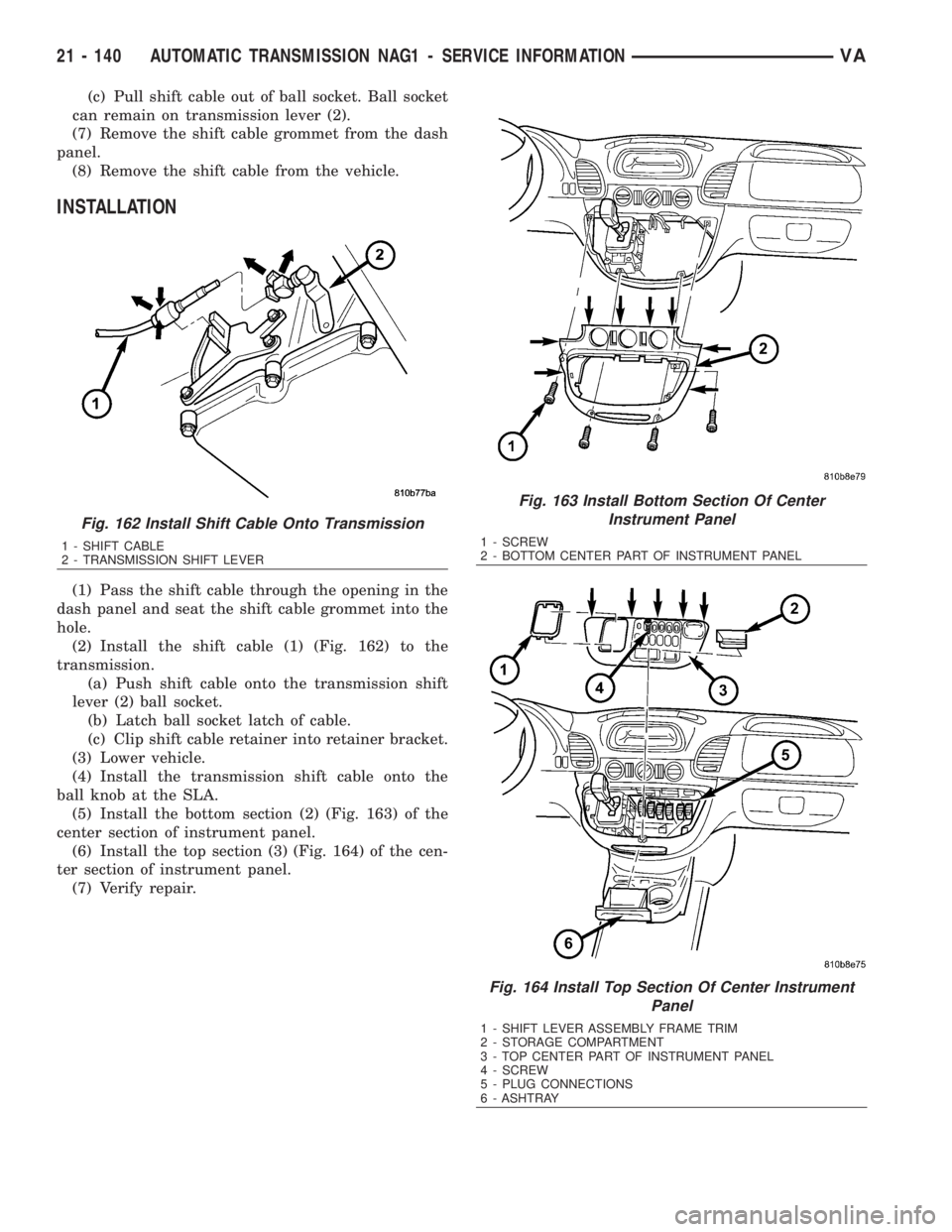
(c) Pull shift cable out of ball socket. Ball socket
can remain on transmission lever (2).
(7) Remove the shift cable grommet from the dash
panel.
(8) Remove the shift cable from the vehicle.
INSTALLATION
(1) Pass the shift cable through the opening in the
dash panel and seat the shift cable grommet into the
hole.
(2) Install the shift cable (1) (Fig. 162) to the
transmission.
(a) Push shift cable onto the transmission shift
lever (2) ball socket.
(b) Latch ball socket latch of cable.
(c) Clip shift cable retainer into retainer bracket.
(3) Lower vehicle.
(4) Install the transmission shift cable onto the
ball knob at the SLA.
(5) Install the bottom section (2) (Fig. 163) of the
center section of instrument panel.
(6) Install the top section (3) (Fig. 164) of the cen-
ter section of instrument panel.
(7) Verify repair.
Fig. 162 Install Shift Cable Onto Transmission
1 - SHIFT CABLE
2 - TRANSMISSION SHIFT LEVER
Fig. 163 Install Bottom Section Of Center
Instrument Panel
1 - SCREW
2 - BOTTOM CENTER PART OF INSTRUMENT PANEL
Fig. 164 Install Top Section Of Center Instrument
Panel
1 - SHIFT LEVER ASSEMBLY FRAME TRIM
2 - STORAGE COMPARTMENT
3 - TOP CENTER PART OF INSTRUMENT PANEL
4 - SCREW
5 - PLUG CONNECTIONS
6 - ASHTRAY
21 - 140 AUTOMATIC TRANSMISSION NAG1 - SERVICE INFORMATIONVA
Page 1947 of 2305
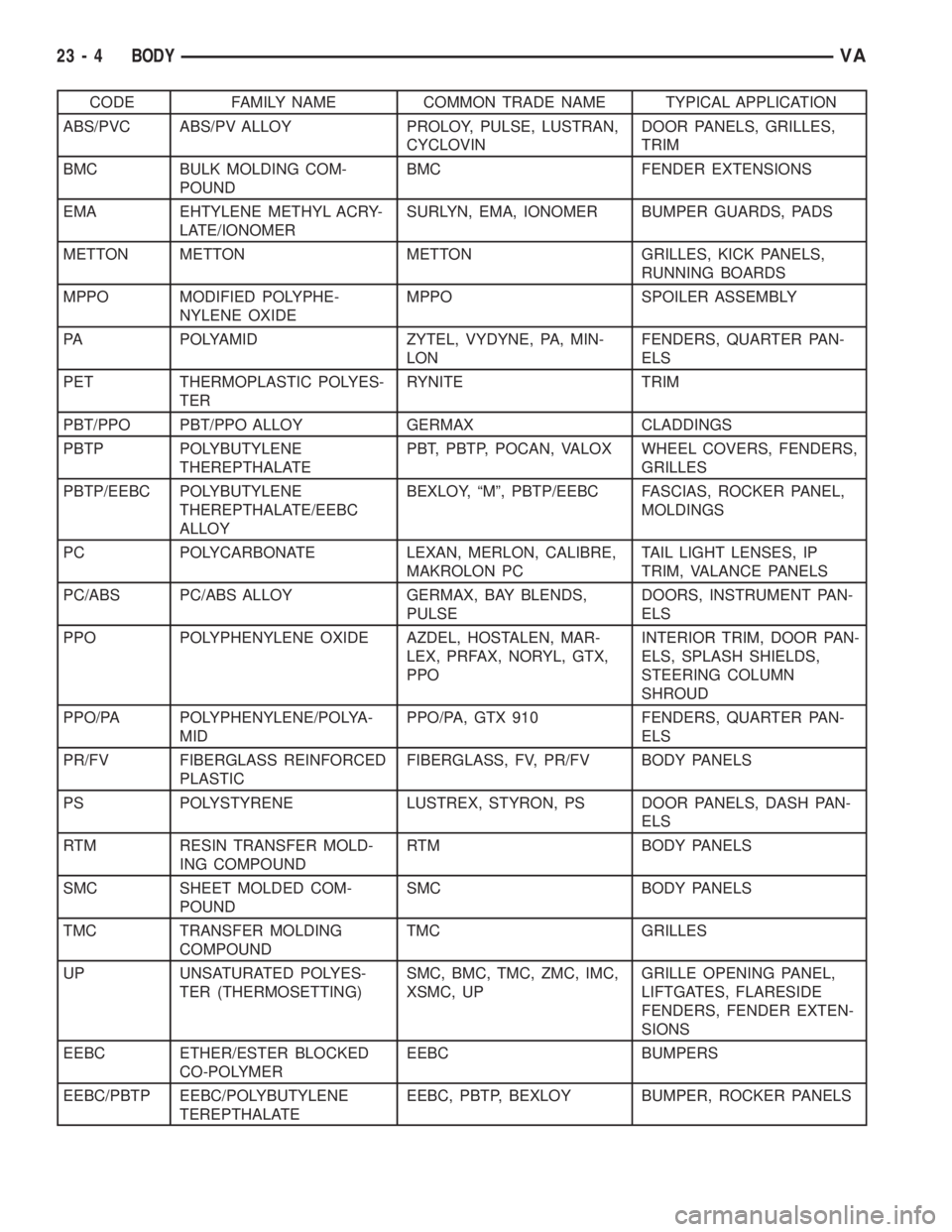
CODE FAMILY NAME COMMON TRADE NAME TYPICAL APPLICATION
ABS/PVC ABS/PV ALLOY PROLOY, PULSE, LUSTRAN,
CYCLOVINDOOR PANELS, GRILLES,
TRIM
BMC BULK MOLDING COM-
POUNDBMC FENDER EXTENSIONS
EMA EHTYLENE METHYL ACRY-
LATE/IONOMERSURLYN, EMA, IONOMER BUMPER GUARDS, PADS
METTON METTON METTON GRILLES, KICK PANELS,
RUNNING BOARDS
MPPO MODIFIED POLYPHE-
NYLENE OXIDEMPPO SPOILER ASSEMBLY
PA POLYAMID ZYTEL, VYDYNE, PA, MIN-
LONFENDERS, QUARTER PAN-
ELS
PET THERMOPLASTIC POLYES-
TERRYNITE TRIM
PBT/PPO PBT/PPO ALLOY GERMAX CLADDINGS
PBTP POLYBUTYLENE
THEREPTHALATEPBT, PBTP, POCAN, VALOX WHEEL COVERS, FENDERS,
GRILLES
PBTP/EEBC POLYBUTYLENE
THEREPTHALATE/EEBC
ALLOYBEXLOY, ªMº, PBTP/EEBC FASCIAS, ROCKER PANEL,
MOLDINGS
PC POLYCARBONATE LEXAN, MERLON, CALIBRE,
MAKROLON PCTAIL LIGHT LENSES, IP
TRIM, VALANCE PANELS
PC/ABS PC/ABS ALLOY GERMAX, BAY BLENDS,
PULSEDOORS, INSTRUMENT PAN-
ELS
PPO POLYPHENYLENE OXIDE AZDEL, HOSTALEN, MAR-
LEX, PRFAX, NORYL, GTX,
PPOINTERIOR TRIM, DOOR PAN-
ELS, SPLASH SHIELDS,
STEERING COLUMN
SHROUD
PPO/PA POLYPHENYLENE/POLYA-
MIDPPO/PA, GTX 910 FENDERS, QUARTER PAN-
ELS
PR/FV FIBERGLASS REINFORCED
PLASTICFIBERGLASS, FV, PR/FV BODY PANELS
PS POLYSTYRENE LUSTREX, STYRON, PS DOOR PANELS, DASH PAN-
ELS
RTM RESIN TRANSFER MOLD-
ING COMPOUNDRTM BODY PANELS
SMC SHEET MOLDED COM-
POUNDSMC BODY PANELS
TMC TRANSFER MOLDING
COMPOUNDTMC GRILLES
UP UNSATURATED POLYES-
TER (THERMOSETTING)SMC, BMC, TMC, ZMC, IMC,
XSMC, UPGRILLE OPENING PANEL,
LIFTGATES, FLARESIDE
FENDERS, FENDER EXTEN-
SIONS
EEBC ETHER/ESTER BLOCKED
CO-POLYMEREEBC BUMPERS
EEBC/PBTP EEBC/POLYBUTYLENE
TEREPTHALATEEEBC, PBTP, BEXLOY BUMPER, ROCKER PANELS
23 - 4 BODYVA
Page 1996 of 2305
PROP ROD
REMOVAL
(1) Open and support hood.
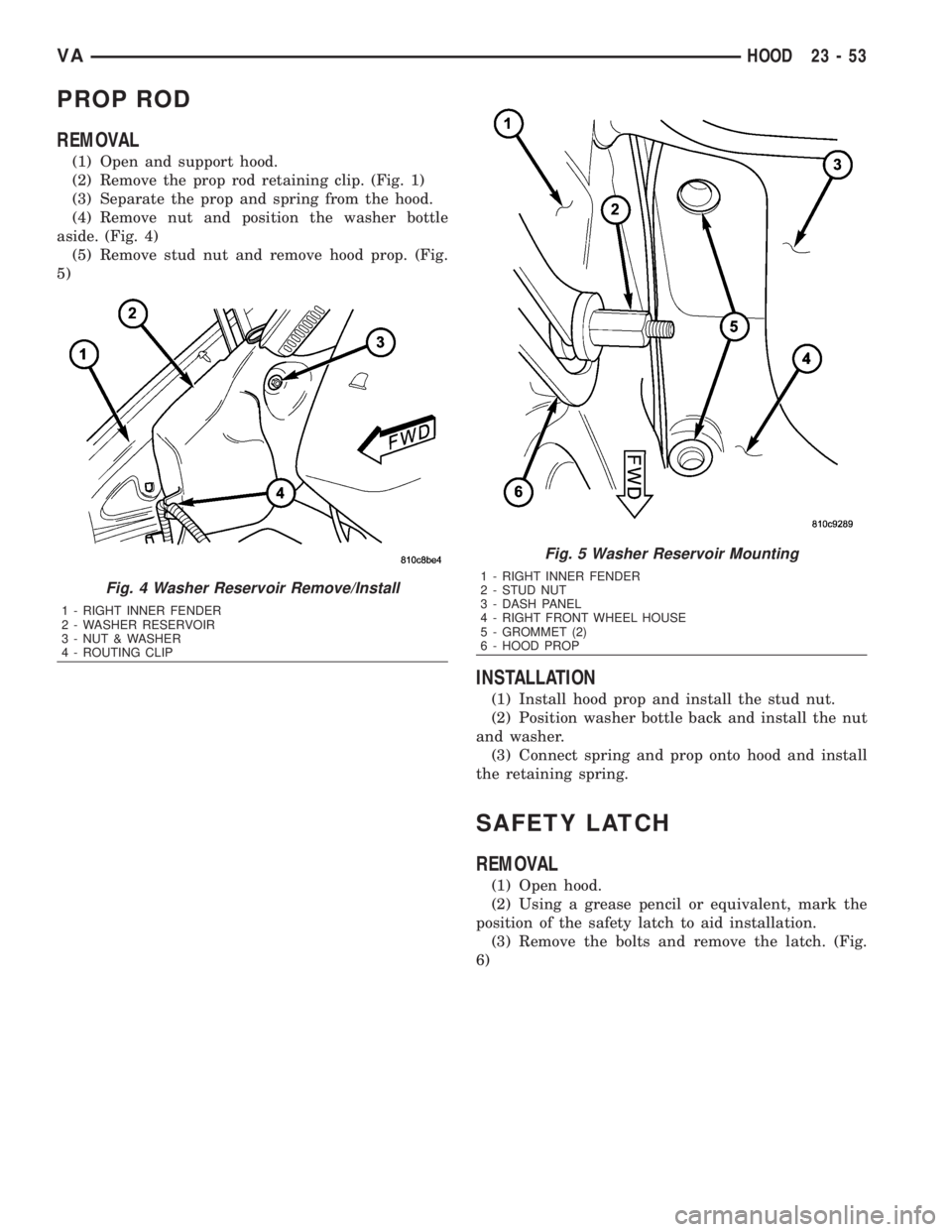
(2) Remove the prop rod retaining clip. (Fig. 1)
(3) Separate the prop and spring from the hood.
(4) Remove nut and position the washer bottle
aside. (Fig. 4)
(5) Remove stud nut and remove hood prop. (Fig.
5)
INSTALLATION
(1) Install hood prop and install the stud nut.
(2) Position washer bottle back and install the nut
and washer.
(3) Connect spring and prop onto hood and install
the retaining spring.
SAFETY LATCH
REMOVAL
(1) Open hood.
(2) Using a grease pencil or equivalent, mark the
position of the safety latch to aid installation.
(3) Remove the bolts and remove the latch. (Fig.
6)
Fig. 4 Washer Reservoir Remove/Install
1 - RIGHT INNER FENDER
2 - WASHER RESERVOIR
3 - NUT & WASHER
4 - ROUTING CLIP
Fig. 5 Washer Reservoir Mounting
1 - RIGHT INNER FENDER
2 - STUD NUT
3 - DASH PANEL
4 - RIGHT FRONT WHEEL HOUSE
5 - GROMMET (2)
6 - HOOD PROP
VAHOOD 23 - 53
Page 2087 of 2305
(3) Remove the gasket located at the A/C evapora-
tor and heater core tubes and the gasket that seals
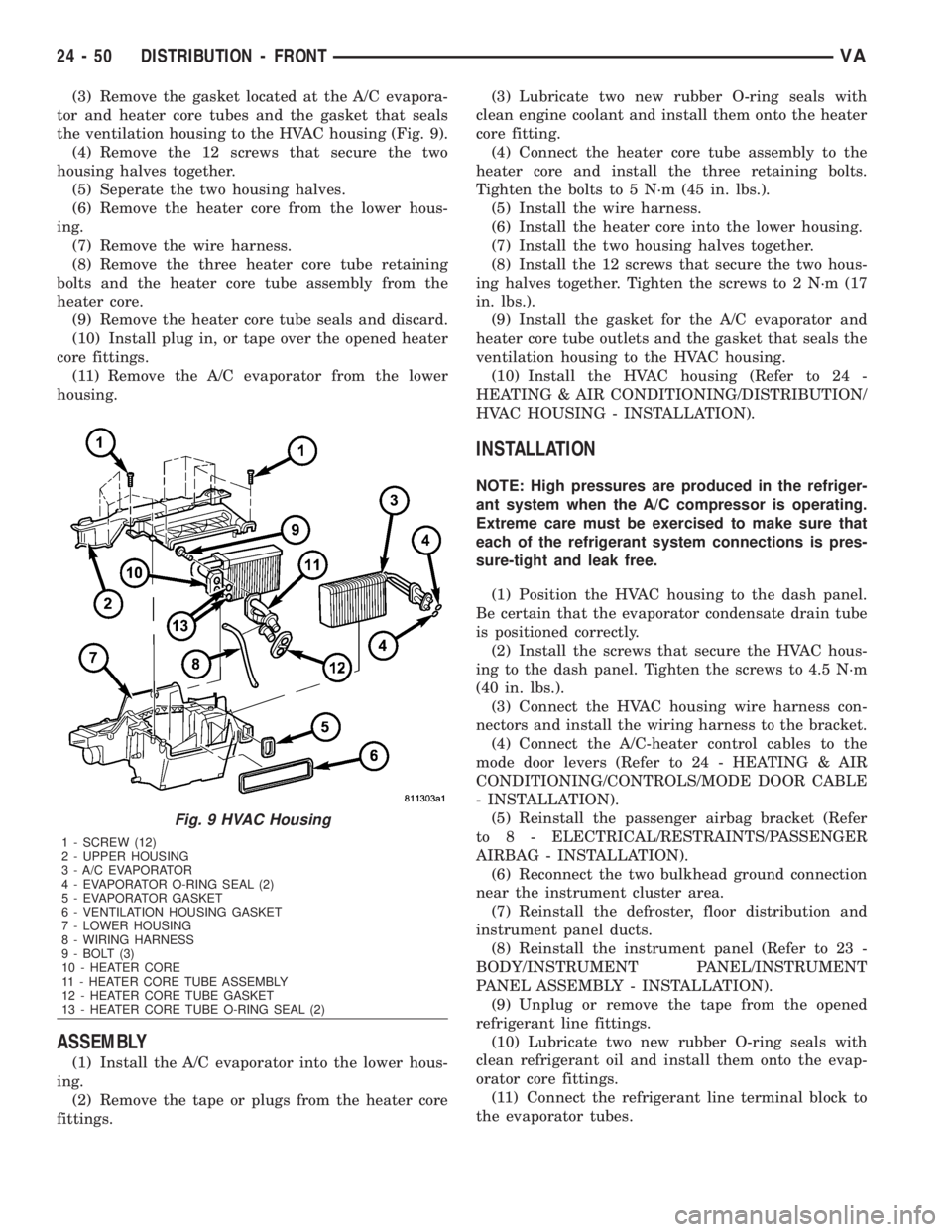
the ventilation housing to the HVAC housing (Fig. 9).
(4) Remove the 12 screws that secure the two
housing halves together.
(5) Seperate the two housing halves.
(6) Remove the heater core from the lower hous-
ing.
(7) Remove the wire harness.
(8) Remove the three heater core tube retaining
bolts and the heater core tube assembly from the
heater core.
(9) Remove the heater core tube seals and discard.
(10) Install plug in, or tape over the opened heater
core fittings.
(11) Remove the A/C evaporator from the lower
housing.
ASSEMBLY
(1) Install the A/C evaporator into the lower hous-
ing.
(2) Remove the tape or plugs from the heater core
fittings.(3) Lubricate two new rubber O-ring seals with
clean engine coolant and install them onto the heater
core fitting.
(4) Connect the heater core tube assembly to the
heater core and install the three retaining bolts.
Tighten the bolts to 5 N´m (45 in. lbs.).
(5) Install the wire harness.
(6) Install the heater core into the lower housing.
(7) Install the two housing halves together.
(8) Install the 12 screws that secure the two hous-
ing halves together. Tighten the screws to 2 N´m (17
in. lbs.).
(9) Install the gasket for the A/C evaporator and
heater core tube outlets and the gasket that seals the
ventilation housing to the HVAC housing.
(10) Install the HVAC housing (Refer to 24 -
HEATING & AIR CONDITIONING/DISTRIBUTION/
HVAC HOUSING - INSTALLATION).
INSTALLATION
NOTE: High pressures are produced in the refriger-
ant system when the A/C compressor is operating.
Extreme care must be exercised to make sure that
each of the refrigerant system connections is pres-
sure-tight and leak free.
(1) Position the HVAC housing to the dash panel.
Be certain that the evaporator condensate drain tube
is positioned correctly.
(2) Install the screws that secure the HVAC hous-
ing to the dash panel. Tighten the screws to 4.5 N´m
(40 in. lbs.).
(3) Connect the HVAC housing wire harness con-
nectors and install the wiring harness to the bracket.
(4) Connect the A/C-heater control cables to the
mode door levers (Refer to 24 - HEATING & AIR
CONDITIONING/CONTROLS/MODE DOOR CABLE
- INSTALLATION).
(5) Reinstall the passenger airbag bracket (Refer
to 8 - ELECTRICAL/RESTRAINTS/PASSENGER
AIRBAG - INSTALLATION).
(6) Reconnect the two bulkhead ground connection
near the instrument cluster area.
(7) Reinstall the defroster, floor distribution and
instrument panel ducts.
(8) Reinstall the instrument panel (Refer to 23 -
BODY/INSTRUMENT PANEL/INSTRUMENT
PANEL ASSEMBLY - INSTALLATION).
(9) Unplug or remove the tape from the opened
refrigerant line fittings.
(10) Lubricate two new rubber O-ring seals with
clean refrigerant oil and install them onto the evap-
orator core fittings.
(11) Connect the refrigerant line terminal block to
the evaporator tubes.
Fig. 9 HVAC Housing
1 - SCREW (12)
2 - UPPER HOUSING
3 - A/C EVAPORATOR
4 - EVAPORATOR O-RING SEAL (2)
5 - EVAPORATOR GASKET
6 - VENTILATION HOUSING GASKET
7 - LOWER HOUSING
8 - WIRING HARNESS
9 - BOLT (3)
10 - HEATER CORE
11 - HEATER CORE TUBE ASSEMBLY
12 - HEATER CORE TUBE GASKET
13 - HEATER CORE TUBE O-RING SEAL (2)
24 - 50 DISTRIBUTION - FRONTVA
Page 2088 of 2305
(12) Install the two bolts that secure the refriger-
ant line terminal block to the A/C evaporator.
Tighten the bolts to 5 N´m (45 in. lbs.).
(13) Unplug or remove the tape from the heater
core hoses and tubes.
(14) Connect the heater hoses to the heater core
tubes and install the heater hose clamps.
(15) Install the ventilation housing to the dash
panel.
(16) Install the nuts and washers that secure the
ventilation housing to the dash panel. Tighten the
nuts to 5 N´m (45 in. lbs.).
(17) Connect the wire harness connectors to the
blower motor, blower motor resistor block and the
recirculation door actuator.
(18) Connect the vacuum harness connector to the
recirculation door actuator.
(19) Install the air filter into the ventilation hous-
ing (Refer to 24 - HEATING & AIR CONDITION-
ING/DISTRIBUTION/AIR FILTER -
INSTALLATION).
(20) Install the windshield washer reservoir (Refer
to 8 - ELECTRICAL/WIPERS/WASHERS/WASHER
RESERVOIR - INSTALLATION).
(21) Install the air cleaner housing (Refer to 9 -
ENGINE/AIR INTAKE SYSTEM/AIR CLEANER
HOUSING - INSTALLATION).
(22) Reconnect the negative battery cable.
(23) If the heater core is being replaced, flush the
cooling system (Refer to 7 - COOLING - STANDARD
PROCEDURE - COOLING SYSTEM CLEANING/
REVERSE FLUSHING).
(24) Refill the engine cooling system (Refer to 7 -
COOLING/ENGINE/COOLANT - STANDARD PRO-
CEDURE - COOLANT SYSTEM FILL).
(25) Evacuate the refrigerant system (Refer to 24 -
HEATING & AIR CONDITIONING/PLUMBING -
STANDARD PROCEDURE - REFRIGERANT SYS-
TEM EVACUATE).
(26) Charge the refrigerant system (Refer to 24 -
HEATING & AIR CONDITIONING/PLUMBING -
STANDARD PROCEDURE - REFRIGERANT SYS-
TEM CHARGE).
INSTRUMENT PANEL DUCTS
REMOVAL
(1) Remove the instrument panel (Refer to 23 -
BODY/INSTRUMENT PANEL/INSTRUMENT
PANEL ASSEMBLY - REMOVAL).
(2) Remove the defroster ducts (Refer to 24 -
HEATING & AIR CONDITIONING/DISTRIBUTION/
DEFROSTER DUCTS - REMOVAL).
(3) Remove the floor distribution ducts (Refer to 24
- HEATING & AIR CONDITIONING/DISTRIBU-
TION/FLOOR DISTRIBUTION DUCTS -
REMOVAL).(4) If removing the right instrument panel duct,
remove the passenger air bag module and bracket
(Refer to 8 - ELECTRICAL/RESTRAINTS/PASSEN-
GER AIRBAG - REMOVAL).
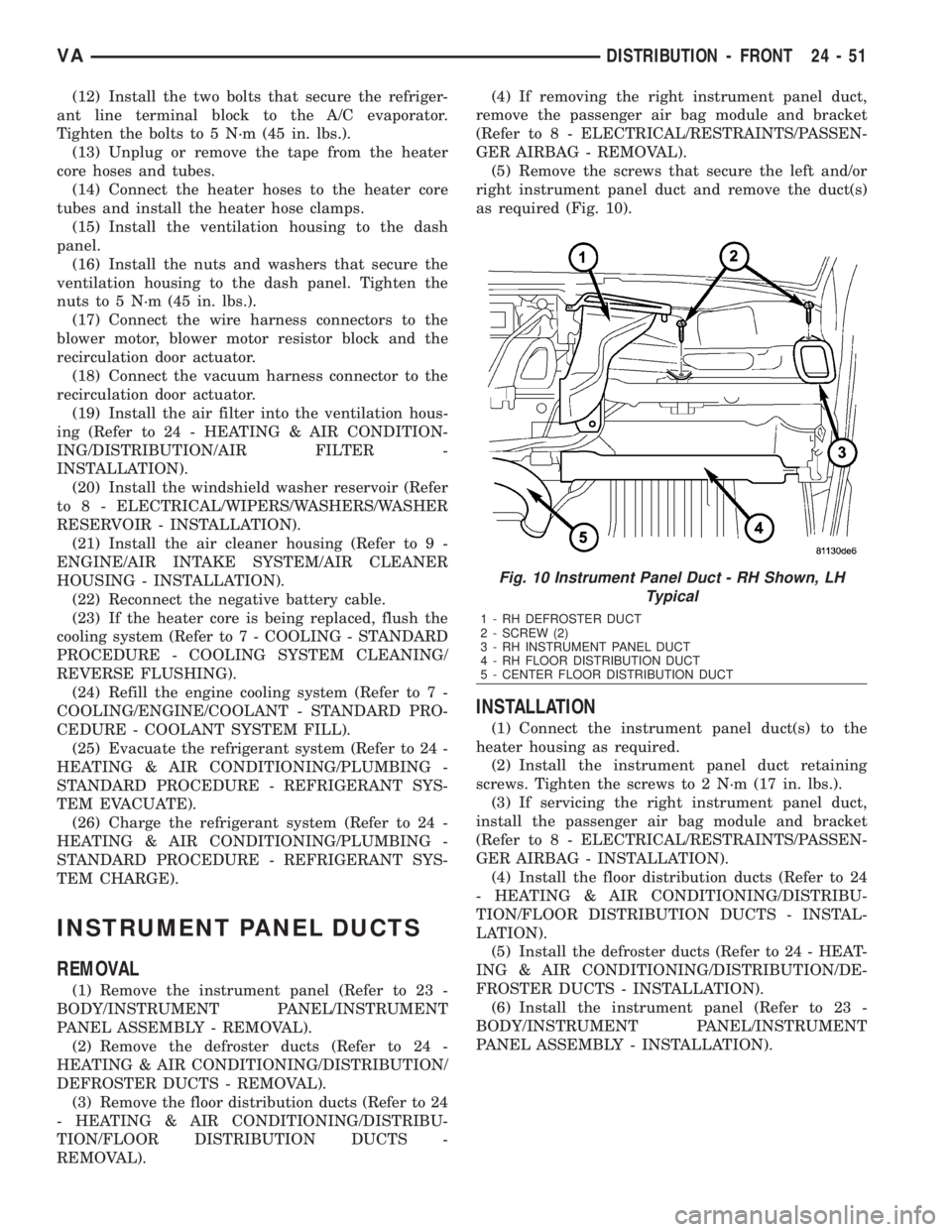
(5) Remove the screws that secure the left and/or
right instrument panel duct and remove the duct(s)
as required (Fig. 10).
INSTALLATION
(1) Connect the instrument panel duct(s) to the
heater housing as required.
(2) Install the instrument panel duct retaining
screws. Tighten the screws to 2 N´m (17 in. lbs.).
(3) If servicing the right instrument panel duct,
install the passenger air bag module and bracket
(Refer to 8 - ELECTRICAL/RESTRAINTS/PASSEN-
GER AIRBAG - INSTALLATION).
(4) Install the floor distribution ducts (Refer to 24
- HEATING & AIR CONDITIONING/DISTRIBU-
TION/FLOOR DISTRIBUTION DUCTS - INSTAL-
LATION).
(5) Install the defroster ducts (Refer to 24 - HEAT-
ING & AIR CONDITIONING/DISTRIBUTION/DE-
FROSTER DUCTS - INSTALLATION).
(6) Install the instrument panel (Refer to 23 -
BODY/INSTRUMENT PANEL/INSTRUMENT
PANEL ASSEMBLY - INSTALLATION).
Fig. 10 Instrument Panel Duct - RH Shown, LH
Typical
1 - RH DEFROSTER DUCT
2 - SCREW (2)
3 - RH INSTRUMENT PANEL DUCT
4 - RH FLOOR DISTRIBUTION DUCT
5 - CENTER FLOOR DISTRIBUTION DUCT
VADISTRIBUTION - FRONT 24 - 51
Page 2101 of 2305
FRONTA/CSYSTEM
²LOW PRESSURE GAUGE HOSEÐThe low
pressure hose (Blue with Black stripe) attaches to
the suction line service port. This port is located on
the suction line near the dash panel.
²HIGH PRESSURE GAUGE HOSEÐThe high
pressure hose (Red with Black stripe) attaches to the
discharge line service port. This port is located on the
liquid line between the condenser and the reciver-
drier.
²RECOVERY/RECYCLING/EVACUATION/
CHARGING HOSEÐThe center manifold hose (Yel-
low, or White, with Black stripe) is used to recover,
evacuate, and charge the refrigerant system. When
the low or high pressure valves on the manifold
gauge set are opened, the refrigerant in the system
will escape through this hose.
REARA/CSYSTEM
²LOW PRESSURE GAUGE HOSEÐThe low
pressure hose (Blue with Black stripe) attaches to
the suction line service port. This port is located
within the rear A/C evaporator housing near the left
side of the evaporator, below the high-pressure ser-
vice port.
²HIGH PRESSURE GAUGE HOSEÐThe high
pressure hose (Red with Black stripe) attaches to the
liquid line service port. This port is located within
the rear A/C evaporator housing near the left side of
the evaporator, above the low-pressure service port.
²RECOVERY/RECYCLING/EVACUATION/
CHARGING HOSEÐThe center manifold hose (Yel-
low, or White, with Black stripe) is used to recover,
evacuate, and charge the refrigerant system. When
the low or high pressure valves on the manifold
gauge set are opened, the refrigerant in the system
will escape through this hose.
REFRIGERANT SYSTEM RECOVERY
WARNING: Refer to the applicable warnings and
cautions for this system before performing the fol-
lowing operation (Refer to 24 - HEATING & AIR
CONDITIONING/PLUMBING - WARNINGS) and (Refer
to 24 - HEATING & AIR CONDITIONING/PLUMBING -
CAUTIONS). Failure to follow the warnings and cau-
tions could result in possible personal injury or
death.
A R-134a refrigerant recovery/recycling/charging
station that meets SAE Standard J2210 must be
used to recover the refrigerant from an R-134a refrig-
erant system. Refer to the operating instructions sup-
plied by the equipment manufacturer for the proper
care and use of this equipment.
REFRIGERANT SYSTEM EVACUATE
WARNING: Refer to the applicable warnings and
cautions for this system before performing the fol-
lowing operation (Refer to 24 - HEATING & AIR
CONDITIONING/PLUMBING - WARNINGS) and (Refer
to 24 - HEATING & AIR CONDITIONING/PLUMBING -
CAUTIONS). Failure to follow the warnings and cau-
tions could result in possible personal injury or
death.
If the refrigerant system has been open to the
atmosphere, it must be evacuated before the system
can be charged. If moisture and air enters the system
and becomes mixed with the refrigerant, the com-
pressor head pressure will rise above acceptable
operating levels. This will reduce the performance of
the air conditioner and damage the compressor.
Evacuating the refrigerant system will remove the
air and boil the moisture out of the system at near
room temperature. To evacuate the refrigerant sys-
tem, use the following procedure:
(1) Connect a R-134a refrigerant recovery/recy-
cling/charging station that meets SAE Standard
J2210 and a manifold gauge set to the refrigerant
system of the vehicle.
(2) Open the low and high side valves and start
the charging station vacuum pump. When the suc-
tion gauge reads 88 kPa (26 in. Hg.) vacuum or
greater, close all of the valves and turn off the vac-
uum pump.
(a) If the refrigerant system fails to reach the
specified vacuum, the system has a leak that must
be corrected. (Refer to 24 - HEATING & AIR CON-
DITIONING/PLUMBING - DIAGNOSIS AND
TESTING - REFRIGERANT SYSTEM LEAKS)
(b) If the refrigerant system maintains the spec-
ified vacuum for five minutes, restart the vacuum
pump, open the suction and discharge valves and
evacuate the system for an additional ten minutes.
(3) Close all of the valves, and turn off the charg-
ing station vacuum pump.
(4) The refrigerant system is now ready to be
charged with R-134a refrigerant. (Refer to 24 -
HEATING & AIR CONDITIONING/PLUMBING -
STANDARD PROCEDURE - REFRIGERANT SYS-
TEM CHARGE)
REFRIGERANT SYSTEM CHARGE
WARNING: Refer to the applicable warnings and
cautions for this system before performing the fol-
lowing operation (Refer to 24 - HEATING & AIR
CONDITIONING/PLUMBING - WARNINGS) and (Refer
to 24 - HEATING & AIR CONDITIONING/PLUMBING -
CAUTIONS). Failure to follow the warnings and cau-
tions could result in possible personal injury or
death.
24 - 64 PLUMBINGVA
Page 2110 of 2305
WARNING: Refer to the applicable warnings and
cautions for this system before performing the fol-
lowing operation (Refer to 24 - HEATING & AIR
CONDITIONING/PLUMBING - WARNINGS) and (Refer
to 24 - HEATING & AIR CONDITIONING/PLUMBING -
CAUTIONS). Failure to follow the warnings and cau-
tions could result in possible personal injury or
death.
(1) Remove the HVAC housing (Refer to 24 -
HEATING & AIR CONDITIONING/DISTRIBUTION/
HVAC HOUSING - REMOVAL).
(2) Disassemble the HVAC housing to access the
A/C evaporator (Refer to 24 - HEATING & AIR CON-
DITIONING/DISTRIBUTION/HVAC HOUSING -
DISASSEMBLY).
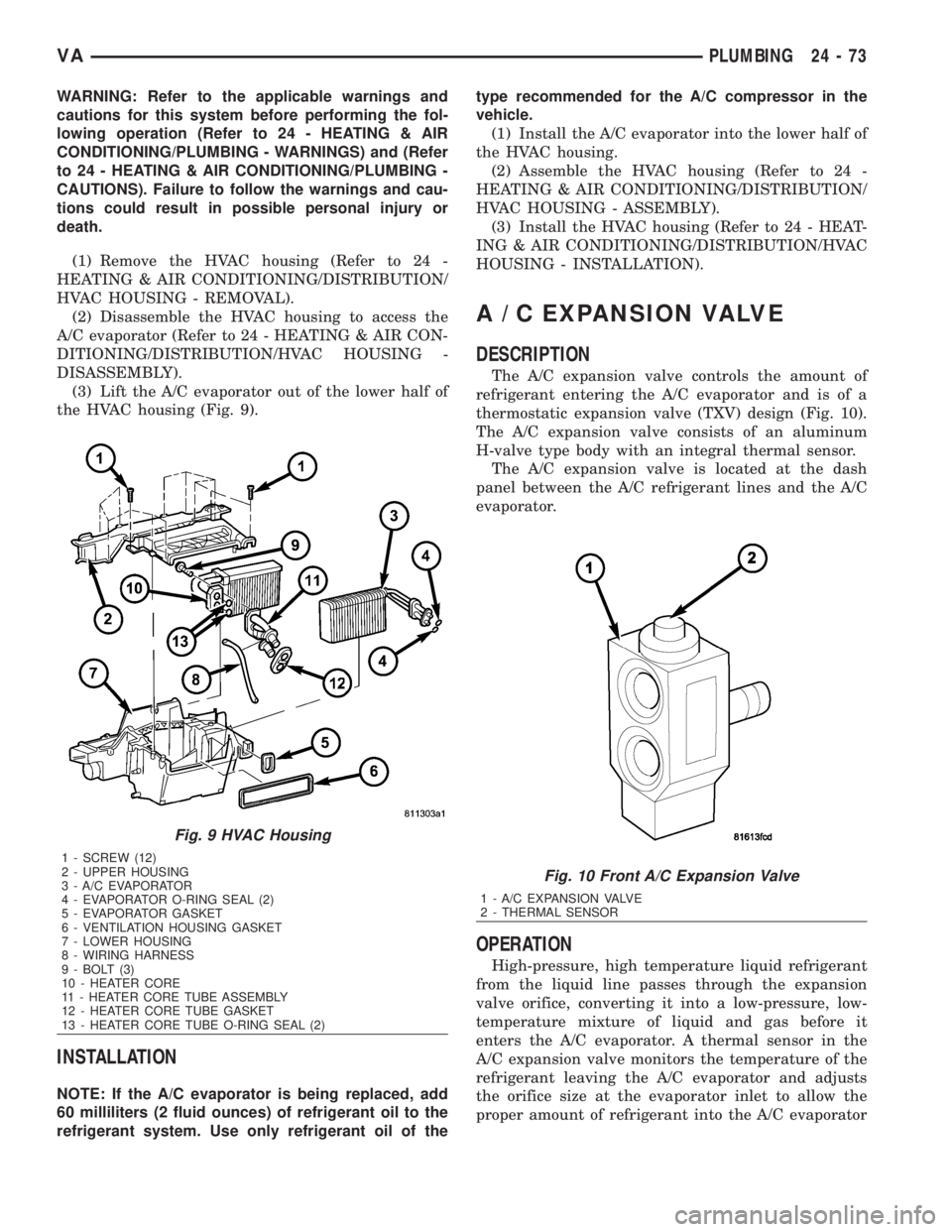
(3) Lift the A/C evaporator out of the lower half of
the HVAC housing (Fig. 9).
INSTALLATION
NOTE: If the A/C evaporator is being replaced, add
60 milliliters (2 fluid ounces) of refrigerant oil to the
refrigerant system. Use only refrigerant oil of thetype recommended for the A/C compressor in the
vehicle.
(1) Install the A/C evaporator into the lower half of
the HVAC housing.
(2) Assemble the HVAC housing (Refer to 24 -
HEATING & AIR CONDITIONING/DISTRIBUTION/
HVAC HOUSING - ASSEMBLY).
(3) Install the HVAC housing (Refer to 24 - HEAT-
ING & AIR CONDITIONING/DISTRIBUTION/HVAC
HOUSING - INSTALLATION).
A / C EXPANSION VALVE
DESCRIPTION
The A/C expansion valve controls the amount of
refrigerant entering the A/C evaporator and is of a
thermostatic expansion valve (TXV) design (Fig. 10).
The A/C expansion valve consists of an aluminum
H-valve type body with an integral thermal sensor.
The A/C expansion valve is located at the dash
panel between the A/C refrigerant lines and the A/C
evaporator.
OPERATION
High-pressure, high temperature liquid refrigerant
from the liquid line passes through the expansion
valve orifice, converting it into a low-pressure, low-
temperature mixture of liquid and gas before it
enters the A/C evaporator. A thermal sensor in the
A/C expansion valve monitors the temperature of the
refrigerant leaving the A/C evaporator and adjusts
the orifice size at the evaporator inlet to allow the
proper amount of refrigerant into the A/C evaporator
Fig. 9 HVAC Housing
1 - SCREW (12)
2 - UPPER HOUSING
3 - A/C EVAPORATOR
4 - EVAPORATOR O-RING SEAL (2)
5 - EVAPORATOR GASKET
6 - VENTILATION HOUSING GASKET
7 - LOWER HOUSING
8 - WIRING HARNESS
9 - BOLT (3)
10 - HEATER CORE
11 - HEATER CORE TUBE ASSEMBLY
12 - HEATER CORE TUBE GASKET
13 - HEATER CORE TUBE O-RING SEAL (2)
Fig. 10 Front A/C Expansion Valve
1 - A/C EXPANSION VALVE
2 - THERMAL SENSOR
VAPLUMBING 24 - 73
Page 2111 of 2305
in order to meet vehicle cooling requirements. Con-
trolling the refrigerant flow through the A/C evapo-
rator ensures that none of the refrigerant leaving the
evaporator is still in a liquid state, which could cause
damage to the A/C compressor.
The A/C expansion valve is factory calibrated and
cannot be adjusted or repaired and, if faulty or dam-
aged, it must be replaced.
DIAGNOSIS AND TESTING
A / C EXPANSION VALVE
The A/C expansion valve is located on the engine
side of the dash panel near the shock tower.
The A/C expansion valve can fail in three different
positions (open, closed or restricted).
In an Open Position: this will result in a noisy A/C
compressor or no cooling. The cause can be broken
spring, broken ball or excessive moisture in the A/C
system. If the spring or ball are found to be defective,
replace the A/C expansion valve. If excessive mois-
ture is found in the A/C system, recycle the refriger-
ant.
In a Closed Position: There will be low suction
pressure and no cooling. This may be caused by a
failed power dome or excessive moisture in the A/C
system. If the power dome on the A/C expansion
valve is found to be defective replace the A/C expan-
sion valve. If excessive moisture is found recycle the
refrigerant.
A Restricted Orifice: There will be low suction
pressure and no cooling. This may be caused by
debris in the refrigerant system. If debris is believed
to be the cause, recycle the refrigerant and replace
the A/C expansion valve and the receiver-drier.
REMOVAL
WARNING: Refer to the applicable warnings and
cautions for this system before performing the fol-
lowing operation (Refer to 24 - HEATING & AIR
CONDITIONING/PLUMBING - WARNINGS) and (Refer
to 24 - HEATING & AIR CONDITIONING/PLUMBING -
CAUTIONS). Failure to follow the warnings and cau-
tions could result in possible personal injury or
death.
(1) Recover the refrigerant from the A/C system
(Refer to 24 - HEATING & AIR CONDITIONING/
PLUMBING - STANDARD PROCEDURE - REFRIG-
ERANT SYSTEM RECOVERY).
(2) Disconnect and isolate the negative battery
cable.
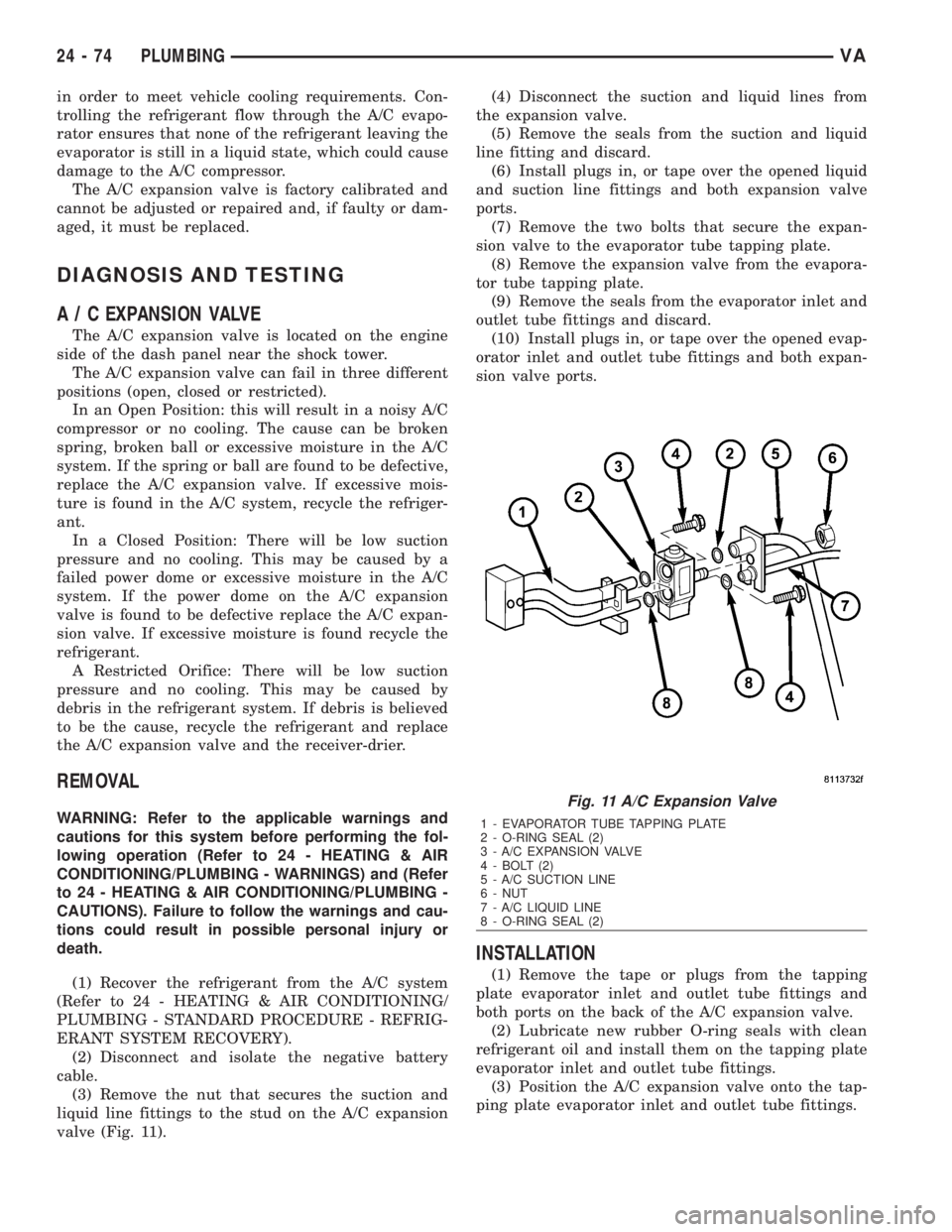
(3) Remove the nut that secures the suction and
liquid line fittings to the stud on the A/C expansion
valve (Fig. 11).(4) Disconnect the suction and liquid lines from
the expansion valve.
(5) Remove the seals from the suction and liquid
line fitting and discard.
(6) Install plugs in, or tape over the opened liquid
and suction line fittings and both expansion valve
ports.
(7) Remove the two bolts that secure the expan-
sion valve to the evaporator tube tapping plate.
(8) Remove the expansion valve from the evapora-
tor tube tapping plate.
(9) Remove the seals from the evaporator inlet and
outlet tube fittings and discard.
(10) Install plugs in, or tape over the opened evap-
orator inlet and outlet tube fittings and both expan-
sion valve ports.
INSTALLATION
(1) Remove the tape or plugs from the tapping
plate evaporator inlet and outlet tube fittings and
both ports on the back of the A/C expansion valve.
(2) Lubricate new rubber O-ring seals with clean
refrigerant oil and install them on the tapping plate
evaporator inlet and outlet tube fittings.
(3) Position the A/C expansion valve onto the tap-
ping plate evaporator inlet and outlet tube fittings.
Fig. 11 A/C Expansion Valve
1 - EVAPORATOR TUBE TAPPING PLATE
2 - O-RING SEAL (2)
3 - A/C EXPANSION VALVE
4 - BOLT (2)
5 - A/C SUCTION LINE
6 - NUT
7 - A/C LIQUID LINE
8 - O-RING SEAL (2)
24 - 74 PLUMBINGVA