2006 MERCEDES-BENZ SPRINTER ECU
[x] Cancel search: ECUPage 2060 of 2305
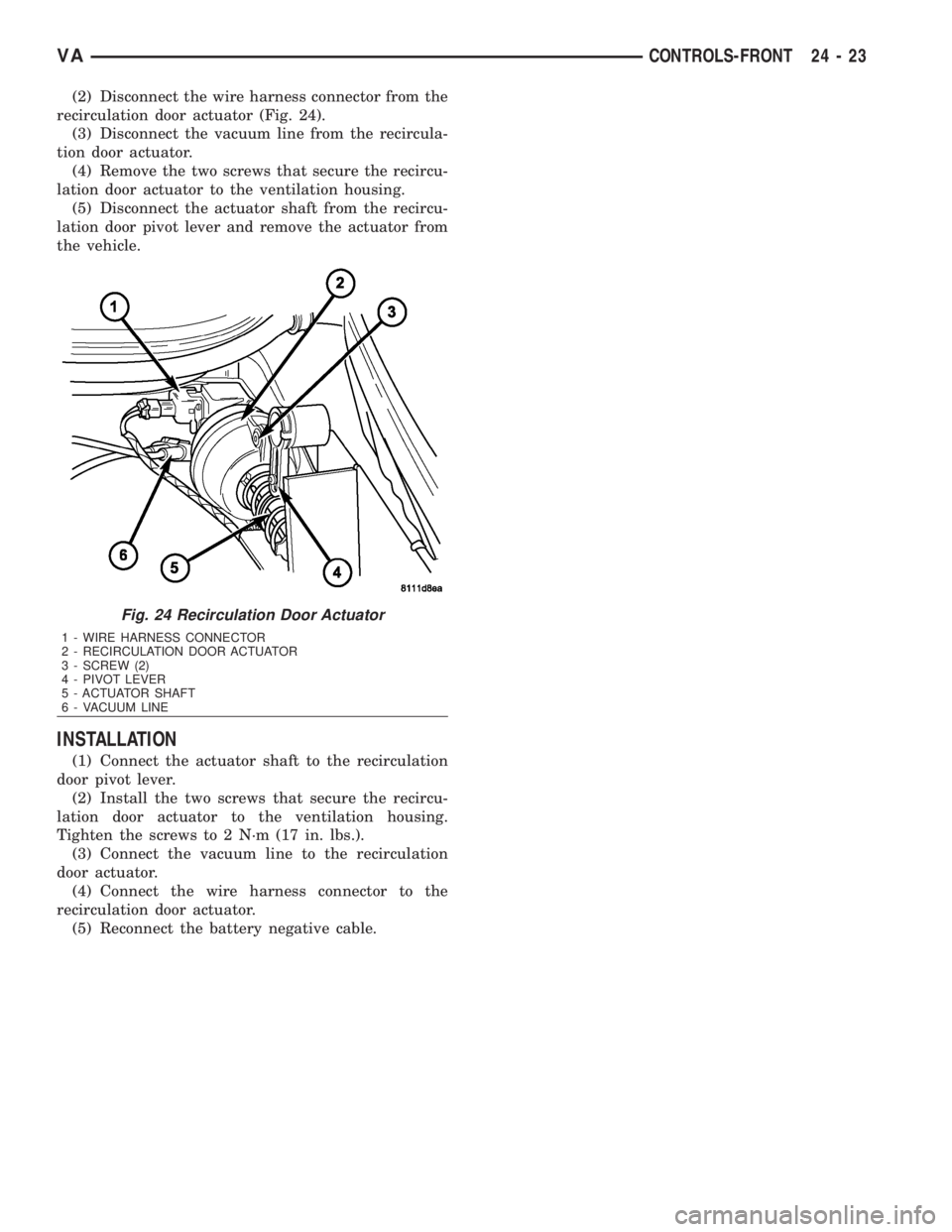
(2) Disconnect the wire harness connector from the
recirculation door actuator (Fig. 24).
(3) Disconnect the vacuum line from the recircula-
tion door actuator.
(4) Remove the two screws that secure the recircu-
lation door actuator to the ventilation housing.
(5) Disconnect the actuator shaft from the recircu-
lation door pivot lever and remove the actuator from
the vehicle.
INSTALLATION
(1) Connect the actuator shaft to the recirculation
door pivot lever.
(2) Install the two screws that secure the recircu-
lation door actuator to the ventilation housing.
Tighten the screws to 2 N´m (17 in. lbs.).
(3) Connect the vacuum line to the recirculation
door actuator.
(4) Connect the wire harness connector to the
recirculation door actuator.
(5) Reconnect the battery negative cable.
Fig. 24 Recirculation Door Actuator
1 - WIRE HARNESS CONNECTOR
2 - RECIRCULATION DOOR ACTUATOR
3 - SCREW (2)
4 - PIVOT LEVER
5 - ACTUATOR SHAFT
6 - VACUUM LINE
VACONTROLS-FRONT 24 - 23
Page 2066 of 2305
input signals to control rear blower motor speed and
output air temperature, and to prevent freezing of
the rear evaporator core.
The rear A/C control module cannot be repaired
and, if faulty or damaged, it must be replaced. Refer
to the appropriate wiring information for complete
HVAC wiring diagrams.
REMOVAL
(1) Disconnect and isolate the negative battery
cable.
(2) Remove the air filter from the rear A/C evapo-
rator housing (Refer to 24 - HEATING & AIR CON-
DITIONING/DISTRIBUTION - REAR/AIR FILTER -
REMOVAL).
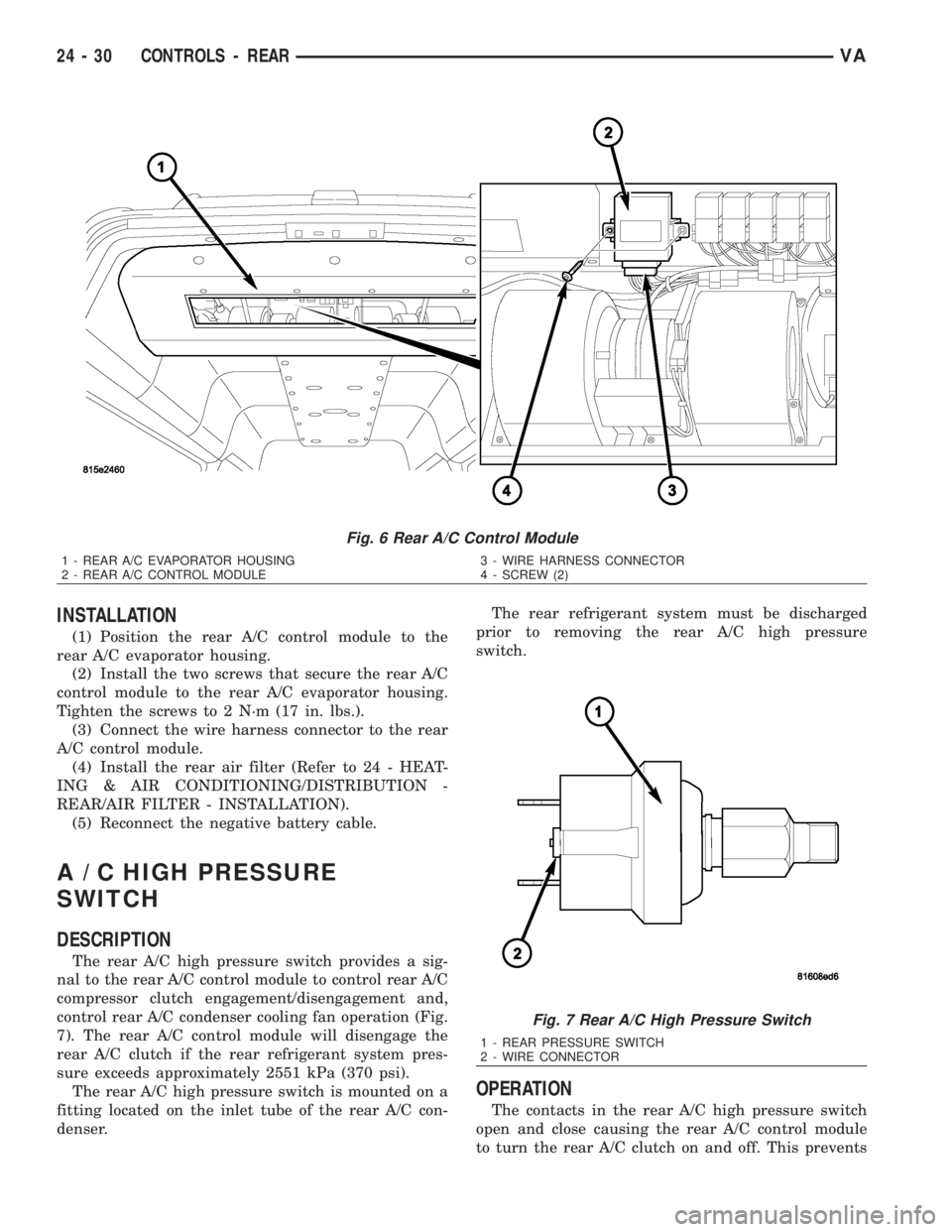
(3) Reach up into the rear A/C evaporator housing
and disconnect the wire harness connector from the
rear A/C control module (Fig. 6).
(4) Remove the two screws that secure the rear
A/C control module to the rear A/C evaporator hous-
ing and remove the control module.
VACONTROLS - REAR 24 - 29
Page 2067 of 2305
INSTALLATION
(1) Position the rear A/C control module to the
rear A/C evaporator housing.
(2) Install the two screws that secure the rear A/C
control module to the rear A/C evaporator housing.
Tighten the screws to 2 N´m (17 in. lbs.).
(3) Connect the wire harness connector to the rear
A/C control module.
(4) Install the rear air filter (Refer to 24 - HEAT-
ING & AIR CONDITIONING/DISTRIBUTION -
REAR/AIR FILTER - INSTALLATION).
(5) Reconnect the negative battery cable.
A / C HIGH PRESSURE
SWITCH
DESCRIPTION
The rear A/C high pressure switch provides a sig-
nal to the rear A/C control module to control rear A/C
compressor clutch engagement/disengagement and,
control rear A/C condenser cooling fan operation (Fig.
7). The rear A/C control module will disengage the
rear A/C clutch if the rear refrigerant system pres-
sure exceeds approximately 2551 kPa (370 psi).
The rear A/C high pressure switch is mounted on a
fitting located on the inlet tube of the rear A/C con-
denser.The rear refrigerant system must be discharged
prior to removing the rear A/C high pressure
switch.
OPERATION
The contacts in the rear A/C high pressure switch
open and close causing the rear A/C control module
to turn the rear A/C clutch on and off. This prevents
Fig. 6 Rear A/C Control Module
1 - REAR A/C EVAPORATOR HOUSING
2 - REAR A/C CONTROL MODULE3 - WIRE HARNESS CONNECTOR
4 - SCREW (2)
Fig. 7 Rear A/C High Pressure Switch
1 - REAR PRESSURE SWITCH
2 - WIRE CONNECTOR
24 - 30 CONTROLS - REARVA
Page 2074 of 2305
INSTALLATION
(1) Install the rear A/C blower motor switch into
the accessory switch panel. Make sure the retaining
tabs are fully engaged.
(2) Connect the wire harness connector to the rear
A/C blower motor switch.
(3) Install the accessory switch panel (Refer to 23 -
BODY/INSTRUMENT PANEL/ACCESSORY
SWITCH BEZEL - INSTALLATION).
(4) Reconnect the negative battery cable.
EVAPORATOR TEMPERATURE
SENSOR
DESCRIPTION
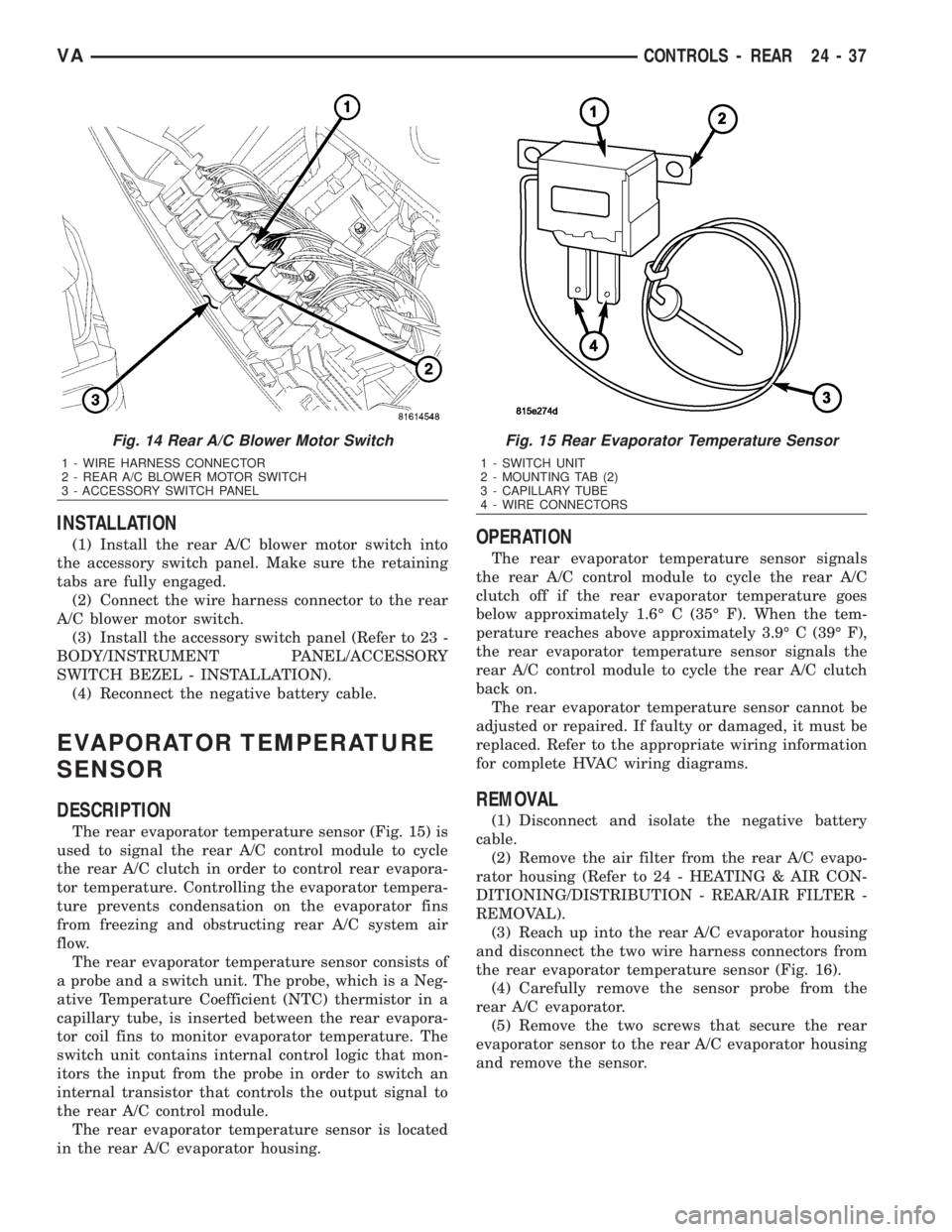
The rear evaporator temperature sensor (Fig. 15) is
used to signal the rear A/C control module to cycle
the rear A/C clutch in order to control rear evapora-
tor temperature. Controlling the evaporator tempera-
ture prevents condensation on the evaporator fins
from freezing and obstructing rear A/C system air
flow.
The rear evaporator temperature sensor consists of
a probe and a switch unit. The probe, which is a Neg-
ative Temperature Coefficient (NTC) thermistor in a
capillary tube, is inserted between the rear evapora-
tor coil fins to monitor evaporator temperature. The
switch unit contains internal control logic that mon-
itors the input from the probe in order to switch an
internal transistor that controls the output signal to
the rear A/C control module.
The rear evaporator temperature sensor is located
in the rear A/C evaporator housing.
OPERATION
The rear evaporator temperature sensor signals
the rear A/C control module to cycle the rear A/C
clutch off if the rear evaporator temperature goes
below approximately 1.6É C (35É F). When the tem-
perature reaches above approximately 3.9É C (39É F),
the rear evaporator temperature sensor signals the
rear A/C control module to cycle the rear A/C clutch
back on.
The rear evaporator temperature sensor cannot be
adjusted or repaired. If faulty or damaged, it must be
replaced. Refer to the appropriate wiring information
for complete HVAC wiring diagrams.
REMOVAL
(1) Disconnect and isolate the negative battery
cable.
(2) Remove the air filter from the rear A/C evapo-
rator housing (Refer to 24 - HEATING & AIR CON-
DITIONING/DISTRIBUTION - REAR/AIR FILTER -
REMOVAL).
(3) Reach up into the rear A/C evaporator housing
and disconnect the two wire harness connectors from
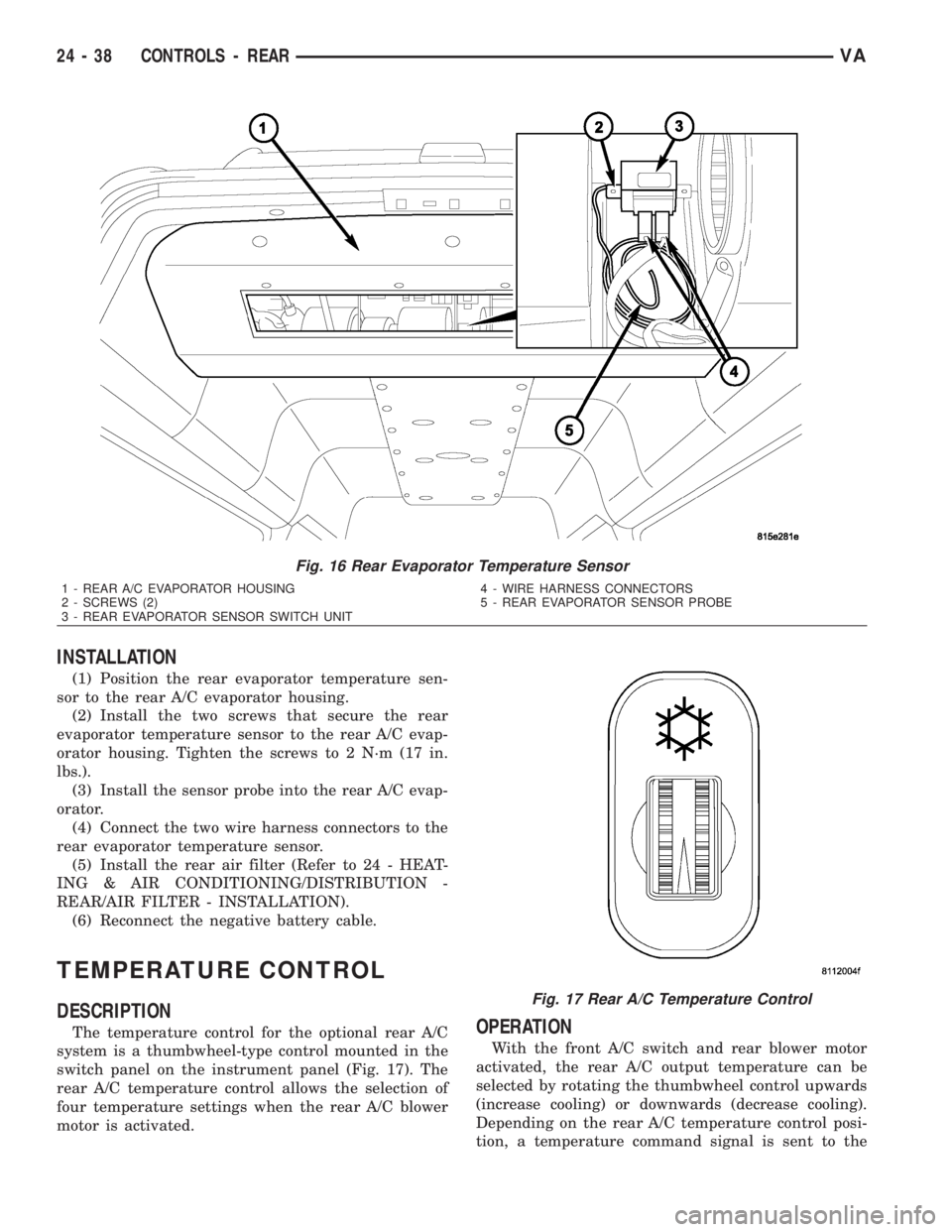
the rear evaporator temperature sensor (Fig. 16).
(4) Carefully remove the sensor probe from the
rear A/C evaporator.
(5) Remove the two screws that secure the rear
evaporator sensor to the rear A/C evaporator housing
and remove the sensor.
Fig. 14 Rear A/C Blower Motor Switch
1 - WIRE HARNESS CONNECTOR
2 - REAR A/C BLOWER MOTOR SWITCH
3 - ACCESSORY SWITCH PANEL
Fig. 15 Rear Evaporator Temperature Sensor
1 - SWITCH UNIT
2 - MOUNTING TAB (2)
3 - CAPILLARY TUBE
4 - WIRE CONNECTORS
VACONTROLS - REAR 24 - 37
Page 2075 of 2305
INSTALLATION
(1) Position the rear evaporator temperature sen-
sor to the rear A/C evaporator housing.
(2) Install the two screws that secure the rear
evaporator temperature sensor to the rear A/C evap-
orator housing. Tighten the screws to 2 N´m (17 in.
lbs.).
(3) Install the sensor probe into the rear A/C evap-
orator.
(4) Connect the two wire harness connectors to the
rear evaporator temperature sensor.
(5) Install the rear air filter (Refer to 24 - HEAT-
ING & AIR CONDITIONING/DISTRIBUTION -
REAR/AIR FILTER - INSTALLATION).
(6) Reconnect the negative battery cable.
TEMPERATURE CONTROL
DESCRIPTION
The temperature control for the optional rear A/C
system is a thumbwheel-type control mounted in the
switch panel on the instrument panel (Fig. 17). The
rear A/C temperature control allows the selection of
four temperature settings when the rear A/C blower
motor is activated.OPERATION
With the front A/C switch and rear blower motor
activated, the rear A/C output temperature can be
selected by rotating the thumbwheel control upwards
(increase cooling) or downwards (decrease cooling).
Depending on the rear A/C temperature control posi-
tion, a temperature command signal is sent to the
Fig. 16 Rear Evaporator Temperature Sensor
1 - REAR A/C EVAPORATOR HOUSING
2 - SCREWS (2)
3 - REAR EVAPORATOR SENSOR SWITCH UNIT4 - WIRE HARNESS CONNECTORS
5 - REAR EVAPORATOR SENSOR PROBE
Fig. 17 Rear A/C Temperature Control
24 - 38 CONTROLS - REARVA
Page 2079 of 2305
the rear A/C control module circuits and radio recep-
tion quality. The suppression filters for the rear
blower motors consist of capacitors and inductance
coils.
The rear blower motor suppression filters cannot
be repaired and, if faulty or damaged, they must be
replaced. Refer to the appropriate wiring information
for complete HVAC wiring diagrams.
REMOVAL
(1) Disconnect and isolate the negative battery
cable.
(2) Remove the cover from the rear A/C evaporator
housing (Refer to 24 - HEATING & AIR CONDI-
TIONING/DISTRIBUTION - REAR/A/C EVAPORA-
TOR COVER-REAR - REMOVAL).
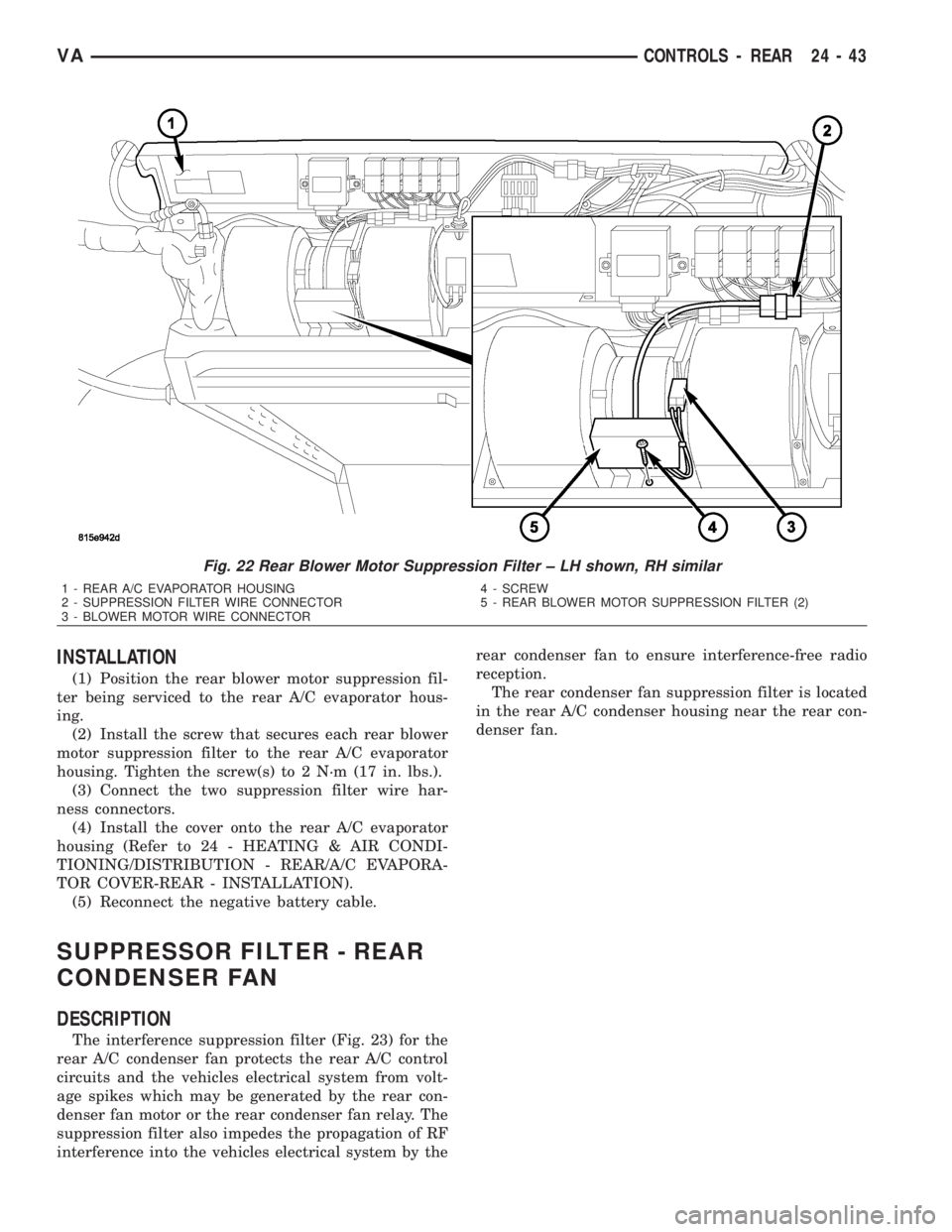
(3) Disconnect the two wire harness connectors
from the rear blower motor suppression filter being
serviced (Fig. 22).
(4) Remove the screw that secures the each rear
blower motor suppression filter to the rear A/C evap-
orator housing and remove the suppression filters as
required.
24 - 42 CONTROLS - REARVA
Page 2080 of 2305
INSTALLATION
(1) Position the rear blower motor suppression fil-
ter being serviced to the rear A/C evaporator hous-
ing.
(2) Install the screw that secures each rear blower
motor suppression filter to the rear A/C evaporator
housing. Tighten the screw(s) to 2 N´m (17 in. lbs.).
(3) Connect the two suppression filter wire har-
ness connectors.
(4) Install the cover onto the rear A/C evaporator
housing (Refer to 24 - HEATING & AIR CONDI-
TIONING/DISTRIBUTION - REAR/A/C EVAPORA-
TOR COVER-REAR - INSTALLATION).
(5) Reconnect the negative battery cable.
SUPPRESSOR FILTER - REAR
CONDENSER FAN
DESCRIPTION
The interference suppression filter (Fig. 23) for the
rear A/C condenser fan protects the rear A/C control
circuits and the vehicles electrical system from volt-
age spikes which may be generated by the rear con-
denser fan motor or the rear condenser fan relay. The
suppression filter also impedes the propagation of RF
interference into the vehicles electrical system by therear condenser fan to ensure interference-free radio
reception.
The rear condenser fan suppression filter is located
in the rear A/C condenser housing near the rear con-
denser fan.
Fig. 22 Rear Blower Motor Suppression Filter ± LH shown, RH similar
1 - REAR A/C EVAPORATOR HOUSING
2 - SUPPRESSION FILTER WIRE CONNECTOR
3 - BLOWER MOTOR WIRE CONNECTOR4 - SCREW
5 - REAR BLOWER MOTOR SUPPRESSION FILTER (2)
VACONTROLS - REAR 24 - 43
Page 2081 of 2305
OPERATION
The rear condenser fan suppression filter provides
protection against transient interference signals or
similar interference to the electronic rear condenser
fan circuits which can effect the performance of the
rear A/C control module circuits and radio reception
quality. The suppression filter for the rear condenser
fan consist of capacitors and inductance coils.
The rear condenser fan suppression filter cannot be
repaired and, if faulty or damaged, it must be
replaced. Refer to the appropriate wiring information
for complete HVAC wiring diagrams.
REMOVAL
(1) Disconnect and isolate the negative battery
cable.
(2) Remove the cover from the rear A/C condenser
housing (Refer to 24 - HEATING & AIR CONDI-
TIONING/DISTRIBUTION - REAR/A/C CON-
DENSER COVER-REAR - REMOVAL).
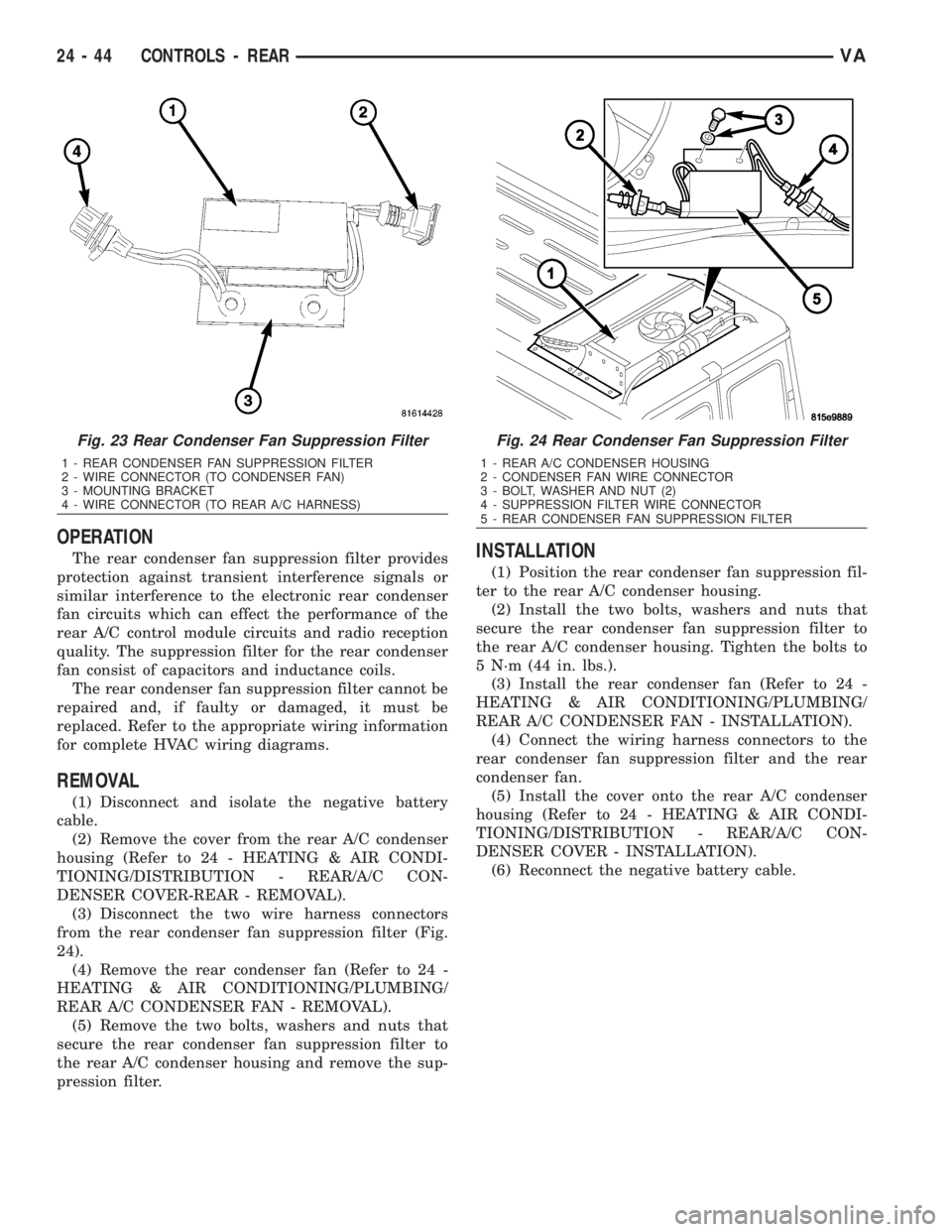
(3) Disconnect the two wire harness connectors
from the rear condenser fan suppression filter (Fig.
24).
(4) Remove the rear condenser fan (Refer to 24 -
HEATING & AIR CONDITIONING/PLUMBING/
REAR A/C CONDENSER FAN - REMOVAL).
(5) Remove the two bolts, washers and nuts that
secure the rear condenser fan suppression filter to
the rear A/C condenser housing and remove the sup-
pression filter.
INSTALLATION
(1) Position the rear condenser fan suppression fil-
ter to the rear A/C condenser housing.
(2) Install the two bolts, washers and nuts that
secure the rear condenser fan suppression filter to
the rear A/C condenser housing. Tighten the bolts to
5 N´m (44 in. lbs.).
(3) Install the rear condenser fan (Refer to 24 -
HEATING & AIR CONDITIONING/PLUMBING/
REAR A/C CONDENSER FAN - INSTALLATION).
(4) Connect the wiring harness connectors to the
rear condenser fan suppression filter and the rear
condenser fan.
(5) Install the cover onto the rear A/C condenser
housing (Refer to 24 - HEATING & AIR CONDI-
TIONING/DISTRIBUTION - REAR/A/C CON-
DENSER COVER - INSTALLATION).
(6) Reconnect the negative battery cable.
Fig. 23 Rear Condenser Fan Suppression Filter
1 - REAR CONDENSER FAN SUPPRESSION FILTER
2 - WIRE CONNECTOR (TO CONDENSER FAN)
3 - MOUNTING BRACKET
4 - WIRE CONNECTOR (TO REAR A/C HARNESS)
Fig. 24 Rear Condenser Fan Suppression Filter
1 - REAR A/C CONDENSER HOUSING
2 - CONDENSER FAN WIRE CONNECTOR
3 - BOLT, WASHER AND NUT (2)
4 - SUPPRESSION FILTER WIRE CONNECTOR
5 - REAR CONDENSER FAN SUPPRESSION FILTER
24 - 44 CONTROLS - REARVA