2006 MERCEDES-BENZ SPRINTER warning
[x] Cancel search: warningPage 602 of 2305
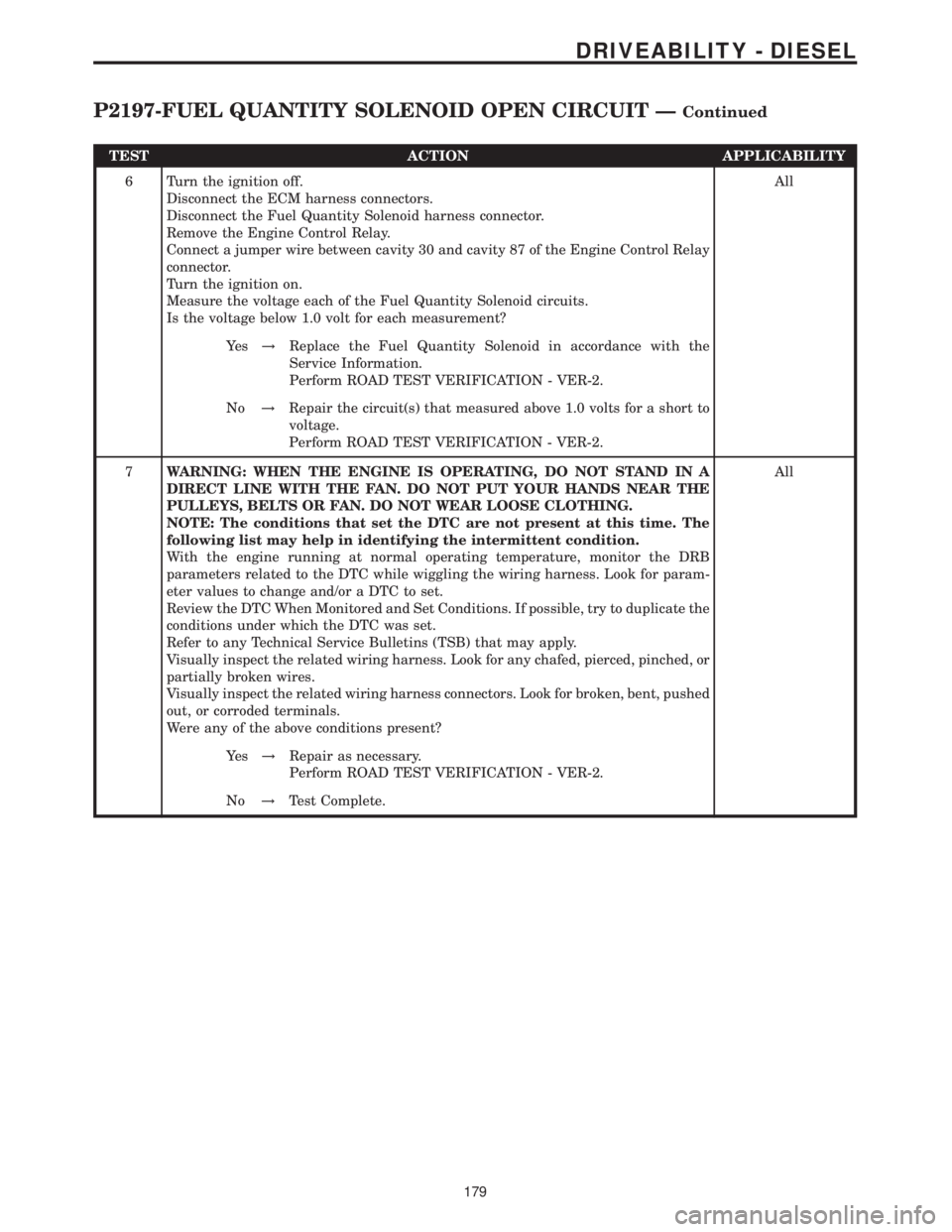
TEST ACTION APPLICABILITY
6 Turn the ignition off.
Disconnect the ECM harness connectors.
Disconnect the Fuel Quantity Solenoid harness connector.
Remove the Engine Control Relay.
Connect a jumper wire between cavity 30 and cavity 87 of the Engine Control Relay
connector.
Turn the ignition on.
Measure the voltage each of the Fuel Quantity Solenoid circuits.
Is the voltage below 1.0 volt for each measurement?All
Ye s!Replace the Fuel Quantity Solenoid in accordance with the
Service Information.
Perform ROAD TEST VERIFICATION - VER-2.
No!Repair the circuit(s) that measured above 1.0 volts for a short to
voltage.
Perform ROAD TEST VERIFICATION - VER-2.
7WARNING: WHEN THE ENGINE IS OPERATING, DO NOT STAND IN A
DIRECT LINE WITH THE FAN. DO NOT PUT YOUR HANDS NEAR THE
PULLEYS, BELTS OR FAN. DO NOT WEAR LOOSE CLOTHING.
NOTE: The conditions that set the DTC are not present at this time. The
following list may help in identifying the intermittent condition.
With the engine running at normal operating temperature, monitor the DRB
parameters related to the DTC while wiggling the wiring harness. Look for param-
eter values to change and/or a DTC to set.
Review the DTC When Monitored and Set Conditions. If possible, try to duplicate the
conditions under which the DTC was set.
Refer to any Technical Service Bulletins (TSB) that may apply.
Visually inspect the related wiring harness. Look for any chafed, pierced, pinched, or
partially broken wires.
Visually inspect the related wiring harness connectors. Look for broken, bent, pushed
out, or corroded terminals.
Were any of the above conditions present?All
Ye s!Repair as necessary.
Perform ROAD TEST VERIFICATION - VER-2.
No!Test Complete.
179
DRIVEABILITY - DIESEL
P2197-FUEL QUANTITY SOLENOID OPEN CIRCUIT ÐContinued
Page 604 of 2305
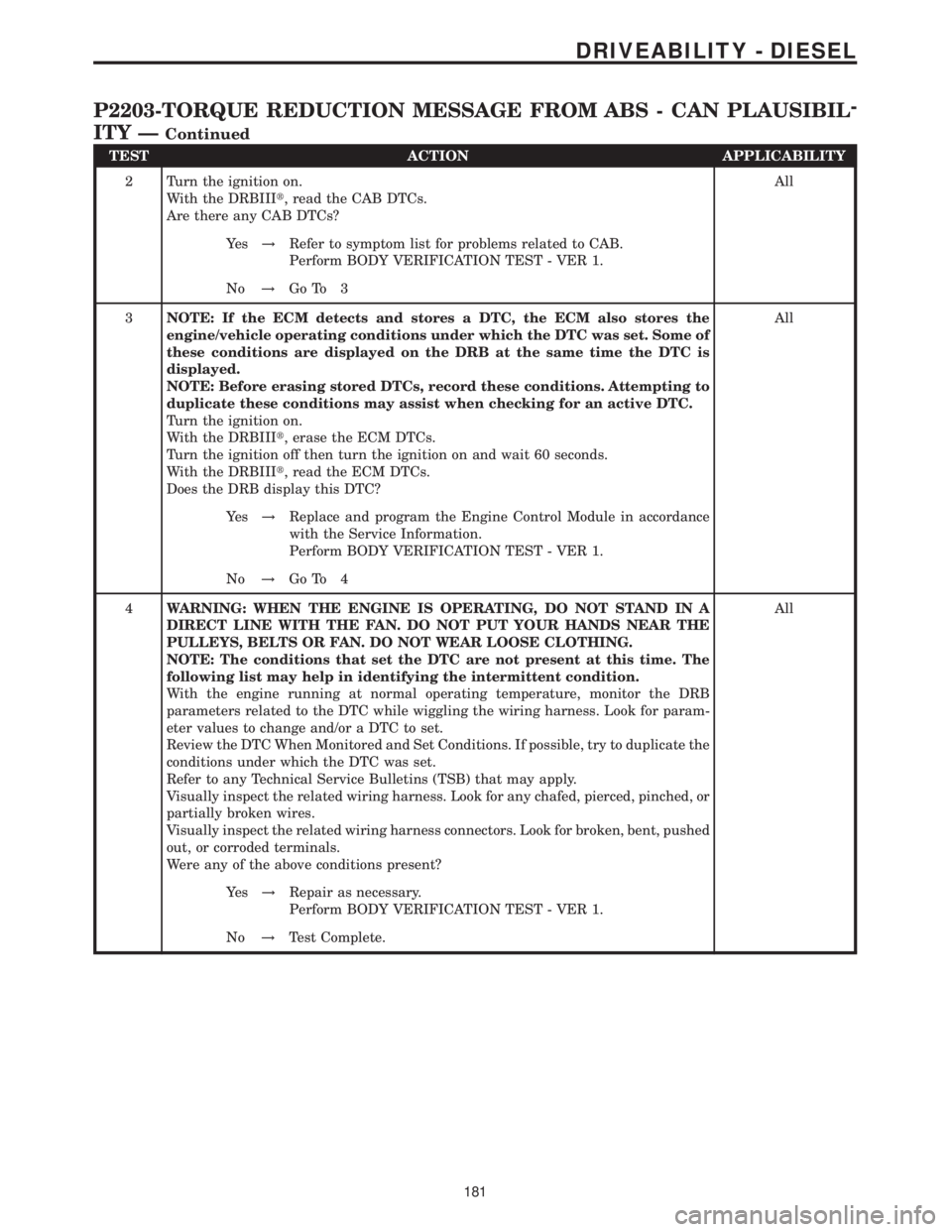
TEST ACTION APPLICABILITY
2 Turn the ignition on.
With the DRBIIIt, read the CAB DTCs.
Are there any CAB DTCs?All
Ye s!Refer to symptom list for problems related to CAB.
Perform BODY VERIFICATION TEST - VER 1.
No!Go To 3
3NOTE: If the ECM detects and stores a DTC, the ECM also stores the
engine/vehicle operating conditions under which the DTC was set. Some of
these conditions are displayed on the DRB at the same time the DTC is
displayed.
NOTE: Before erasing stored DTCs, record these conditions. Attempting to
duplicate these conditions may assist when checking for an active DTC.
Turn the ignition on.
With the DRBIIIt, erase the ECM DTCs.
Turn the ignition off then turn the ignition on and wait 60 seconds.
With the DRBIIIt, read the ECM DTCs.
Does the DRB display this DTC?All
Ye s!Replace and program the Engine Control Module in accordance
with the Service Information.
Perform BODY VERIFICATION TEST - VER 1.
No!Go To 4
4WARNING: WHEN THE ENGINE IS OPERATING, DO NOT STAND IN A
DIRECT LINE WITH THE FAN. DO NOT PUT YOUR HANDS NEAR THE
PULLEYS, BELTS OR FAN. DO NOT WEAR LOOSE CLOTHING.
NOTE: The conditions that set the DTC are not present at this time. The
following list may help in identifying the intermittent condition.
With the engine running at normal operating temperature, monitor the DRB
parameters related to the DTC while wiggling the wiring harness. Look for param-
eter values to change and/or a DTC to set.
Review the DTC When Monitored and Set Conditions. If possible, try to duplicate the
conditions under which the DTC was set.
Refer to any Technical Service Bulletins (TSB) that may apply.
Visually inspect the related wiring harness. Look for any chafed, pierced, pinched, or
partially broken wires.
Visually inspect the related wiring harness connectors. Look for broken, bent, pushed
out, or corroded terminals.
Were any of the above conditions present?All
Ye s!Repair as necessary.
Perform BODY VERIFICATION TEST - VER 1.
No!Test Complete.
181
DRIVEABILITY - DIESEL
P2203-TORQUE REDUCTION MESSAGE FROM ABS - CAN PLAUSIBIL-
ITY Ð
Continued
Page 606 of 2305
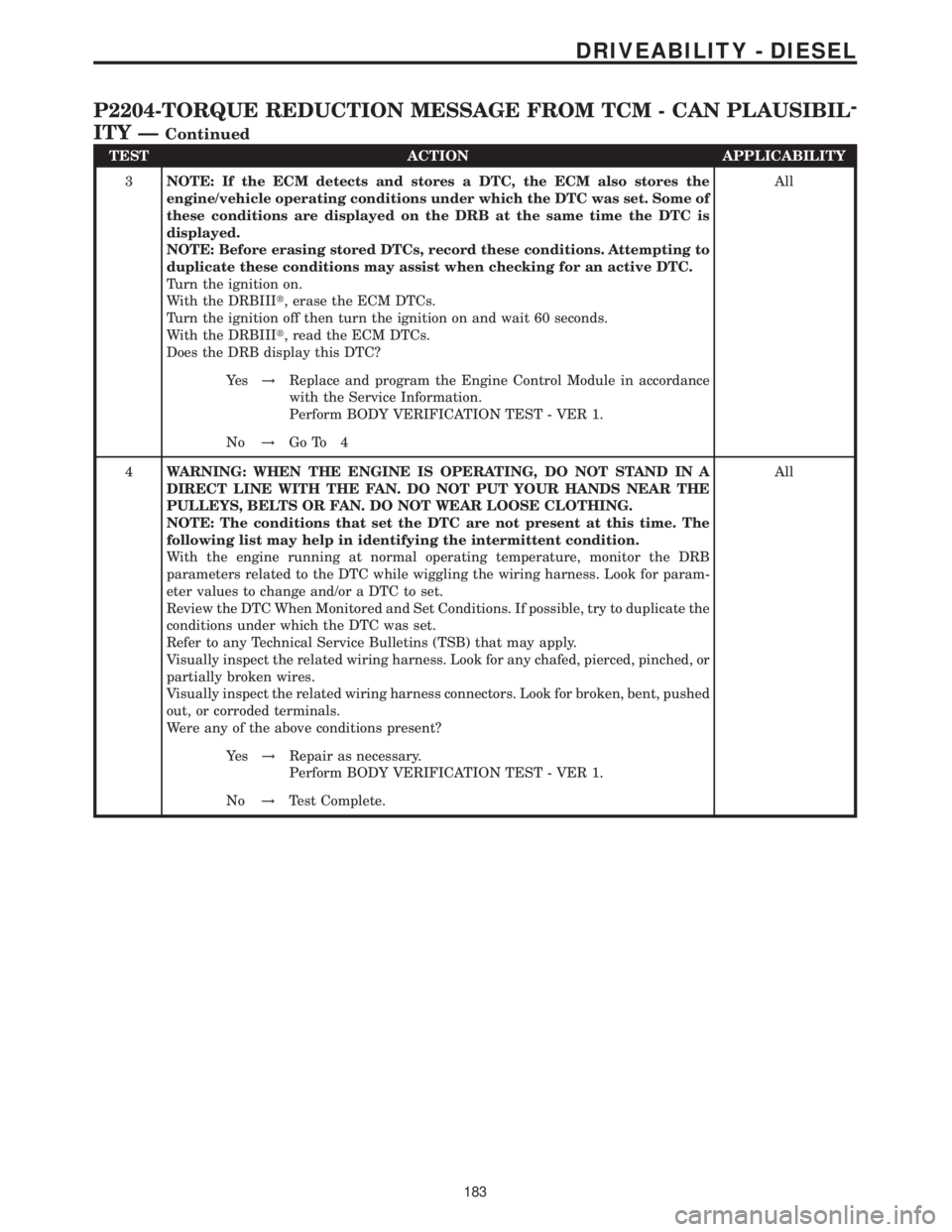
TEST ACTION APPLICABILITY
3NOTE: If the ECM detects and stores a DTC, the ECM also stores the
engine/vehicle operating conditions under which the DTC was set. Some of
these conditions are displayed on the DRB at the same time the DTC is
displayed.
NOTE: Before erasing stored DTCs, record these conditions. Attempting to
duplicate these conditions may assist when checking for an active DTC.
Turn the ignition on.
With the DRBIIIt, erase the ECM DTCs.
Turn the ignition off then turn the ignition on and wait 60 seconds.
With the DRBIIIt, read the ECM DTCs.
Does the DRB display this DTC?All
Ye s!Replace and program the Engine Control Module in accordance
with the Service Information.
Perform BODY VERIFICATION TEST - VER 1.
No!Go To 4
4WARNING: WHEN THE ENGINE IS OPERATING, DO NOT STAND IN A
DIRECT LINE WITH THE FAN. DO NOT PUT YOUR HANDS NEAR THE
PULLEYS, BELTS OR FAN. DO NOT WEAR LOOSE CLOTHING.
NOTE: The conditions that set the DTC are not present at this time. The
following list may help in identifying the intermittent condition.
With the engine running at normal operating temperature, monitor the DRB
parameters related to the DTC while wiggling the wiring harness. Look for param-
eter values to change and/or a DTC to set.
Review the DTC When Monitored and Set Conditions. If possible, try to duplicate the
conditions under which the DTC was set.
Refer to any Technical Service Bulletins (TSB) that may apply.
Visually inspect the related wiring harness. Look for any chafed, pierced, pinched, or
partially broken wires.
Visually inspect the related wiring harness connectors. Look for broken, bent, pushed
out, or corroded terminals.
Were any of the above conditions present?All
Ye s!Repair as necessary.
Perform BODY VERIFICATION TEST - VER 1.
No!Test Complete.
183
DRIVEABILITY - DIESEL
P2204-TORQUE REDUCTION MESSAGE FROM TCM - CAN PLAUSIBIL-
ITY Ð
Continued
Page 608 of 2305
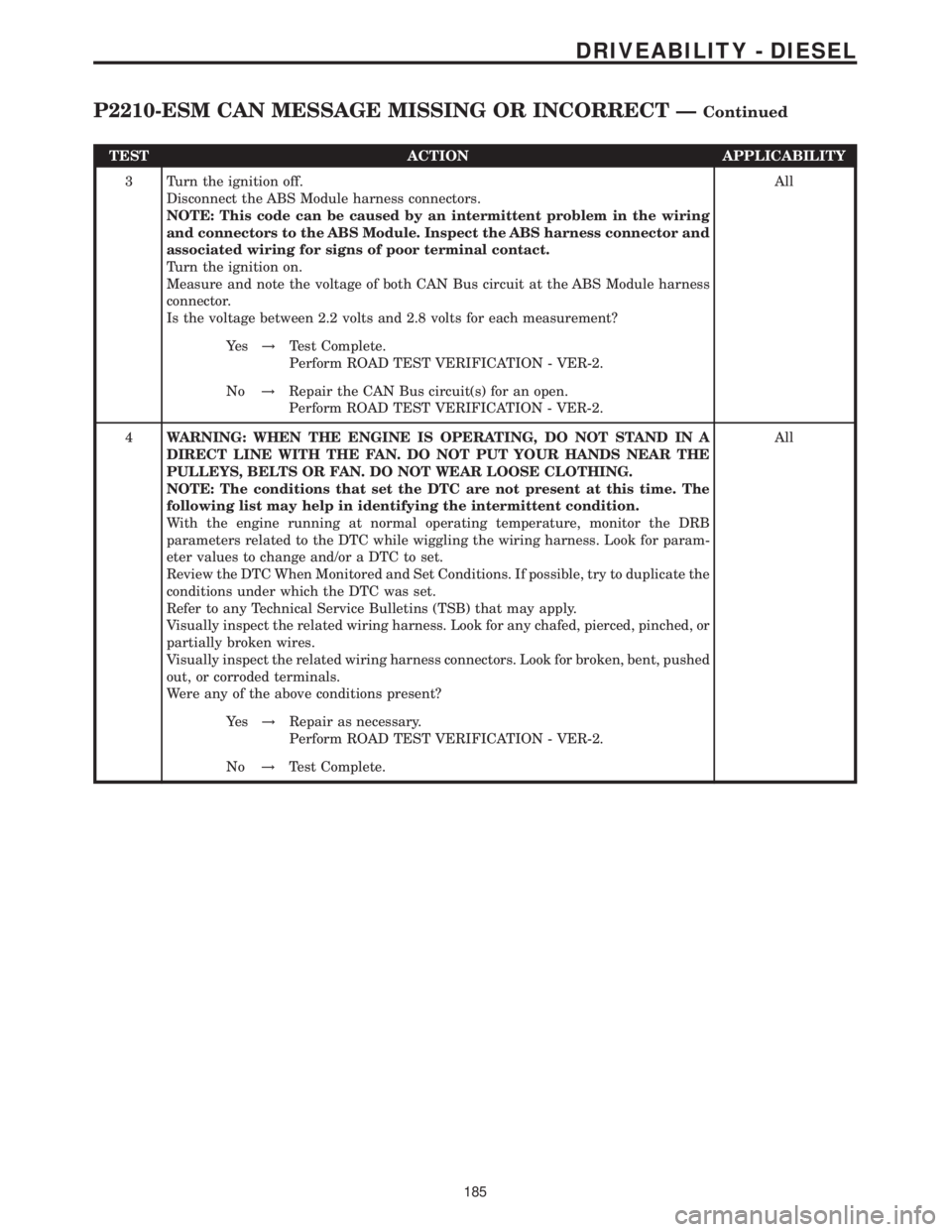
TEST ACTION APPLICABILITY
3 Turn the ignition off.
Disconnect the ABS Module harness connectors.
NOTE: This code can be caused by an intermittent problem in the wiring
and connectors to the ABS Module. Inspect the ABS harness connector and
associated wiring for signs of poor terminal contact.
Turn the ignition on.
Measure and note the voltage of both CAN Bus circuit at the ABS Module harness
connector.
Is the voltage between 2.2 volts and 2.8 volts for each measurement?All
Ye s!Test Complete.
Perform ROAD TEST VERIFICATION - VER-2.
No!Repair the CAN Bus circuit(s) for an open.
Perform ROAD TEST VERIFICATION - VER-2.
4WARNING: WHEN THE ENGINE IS OPERATING, DO NOT STAND IN A
DIRECT LINE WITH THE FAN. DO NOT PUT YOUR HANDS NEAR THE
PULLEYS, BELTS OR FAN. DO NOT WEAR LOOSE CLOTHING.
NOTE: The conditions that set the DTC are not present at this time. The
following list may help in identifying the intermittent condition.
With the engine running at normal operating temperature, monitor the DRB
parameters related to the DTC while wiggling the wiring harness. Look for param-
eter values to change and/or a DTC to set.
Review the DTC When Monitored and Set Conditions. If possible, try to duplicate the
conditions under which the DTC was set.
Refer to any Technical Service Bulletins (TSB) that may apply.
Visually inspect the related wiring harness. Look for any chafed, pierced, pinched, or
partially broken wires.
Visually inspect the related wiring harness connectors. Look for broken, bent, pushed
out, or corroded terminals.
Were any of the above conditions present?All
Ye s!Repair as necessary.
Perform ROAD TEST VERIFICATION - VER-2.
No!Test Complete.
185
DRIVEABILITY - DIESEL
P2210-ESM CAN MESSAGE MISSING OR INCORRECT ÐContinued
Page 610 of 2305
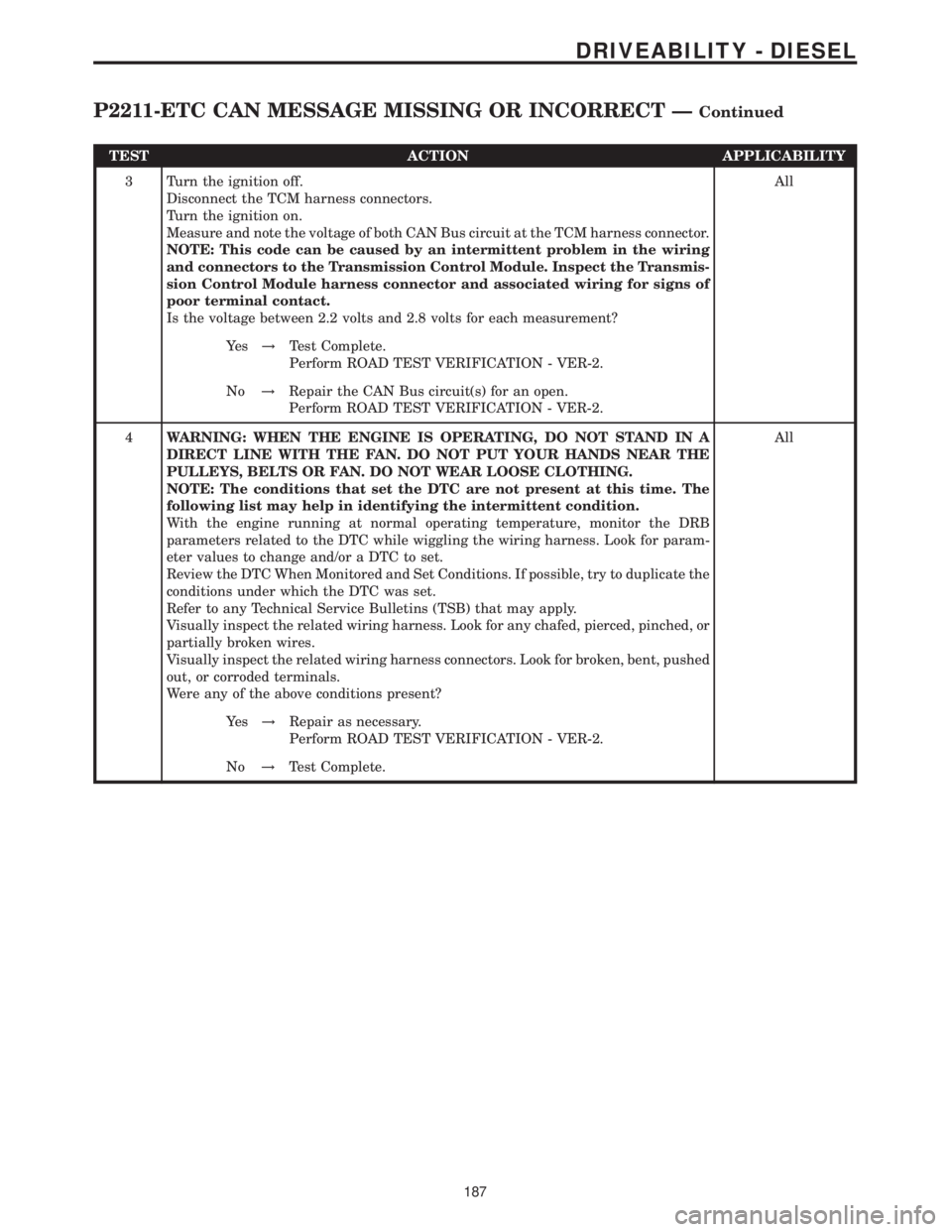
TEST ACTION APPLICABILITY
3 Turn the ignition off.
Disconnect the TCM harness connectors.
Turn the ignition on.
Measure and note the voltage of both CAN Bus circuit at the TCM harness connector.
NOTE: This code can be caused by an intermittent problem in the wiring
and connectors to the Transmission Control Module. Inspect the Transmis-
sion Control Module harness connector and associated wiring for signs of
poor terminal contact.
Is the voltage between 2.2 volts and 2.8 volts for each measurement?All
Ye s!Test Complete.
Perform ROAD TEST VERIFICATION - VER-2.
No!Repair the CAN Bus circuit(s) for an open.
Perform ROAD TEST VERIFICATION - VER-2.
4WARNING: WHEN THE ENGINE IS OPERATING, DO NOT STAND IN A
DIRECT LINE WITH THE FAN. DO NOT PUT YOUR HANDS NEAR THE
PULLEYS, BELTS OR FAN. DO NOT WEAR LOOSE CLOTHING.
NOTE: The conditions that set the DTC are not present at this time. The
following list may help in identifying the intermittent condition.
With the engine running at normal operating temperature, monitor the DRB
parameters related to the DTC while wiggling the wiring harness. Look for param-
eter values to change and/or a DTC to set.
Review the DTC When Monitored and Set Conditions. If possible, try to duplicate the
conditions under which the DTC was set.
Refer to any Technical Service Bulletins (TSB) that may apply.
Visually inspect the related wiring harness. Look for any chafed, pierced, pinched, or
partially broken wires.
Visually inspect the related wiring harness connectors. Look for broken, bent, pushed
out, or corroded terminals.
Were any of the above conditions present?All
Ye s!Repair as necessary.
Perform ROAD TEST VERIFICATION - VER-2.
No!Test Complete.
187
DRIVEABILITY - DIESEL
P2211-ETC CAN MESSAGE MISSING OR INCORRECT ÐContinued
Page 614 of 2305

TEST ACTION APPLICABILITY
3WARNING: WHEN THE ENGINE IS OPERATING, DO NOT STAND IN A
DIRECT LINE WITH THE FAN. DO NOT PUT YOUR HANDS NEAR THE
PULLEYS, BELTS OR FAN. DO NOT WEAR LOOSE CLOTHING.
NOTE: The conditions that set the DTC are not present at this time. The
following list may help in identifying the intermittent condition.
With the engine running at normal operating temperature, monitor the DRB
parameters related to the DTC while wiggling the wiring harness. Look for param-
eter values to change and/or a DTC to set.
Review the DTC When Monitored and Set Conditions. If possible, try to duplicate the
conditions under which the DTC was set.
Refer to any Technical Service Bulletins (TSB) that may apply.
Visually inspect the related wiring harness. Look for any chafed, pierced, pinched, or
partially broken wires.
Visually inspect the related wiring harness connectors. Look for broken, bent, pushed
out, or corroded terminals.
Were any of the above conditions present?All
Ye s!Repair as necessary.
Perform ROAD TEST VERIFICATION - VER-2.
No!Test Complete.
191
DRIVEABILITY - DIESEL
P2240-ABS STEERING ANGLE SENSOR CAN MESSAGE IMPLAUSIBLE 1
Ð
Continued
Page 618 of 2305
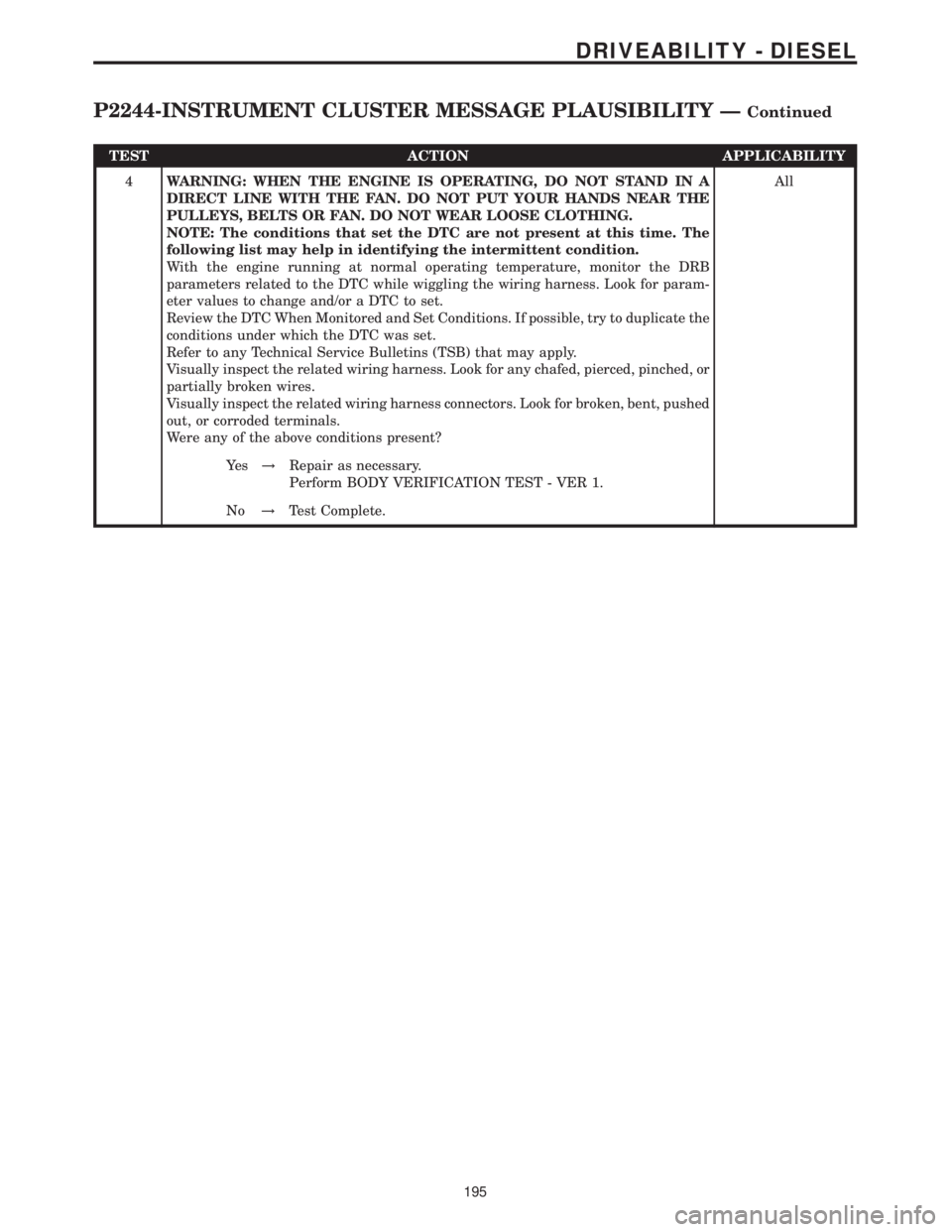
TEST ACTION APPLICABILITY
4WARNING: WHEN THE ENGINE IS OPERATING, DO NOT STAND IN A
DIRECT LINE WITH THE FAN. DO NOT PUT YOUR HANDS NEAR THE
PULLEYS, BELTS OR FAN. DO NOT WEAR LOOSE CLOTHING.
NOTE: The conditions that set the DTC are not present at this time. The
following list may help in identifying the intermittent condition.
With the engine running at normal operating temperature, monitor the DRB
parameters related to the DTC while wiggling the wiring harness. Look for param-
eter values to change and/or a DTC to set.
Review the DTC When Monitored and Set Conditions. If possible, try to duplicate the
conditions under which the DTC was set.
Refer to any Technical Service Bulletins (TSB) that may apply.
Visually inspect the related wiring harness. Look for any chafed, pierced, pinched, or
partially broken wires.
Visually inspect the related wiring harness connectors. Look for broken, bent, pushed
out, or corroded terminals.
Were any of the above conditions present?All
Ye s!Repair as necessary.
Perform BODY VERIFICATION TEST - VER 1.
No!Test Complete.
195
DRIVEABILITY - DIESEL
P2244-INSTRUMENT CLUSTER MESSAGE PLAUSIBILITY ÐContinued
Page 622 of 2305

TEST ACTION APPLICABILITY
4 Turn the ignition off.
Disconnect the Fuel Pressure Sensor harness connector.
Turn the ignition on.
With the DRBIIIt, erase ECM DTCs.
Turn the ignition off for 10 seconds. Turn the ignition on.
With the DRBIIIt, read ECM DTCs.
Does the DRB display this DTC?All
Ye s!Go To 5
No!Replace the Fuel Pressure Sensor in accordance with the Service
Information.
Perform ROAD TEST VERIFICATION - VER-2.
5 Turn the ignition off.
Disconnect the Boost Pressure Sensor harness connector.
Turn the ignition on.
With the DRBIIIt, erase ECM DTCs.
Turn the ignition off for 10 seconds. Turn the ignition on.
With the DRBIIIt, read ECM DTCs.
Does the DRB display this DTC?All
Ye s!Replace and program the Engine Control Module in accordance
with the Service Information.
Perform ROAD TEST VERIFICATION - VER-2.
No!Replace the Boost Pressure Sensor.
Perform ROAD TEST VERIFICATION - VER-2.
6WARNING: WHEN THE ENGINE IS OPERATING, DO NOT STAND IN A
DIRECT LINE WITH THE FAN. DO NOT PUT YOUR HANDS NEAR THE
PULLEYS, BELTS OR FAN. DO NOT WEAR LOOSE CLOTHING.
NOTE: The conditions that set the DTC are not present at this time. The
following list may help in identifying the intermittent condition.
With the engine running at normal operating temperature, monitor the DRB
parameters related to the DTC while wiggling the wiring harness. Look for param-
eter values to change and/or a DTC to set.
Review the DTC When Monitored and Set Conditions. If possible, try to duplicate the
conditions under which the DTC was set.
Refer to any Technical Service Bulletins (TSB) that may apply.
Visually inspect the related wiring harness. Look for any chafed, pierced, pinched, or
partially broken wires.
Visually inspect the related wiring harness connectors. Look for broken, bent, pushed
out, or corroded terminals.
Were any of the above conditions present?All
Ye s!Repair as necessary.
Perform ROAD TEST VERIFICATION - VER-2.
No!Test Complete.
199
DRIVEABILITY - DIESEL
P2306-SENSOR SUPPLY 2 VOLTAGE IS TOO HIGH ÐContinued