Page 522 of 651

IN CASE OF AN EMERGENCY
501
CAUTION
When jacking, be sure to observe the following
to reduce the possibility of personal injury:
�Follow jacking instructions.
� Do not put any part of your body under a
vehicle supported by a jack. Otherwise,
personal injury may occur.
� Do not start or run the engine while your
vehicle is supported by the jack.
� Stop the vehicle on a level firm ground, firmly
set the parking brake and put the
transmission in “P”. Block the wheel
diagonally opposite to the one being changed
if necessary.
�Make sure to set the jack properly in the jack
point. Raising the vehicle with jack
improperly positioned will damage the vehicle
or may allow the vehicle to fall off the jack
and cause personal injury.
� Never get under the vehicle when the vehicle
is supported by the jack alone.
� Use the jack only for lifting your vehicle
during wheel changing.
� Do not raise the vehicle with someone in the
vehicle.
� When raising the vehicle, do not place any
objects on top of or underneath the jack.
� Raise the vehicle only high enough to remove
and change the tire.
� Vehicles with electronically modulated air
suspension: When jacking up, be sure to turn
off the height control and stop the engine.
Otherwise, the vehicle height may change in
the automatic leveling function, resulting in
an unexpected accident. For details, see
page 446.
Page 523 of 651
IN CASE OF AN EMERGENCY
502
NOTICE
Do not continue driving with a deflated tire.
Driving even a short distance can damage a tire
and wheel beyond repair.
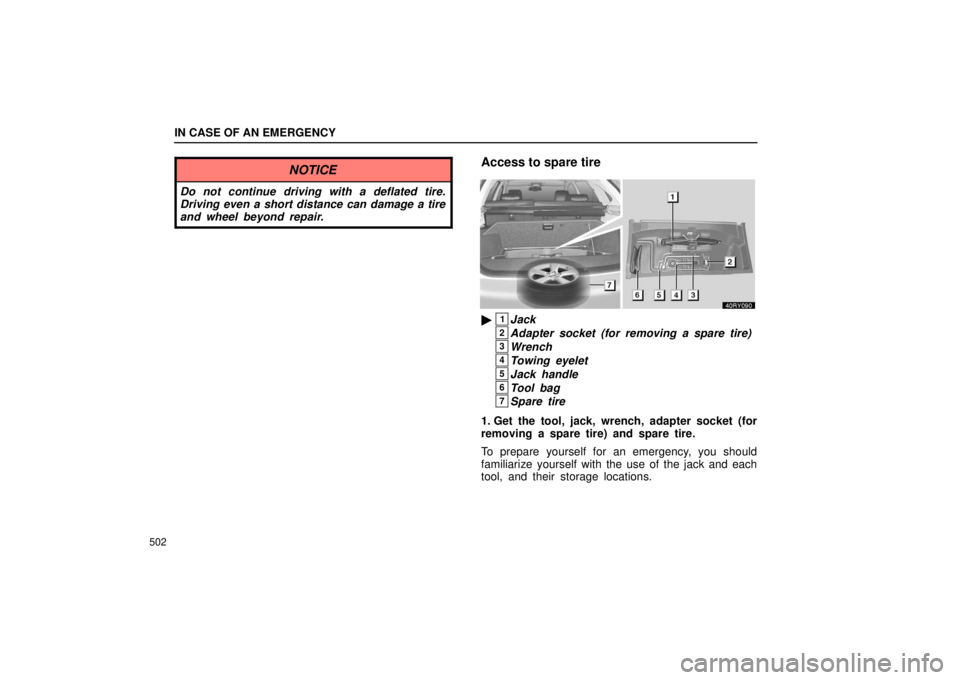
Access to spare tire
�1Jack
2Adapter socket (for removing a spare tire)
3Wrench
4Towing eyelet
5Jack handle
6Tool bag
7Spare tire
1. Get the tool, jack, wrench, adapter socket (for
removing a spare tire) and spare tire.
To prepare yourself for an emergency, you should
familiarize yourself with the use of the jack and each
tool, and their storage locations.
Page 534 of 651
IN CASE OF AN EMERGENCY
513
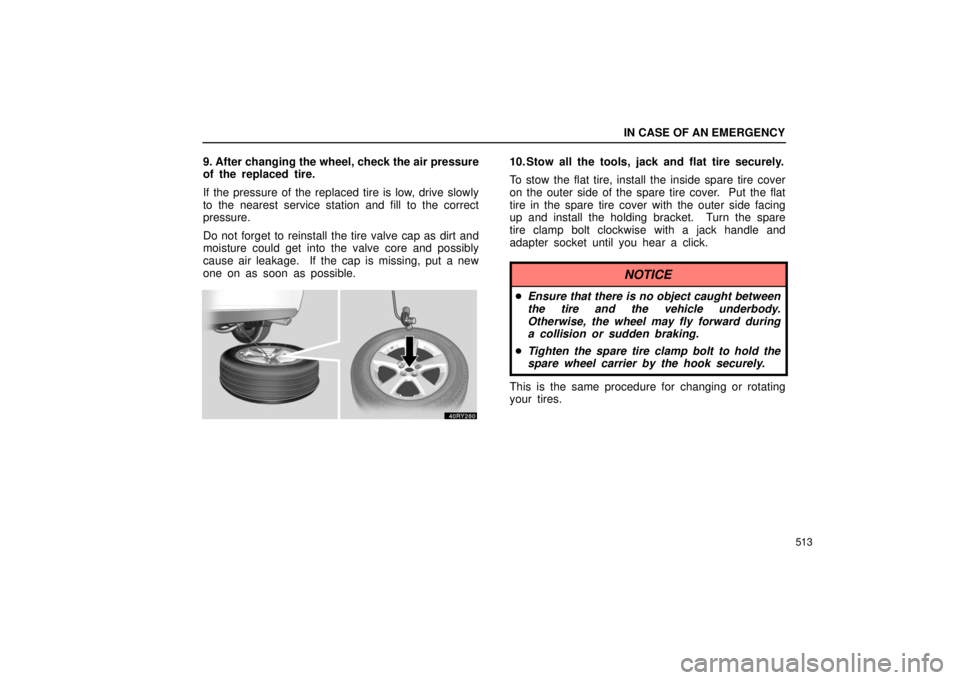
9. After changing the wheel, check the air pressure
of the replaced tire.
If the pressure of the replaced tire is low, drive slowly
to the nearest service station and fill to the correct
pressure.
Do not forget to reinstall the tire valve cap as dirt and
moisture could get into the valve core and possibly
cause air leakage. If the cap is missing, put a new
one on as soon as possible.10. Stow all the tools, jack and flat tire securely.
To stow the flat tire, install the inside spare tire cover
on the outer side of the spare tire cover. Put the flat
tire in the spare tire cover with the outer side facing
up and install the holding bracket. Turn the spare
tire clamp bolt clockwise with a jack handle and
adapter socket until you hear a click.
NOTICE
�Ensure that there is no object caught between
the tire and the vehicle underbody.
Otherwise, the wheel may fly forward during
a collision or sudden braking.
� Tighten the spare tire clamp bolt to hold the
spare wheel carrier by the hook securely.
This is the same procedure for changing or rotating
your tires.
Page 537 of 651
IN CASE OF AN EMERGENCY
516TOWING PRECAUTIONS:
Use a safety chain system for all towing, and abide by the
state/provincial and local laws. The wheels and axle on the
ground must be in good condition. If they are damaged, use
a towing dolly.
CAUTION
Vehicles with electronically modulated air suspension:
When
your vehicle is towed, put the vehicle height in the
“N” (normal) mode and push the height control switch
to turn off the electronically modulated air suspension.
Otherwise, the vehicle height may be changed in the
automatic leveling function, resulting in an unexpected
accident. For details, see “Electronically modulated air
suspension” on page 437.
(a) Towing with a wheel lift type truck
� From front
� Twowheel drive models
Release the parking brake.
NOTICE
When lifting wheels, take care to ensure adequate
ground clearance for towing at the opposite end of the
raised vehicle. Otherwise, the bumper and/or
underbody of the towed vehicle will be damaged during
towing.
Page 548 of 651
SECTION 5
527
MAINTENANCE
Maintenance
Maintenance requirements528
. . . . . . . . . . . . . . . . . . . . . . . . . . . . . . . .
General maintenance 529
. . . . . . . . . . . . . . . . . . . . . . . . . . . . . . . . . . . . .\
Does your vehicle need repairing? 532
. . . . . . . . . . . . . . . . . . . . . . . . .
Emissions Inspection and Maintenance (I/M) programs 533
. . . . . . . .
For scheduled maintenance informa tion, please refer
to the “Owner’s Manual Supplement / Scheduled
Maintenance”.
Page 549 of 651

MAINTENANCE
528
MAINTENANCE REQUIREMENTS
Your Lexus vehicle has been designed to have fewer
maintenance requirements with longer service intervals to
save both your time and money. However, each regular
maintenance as well as day−to−day care is more important
than ever before to ensure smooth, trouble −free, safe, and
economical driving.
It is the owner’s responsibility to make sure the specified
maintenance, including general maintenance services, is
performed. Note that both the new vehicle and emission
control system warranties specify that proper maintenance
and care must be performed. See “Owner’s Guide”, “Owner’s
Manual Supplement” or “Warranty Booklet” for complete
warranty information.
General maintenance
General maintenance items are those day −to−day care
practices that are important to your vehicle for proper
operation. It is the owner’s responsibility to ensure that the
general maintenance items are performed regularly.
These checks or inspections can be done either by yourself or
your Lexus dealer.
Scheduled maintenance
The scheduled maintenance items listed in the “Owner’s
Manual Supplement / Scheduled Maintenance” are those
required to be serviced at regular intervals.
For details of your maintenance schedule, read the “Owner’s
Manual Supplement / Scheduled Maintenance”.
It is recommended that only genuine Lexus parts be used
for maintenance or for the repair of the emission control
system.
The owner may elect to use nonLexus supplied parts for
replacement purposes without invalidating the emission
control system warranty. However, use of replacement
parts which are not of equivalent quality may impair the
effectiveness of the emission control systems.
You may also elect to have maintenance, replacement, or
repair of the emission control devices and system
performed by any automotive repair establishment or
individual without invalidating this warranty. See
“Owner’s Guide”, “Owner’s Manual Supplement” or
“Warranty Booklet” for complete warranty information.
Where to go for service?
Lexus technicians are well −trained specialists and are kept up
to date with the latest service information through technical
bulletins, service tips, and in −dealership training programs.
They are well informed about the operation of all the systems
on your vehicle.
Page 550 of 651

MAINTENANCE
529
You can be confident that your Lexus dealer’s service
department performs the best job to meet the maintenance
requirements of your vehicle.
Your copy of the repair order is proof that all required
maintenance has been performed for warranty coverage. If
any problems should arise with your vehicle while under
warranty,
your Lexus dealer will promptly take care of it. Again,
be sure to keep a copy of the repair order for any service
performed on your Lexus.
What about doityourself maintenance?
Many of the maintenance items are easy to do yourself, if you
have a little mechanical ability and a few basic automotive
tools. Simple instructions for how to perform them are
presented in Section 6.
If you are a skilled do −it− yourself mechanic, the Lexus service
manuals are recommended. Please be aware that
do−it−yourself maintenance can affect your warranty
coverage. See “Owner’s Guide”, “Owner’s Manual
Supplement” or “Warranty Booklet” for the details.
GENERAL MAINTENANCE
Listed below are the general maintenance items that should be
performed at the intervals specified. It is recommended that
any problem you notice be brought to the attention of your
Lexus dealer or qualified service shop for their advice.
CAUTION
Make these checks only with adequate ventilation if you
run the engine.
Engine compartment
Items listed below should be checked from time to time,
e.g. each time when refueling.
Washer fluid
Make sure there is sufficient fluid in the tank. See page 609 for
additional information.
Engine coolant level
Make sure the coolant level is between the “FULL” and “LOW”
lines on the see−through reservoir when the engine is cold.
See page 559 for additional information.
Radiator, condenser and hoses
Check that the front of the radiator and condenser are clean
and not blocked with leaves, dirt or insects. See page 561 for
additional information.
Page 553 of 651

MAINTENANCE
532
Tire inflation pressure
Check the pressure with a gauge every two weeks,
or at least once a month and adjust as shown on the
tire and loading information label. See page 570 for
additional information.
Tire surface
Check the tires carefully for cuts, damage or
excessive wear. See page 585 for additional
information.
Tire rotation
Rotate the tires according to the maintenance
schedule. (For scheduled maintenance information,
please refer to the “Owner’s Manual Supplement /
Scheduled Maintenance”.) See “Rotating tires” on
page 584.DOES YOUR VEHICLE NEEDREPAIRING?
Be on the alert for changes in performance and sounds, and
visual tip −offs that indicate service is needed. Some important
clues are:
� Engine missing, stumbling, or pinging
� Appreciable loss of power
� Strange engine noises
� A fluid leak under the vehicle (However, water dripping from
the air conditioning after use is normal.)
� Change in exhaust sound (This may indicate a dangerous
carbon monoxide leak. Drive with the windows open and
have the exhaust system checked immediately.)
� Flat−looking tires, excessive tire squeal when cornering,
uneven tire wear
� Vehicle pulls to one side when driving straight on a level
road
� Strange noises related to suspension movement
� Loss of brake effectiveness, spongy feeling brake pedal,
pedal almost touches floors, vehicle pulls to one side when
braking
� Engine coolant temperature continually higher than normal
If you notice any of these clues, take your vehicle to your Lexus
dealer as soon as possible. It probably needs adjustment or
repair.