Page 396 of 651

AUDIO
375
Use high−
quality cassettes.
� Low−quality cassette tapes can cause many problems,
including poor sound, inconsistent playing speed, and
constant auto−reversing. They can also get stuck or tangled
in the cassette player.
� Do not use a cassette if it has been damaged or tangled or
if its label is peeling off.
� Do not leave a cassette in the player if you are not listening
to it, especially if it is hot outside.
� Store cassettes in their cases and out of direct sunlight.
� Avoid using cassettes with a total playing time longer than
100 minutes (50 minutes per side). The tape used in these
cassettes is thin and could get stuck or tangled in the
cassette player. Caring for your CD player, DVD player and CDs
�
Extremely high temperatures can keep your CD player and
DVD player from working. On hot days, use the air
conditioning to cool the vehicle interior before you use the
players.
� Bumpy roads or other vibrations may make your CD player
and DVD player skip.
� If moisture gets into your CD player and DVD player, the
players may not play even though they appear to be
working. Remove the disc from the player and wait until it
dries.
Page 402 of 651

SECTION 3 – 1
381
STARTING AND DRIVING
Starting and driving
Three−way catalytic converters382
. . . . . . . . . . . . . . . . . . . . . . . . . . . .
Engine exhaust caution 384
. . . . . . . . . . . . . . . . . . . . . . . . . . . . . . . . . . .
Before starting the engine 385
. . . . . . . . . . . . . . . . . . . . . . . . . . . . . . . . .
Ignition switch 385
. . . . . . . . . . . . . . . . . . . . . . . . . . . . . . . . . . . . .\
. . . . . .
Parking brake 387
. . . . . . . . . . . . . . . . . . . . . . . . . . . . . . . . . . . . .\
. . . . . .
How to start the engine 388
. . . . . . . . . . . . . . . . . . . . . . . . . . . . . . . . . . .
Automatic transmission (standard type) 389
. . . . . . . . . . . . . . . . . . . . .
Automatic transmission (multi −mode type) 398
. . . . . . . . . . . . . . . . . . .
Rear view monitor system 408
. . . . . . . . . . . . . . . . . . . . . . . . . . . . . . . . .
Cruise control 412
. . . . . . . . . . . . . . . . . . . . . . . . . . . . . . . . . . . . .\
. . . . . .
Dynamic laser cruise control 416
. . . . . . . . . . . . . . . . . . . . . . . . . . . . . . .
Electronically modulated air suspension 437
. . . . . . . . . . . . . . . . . . . . .
Traction control system (two− wheel drive models) 449
. . . . . . . . . . . .
Traction control system (four −wheel drive models) 453
. . . . . . . . . . . .
Vehicle stability control system 455
. . . . . . . . . . . . . . . . . . . . . . . . . . . . .
Brake system 458
. . . . . . . . . . . . . . . . . . . . . . . . . . . . . . . . . . . . .\
. . . . . .
Tire pressure warning system 462
. . . . . . . . . . . . . . . . . . . . . . . . . . . . . .
Brake pad wear limit indicators 465
. . . . . . . . . . . . . . . . . . . . . . . . . . . .
Page 405 of 651

STARTING AND DRIVING
384
ENGINE EXHAUST CAUTION
CAUTION
�Avoid inhaling the engine exhaust. It contains
carbon monoxide, which is a colorless and odorless
gas. It can cause unconsciousness or even death.
� Make sure the exhaust system has no holes or loose
connections. The system should be checked from
time to time. If you hit something, or notice a change
in the sound of the exhaust, have the system checked
immediately.
� Do not run the engine in a garage or enclosed area
except for the time needed to drive the vehicle in or
out. The exhaust gases cannot escape, making this
a particularly dangerous situation.
� Do not remain for a long time in a parked vehicle with
the engine running. If it is unavoidable, however, do
so only in an unconfined area and adjust the heating
or cooling system to force outside air into the vehicle.
� Keep the back door closed while driving. An open or
unsealed back door may cause exhaust gases to be
drawn into the vehicle.
� To allow proper operation of your vehicle’s
ventilation system, keep the inlet grilles in front of the
windshield clear of snow, leaves, or other
obstructions.
� If you smell exhaust fumes in the vehicle, drive with
the windows open and the back door closed. Have
the cause immediately located and corrected.
Page 409 of 651

STARTING AND DRIVING
388
HOW TO START THE ENGINE
Before cranking
1. Apply the parking brake firmly.
2. Turn off unnecessary lights and accessories.
3. Put the selector lever in “P”. If you need to restart the engine
while the vehicle is moving, put the selector lever in “N”. A
starter safety device will prevent the starter from operating if
the selector lever is in any drive position.
4. Depress the brake pedal and hold it to the floor until driving
off.
Starting the engine
Before starting the engine, be sure to follow the instructions in
“Before cranking”.
Normal starting procedure
The multiport fuel injection system/sequential multiport fuel
injection system in your engine automatically controls the
proper air −fuel mixture for starting. You can start a cold or hot
engine as follows:
With your foot off the accelerator pedal, crank the engine by
turning the key to “START”. Release it when the engine starts.
Engine should be warmed up by driving, not in idle. For
warming up, drive with the engine turning smoothly until engine
coolant temperature is within normal range.
Page 423 of 651

STARTING AND DRIVING
402“3” (third range): The most suitable gear is automatically
selected between first and third gears according to vehicle
speed and driving conditions. This range is best used when
stronger engine braking is necessary.
“2” (second range): First or second gear will automatically
be selected according to vehicle speed and driving
conditions. This range is to be used when engine braking
stronger than that of the “3” (third range) position is
necessary.
“1” (first range): This gear is fixed in first regardless of
vehicle
speed or driving conditions. This range is to be used
when maximum engine braking is necessary.
If you attempt to downshift the transmission when it is not
possible to downshift due to high vehicle speed, a warning tone
sounds twice. �
Maximum allowable speeds
To get on a highway or to pass slower traffic, maximum
acceleration may be necessary. Make sure you observe the
following maximum allowable speeds in each range:
range km/h (mph)1 51 (32)
2 92 (58)
3 144 (90)
NOTICE
Do not downshift if you are going faster than the
maximum allowable speed for the next lower range.
� “S” mode indicator light
“S” mode allows you to use the shift range positions.
The “S” mode indicator light comes on when the selector
lever is shifted into the “S” position. When the “S” mode
indicator light does not come on even with the selector lever
moved to the “S” position, there may be a problem
somewhere in the system. Have your vehicle
checked/repaired by your Lexus dealer as soon as possible.
In this case, you can drive in the same condition as in the “D”
position.
Page 458 of 651
STARTING AND DRIVING
437
(g) Conventional cruise control mode failure warning
If there is trouble in the conventional cruise control mode, the
“CRUISE” indicator light in the instrument cluster flashes, the
master warning light comes on and the alarm sounds, the
warning code “E3” will appear on the display.
If a system malfunction is detected when the conventional
cruise control mode is in the ready mode or operating, the
master warning light comes on, an alarm sounds and the
above code appears.
If this code appears, press the “ON
−OFF” button to turn the
system off and then push it again to turn it on. If the setting still
cannot be made or the same code appears again, the system
might have malfunctioned. Although there is no problem to
continue driving, please contact your Lexus dealer.
ELECTRONICALLY MODULATED AIR SUSPENSION
�1Easy access mode switch
2Height control switch
3Height select switch
Page 459 of 651

STARTING AND DRIVING
438This electronically modulated air suspension allows the
driver to
control the vehicle’s height in order to adjust for
driving conditions. Select your desired height among the
“HI” (high), “N” (normal) and “LO” (low) modes with the
height select switch.
You can turn on or off the easy access mode with the easy
access mode switch. If the engine is stopped when the easy
access mode is on, the vehicle height is lowered automatically.
(a) Vehicle height modes
Vehicle’s height mm (in.)
“N”
− 7.0 (0.3)
Vehicle speedkm/h (mph)
80
(50) 100
(62)
�
“N” (normal) mode
“N” (normal) mode: The vehicle’s height in this mode is
standard.
This mode is suitable for ordinary driving.
When the vehicle speed exceeds approximately 100 km/h (62
mph), the vehicle’s height automatically lowers about 7 mm
(0.3 in.) from normal height to provide better stability. When the
vehicle speed reduces to under approximately 80 km/h (50
mph), the vehicle’s height automatically returns to the normal
height.
Page 463 of 651
STARTING AND DRIVING
442In the following cases, the electronically modulated air
suspension will not operate.
�
The underbody of the vehicle has touched the surface of the
road.
� The area around the suspension is covered with ice.
The indicator lights change as follows when the
electronically modulated air suspension will not operate.
1. The current mode indicator light goes off and the currently
selected mode indicator light blinks.
2. The selected mode indicator light goes off. (The vehicle
height does not change.) The selected mode indicator light
comes on again.
The vehicle’s electronically modulated air suspension will not
be operable even if the vehicle is moved to a smooth road or
the ice is removed. To operate electronically modulated air
suspension, turn off the engine and then restart it. The
electronically modulated air suspension will operate again.
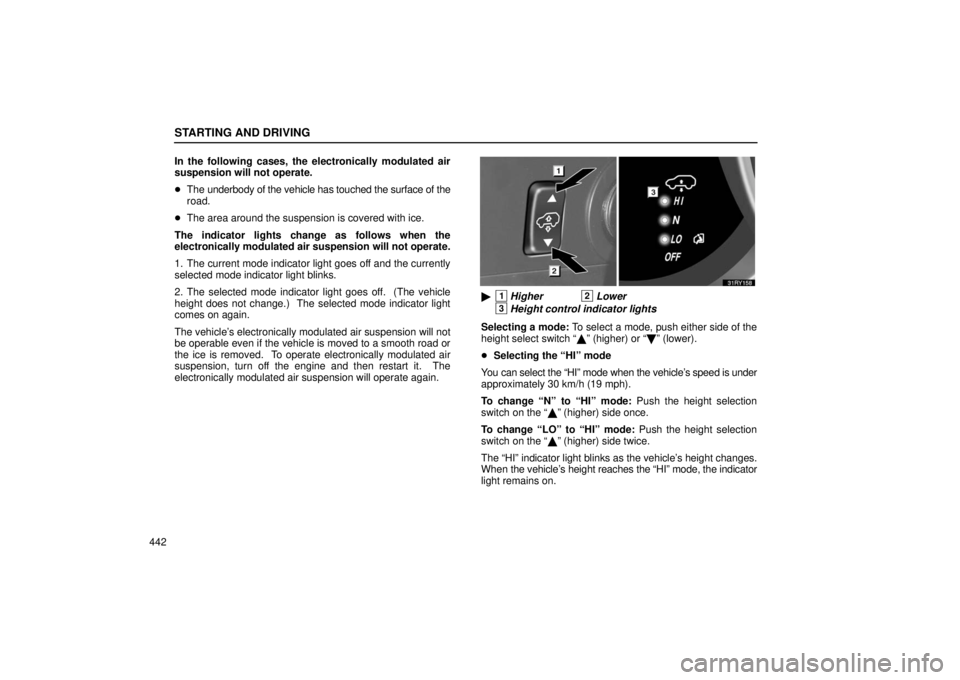
�1Higher2Lower
3Height control indicator lights
Selecting a mode: To select a mode, push either side of the
height select switch “ ” (higher) or “
” (lower).
� Selecting the “HI” mode
You can select the “HI” mode when the vehicle’s speed is under
approximately 30 km/h (19 mph).
To change “N” to “HI” mode: Push the height selection
switch on the “ ” (higher) side once.
To change “LO” to “HI” mode: Push the height selection
switch on the “ ” (higher) side twice.
The “HI” indicator light blinks as the vehicle’s height changes.
When the vehicle’s height reaches the “HI” mode, the indicator
light remains on.
