Page 479 of 4462

AIR CONDITIONER CONTROL ATC-33
C
D E
F
G H
I
K L
M A
B
AT C
Revision: 2006 December 2006 FX35/FX45
MAGNET CLUTCH CONTROL
When A/C switch or DEF switch is pressed, unified meter and A/C amp. transmits compressor ON signal to
BCM.
BCM sends compressor ON signal to ECM, via CAN communication.
ECM judges whether compressor can be turned ON, based on each sensor status (refrigerant-pressure sen-
sor signal, throttle angle, etc.). If it judges compressor can be turned ON, it sends compressor ON signal to
IPDM E/R, via CAN communication line.
Upon receipt of compressor ON signal from ECM, IPDM E/R turns air conditioner relay ON to operate com-
pressor.
When sending compressor ON signal to IPDM E/R via CAN communication line, ECM simultaneously sends
compressor feedback signal to unified meter and A/C amp. via CAN communication line.
Unified meter and A/C amp., then, uses input compressor feedback signal to control air inlet.
SELF-DIAGNOSIS SYSTEM
The self-diagnosis system is built into the unified meter and A/C amp. to quickly locate the cause of malfunc-
tions.
RJIA1957E
Page 528 of 4462
ATC-82
TROUBLE DIAGNOSIS
Revision: 2006 December 2006 FX35/FX45
Magnet Clutch CircuitNJS000E9
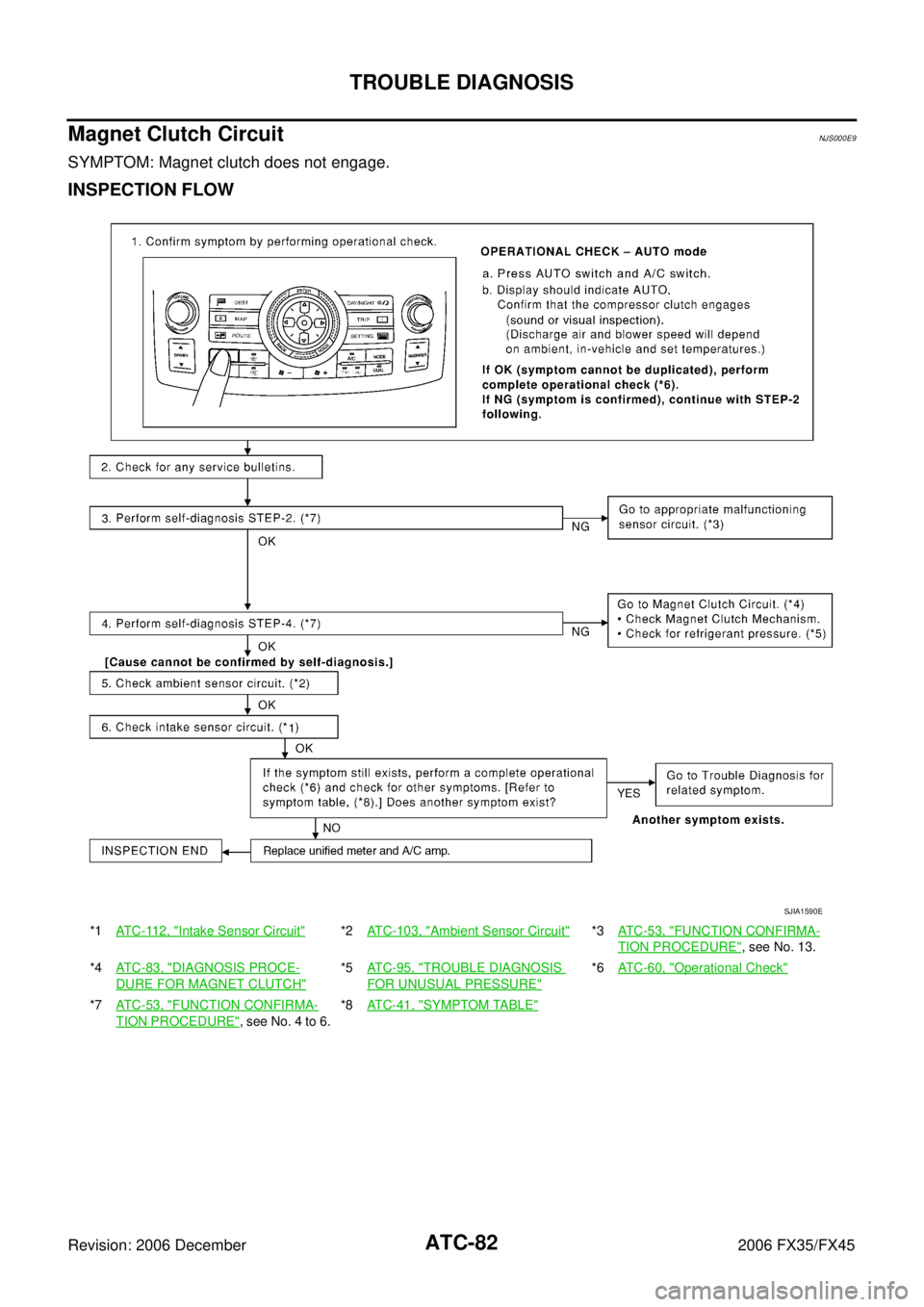
SYMPTOM: Magnet clutch does not engage.
INSPECTION FLOW
*1 ATC-112, "Intake Sensor Circuit"*2 ATC-103, "Ambient Sensor Circuit"*3AT C - 5 3 , "FUNCTION CONFIRMA-
TION PROCEDURE", see No. 13.
*4 ATC-83, "
DIAGNOSIS PROCE-
DURE FOR MAGNET CLUTCH"
*5 ATC-95, "TROUBLE DIAGNOSIS
FOR UNUSUAL PRESSURE"
*6AT C - 6 0 , "Operational Check"
*7ATC-53, "FUNCTION CONFIRMA-
TION PROCEDURE", see No. 4 to 6. *8
ATC-41, "
SYMPTOM TABLE"
SJIA1590E
Page 533 of 4462
TROUBLE DIAGNOSIS ATC-87
C
D E
F
G H
I
K L
M A
B
AT C
Revision: 2006 December 2006 FX35/FX45
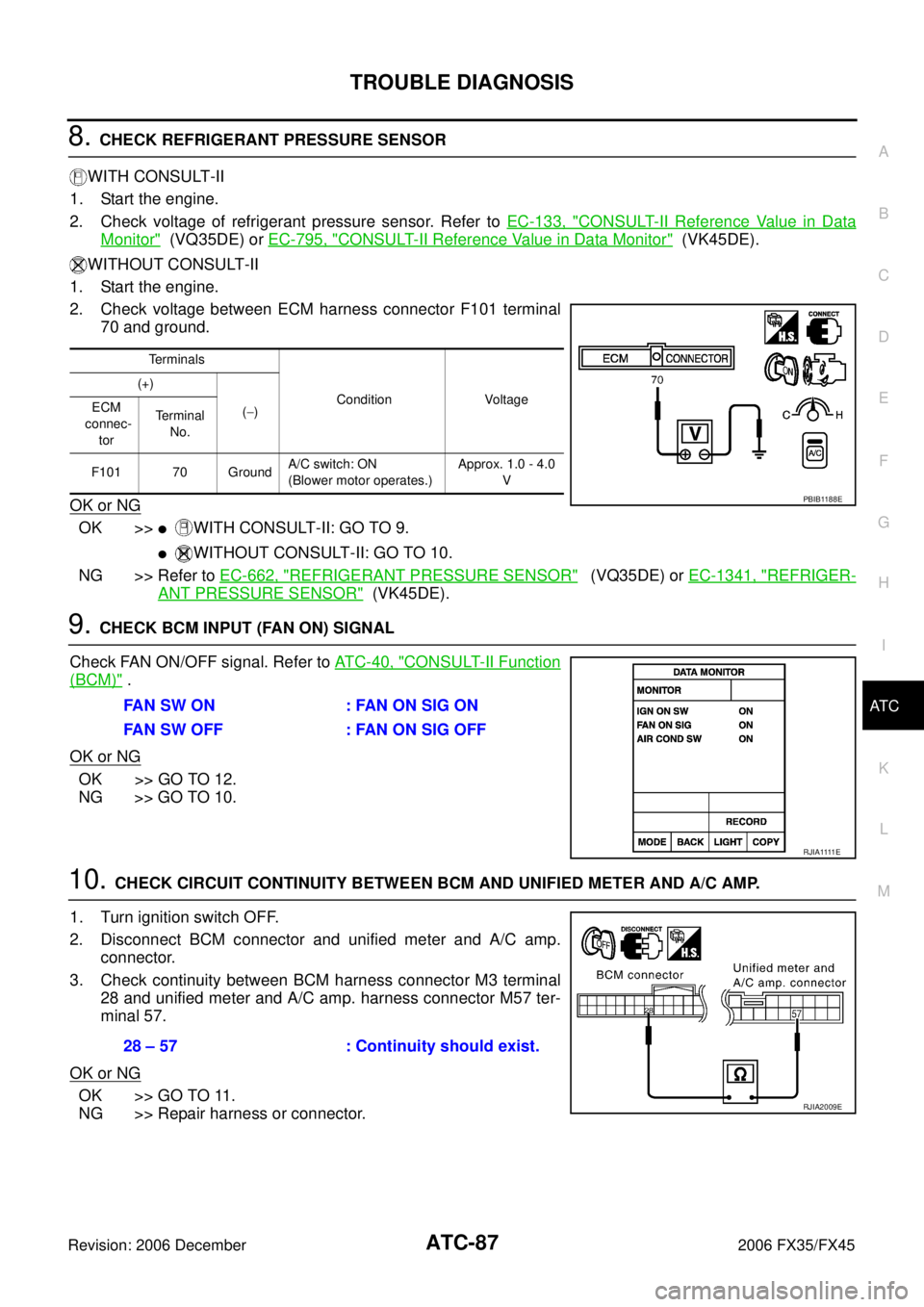
8. CHECK REFRIGERANT PRESSURE SENSOR
WITH CONSULT-II
1. Start the engine.
2. Check voltage of refrigerant pressure sensor. Refer to EC-133, "
CONSULT-II Reference Value in Data
Monitor" (VQ35DE) or EC-795, "CONSULT-II Reference Value in Data Monitor" (VK45DE).
WITHOUT CONSULT-II
1. Start the engine.
2. Check voltage between ECM harness connector F101 terminal 70 and ground.
OK or NG
OK >>�WITH CONSULT-II: GO TO 9.
�WITHOUT CONSULT-II: GO TO 10.
NG >> Refer to EC-662, "
REFRIGERANT PRESSURE SENSOR" (VQ35DE) or EC-1341, "REFRIGER-
ANT PRESSURE SENSOR" (VK45DE).
9. CHECK BCM INPUT (FAN ON) SIGNAL
Check FAN ON/OFF signal. Refer to AT C - 4 0 , "
CONSULT-II Function
(BCM)" .
OK or NG
OK >> GO TO 12.
NG >> GO TO 10.
10. CHECK CIRCUIT CONTINUITY BETWEEN BCM AND UNIFIED METER AND A/C AMP.
1. Turn ignition switch OFF.
2. Disconnect BCM connector and unified meter and A/C amp. connector.
3. Check continuity between BCM harness connector M3 terminal 28 and unified meter and A/C amp. harness connector M57 ter-
minal 57.
OK or NG
OK >> GO TO 11.
NG >> Repair harness or connector.
Terminals
Condition Voltage
(+)
( − )
ECM
connec-
tor Terminal
No.
F101 70 Ground A/C switch: ON
(Blower motor operates.) Approx. 1.0 - 4.0
V
PBIB1188E
FAN SW ON : FAN ON SIG ON
FAN SW OFF : FAN ON SIG OFF
R J I A 1111 E
28 – 57 : Continuity should exist.
RJIA2009E
Page 535 of 4462
TROUBLE DIAGNOSIS ATC-89
C
D E
F
G H
I
K L
M A
B
AT C
Revision: 2006 December 2006 FX35/FX45
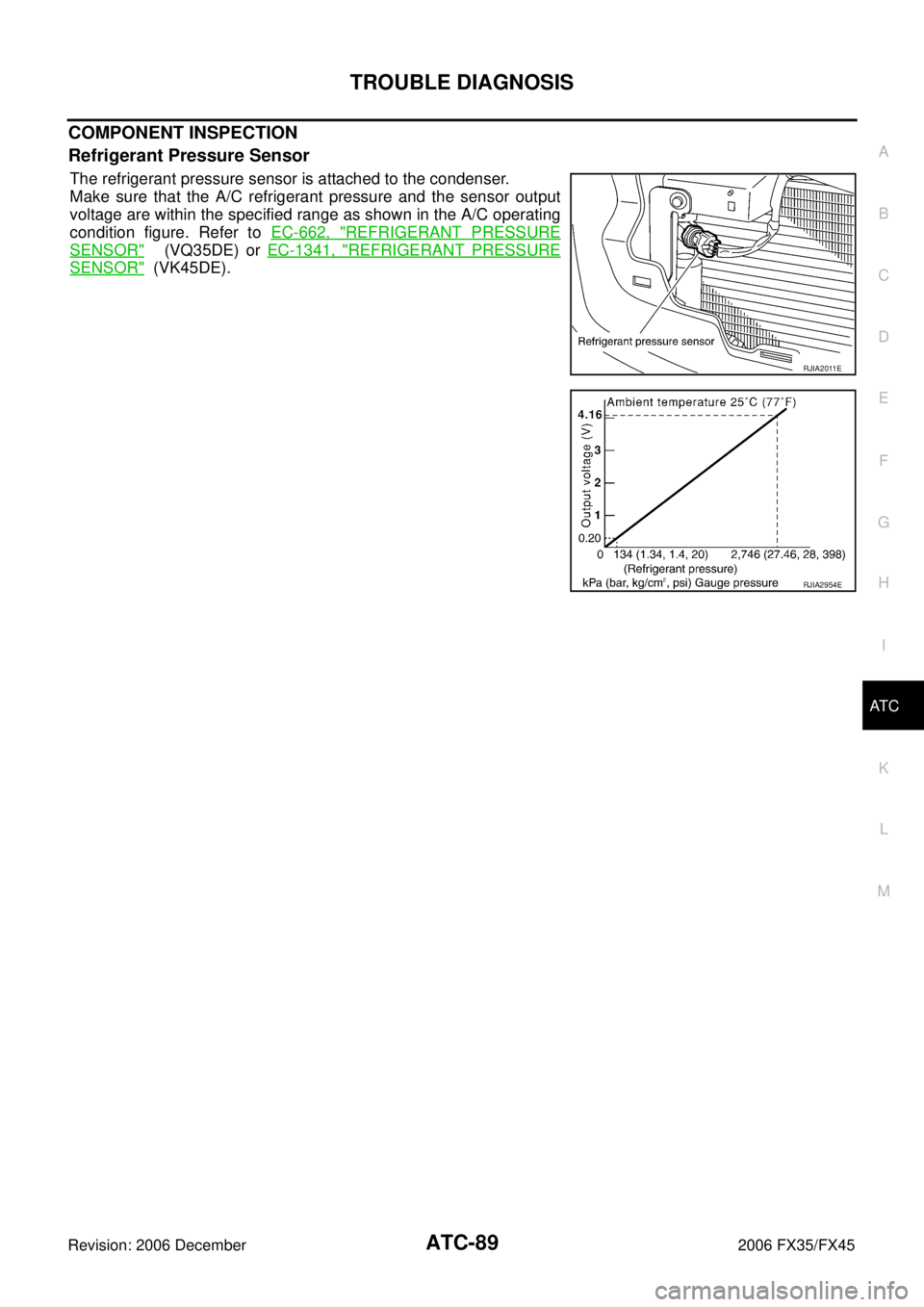
COMPONENT INSPECTION
Refrigerant Pressure Sensor
The refrigerant pressure sensor is attached to the condenser.
Make sure that the A/C refrigerant pressure and the sensor output
voltage are within the specified range as shown in the A/C operating
condition figure. Refer to EC-662, "
REFRIGERANT PRESSURE
SENSOR" (VQ35DE) or EC-1341, "REFRIGERANT PRESSURE
SENSOR" (VK45DE).
RJIA2011E
RJIA2954E
Page 538 of 4462
ATC-92
TROUBLE DIAGNOSIS
Revision: 2006 December 2006 FX35/FX45
PERFORMANCE TEST DIAGNOSIS
*1 ATC-94, "PERFORMANCE CHART"*2 ATC-94, "PERFORMANCE CHART"*3AT C - 9 5 , "TROUBLE DIAGNOSIS
FOR UNUSUAL PRESSURE"
*4ATC-71, "Air Mix Door Motor Circuit"
SJIA1226E
Page 540 of 4462

ATC-94
TROUBLE DIAGNOSIS
Revision: 2006 December 2006 FX35/FX45
PERFORMANCE CHART
Test Condition
Testing must be performed as follows:
Test Reading
Recirculating-to-discharge Air Temperature Table
Ambient Air Temperature-to-operating Pressure Table
Vehicle condition Indoors or in the shade (in a well-ventilated place)
Doors Closed
Door windows Open
Hood Open
TEMP. Max. COLD
Mode switch (Ventilation) set
Intake switch (Recirculation) set
Fan (blower) speed Max. speed set
Engine speed Idle speed
Operate the air conditioning system for 10 minutes before taking measurements.
Inside air (Recirculating air) at blower assembly inlet Discharge air temperature at center ventilator
° C ( °F)
Relative humidity
% Air temperature
° C ( °F)
50 - 60 20 (68) 11.2 - 13.2 (52 - 56)
25 (77) 12.2 - 14.8 (54 - 59)
30 (86) 15.5 - 18.6 (60 - 65)
35 (95) 21.0 - 24.5 (70 - 76)
40 (104) 28.7 - 32.6 (84 - 91)
60 - 70 20 (68) 13.2 - 15.2 (56 - 59)
25 (77) 14.8 - 17.3 (59 - 63)
30 (86) 18.6 - 21.6 (65 - 71)
35 (95) 24.5 - 28.0 (76 - 82)
40 (104) 32.6 - 36.5 (91 - 98)
Ambient air High-pressure (Discharge side)
kPa (kg/cm
2 , psi) Low-pressure (Suction side)
kPa (kg/cm2 , psi)
Relative humidity
% Air temperature
° C ( °F)
50 - 70 20 (68)
961 - 1,167
(9.8 - 11.9, 139 - 169) 216 - 265
(2.2 - 2.7, 31 - 38)
25 (77) 1,108 - 1,353
(11.3 - 13.8, 161 - 196) 230 - 281
(2.3 - 2.9, 33 - 41)
30 (86) 1,275 - 1,549
(13.0 - 15.8, 185 - 225) 261 - 320
(2.7 - 3.3, 38 - 46)
35 (95) 1,549 - 1,893
(15.8 - 19.3, 225 - 274) 297 - 364
(3.0 - 3.7, 43 - 53)
40 (104) 1,814 - 2,216
(18.5 - 22.6, 263 - 321) 357 - 435
(3.6 - 4.4, 52 - 63)
Page 541 of 4462

TROUBLE DIAGNOSIS ATC-95
C
D E
F
G H
I
K L
M A
B
AT C
Revision: 2006 December 2006 FX35/FX45
TROUBLE DIAGNOSIS FOR UNUSUAL PRESSURE
Whenever system’s high and/or low side pressure(s) is/are unusual, diagnose using a manifold gauge. The
marker above the gauge scale in the following tables indicates the standard (usual) pressure range. Since the
standard (usual) pressure, however, differs from vehicle to vehicle, refer to above table (Ambient air tempera-
ture-to-operating pressure table).
Both High- and Low-pressure Sides are Too High
High-pressure Side is Too High and Low-pressure Side is Too Low
Gauge indication Refrigerant cycle Probable cause Corrective action
Both high- and low-pressure sides
are too high. The pressure returns to nor-
mal soon after water is
splashed on condenser. Excessive refrigerant charge
in refrigeration cycle. Reduce refrigerant until speci-
fied pressure is obtained.
Air suction by cooling fan is
insufficient. Insufficient condenser cooling
performance.
↓
1. Condenser fins are clogged.
2. Improper fan rotation of cooling fan.
�Clean condenser.
�Check and repair cooling fan
as necessary.
�Low-pressure pipe is not
cold.
�When compressor is
stopped high-pressure
value quickly drops by
approximately 196 kPa (2
kg/cm
2 , 28 psi). It then
decreases gradually there-
after. Poor heat exchange in con-
denser
(After compressor operation
stops, high-pressure
decreases too slowly.).
↓
Air in refrigeration cycle. Evacuate repeatedly and
recharge system.
Engine tends to overheat. Engine cooling systems mal-
function. Check and repair each engine
cooling system.
�An area of the low-pres-
sure pipe is colder than
areas near the evaporator
outlet.
�Low-pressure pipe is
sometimes covered with
frost.
�Excessive liquid refrigerant
on low-pressure side.
�Excessive refrigerant dis-
charge flow.
�Expansion valve is open a
little compared with the
specification.
↓
Improper expansion valve
adjustment. Replace expansion valve.
AC359A
Gauge indication Refrigerant cycle Probable cause Corrective action
High-pressure side is too high and
low-pressure side is too low.
Upper side of condenser and
high-pressure side are hot,
however, liquid tank is not so
hot. High-pressure tube or parts
located between compressor
and condenser are clogged or
crushed.
�Check and repair or replace
malfunctioning parts.
�Check lubricant for contami-
nation.
AC360A
Page 542 of 4462

ATC-96
TROUBLE DIAGNOSIS
Revision: 2006 December 2006 FX35/FX45
High-pressure Side is Too Low and Low-pressure Side is Too High
Both High- and Low-pressure Sides are Too Low
Gauge indication Refrigerant cycle Probable cause Corrective action
High-pressure side is too low and
low-pressure side is too high. High- and low-pressure sides
become equal soon after com-
pressor operation stops. Compressor pressure opera-
tion is improper.
↓
Damaged inside compressor
packings. Replace compressor.
No temperature difference
between high- and low-pres-
sure sides. Compressor pressure opera-
tion is improper.
↓
Damaged inside compressor
packings. Replace compressor.
AC356A
Gauge indication Refrigerant cycle Probable cause Corrective action
Both high- and low-pressure sides
are too low.
�There is a big temperature
difference between liquid
tank outlet and inlet. Outlet
temperature is extremely
low.
�Liquid tank inlet and expan-
sion valve are frosted. Liquid tank inside is slightly
clogged.
�Replace liquid tank.
�Check lubricant for contami-
nation.
�Temperature of expansion
valve inlet is extremely low
as compared with areas
near liquid tank.
�Expansion valve inlet may
be frosted.
�Temperature difference
occurs somewhere in high-
pressure side. High-pressure pipe located
between liquid tank and
expansion valve is clogged.
�Check and repair malfunc-
tioning parts.
�Check lubricant for contami-
nation.
Expansion valve and liquid
tank are warm or slightly cool
when touched. Low refrigerant charge.
↓
Leaking fittings or compo-
nents. Check refrigerant for leaks.
Refer to ATC-156, "
Checking
for Refrigerant Leaks" .
There is a big temperature dif-
ference between expansion
valve inlet and outlet while the
valve itself is frosted. Expansion valve closes a little
compared with the specifica-
tion.
↓
1. Improper expansion valve adjustment.
2. Malfunctioning expansion valve.
3. Outlet and inlet may be clogged.
�Remove foreign particles by
using compressed air.
�Replace expansion valve.
�Check lubricant for contami-
nation.
An area of the low-pressure
pipe is colder than areas near
the evaporator outlet. Low-pressure pipe is clogged
or crushed.
�Check and repair malfunc-
tioning parts.
�Check lubricant for contami-
nation.
Air flow volume is not enough
or is too low. Evaporator is frozen.
�Check intake sensor circuit.
Refer to AT C - 11 2 , "
Intake
Sensor Circuit" .
�Replace compressor.
�Repair evaporator fins.
�Replace evaporator.
�Refer to AT C - 7 7 , "Blower
Motor Circuit" .
AC353A