Page 543 of 4462

TROUBLE DIAGNOSIS ATC-97
C
D E
F
G H
I
K L
M A
B
AT C
Revision: 2006 December 2006 FX35/FX45
Low-pressure Side Sometimes Becomes Negative
Low-pressure Side Becomes Negative
DIAGNOSIS PROCEDURE FOR INSUFFICIENT COOLING
SYMPTOM: Insufficient cooling
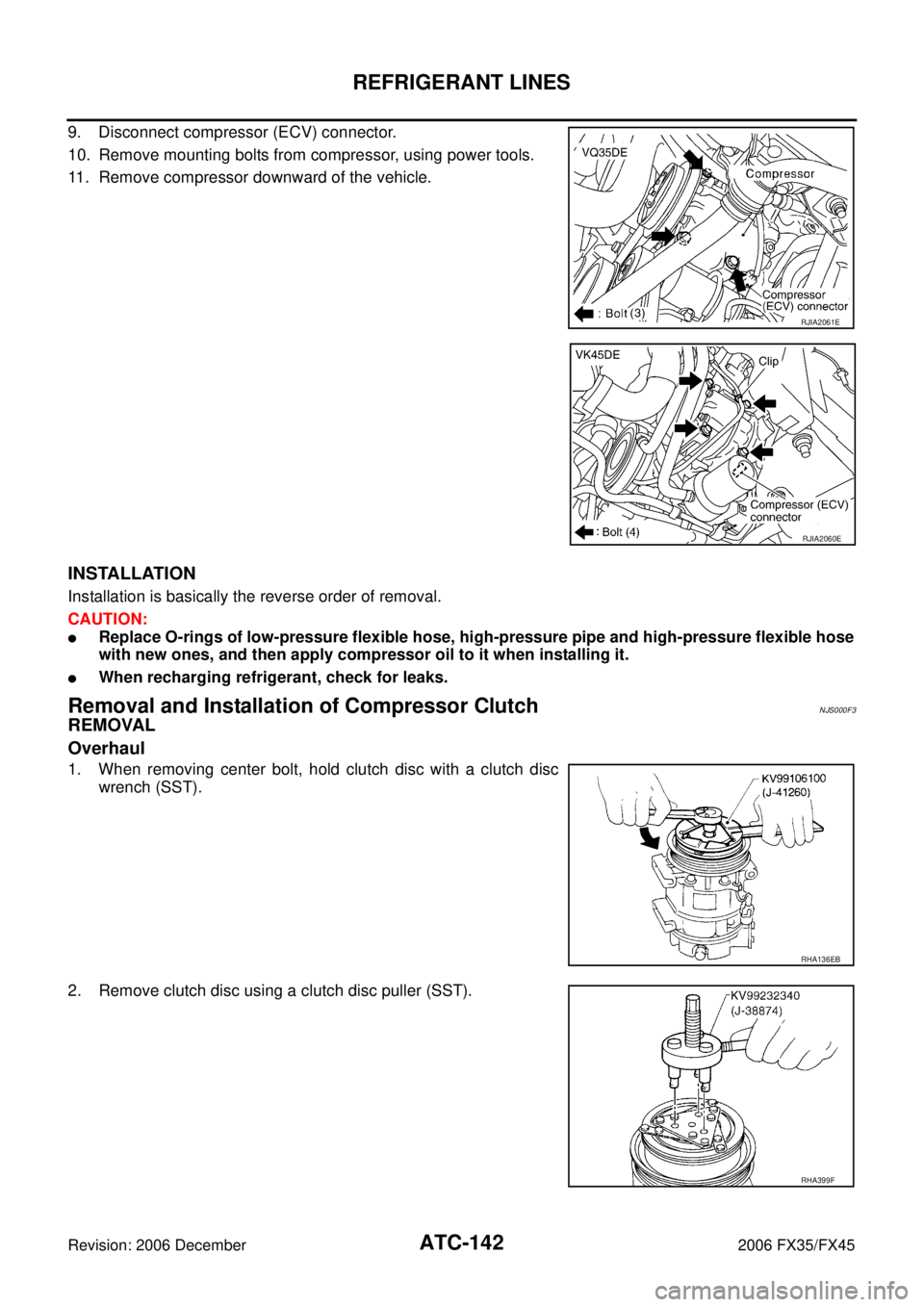
1. CHECK POWER SUPPLY FOR ECV (ELECTRONIC CONTROL VALVE)
1. Disconnect compressor (ECV) connector.
2. Turn ignition switch ON.
3. Check voltage between compressor (ECV) harness connector F6 terminal 2 and ground.
OK or NG
OK >> GO TO 2.
NG >> Check power supply circuit and 10A fuse [No. 12, located in the fuse block (J/B)]. Refer to PG-81, "
FUSE
BLOCK - JUNCTION BOX (J/B)" .
�If fuse is OK, check harness for open circuit. Repair or replace if necessary.
�If fuse is NG, check harness for short circuit and replace fuse.
Gauge indication Refrigerant cycle Probable cause Corrective action
Low-pressure side sometimes
becomes negative.
�Air conditioning system
does not function and does
not cyclically cool the com-
partment air.
�The system constantly func-
tions for a certain period of
time after compressor is
stopped and restarted. Refrigerant does not dis-
charge cyclically.
↓
Moisture is frozen at expan-
sion valve outlet and inlet.
↓
Water is mixed with refriger-
ant.
�Drain water from refrigerant
or replace refrigerant.
�Replace liquid tank.
AC354A
Gauge indication Refrigerant cycle Probable cause Corrective action
Low-pressure side becomes nega-
tive.
Liquid tank or front/rear side of
expansion valve’s pipe is
frosted or wet with dew. High-pressure side is closed
and refrigerant does not flow.
↓
Expansion valve or liquid tank
is frosted. Leave the system at rest until
no frost is present. Start it
again to check whether or not
the malfunction is caused by
water or foreign particles.
�If water is the cause, initially
cooling is okay. Then the
water freezes causing a
blockage. Drain water from
refrigerant or replace refrig-
erant.
�If due to foreign particles,
remove expansion valve
and remove the particles
with dry and compressed air
(not shop air).
�If either of the above meth-
ods cannot correct the mal-
function, replace expansion
valve.
�Replace liquid tank.
�Check lubricant for contami-
nation.
AC362A
2 – ground : Battery voltage
RJIA2294E
Page 552 of 4462
ATC-106
TROUBLE DIAGNOSIS
Revision: 2006 December 2006 FX35/FX45
In-vehicle Sensor CircuitNJS000EG
COMPONENT DESCRIPTION
In-vehicle Sensor
The in-vehicle sensor is located on instrument driver lower panel. It
converts variations in temperature of compartment air drawn from
the aspirator into a resistance value. It is then input into the unified
meter and A/C amp.
Aspirator
The aspirator is located on driver’s side of heater & cooling unit
assembly. It produces vacuum pressure due to air discharged from
the heater & cooling unit assembly, continuously taking compartment
air in the aspirator.
RJIA2021E
RJIA0921E
RJIA1804E
Page 565 of 4462
INTAKE SENSOR ATC-119
C
D E
F
G H
I
K L
M A
B
AT C
Revision: 2006 December 2006 FX35/FX45
INTAKE SENSORPFP:27723
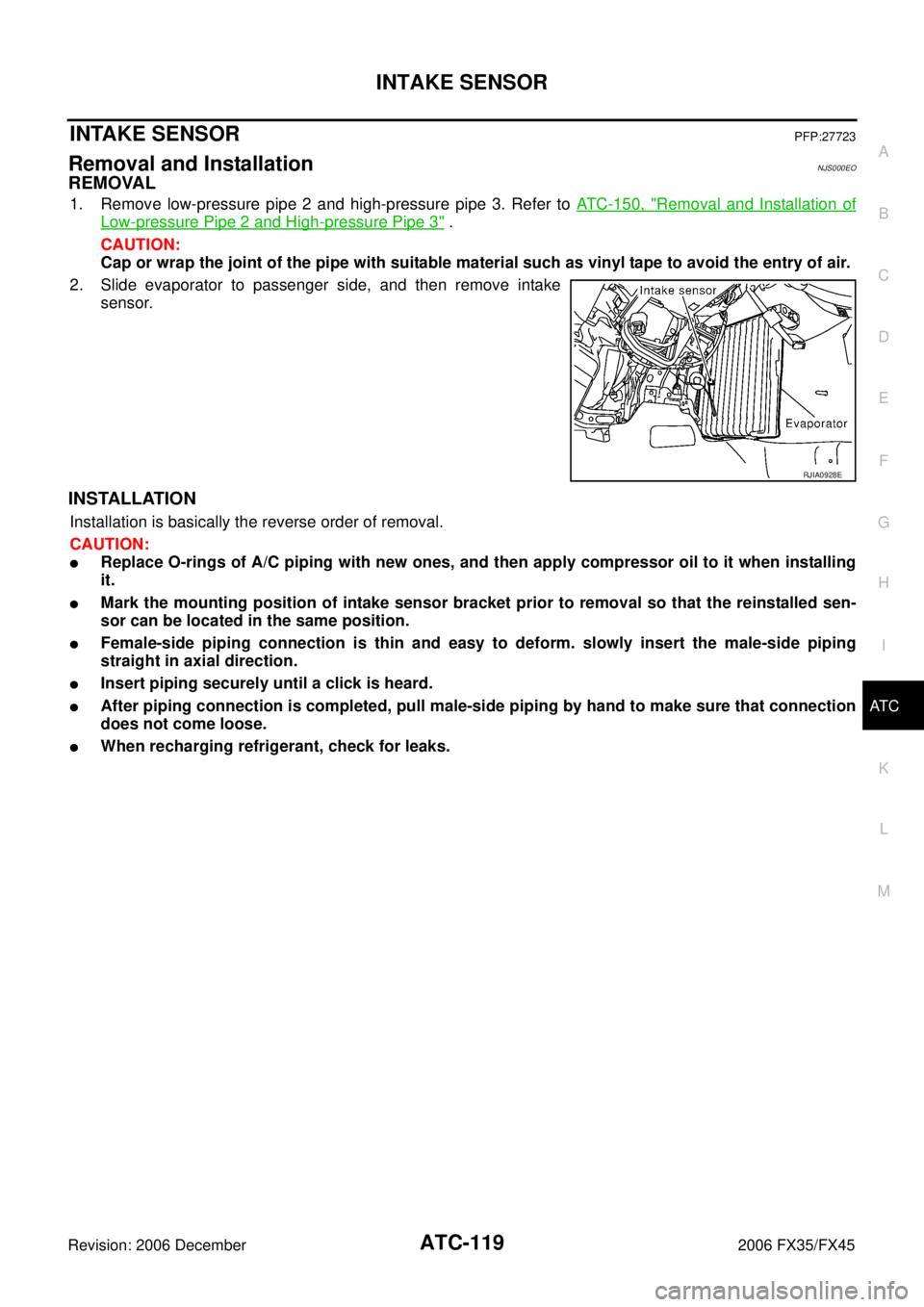
Removal and InstallationNJS000EO
REMOVAL
1. Remove low-pressure pipe 2 and high-pressure pipe 3. Refer to ATC-150, "Removal and Installation of
Low-pressure Pipe 2 and High-pressure Pipe 3" .
CAUTION:
Cap or wrap the joint of the pipe with suitable material such as vinyl tape to avoid the entry of air.
2. Slide evaporator to passenger side, and then remove intake sensor.
INSTALLATION
Installation is basically the reverse order of removal.
CAUTION:
�Replace O-rings of A/C piping with new ones, and then apply compressor oil to it when installing
it.
�Mark the mounting position of intake sensor bracket prior to removal so that the reinstalled sen-
sor can be located in the same position.
�Female-side piping connection is thin and easy to deform. slowly insert the male-side piping
straight in axial direction.
�Insert piping securely until a click is heard.
�After piping connection is completed, pull male-side piping by hand to make sure that connection
does not come loose.
�When recharging refrigerant, check for leaks.
RJIA0928E
Page 571 of 4462

HEATER & COOLING UNIT ASSEMBLY ATC-125
C
D E
F
G H
I
K L
M A
B
AT C
Revision: 2006 December 2006 FX35/FX45
HEATER & COOLING UNIT ASSEMBLYPFP:27110
Removal and InstallationNJS000EU
REMOVAL
1. Use a refrigerant collecting equipment (for HFC-134a) to discharge the refrigerant.
2. Drain coolant from cooling system. Refer to CO-11, "
Changing Engine Coolant" (VQ35DE) or CO-38,
"Changing Engine Coolant" (VK45DE).
3. Remove cowl top cover. Refer to EI-23, "
COWL TOP" .
4. Remove high-pressure pipe 2 mounting clip.
5. Remove low-pressure flexible hose bracket mounting bolt. Refer to ATC-146, "
Removal and Installation of
Low-pressure Flexible Hose" .
6. Disconnect low-pressure pipe 1 and high-pressure pipe 2 from evaporator.
a. Set a disconnector [high-pressure side (SST: 9253089908), low- pressure side (SST: 9253089916)] on A/C piping.
b. Slide a disconnector toward vehicle front until it clicks.
c. Slide A/C piping toward vehicle front and disconnect it.
CAUTION:
Cap or wrap the joint of the pipe with suitable material such
as vinyl tape to avoid the entry of air.
7. Remove electric throttle control actuator (VQ35DE). Refer to EM-19, "
INTAKE MANIFOLD COLLECTOR" .
8. Disconnect two heater hoses from heater core.
9. Remove instrument panel assembly. Refer to IP-10, "
INSTRUMENT PANEL ASSEMBLY" .
10. Remove blower unit. Refer to ATC-120, "
BLOWER UNIT" .
RJIA2037E
RJIA2041E
RJIA2077E
Page 575 of 4462
HEATER & COOLING UNIT ASSEMBLY ATC-129
C
D E
F
G H
I
K L
M A
B
AT C
Revision: 2006 December 2006 FX35/FX45
19. Insulator 20. Heater case (right) 21. Low-pressure pipe 2
22. High-pressure pipe 3 23. Expansion valve 24. Evaporator
25. Heater case (left) 26. Foot duct (left) 27. Center case
28. Max. cool door (left) 29. Ventilator door 30. Side link
31. Mode door motor 32. Defroster door 33. Max. cool door (right)
34. Defroster door lever 35. Defroster door link
Page 587 of 4462
REFRIGERANT LINES ATC-141
C
D E
F
G H
I
K L
M A
B
AT C
Revision: 2006 December 2006 FX35/FX45
VK45DE
1. Use a refrigerant collecting equipment (for HFC-134a) to discharge the refrigerant.
2. Remove air cleaner case and air duct. Refer to EM-17, "
AIR CLEANER AND AIR DUCT" (VQ35DE) or
EM-177, "
AIR CLEANER AND AIR DUCT" (VK45DE).
3. Remove front engine undercover, using power tools.
4. Remove cooling fan shroud (lower). Refer to CO-41, "
RADIATOR" (VK45DE).
5. Remove mounting nuts from low-pressure flexible hose and high-pressure flexible hose.
CAUTION:
Cap or wrap the joint of the pipe with suitable material such
as vinyl tape to avoid the entry of air.
6. Remove high-pressure flexible hose. Refer to ATC-147,
"Removal and Installation of High-pressure Flexible Hose"
(VK45DE).
7. Disconnect compressor connector.
8. Remove A/C compressor belt. Refer to EM-15, "
DRIVE BELTS" (VQ35DE) or EM-174, "DRIVE BELTS"
(VK45DE).
RJIA2244E
RJIA2059E
RJIA2058E
Page 588 of 4462
ATC-142
REFRIGERANT LINES
Revision: 2006 December 2006 FX35/FX45
9. Disconnect compressor (ECV) connector.
10. Remove mounting bolts from compressor, using power tools.
11. Remove compressor downward of the vehicle.
INSTALLATION
Installation is basically the reverse order of removal.
CAUTION:
�Replace O-rings of low-pressure flexible hose, high-pressure pipe and high-pressure flexible hose
with new ones, and then apply compressor oil to it when installing it.
�When recharging refrigerant, check for leaks.
Removal and Installation of Compressor ClutchNJS000F3
REMOVAL
Overhaul
1. When removing center bolt, hold clutch disc with a clutch disc wrench (SST).
2. Remove clutch disc using a clutch disc puller (SST).
RJIA2061E
RJIA2060E
RHA136EB
RHA399F
Page 592 of 4462
ATC-146
REFRIGERANT LINES
Revision: 2006 December 2006 FX35/FX45
Removal and Installation of Low-pressure Flexible HoseNJS000F4
REMOVAL
1. Use a refrigerant collecting equipment (for HFC-134a) to discharge the refrigerant.
2. Remove the air cleaner case and air duct. Refer to EM-17, "
AIR CLEANER AND AIR DUCT" (VQ35DE)
or EM-177, "
AIR CLEANER AND AIR DUCT" (VK45DE).
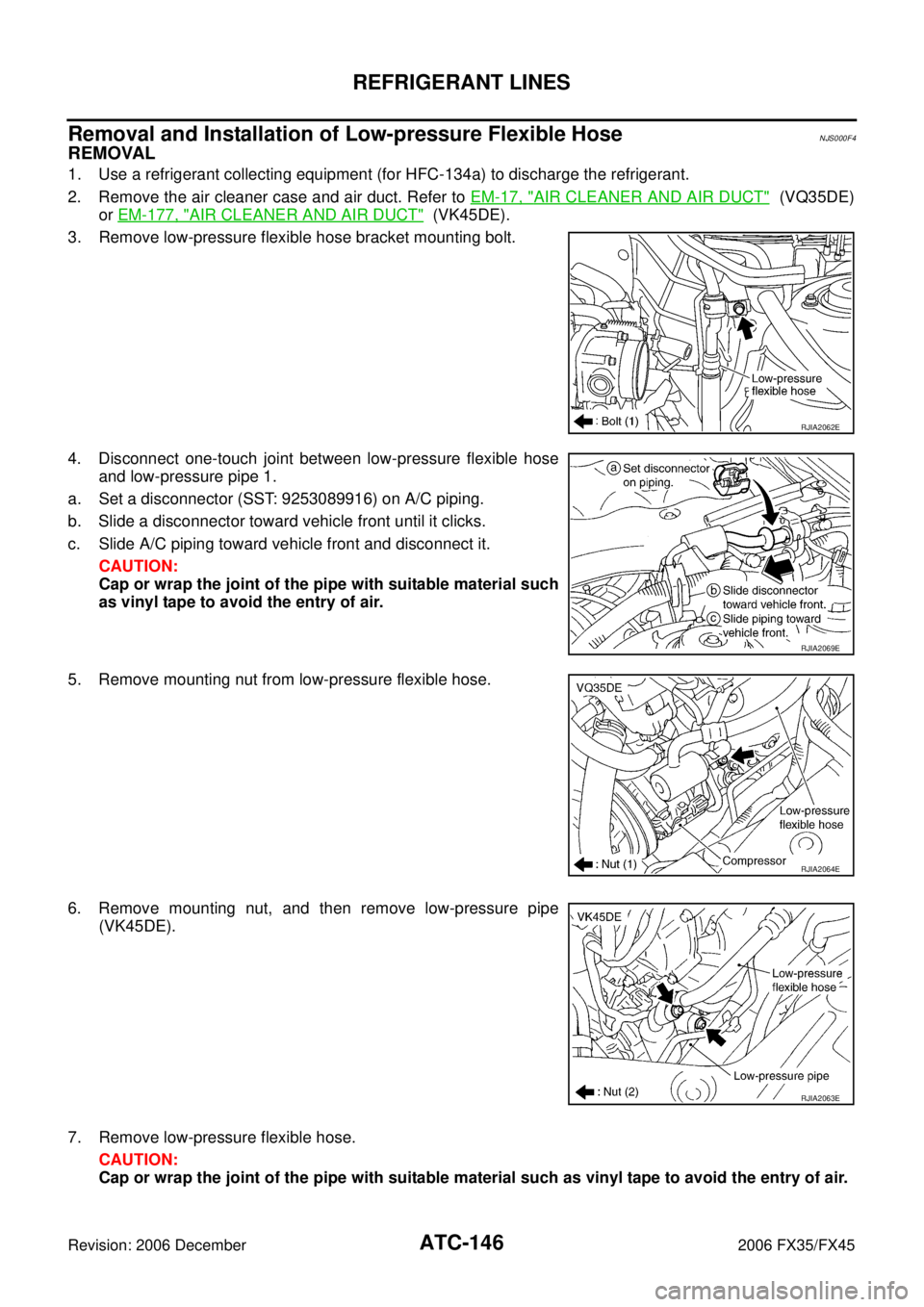
3. Remove low-pressure flexible hose bracket mounting bolt.
4. Disconnect one-touch joint between low-pressure flexible hose and low-pressure pipe 1.
a. Set a disconnector (SST: 9253089916) on A/C piping.
b. Slide a disconnector toward vehicle front until it clicks.
c. Slide A/C piping toward vehicle front and disconnect it. CAUTION:
Cap or wrap the joint of the pipe with suitable material such
as vinyl tape to avoid the entry of air.
5. Remove mounting nut from low-pressure flexible hose.
6. Remove mounting nut, and then remove low-pressure pipe (VK45DE).
7. Remove low-pressure flexible hose. CAUTION:
Cap or wrap the joint of the pipe with suitable material such as vinyl tape to avoid the entry of air.
RJIA2062E
RJIA2069E
RJIA2064E
RJIA2063E