2006 Hyundai Accent lock
[x] Cancel search: lockPage 423 of 599

1CONTROLS AND EQUIPMENT
16
!WARNING:
o For maximum effectiveness in case of an accident, the headrest should be adjusted so the top of the head- rest is at the same height as the
top of the occupant's ears. Theuse of a cushion that holds the body away from the seatback is not recommended.
o Do not operate vehicle with the headrests removed as severe in-jury to an occupant may occur inthe event of an accident. Head- rests may provide protection against severe neck injuries whenproperly adjusted. B110A03A-EAT Folding Rear Seatbacks
B110A02A
To raise the head restraint, pull it up. To lower it, push it down whilst pressingthe lock knob. For maximum effective- ness in the event of an accident, the restraint must be adjusted so that therestraint is approximately at the level of the seat occupant's ears. The restraint must never be so adjusted that it iscentred about the level of the seat occupant's neck.
!WARNING:
The purpose of the fold-down rear seatbacks is to allow you to carrylonger objects than could otherwise be accommodated. Do not allow pas- sengers to sit on top of the folded-down seatback whilst the car is mov- ing as this is not a proper seating position and no seat belts are avail-able for use when the seatbacks are folded down. This could result in serious injury or death in case of anaccident or a sudden stop. Objects
SB070D2-E REAR SEAT Head Restraint Adjustment(Not all models)
!WARNING:
Passengers sitting in the rear seat should be careful not to accidentally press the foot lever (2) whilst thevehicle is moving. As this may cause the seatback to move forward and injure a front seat occupant.
Page 424 of 599

17
1
CONTROLS AND EQUIPMENT
For greater convenience, the seat backs may be folded down individually.
o To unlock the seatback, pull up the
seatback locking knob, then push forward on the seatback panel.
o When you return the seatback to its
upright position, always be sure it haslocked into position by pulling and pushing on the top of the seatback. B110A02A-E
carried on the folded-down seatback should not extend higher than thetop of the front seats. This could allow cargo to slide forward and cause injury or damage during sud-den stops.
B140A01A
B140A01S-AAT REAR SEAT WARNING
For the safety of all passengers, lug- gage or other cargo should not be piledhigher than the top of the seatback. In addition, do not place objects on the rear shelf as they may move forwardduring braking or in an accident and strike vehicle passengers.
!WARNING:
When you return the rear seatback to its upright position after being folded down, be careful not to damage the seat belt webbing or buckle. In addi-tion, do not allow the seat belt web- bing or buckle to get caught or pinched in the rear seat.
Page 427 of 599

1CONTROLS AND EQUIPMENT
20
SB090P1-E SEAT BELTS (3-Point Type) To Fasten The Seat Belt The seat belts are fastened by pulling the belt buckle towards the seat belt stalk and inserting the metal tongue ofthe buckle into the stalk. The buckle should be firmly pressed into the stalk until locked which will be indicated byan audible "click". The length of the seat belt webbing will be automatically adjusted by the seatbelt mechanism to allow the wearer maximum freedom of movement whilst the belt is being worn. However, in theevent of rapid deceleration or impact, the belt mechanism will automatically lock. B180A01L-R
B200A01S-GAT Adjusting Your Seat Belt
B200A01A-D
The mechanism will also lock if the seat belt webbing is withdrawn too quicklywhen the belt is being fastened or if attempts are made to withdraw the webbing whilst the vehicle is not onlevel ground. Should the seat belt lock under these conditions, it will be pos- sible to release the mechanism by al-lowing a small amount of webbing to be retracted and the belt withdrawn again.
You should place the belt as low as possible on your hips, not on your waist. If the belt is located too high on your body, you could slide under it incase of accident or a sudden stop. This
!
You can adjust the height of the shoul- der belt anchor to one of the 4 positions.If the height of the adjusting seat belt is too near your neck, you will not be getting the most effective protection.The shoulder portion should be ad- justed so that it lies across your chest and midway over your shoulder nearestthe door and not your neck. To adjust the height of the seat belt anchor, lower or raise the height ad-juster into an appropriate position. To raise the height adjuster, pull it up. To lower it, push it down while pressing theheight adjuster button. Release the button to lock the anchor into position. Try sliding the height ad-juster to make sure that it has locked into the position. WARNING:
o The height adjuster must be in the locked position when the vehicle is moving.
o The misadjustment of height of
the shoulder belt could reduce theeffectiveness of the seat belt in a crash.
Page 428 of 599

21
1
CONTROLS AND EQUIPMENT
could result of death, serious injury or property damage. Both arms should notbe under or over the belt. Rather, one should be over and the other under, as shown in the illustration.Never wear the seat belt under the arm nearest the door.
B210A01A-AAT To Release the Seat Belt
The seat belt is released by pressing the release button in the locking buckle. When it is released, the belt should automatically draw back into the retrac-tor. If this does not happen, check the belt to be sure it is not twisted, then try again. B210A01L-R
B220D01A-EAT SEAT BELTS - Rear Seat Centre's 3-Point System WithEmergency Locking Retractor
1. Pass the webbing through the web-
bing guide. (3/5 Door only)
2. Before fastening the rear seat centre belt, confirm the metal tab (a) and buckle (b) are latched together.
3. After confirming that (a) and (b) are latched, pull the seat belt out of theretractor and insert the metal tab (c)into the buckle (d). B220D01A
(a)
Webbing Guide
(c)
(d)
(b) B220A02Y
There will be an audible "click" when the tab locks in the buckle. The seat belt automatically adjusts to the proper length only after the lap belt is adjusted manu- ally so that it fits snugly around your hips. If you lean forward in a slow, easymotion, the belt will extend and let you move around. If there is a sudden stop or impact, the belt will lock into position.It will also lock if you try to lean forward too quickly.
Page 429 of 599

1CONTROLS AND EQUIPMENT
22CHILD RESTRAINT SYSTEM
B230A03A-EAT Children riding in the car should sit in the rear seat and must always be prop- erly restrained to minimize the risk of injury in an accident, sudden stop orsudden manoeuvre. According to acci- dent statistics, children are safer when properly restrained in the rear seatsthan in the front seat. Larger children should use one of the seat belts pro- vided.You are required by law to use safety restraints for children. If small children ride in your vehicle you must put themin a child restraint system (safety seat). Children could be injured or killed in a crash if their restraints are not properlysecured. For small children and babies, a child seat or infant seat must be used. Before buying a particular child restraintsystem, make sure it fits your car and seat belts, and fits your child. Follow all the instructions provided by the manu-facturer when installing the child re- straint system.
!
B220C01A-EAT To Release the Seat Belt
When you want to release the seat belt, press the button in the locking buckle. B220E01A
WARNING:
The centre belt latching mechanism is different from those for the rear seat shoulder belts. When fastening the rear seat shoulder belts or therear seat centre belt, make sure they are inserted into the correct buckles to obtain maximum protection fromthe seat belt system and assure proper operation.
!WARNING:
o When using the rear seat centre belt, you must lock all metal tabs and buckles. If any metal tab or buckle is not locked, it will in- crease the chance of injury in theevent of collision.
o Never unlock the metal tab (a) and
the buckle (b) with the followingexceptions.(1) In case of folding rear
seatbacks down.
(2) If transporting an object on the rear seat may cause damage tothe rear seat center belt.
o Lock the metal tab (a) and the buckle (b) immediately after fold-ing rear seatbacks up.
Page 431 of 599

1CONTROLS AND EQUIPMENT
24
!
If you need to tighten the belt, pull more webbing toward the retractor. When youunbuckle the seat belt and allow it to retract, the retractor will automatically revert back to its normal seated pas-senger emergency locking usage con- dition. NOTE:
o Before installing the child restraint
system, read the instructions sup- plied by the child restraint system manufacturer.
o If the seat belt does not operate as described, have the systemchecked immediately by your au-thorized Hyundai dealer.
WARNING:
Do not install any child restraint sys-tem in the front passenger seat.Should an accident occur and cause the passenger side airbag to deploy, it could severely injure or kill aninfant or child seated in an infant or child seat. Therefore, only use a child restraint system in the rear seat ofyour vehicle.
To install a child restraint system in the outboard rear seats, extend the shoul- der/lap belt from its retractor. Install thechild restraint system, buckle the seat belt and allow the seat belt to take up any slack. Make sure that the lap por-tion of the belt is tight around the child restraint system and the shoulder por- tion of the belt is positioned so that itcannot interfere with the child's head or neck. After installation of the child re- straint system, try to move it in alldirections to be sure the child restraint system is securely installed.
B230G01A-GAT Installation on Outboard Rear Seats
B230G01A
B230F01A-EAT Installation on Rear Seat Centre Position Use the centre seat belt for the rear to secure the child restraint system as illustrated. After installation of the childrestraint system, rock the child seat back and forth, and side to side to ensure that it is properly secured by theseat belt. If the child seat moves, readjust the length of the seat belt. Then, if equipped,insert the child restraint tether strap hook into the child restraint hook holder and tighten to secure the seat. Alwaysrefer to the child restraint system manufacturer's recommendation before installing the child restraint system inyour vehicle.
B230F01A-E
Page 436 of 599

29
1
CONTROLS AND EQUIPMENT
U : Suitable for "universal" category
restraints approved for use in this mass group
UF :Suitable for forward-facing "univer-
sal" category restraints approvedfor use in this mass group
L1: Suitable for "Römer ISOFIX GR1"
approved for use in this mass group(Approval No: E1 R44-03301133)
X : Seat position not suitable for chil-
dren in this mass group
The seat belt pre-tensioner system consists mainly of the following compo- nents. Their locations are shown in theillustration.
1. SRS airbag warning light
2. Seat belt pre-tensioner assembly
3. SRS control module B180D01A-D
Driver's airbag1
2
3
Passenger airbag
The pre-tensioner seat belt operates in a similar way as an Emergency Locking Retractor (ELR) type of seat belt. Whenthe vehicle stops suddenly, or if the occupant tries to lean forward too quickly, the seat belt retractor will lockinto position. However, in certain frontal B180B02A-D
B180B01A-EAT Pre-Tensioner Seat Belt Your Hyundai vehicle is equipped with driver's and front passenger's pre-tensioner seat belts. The purpose of the pre-tensioner is to make sure that the seat belts fit tightly against theoccupant's body in certain frontal colli- sions. The pre-tensioner seat belts can be activated with the airbags.
collisions, the pre-tensioner will acti-vate and pull the seat belt into tightercontact against the occupant's body.
Page 441 of 599
1CONTROLS AND EQUIPMENT
34
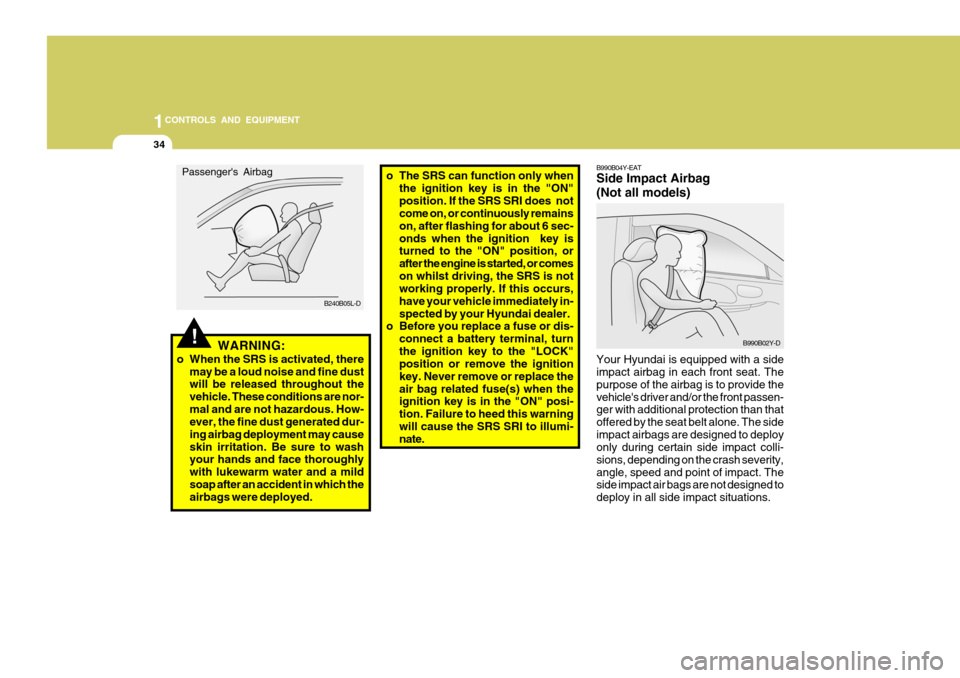
B990B04Y-EAT Side Impact Airbag (Not all models) Your Hyundai is equipped with a side impact airbag in each front seat. The purpose of the airbag is to provide thevehicle's driver and/or the front passen- ger with additional protection than that offered by the seat belt alone. The sideimpact airbags are designed to deploy only during certain side impact colli- sions, depending on the crash severity,angle, speed and point of impact. The side impact air bags are not designed to deploy in all side impact situations. B990B02Y-Do The SRS can function only when
the ignition key is in the "ON" position. If the SRS SRI does not come on, or continuously remains on, after flashing for about 6 sec-onds when the ignition key is turned to the "ON" position, or after the engine is started, or comeson whilst driving, the SRS is not working properly. If this occurs, have your vehicle immediately in-spected by your Hyundai dealer.
o Before you replace a fuse or dis-
connect a battery terminal, turnthe ignition key to the "LOCK" position or remove the ignition key. Never remove or replace theair bag related fuse(s) when the ignition key is in the "ON" posi- tion. Failure to heed this warningwill cause the SRS SRI to illumi- nate.
!WARNING:
o When the SRS is activated, there may be a loud noise and fine dust will be released throughout the vehicle. These conditions are nor-mal and are not hazardous. How- ever, the fine dust generated dur- ing airbag deployment may causeskin irritation. Be sure to wash your hands and face thoroughly with lukewarm water and a mildsoap after an accident in which the airbags were deployed.
Passenger's Airbag
B240B05L-D