Page 495 of 599
2
DRIVING YOUR HYUNDAI
5STARTING
SC060A1-E Starting The Petrol Engine
1. Ensure that the transaxle is in neu-
tral and that the clutch pedal is held depressed (manual transaxle) or the transaxle selector is at the "P" posi- tion (automatic transaxle vehicle).
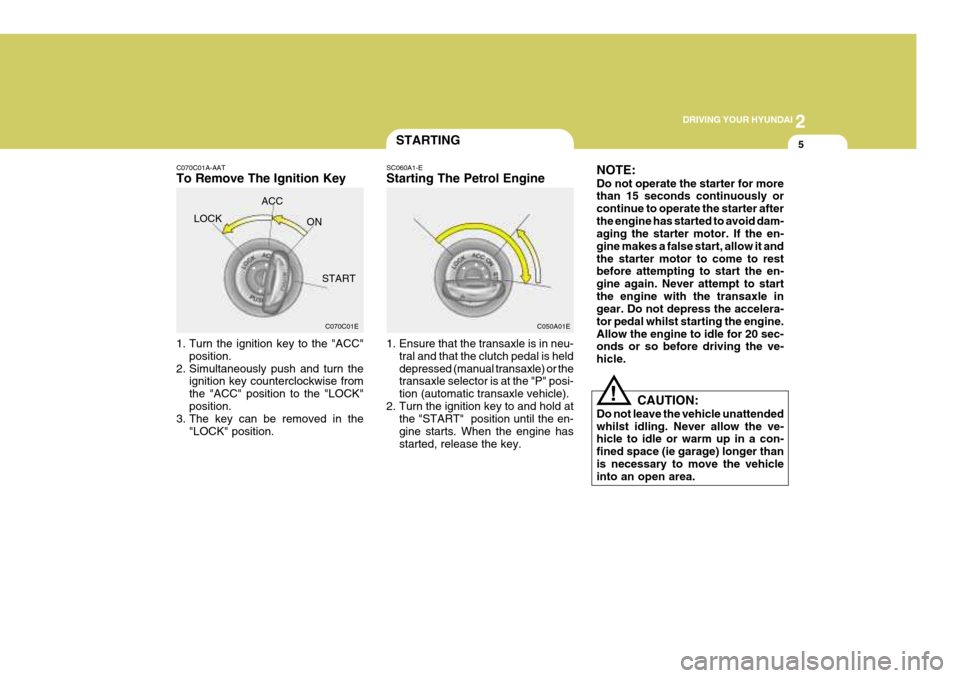
2. Turn the ignition key to and hold at the "START" position until the en-gine starts. When the engine hasstarted, release the key.
C070C01A-AAT
To Remove The Ignition Key
1. Turn the ignition key to the "ACC"
position.
2. Simultaneously push and turn the ignition key counterclockwise from the "ACC" position to the "LOCK"position.
3. The key can be removed in the
"LOCK" position. NOTE: Do not operate the starter for more than 15 seconds continuously or continue to operate the starter afterthe engine has started to avoid dam- aging the starter motor. If the en- gine makes a false start, allow it andthe starter motor to come to rest before attempting to start the en- gine again. Never attempt to startthe engine with the transaxle in gear. Do not depress the accelera- tor pedal whilst starting the engine.Allow the engine to idle for 20 sec- onds or so before driving the ve- hicle.
CAUTION:
Do not leave the vehicle unattendedwhilst idling. Never allow the ve- hicle to idle or warm up in a con- fined space (ie garage) longer thanis necessary to move the vehicle into an open area.
!
C070C01E
LOCK
ACC
ON
START C050A01E
Page 496 of 599
2DRIVING YOUR HYUNDAI
6
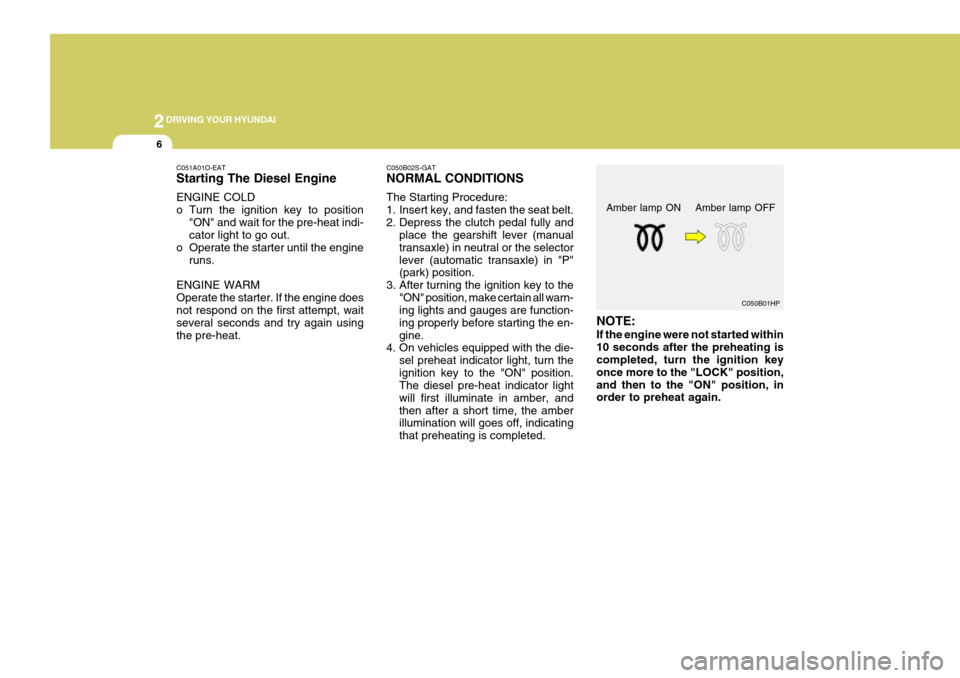
NOTE: If the engine were not started within 10 seconds after the preheating is completed, turn the ignition key once more to the "LOCK" position,and then to the "ON" position, in order to preheat again.
C051A01O-EAT Starting The Diesel Engine ENGINE COLD
o Turn the ignition key to position
"ON" and wait for the pre-heat indi- cator light to go out.
o Operate the starter until the engine runs.
ENGINE WARM Operate the starter. If the engine does not respond on the first attempt, wait several seconds and try again usingthe pre-heat. C050B02S-GAT NORMAL CONDITIONS The Starting Procedure:
1. Insert key, and fasten the seat belt.
2. Depress the clutch pedal fully and
place the gearshift lever (manualtransaxle) in neutral or the selectorlever (automatic transaxle) in "P" (park) position.
3. After turning the ignition key to the "ON" position, make certain all warn-ing lights and gauges are function- ing properly before starting the en-gine.
4. On vehicles equipped with the die-
sel preheat indicator light, turn theignition key to the "ON" position. The diesel pre-heat indicator light will first illuminate in amber, andthen after a short time, the amber illumination will goes off, indicating that preheating is completed. C050B01HP
Amber lamp ON Amber lamp OFF
Page 500 of 599

2DRIVING YOUR HYUNDAI
10AUTOMATIC TRANSAXLE
YC090A1-E SELECTOR POSITIONS o P (Park): With the selector in this position, no drive is transmitted from the engine and the transaxle output and therefore the front wheels locked. The enginemay be started with the selector in this position.
!
CAUTION:
The selector must NEVER be shifted to the "P" position whilst the ve- hicle is in motion, otherwise seri-ous transaxle damage will result.
C090A01A-EAT
The highly efficient Hyundai automatic transaxle has four forward speeds and one reverse speed. It has a conven-tional shift pattern as shown in the illustration. At night, with the first posi- tion of the multi-function switch, theappropriate symbol on the shift pattern indicator will be illuminated according to the range selected. CAUTION:
Never shift into "R" or "P" position whilst the vehicle is moving. NOTE:
Depress the brake pedal andpush the button when shift- ing. Push the button when shift- ing. The selector lever can be shifted freely.
For optimum fuel economy, acceler-ate gradually. The transaxle will auto-matically shift to the second, third and overdrive gears.
!
C090A01A-D
Page 505 of 599

2
DRIVING YOUR HYUNDAI
15ANTI-LOCK BRAKE SYSTEM
C120A02A-EAT (Not all models) The Anti-Lock Brake System (ABS) is designed to prevent wheel lock-upduring sudden braking or on hazard- ous road surfaces. The ABS control module monitors the wheel speed andcontrols the pressure applied to each brake. Thus, in emergency situations or on slick roads, ABS will increasevehicle control during braking. NOTE: During ABS operation, a slight pul- sation may be felt in the brake pedal when the brakes are applied. Also, a noise may be heard in the enginecompartment whilst braking. These conditions are normal and indicate that the anti-lock brake system isfunctioning properly.
These roads should be driven at reduced speeds. The safety features of an ABS equipped vehicle should not be tested by high speed drivingor cornering. This could endanger the safety of yourself or others.
WARNING:
ABS will not prevent accidents due to improper or dangerous driving manoeuvres. Even though vehiclecontrol is improved during emer- gency braking, always maintain a safe distance between you and ob-jects ahead. Vehicle speeds should always be reduced during extreme road conditions. The braking distance for cars equipped with an anti-lock brakingsystem may be longer than for those without it in the following road con- ditions.
o Driving on rough, gravel or snow- covered roads.
o Driving with tyre chains installed.
o Driving on roads where the road surface is pitted or has different surface height.!
Page 508 of 599

2DRIVING YOUR HYUNDAI
18
SC170E1-E Windscreen Washers and Wip- ers The windscreen washer bottle should be filled with a solution of water and aproprietary winter screen wash addi- tive. The windscreen wipers should not be used if the blades are frozen tothe windscreen or if they are covered with snow, before this is removed. NOTE: Never allow undiluted screen washer fluid additive to spill upon the paintwork or use engine cool- ant anti-freeze since damage to thepaintwork may result.
o When driving in extreme conditions,the windscreen wiper blades may fail to clear the screen properly due to the formation of ice upon theblade edge. It will therefore be nec- essary to periodically remove such ice to restore their efficiency.
o If the power operated door mirrors become frozen, attempts to adjustthese may damage the mechanism.
ZC170D1-E Door Locks Should the door lock mechanism be- come frozen, a proprietary lock de-icershould be used. Alternatively, warm- ing the door key may thaw the door lock. However, the key should behandled carefully to avoid burning the fingers. Never attempt to thaw a frozen doorlock using hot water, since the water will eventually freeze and compound the problem. NOTE: The proper temperature for using the immobiliser key is from -40°F to176°F (-40°C to 80°C). If you heat the immobiliser key over 176°F (80°C) to open the frozen lock, it may causedamage to the transponder in its head.
ZC170C1-E Anti-freeze/Corrosion inhibitor The cooling system must always con- tain an Ethylene-Glycol based anti-freeze solution. The system is filled during manufacture with solution of the correct strength which should bechecked before the onset of winter and adjusted or changed as required. NOTE: The anti-freeze solution contains a corrosion inhibitor to prevent deg- radation of the aluminum castingscontained within the engine. There- fore, never, drain the system and refill with water only. In addition, anti-freeze solution must ALWAYS be used in vehicles fittedwith air conditioning, to prevent the heater matrix from freezing and sub- sequently bursting with the refrigera-tion system in use.
Page 519 of 599

3 IN CASE OF EMERGENCY
6SPARE WHEEL
!
CAUTION:
Serious loss of coolant indicates there is a leak in the cooling systemand this should be checked as soon as possible by a Hyundai dealer. SD050A3-E The spare wheel is stored under the luggage compartment floor and is ac- cessed from within the luggage com- partment by lifting the carpet and thefloor panel. To remove the spare wheel, unscrew the retainer, rotating this in an anticlockwise direction and lift out the wheel. To replace the wheel, screw the retainer by hand until tight havinglocated the wheel in the luggage com- partment floor well. The inflation pres- sure of the spare wheel should bechecked at least monthly and when- ever the wheel is fitted to the vehicle. Spare Tyre Pressure
5Jx13 5Jx14
5.5Jx15
5Jx13 5Jx14
5.5Jx15 TYRE
SIZE
RIM
SIZE PRESSURE, kPa (PSI)
175/70R13 185/60R14185/55R15175/70R13 185/60R14 185/55R15 REAR
207(30) 207(30) FRONT
230(33)230(33)
UP TO 2
PERSONS UP TO
MAX. LOAD
REAR
230(33)230(33)
FRONT 207(30) 220(32)
EN-
GINE
Die- sel
Petrol
HLC4011
Page 521 of 599
3 IN CASE OF EMERGENCY
8
4. Reinstall the wheel cap by fitting theboss of the wheel cap in the groove of the wheel, hitting the centre of thewheel cap with hand. SD070D1-E 2. Block the Wheel
Block the wheel that is diagonally op- posite from the flat tyre to prevent thevehicle from rolling when the car is raised on the jack.
Remove the spare tyre and take out the jack and tool bag from the trunk. NOTE: The jack is located beneath the lug- gage mat in the vehicle trunk.
D060B01E-EAT 1. Obtain Spare Tyre and Tool
HLC4010
HTB156
Flat tireD060B01A
Page 522 of 599

3
IN CASE OF EMERGENCY
9
SD070E1-E 3. Loosen Wheel Nuts The wheel nuts should be loosened slightly before raising the car. To loosenthe nuts, turn the wheel brace counter- clockwise. Ensure that the wheel brace socket is seated properly on the nutand that it cannot slip. Do not remove the nuts at this stage. SD070G1-E 5. Raising the Car After inserting a wrench bar into the wheel nut wrench, install the wrenchbar into the jack as shown in the draw- ing. To raise the vehicle, turn the wheel nut wrench clockwise. As the jack be-gins to raise the vehicle, double check that it is properly positioned and will not slip. If the jack is on soft ground orsand, it may be necessary to place a stout piece of timber under the base of the jack to prevent it from sinking.Raise the car high enough so that the fully inflated spare wheel can be in- stalled.
D060E01A-AAT 4. Put the Jack in Place The base of the jack should be placed on firm, level ground. The jack shouldbe positioned as shown in the drawing.
Wrench bar
Wheel nut wrench
D060E03A-D HFC4022
HLC4007
