Page 5 of 420
Your Vehicle at a Glance
4
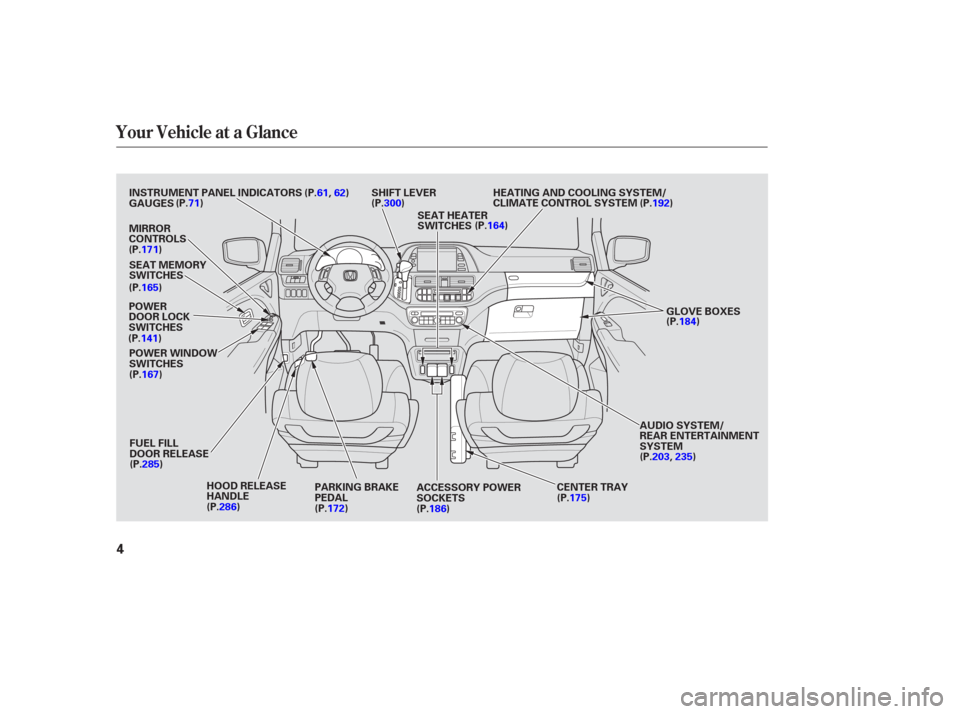
AUDIO SYSTEM/
REAR ENTERTAINMENT
SYSTEM
PARKING BRAKE
PEDAL
FUEL FILL
DOOR RELEASE
HOOD RELEASE
HANDLE
POWER WINDOW
SWITCHES
POWER
DOOR LOCK
SWITCHES INSTRUMENT PANEL INDICATORS
GAUGES SHIFT LEVER
CLIMATE CONTROL SYSTEM
MIRROR
CONTROLS
ACCESSORY POWER
SOCKETS
(P.61,62)
(P.71) HEATING AND COOLING SYSTEM/
CENTER TRAY
SEAT HEATER
SWITCHES
GLOVE BOXES
SEAT MEMORY
SWITCHES
(P.165)
(P.141) (P.167)
(P.285) (P.286) (P.172)(P.186) (P.175)(P.203,235)(P.184)
(P.192)
(P.164)
(P.300)
(P.171)
Page 15 of 420
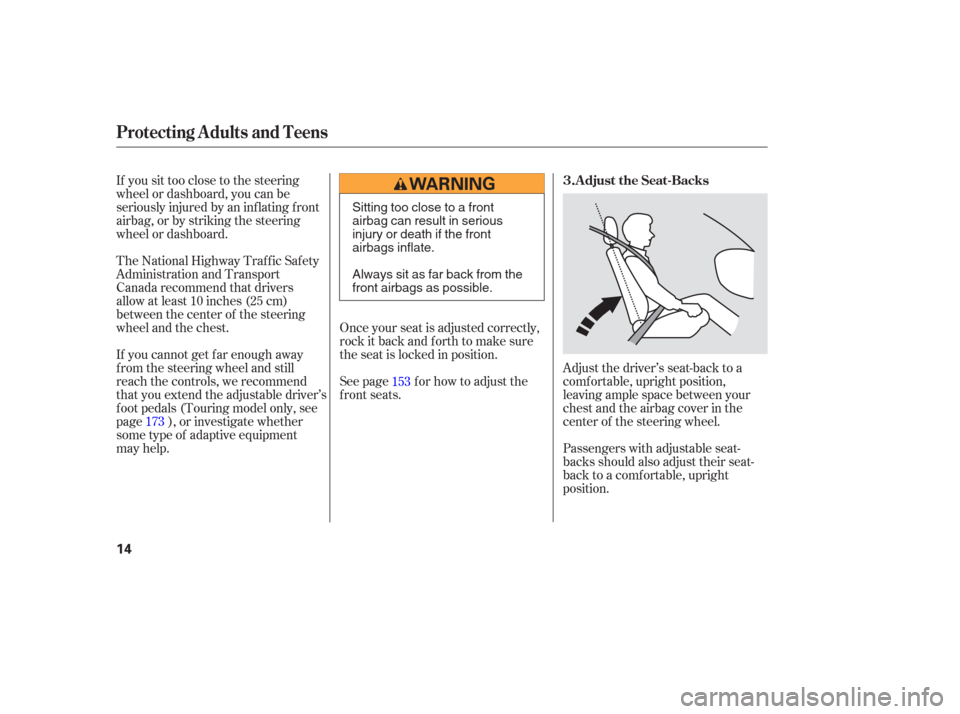
If you sit too close to the steering
wheel or dashboard, you can be
seriously injured by an inf lating f ront
airbag, or by striking the steering
wheel or dashboard.
The National Highway Traffic Safety
Administration and Transport
Canada recommend that drivers
allow at least 10 inches (25 cm)
between the center of the steering
wheel and the chest.Adjust the driver’s seat-back to a
comf ortable, upright position,
leaving ample space between your
chest and the airbag cover in the
center of the steering wheel.
Passengers with adjustable seat-
backs should also adjust their seat-
back to a comf ortable, upright
position.
Once your seat is adjusted correctly,
rock it back and f orth to make sure
the seat is locked in position.
See page f or how to adjust the
f ront seats.
If you cannot get f ar enough away
f rom the steering wheel and still
reach the controls, we recommend
that you extend the adjustable driver’s
f oot pedals (Touring model only, see
page ), or investigate whether
some type of adaptive equipment
may help.
173 153
Protecting A dults and Teens
Adjust the Seat-Backs
3.
14
Sitting too close to a front
airbag can result in serious
injury or death if the front
airbags inflate.
Always sit as far back from the
front airbags as possible.
Page 16 of 420
See page f or how to adjust the
head restraints. Properly adjusted head restraints
will help protect occupants f rom
whiplash and other crash injuries.
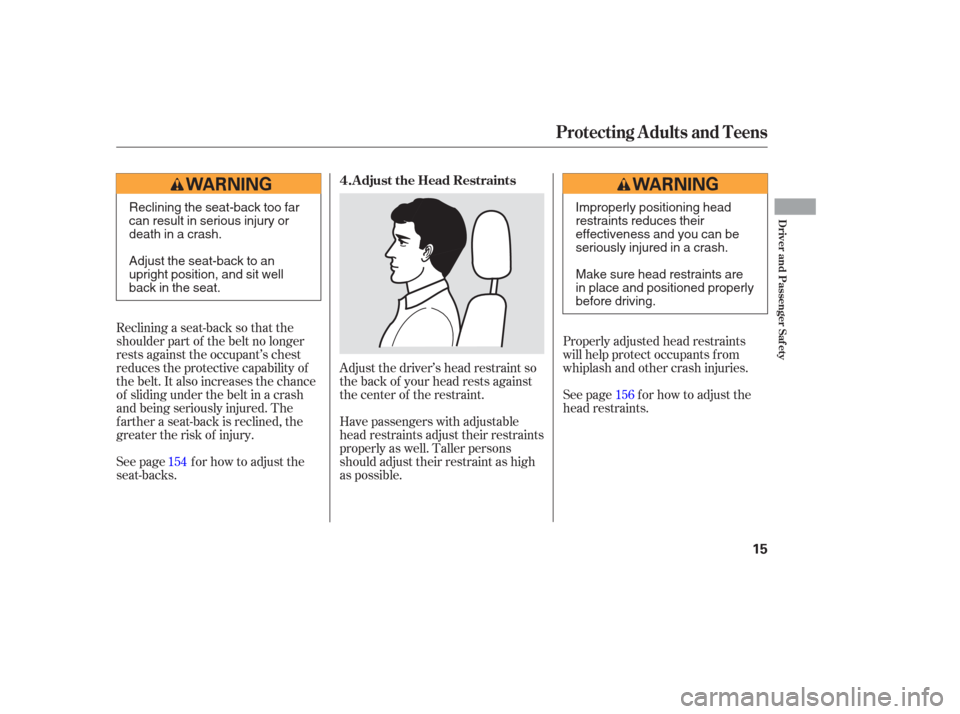
Adjust the driver’s head restraint so
the back of your head rests against
the center of the restraint.
Have passengers with adjustable
head restraints adjust their restraints
properly as well. Taller persons
should adjust their restraint as high
as possible.
Reclining a seat-back so that the
shoulder part of the belt no longer
rests against the occupant’s chest
reduces the protective capability of
the belt. It also increases the chance
of sliding under the belt in a crash
and being seriously injured. The
farther a seat-back is reclined, the
greater the risk of injury.
See page f or how to adjust the
seat-backs.
154 156
Protecting A dults and Teens
A djust the Head Restraints
4.
Driver and Passenger Saf ety
15
Improperly positioning head
restraints reduces their
effectiveness and you can be
seriously injured in a crash.
Make sure head restraints are
in place and positioned properly
before driving.
Reclining the seat-back too far
can result in serious injury or
death in a crash.
Adjust the seat-back to an
upright position, and sit well
back in the seat.
Page 17 of 420
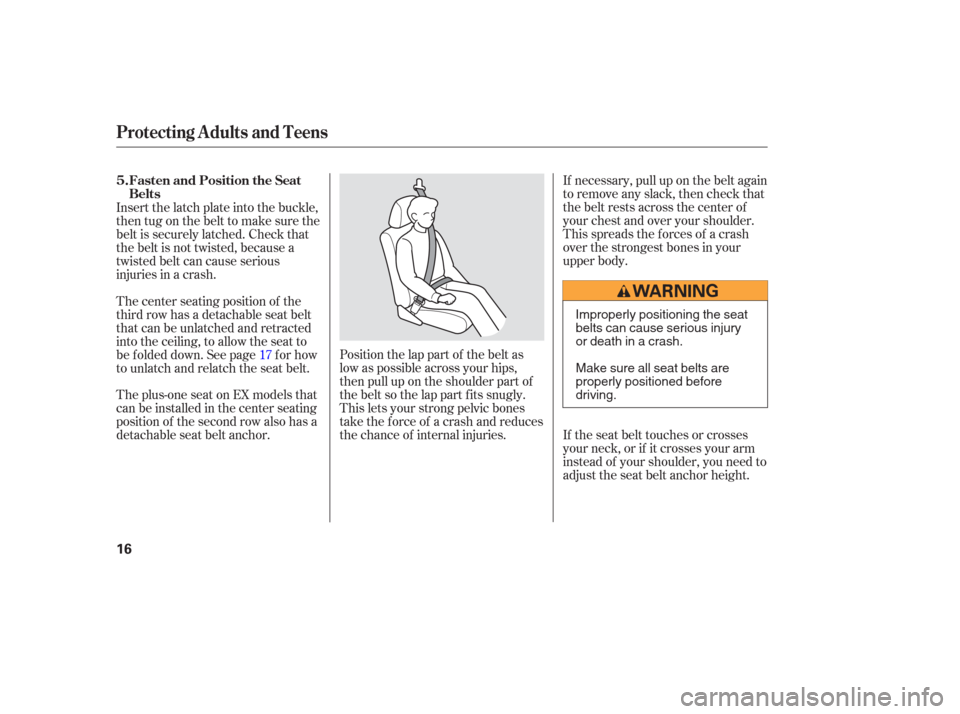
If necessary, pull up on the belt again
to remove any slack, then check that
the belt rests across the center of
your chest and over your shoulder.
This spreads the f orces of a crash
over the strongest bones in your
upper body.
If the seat belt touches or crosses
your neck, or if it crosses your arm
instead of your shoulder, you need to
adjust the seat belt anchor height.
Position the lap part of the belt as
low as possible across your hips,
then pull up on the shoulder part of
the belt so the lap part f its snugly.
This lets your strong pelvic bones
take the force of a crash and reduces
the chance of internal injuries.
Insert the latch plate into the buckle,
then tug on the belt to make sure the
belt is securely latched. Check that
the belt is not twisted, because a
twisted belt can cause serious
injuries in a crash.
The center seating position of the
third row has a detachable seat belt
that can be unlatched and retracted
into the ceiling, to allow the seat to
be f olded down. See page f or how
to unlatch and relatch the seat belt.
The plus-one seat on EX models that
canbeinstalledinthecenterseating
position of the second row also has a
detachable seat belt anchor.
17
Protecting A dults and Teens
Fasten and Position the Seat
Belts
5.
16
Improperly positioning the seat
belts can cause serious injury
or death in a crash.
Make sure all seat belts are
properly positioned before
driving.
Page 26 of 420

Your Airbag System includes:Two SRS (supplemental restraint
system) f ront airbags. The driver’s
airbag is stored in the center of
the steering wheel; the f ront
passenger’sairbagisstoredinthe
dashboard. Both are marked ‘‘SRS
AIRBAG’’ (see page ).
Two side airbags, one f or the
driver and one f or a f ront
passenger. The airbags are stored
in the outer edges of the seat-
backs. Both are marked ‘‘SIDE
AIRBAG’’ (see page ).
Two side curtain airbags, one f or
each side of the vehicle. The
airbags are stored in the ceiling
above the side windows. All pillars
are marked ‘‘SIDE CURTAIN
AIRBAG’’ (see page ). 27
30
32
CONT INUED
A irbag System Components
Additional Inf ormation About Your Airbags
Driver and Passenger Saf ety
25
(3)
(4)
(1)
(8) (9)
(2)
(7) (5) (10)
(6)
(5) (4)
(11)(9)
(11) (12)
(13)
(1) Driver’s Front Airbag
(2) Passenger’s Front Airbag
(3) Control Unit
(4) Seat Belt Tensioners
(5) Side Airbags
(6) Side Curtain Airbag
(7) Driver’s Seat Position Sensor (8) Front Passenger’s Weight Sensors
(9) Front Impact Sensors
(10) Passenger Airbag Off Indicator
(11) Side Impact Sensors
(12) Occupant Position Detection
System (OPDS) Sensors
(13) Rollover Sensor
Page 31 of 420

When the airbag is turned of f , an
indicator in the center of the
dashboard will come on indicating
passenger airbag ‘‘OFF’’ (see page).
If there is no passenger in the f ront
seat, the airbag will be off. However,
the Passenger Airbag Of f indicator
will not come on.
To ensure that the passenger’s
advanced front airbag system will
work properly,
This includes: A rear passenger pushing or
pulling on the back of the
passenger’s seat. Moving the f ront seat f orcibly
back against cargo on the seat or
f loor behind it.
Hanging heavy items on the f ront
passenger seat, or placing heavy
items in the seat-back pocket.
If you ever have a moderate to
severe side impact, sensors will
detect rapid acceleration and signal
the control unit to instantly inf late
either the driver’s or the passenger’s
side airbag and activate the seat belt
tensioner.
33
Additional Inf ormation About Your Airbags
How Your Side A irbags Work
do not do anyt hing
t hat would increase or decrease t he weight on the f ront passenger’s seat.
30
Page 46 of 420
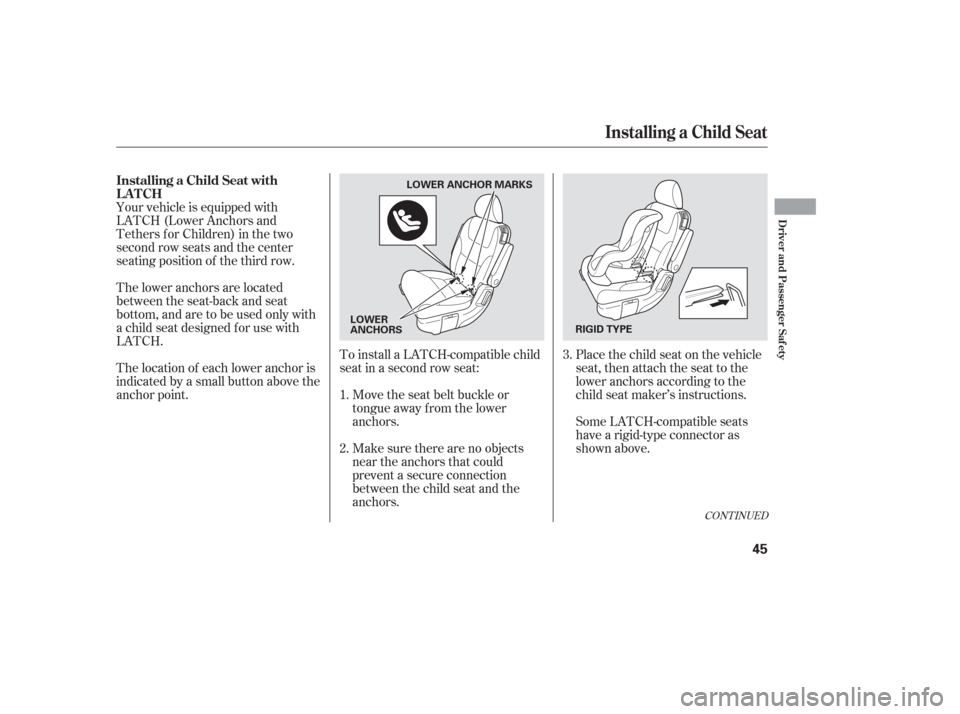
Place the child seat on the vehicle
seat, then attach the seat to the
lower anchors according to the
child seat maker’s instructions.
Your vehicle is equipped with
LATCH (Lower Anchors and
Tethers f or Children) in the two
second row seats and the center
seating position of the third row.
The lower anchors are located
between the seat-back and seat
bottom, and are to be used only with
a child seat designed f or use with
LATCH.
The location of each lower anchor is
indicated by a small button above the
anchor point.
Some LATCH-compatible seats
have a rigid-type connector as
shown above.
To install a LATCH-compatible child
seat in a second row seat:
Make sure there are no objects
near the anchors that could
prevent a secure connection
between the child seat and the
anchors. Move the seat belt buckle or
tongue away f rom the lower
anchors.
1.
2. 3.
CONT INUED
Installing a Child Seat
Installing a Child Seat with
LATCH
Driver and Passenger Saf ety
45
RIGID TYPE
LOWERANCHORMARKS
LOWER
ANCHORS
Page 48 of 420
Slide the anchor cover to open it,
then follow steps 6 and 7 of the
second row installation (see page).
Followsteps1through4of the
second row installation (see pages
and ).
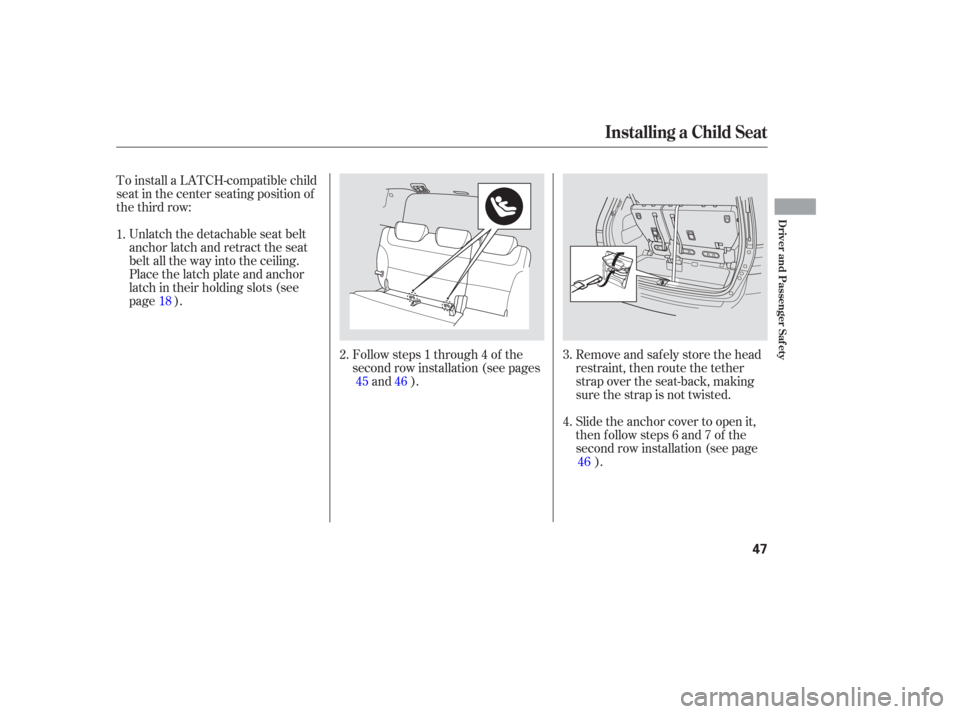
To install a LATCH-compatible child
seat in the center seating position of
the third row:
Unlatch the detachable seat belt
anchor latch and retract the seat
belt all the way into the ceiling.
Place the latch plate and anchor
latch in their holding slots (see
page ).
Remove and safely store the head
restraint, then route the tether
strap over the seat-back, making
sure the strap is not twisted.
1.
2.3.
4.
46
45 46
18
Installing a Child Seat
Driver and Passenger Saf ety
47