Page 315 of 420
The best way to conf irm that vehicle
and trailer weights are within limits
is to have them checked at a public
scale.
Using a suitable scale or a special
tongue load gauge, check the tongue
load the f irst time you set up a
towing combination (a f ully-loaded
vehicle and trailer), then recheck the
tongue load whenever the conditions
change.If the total trailer weight is more
than 1,850 lbs (840 kg), you must
also use a weight distributing hitch.
This device transf ers weight f rom
the vehicle’s rear wheels to the f ront
wheels, and to the trailer’s wheels.
Caref ully f ollow the hitch maker’s
instructions f or proper installation
and adjustment.
Always use saf ety chains when you
tow a trailer. Make sure the chains
are secured to the trailer and hitch,
and that they cross under the tongue
and can catch the trailer if it
becomes unhitched. Leave enough
slack to allow the trailer to turn
corners easily, but do not let the
chains drag on the ground.
Towing generally requires a variety
of supplemental equipment,
depending on the size of your trailer,
how much load you are towing, and
where you tow. To ensure the best
quality, we recommend that you
purchase Honda equipment
whenever possible.
Discuss your needs with your trailer
sales or rental agency, and f ollow the
guidelines in this section. Also make
sure that all equipment is properly
installed and meets f ederal, state,
province, and local regulations.
Any hitch used on your vehicle must
be properly bolted to the underbody,
using the six threaded holes
provided. A hitch and the required
f luid coolers designed especially f or
your Odyssey can be obtained f rom
your Honda dealer.
Towing a Trailer
Checking L oads
T owing Equipment and
A ccessoriesWeight Distributing Hitch
Saf et y Chains
Hitches
314
Page 358 of 420

�´�Ì
Tires marked ‘‘M S’’ or ‘‘All
Season’’ on the sidewall have an all-
weather tread design suitable for
most winter driving conditions.
For the best perf ormance in snowy
or icy conditions, you should install
snow tires or tire chains. They may
be required by local laws under
certain conditions.
If you mount snow tires on your
vehicle, make sure they are radial
tires of the same size and load range
as original tires. Mount snow tires on
all f our wheels. The traction
provided by snow tires on dry roads
maybelowerthanyouroriginaltires.
Check with the tire dealer f or
maximum speed recommendations. Mount tire chains on your tires when
required by driving conditions or
local laws. Install them only on the
f ront tires.
Because your vehicle has limited tire
clearance, Honda strongly
recommends using the chains listed
below.
Thesechainsaretheonlyonesthat
have been approved by Honda f or
use on your vehicle. Since Honda
cannot test all chains, you must be
personally responsible f or proper
selection, installation, and use of tire
chains.
The chains listed here are available
at many auto supply stores. For a
complete list of stores, visit the SCC
website at www.scc-chain.com.
When installing chains, f ollow the
manuf acturer’s instructions, and
mount them as tightly as you can.
Drive slowly with chains installed.
Tire chains cannot be used with a
flat front tire. If a front tire goes flat
when a tire chain is installed on it,
remove the chain, and f ollow the
precautions described under
Michelin PAX System (see page ).
Link-type: Laclede 1142
Cable-type: SCC SC Cable SC1042
Link-type: SCC Quick Grip QG1142
Cable-type: SCC SC Cable SC1042
362
CONT INUED
U.S. Touring model
All except U.S. Touring models
Winter Driving
Snow T ires Tire Chains
Tires
Maint enance
357
Page 365 of 420
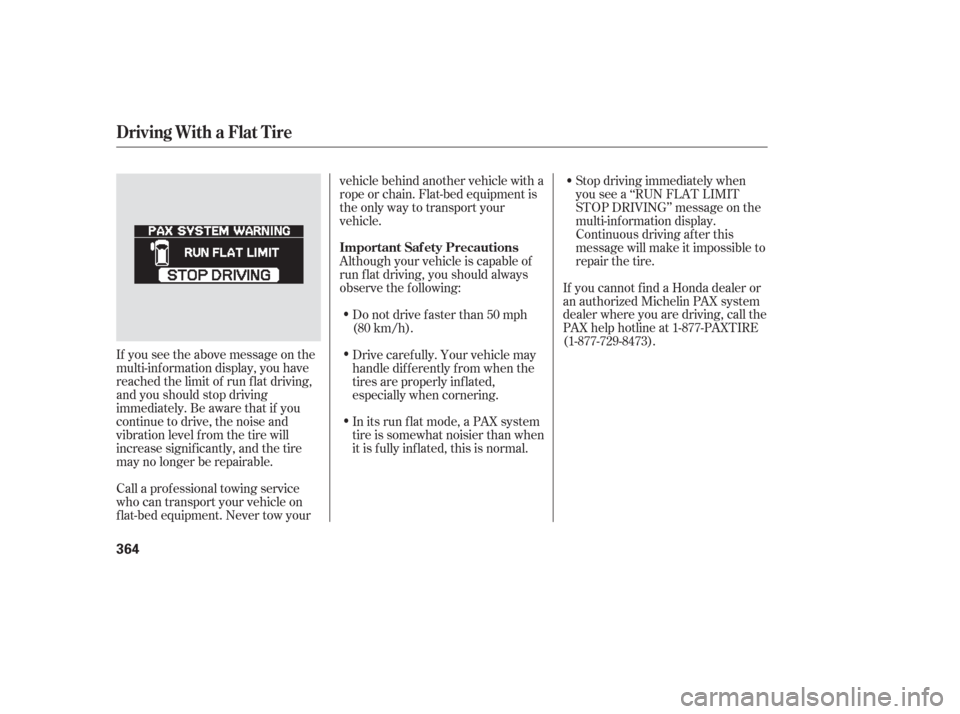
If you see the above message on the
multi-inf ormation display, you have
reached the limit of run f lat driving,
and you should stop driving
immediately. Be aware that if you
continue to drive, the noise and
vibration level f rom the tire will
increase signif icantly, and the tire
may no longer be repairable.Stop driving immediately when
you see a ‘‘RUN FLAT LIMIT
STOP DRIVING’’ message on the
multi-inf ormation display.
Continuous driving af ter this
message will make it impossible to
repair the tire.
If you cannot f ind a Honda dealer or
an authorized Michelin PAX system
dealer where you are driving, call the
PAX help hotline at 1-877-PAXTIRE
(1-877-729-8473).
Call a prof essional towing service
who can transport your vehicle on
f lat-bed equipment. Never tow your vehicle behind another vehicle with a
rope or chain. Flat-bed equipment is
the only way to transport your
vehicle.
Do not drive f aster than 50 mph
(80 km/h).
Drive caref ully. Your vehicle may
handle dif f erently f rom when the
tires are properly inf lated,
especially when cornering.
In its run f lat mode, a PAX system
tire is somewhat noisier than when
it is f ully inf lated, this is normal.
Although your vehicle is capable of
runflatdriving,youshouldalways
observe the f ollowing:
Driving With a Flat Tire
Important Saf ety Precautions
364
Page 384 of 420
If the replacement fuse of the
same rating blows in a short time,
there is probably a serious
electrical problem with your
vehicle. Leave the blown fuse in
that circuit, and have your vehicle
checked by a qualif ied mechanic.
If the radio f use is removed, the
audio system will disable itself . The
nexttimeyouturnontheradioyou
will see ‘‘ ’’ in the f requency
display. Use the preset buttons to
enter the f ive-digit code (see page ).
If you cannot drive the vehicle
without f ixing the problem, and you
do not have a spare fuse, take a fuse
of the same rating or a lower rating
f rom one of the other circuits. Make
sureyoucandowithoutthatcircuit
temporarily (such as the accessory
power socket or radio).
If you replace the blown f use with a
spare f use that has a lower rating, it
might blow out again. This does not
indicate anything wrong. Replace the
f use with one of the correct rating as
soon as you can.
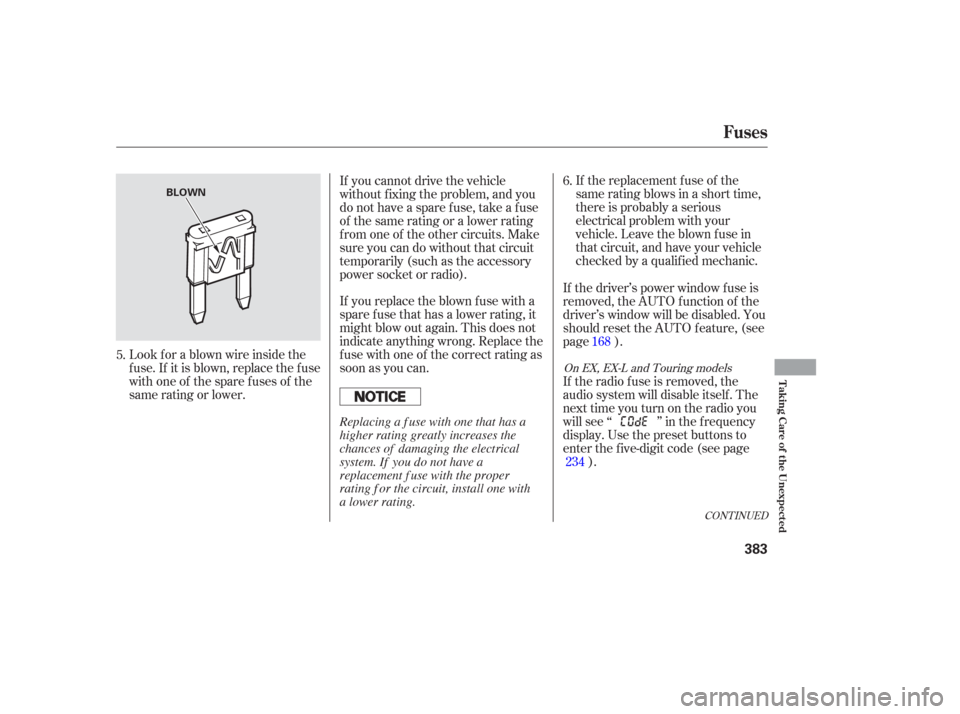
Look f or a blown wire inside the
fuse.If itisblown,replacethefuse
withoneof thesparefusesof the
same rating or lower. If the driver’s power window f use is
removed, the AUTO f unction of the
driver’s window will be disabled. You
should reset the AUTO f eature, (see
page ).
5. 6.
168
234
CONT INUED
On EX, EX-L and Touring models
Fuses
T aking Care of t he Unexpect ed
383
BLOWN
Replacing a f use with one that has a
higher rating greatly increases the
chances of damaging the electrical
system. If you do not have a
replacement f use with the proper
rating f or the circuit, install one with
a lower rating.
Page 396 of 420
�µWarning: The temperature grade f or
this tire is established f or a tire that
is properly inf lated and not
overloaded. Excessive speed,
underinf lation, or excessive loading,
either separately or in combination,
can cause heat buildup and possible
tire f ailure.
The temperature grades are A (the
highest), B, and C, representing the
tire’s resistance to the generation of
heat, and its ability to dissipate heat
when tested under controlled
conditions on a specif ied indoor
laboratory test wheel. Sustained high
temperature can cause the material
of the tire to degenerate and reduce
tire life, and excessive temperature
can lead to sudden tire f ailure. Grade
C corresponds to a level of
perf ormance that all passenger car
tires must meet under the Federal
Motor Vehicle Saf ety Standard No.
109. Grades B and A represent
higher levels of perf ormance on the
laboratory test wheel than the
minimum required by law.
DOT Tire Quality Grading (U.S. Vehicles)
Temperature A,B,C
Technical Inf ormation
395
Page:
< prev 1-8 9-16 17-24