Page 41 of 420
�µ
During a crash, the
belt could press deep into the child
and cause serious or fatal injuries.
If they do, they
could be very seriously injured in a
crash. If you are not wearing a
seat belt in crash, you could be
thrown forward and crush the
child against the dashboard or a
seat-back. If you are wearing a
seat belt, the child can be torn
from your arms and be seriously
hurt or killed. This can prevent children
f rom accidentally f alling out (see
page ).
For example, infants and small
childrenleftinavehicleonahot
day can die f rom heatstroke. A
child lef t alone with the key in the
ignition switch can accidentally set
the vehicle in motion, possibly
injuring themselves or others. Children
who play in vehicles can
accidentally get trapped inside.
Teach your children not to play in
or around vehicles.
Even very young
children learn how to unlock
vehicle doors, turn on the ignition
switch, and open the tailgate,
which can lead to accidental injury
or death.
Leaving children without
adult supervision is illegal in most
states and Canadian provinces,
and can be very hazardous. This
will prevent unintended use of the
doors. 142
Never put a seat belt over yourself
and a child.
Never let two children use thesame seat belt .
Neverholdaninfantorchildon
your lap. Use childproof door locks t o
prevent children f rom opening t hedoors. L ock all doors and t ailgat e when
your vehicle is not in use.
K eep vehicle keys/remot etransmitters out of the reach ofchildren.
Do not leave children alone in a vehicle.
Use t he power sliding door main
swit ch t o prevent children f romoperat ing t he sliding doors.
Additional Saf ety Precautions
Protecting Children General Guidelines
40
Page 42 of 420
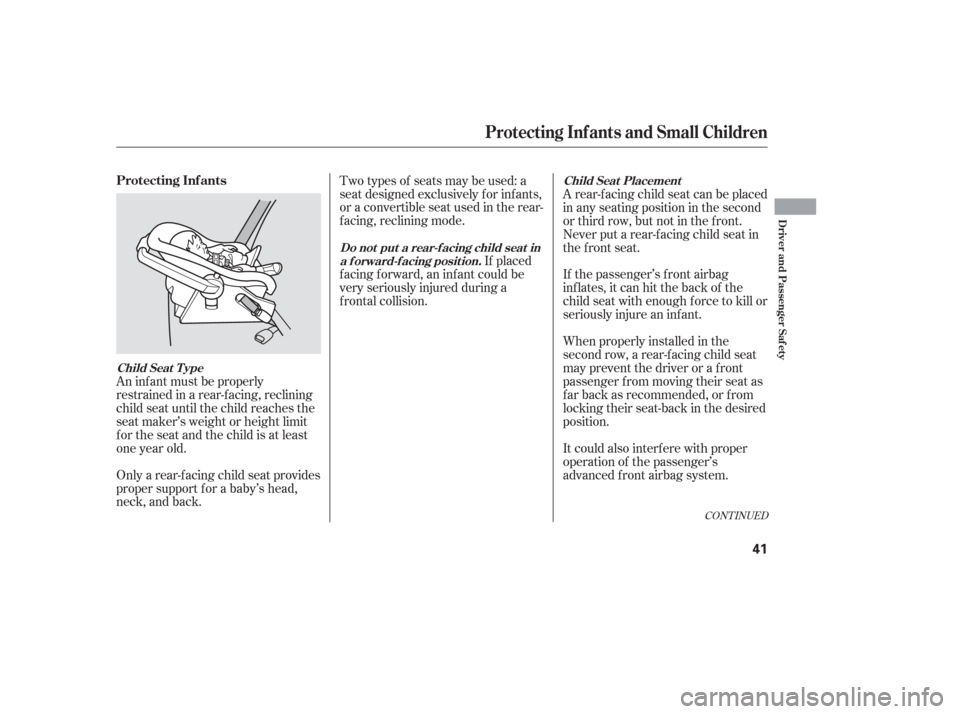
An inf ant must be properly
restrained in a rear-f acing, reclining
child seat until the child reaches the
seat maker’s weight or height limit
for the seat and the child is at least
one year old.
Only a rear-f acing child seat provides
proper support f or a baby’s head,
neck, and back.Two types of seats may be used: a
seat designed exclusively f or inf ants,
or a convertible seat used in the rear-
f acing, reclining mode.
If placed
f acing f orward, an inf ant could be
very seriously injured during a
f rontal collision. If the passenger’s front airbag
inflates, it can hit the back of the
child seat with enough f orce to kill or
seriously injure an inf ant. A rear-f acing child seat can be placed
in any seating position in the second
or third row, but not in the f ront.
Never put a rear-f acing child seat in
the front seat.
When properly installed in the
second row, a rear-f acing child seat
maypreventthedriverorafront
passenger f rom moving their seat as
f ar back as recommended, or f rom
locking their seat-back in the desired
position.
It could also interf ere with proper
operation of the passenger’s
advanced front airbag system.
CONT INUED
Protecting Inf ants
Child Seat T ype Child Seat Placement
Do not put a rear-f acing child seat in a f orward-f acing position.
Protecting Inf ants and Small Children
Driver and Passenger Saf ety
41
Page 49 of 420
When not using the LATCH system,
all child seats must be secured to the
vehicle with the lap part of a lap/
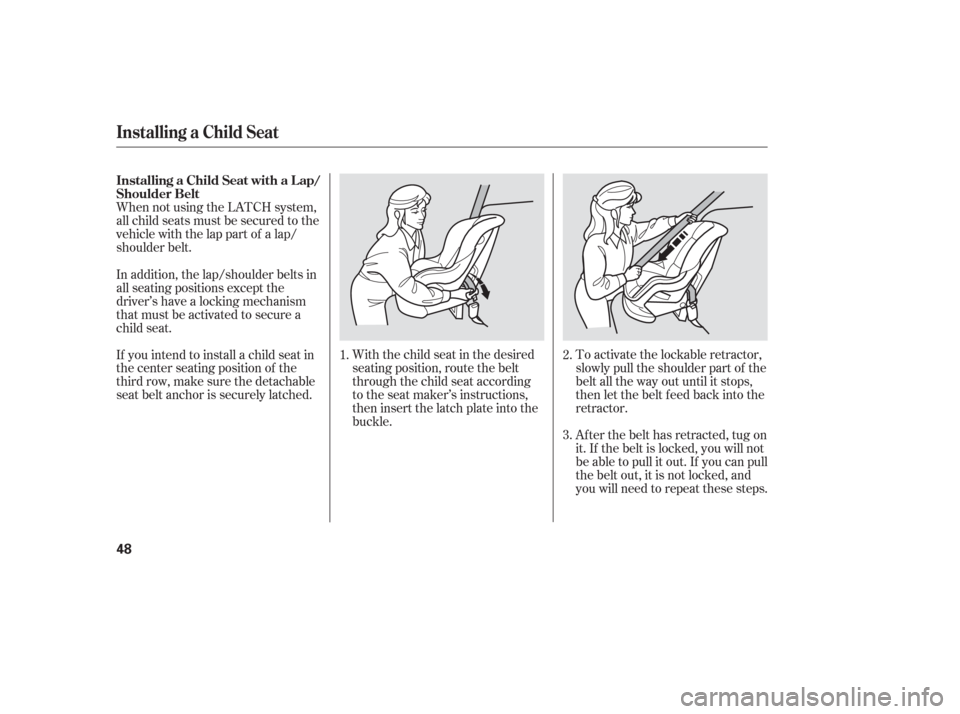
shoulder belt.With the child seat in the desired
seating position, route the belt
through the child seat according
to the seat maker’s instructions,
then insert the latch plate into the
buckle.To activate the lockable retractor,
slowly pull the shoulder part of the
belt all the way out until it stops,
then let the belt f eed back into the
retractor.
Af ter the belt has retracted, tug on
it. If the belt is locked, you will not
be able to pull it out. If you can pull
thebeltout,itisnotlocked,and
you will need to repeat these steps.
In addition, the lap/shoulder belts in
all seating positions except the
driver’s have a locking mechanism
that must be activated to secure a
child seat.
If you intend to install a child seat in
the center seating position of the
thirdrow,makesurethedetachable
seat belt anchor is securely latched.
1.
2.
3.
Installing a Child Seat
Installing a Child Seat with a L ap/
Shoulder Belt
48
Page 50 of 420
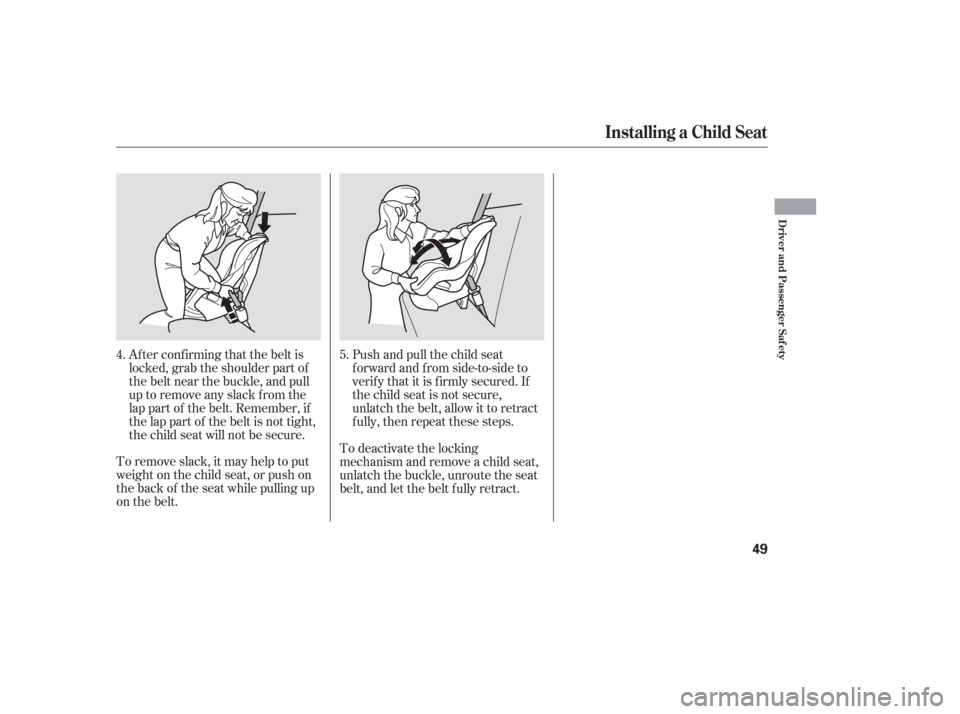
To remove slack, it may help to put
weight on the child seat, or push on
the back of the seat while pulling up
on the belt.Push and pull the child seat
f orward and f rom side-to-side to
verif y that it is f irmly secured. If
the child seat is not secure,
unlatch the belt, allow it to retract
f ully, then repeat these steps.
To deactivate the locking
mechanism and remove a child seat,
unlatch the buckle, unroute the seat
belt, and let the belt f ully retract.
Af ter conf irming that the belt is
locked, grab the shoulder part of
the belt near the buckle, and pull
up to remove any slack from the
lap part of the belt. Remember, if
the lap part of the belt is not tight,
the child seat will not be secure.
5.
4.
Installing a Child Seat
Driver and Passenger Saf ety
49
Page 60 of 420

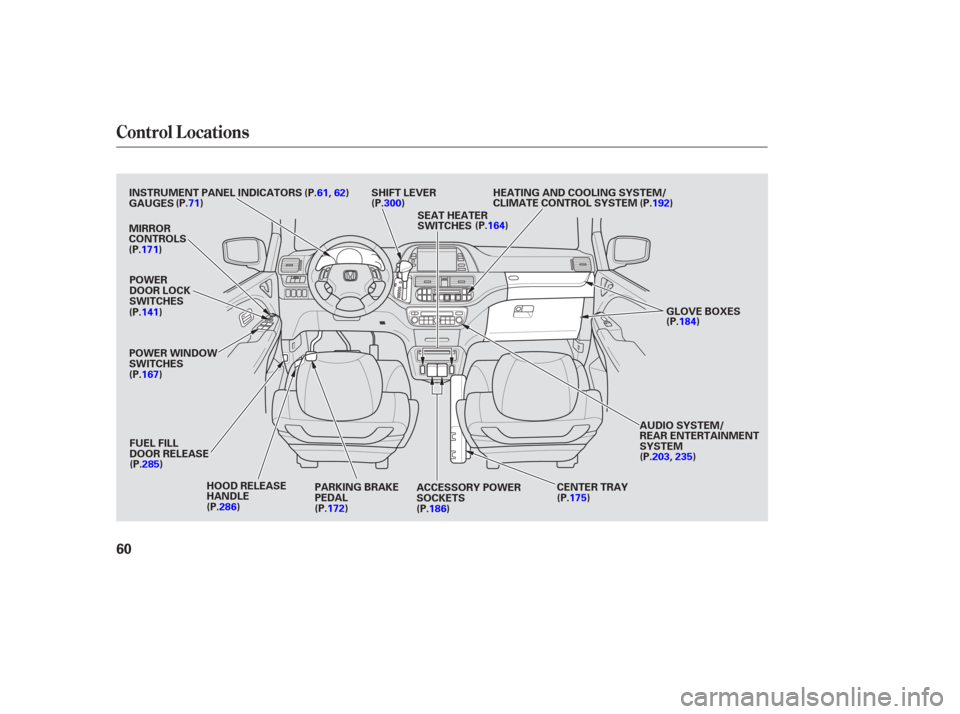
This section gives inf ormation about
the controls and displays that
contribute to the daily operation of
your vehicle. All the essential
controls are within easy reach............................
Control Locations .60............................
Instrument Panel .61
..........
Instrument Panel Indicators .63
.............................................
Gauges .71
.............
Multi-Inf ormation Display .74
Controls Near the Steering
.........................................
Wheel .124
Windshield Wipers and .....................................
Washers .125
Rear Window Wiper and .......................................
Washer .126
.........
Turn Signal and Headlights .126
......
Instrument Panel Brightness .129
...............
Hazard Warning Button .130
...............
Rear Window Def ogger .130
........
Steering Wheel Adjustment .131
.............................
Keys and Locks .132
......................
Immobilizer System .133
..............................
Ignition Switch .134
.....................
Remote Transmitter .135
....................................
Door Locks .141
....................
Power Door Locks .141
............
Childproof Door Locks .142
..........................................
Tailgate .142
..........................
Power Tailgate .143
.................................
Sliding Doors .146
...............................................
Seats .152..................................
Seat Heaters .164
Driver’s Seat Position Memory ........................................
System .165
............................
Power Windows .167
.......................................
Moonroof .170
...........................................
Mirrors .171
...............................
Parking Brake .172
.
Adjustable Driver’s Foot Pedals .173
.........
Interior Convenience Items .174
..........
Retractable Center Tray .175
.....................
Beverage Holders .175
................
Integrated Sunshade .177
....................
Sunglasses Holder .178
................
Conversation Mirror .178
...................................
Sun Visor .179
............................
Vanity Mirror .179
...................
Rear Compartment .179
Removable Second Row
..................................
Console .180
...............
In-Floor Storage Area .181
......................
Lower Glove Box .184
......................
Upper Glove Box .184
...........................
Center Pocket .185
........
Accessory Power Sockets . 186
.......................
AC Power Outlet .186
...............................
Interior Lights .187
Instruments and Controls
Inst rument s and Cont rols
59
Page 61 of 420
Control L ocations
60
AUDIO SYSTEM/
REAR ENTERTAINMENT
SYSTEM
PARKING BRAKE
PEDAL
FUEL FILL
DOOR RELEASE
HOOD RELEASE
HANDLE
POWER WINDOW
SWITCHES
POWER
DOOR LOCK
SWITCHES
INSTRUMENT PANEL INDICATORS
SHIFT LEVER
MIRROR
CONTROLS
ACCESSORY POWER
SOCKETS
(P.61,62)
GAUGES (P.71) HEATING AND COOLING SYSTEM/
CLIMATE CONTROL SYSTEM
CENTER TRAY
SEAT HEATER
SWITCHES
GLOVE BOXES
(P.141)
(P.167)
(P.285) (P.286) (P.172)(P.186) (P.175)(P.203,235)(P.184)
(P.192)
(P.164)
(P.300)
(P.171)
Page 62 of 420
�Î
�Î�Î
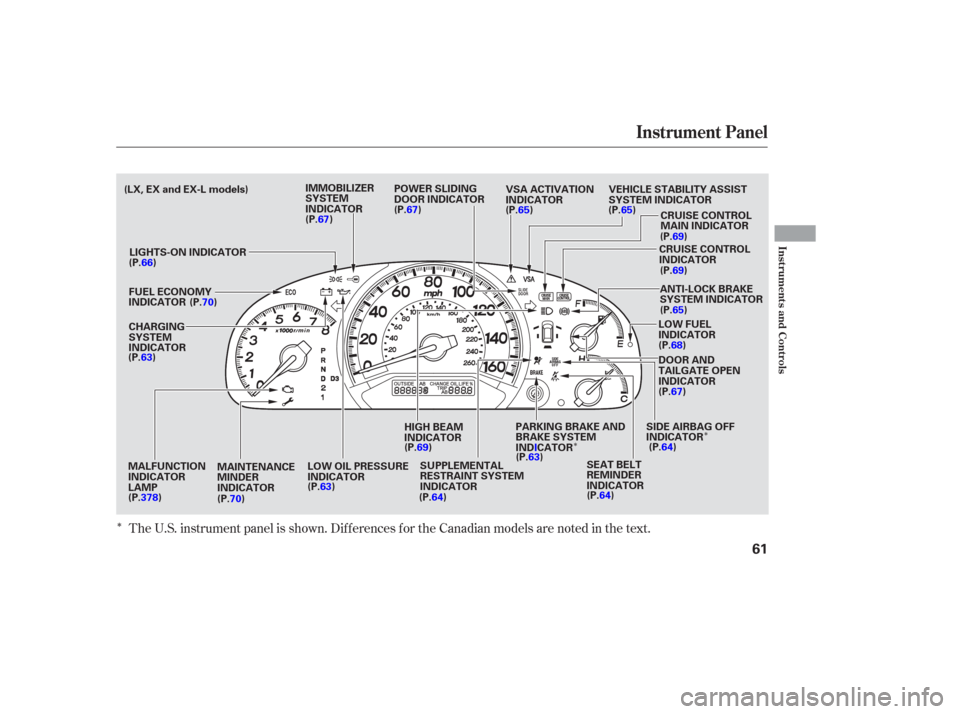
The U.S. instrument panel is shown. Dif f erences f or the Canadian models are noted in the text.
Instrument Panel
Inst rument s and Cont rols
61
SUPPLEMENTAL
RESTRAINT SYSTEM
INDICATOR
HIGH BEAM
INDICATOR
LOW OIL PRESSURE
INDICATOR
IMMOBILIZER
SYSTEM
INDICATOR
POWER SLIDING
DOOR INDICATOR
ANTI-LOCK BRAKE
SYSTEM INDICATOR
LOW FUEL
INDICATOR
DOOR AND
TAILGATE OPEN
INDICATOR
PARKING BRAKE AND
BRAKE SYSTEM
INDICATOR SEAT BELT
REMINDER
INDICATOR
CHARGING
SYSTEM
INDICATOR
CRUISE CONTROL
MAIN INDICATOR
CRUISE CONTROL
INDICATOR
LIGHTS-ON INDICATOR
SIDE AIRBAG OFF
INDICATOR
VSA ACTIVATION
INDICATOR
VEHICLE STABILITY ASSIST
SYSTEM INDICATOR
FUEL ECONOMY
INDICATOR
MALFUNCTION
INDICATOR
LAMP (P.67)
(P.67)
(P.66) (P.70)
(P.63)
(P.70) (P.63)
(P.64)
(P.69)
(P.63)
(P.64)(P.64)(P.67) (P.68)(P.69) (P.69)
(P.65)
(P.65)
(P.65)
MAINTENANCE
MINDER
INDICATOR
(LX, EX and EX-L models)
(P.378)
Page 63 of 420
�Î
�Î�Î
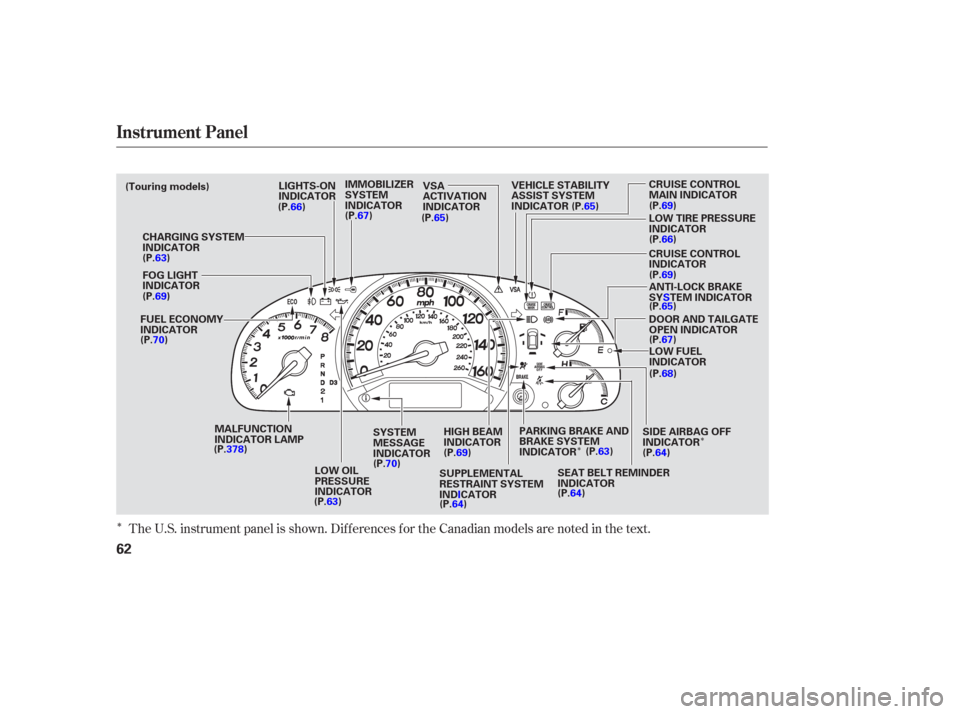
The U.S. instrument panel is shown. Dif f erences f or the Canadian models are noted in the text.
Instrument Panel
62
SEAT BELT REMINDER
INDICATORCRUISE CONTROL
INDICATOR LOW TIRE PRESSURE
INDICATOR
FOG LIGHT
INDICATOR CHARGING SYSTEM
INDICATOR
SUPPLEMENTAL
RESTRAINT SYSTEM
INDICATORCRUISE CONTROL
MAIN INDICATOR
PARKING BRAKE AND
BRAKE SYSTEM
INDICATOR
IMMOBILIZER
SYSTEM
INDICATOR
LIGHTS-ON
INDICATOR
LOW OIL
PRESSURE
INDICATOR HIGH BEAM
INDICATOR LOW FUEL
INDICATOR
DOOR AND TAILGATE
OPEN INDICATOR
VSA
ACTIVATION
INDICATOR
(Touring models)
FUEL ECONOMY
INDICATOR VEHICLE STABILITY
ASSIST SYSTEM
INDICATOR
ANTI-LOCK BRAKE
SYSTEM INDICATOR
SIDE AIRBAG OFF
INDICATOR
MALFUNCTION
INDICATOR LAMP
SYSTEM
MESSAGE
INDICATOR
(P.66)
(P.63)
(P.69)
(P.70)
(P.63)(P.70)
(P.69)
(P.64) (P.64)(P.64)
(P.63) (P.68)
(P.67)
(P.65) (P.65)
(P.69)
(P.66)
(P.69)
(P.65)
(P.67)
(P.378)