Page 197 of 319

Store or secure all items that could
be thrown around and hurt
someone during a crash.
Do not put any items on top of the
rear shelf. They can block your
view and be thrown around the
vehicle during a crash.
In addition, the total weight of the
vehicle, all passengers, accessories,
cargo, and trailer tongue load must
not exceed the Gross Vehicle
Weight Rating (GVWR) or the Gross
Axle Weight Rating (GAWR). Both
areonalabelonthedriver’s
doorjamb.
Distribute cargo evenly on the
floor of the trunk, placing the
heaviest items on the bottom and
as far forward as possible. Tie
down items that could be thrown
about the vehicle during a crash or
sudden stop.
Ifyoufolddownthebackseat,tie
down items that could be thrown
about the vehicle during a crash or
sudden stop.
If you carry large items that
prevent you from closing the trunk
lid,
exhaust gas can enter the
pa ssenger area. To avoid the
possibility of
, follow the instructions
on page .
Be sure items placed on the f loor
behind the f ront seats cannot roll
under the seats and interf ere with
proper operation of the pedals, the
front seats, or the advanced front
airbags.
Keep the glove box closed while
driving. If it is open, a passenger
could injure their knees during a
crash or sudden stop.
50
CONT INUED
Carrying Cargo
Carrying Cargo in the Trunk or on
a Roof Rack
Carrying Items in the Passenger
Compartment
carbon monoxide
poisoning
Bef ore Driving
195
�����—�����—�����y�
�������������y���
�(���%�������y���
�����y
Page 198 of 319
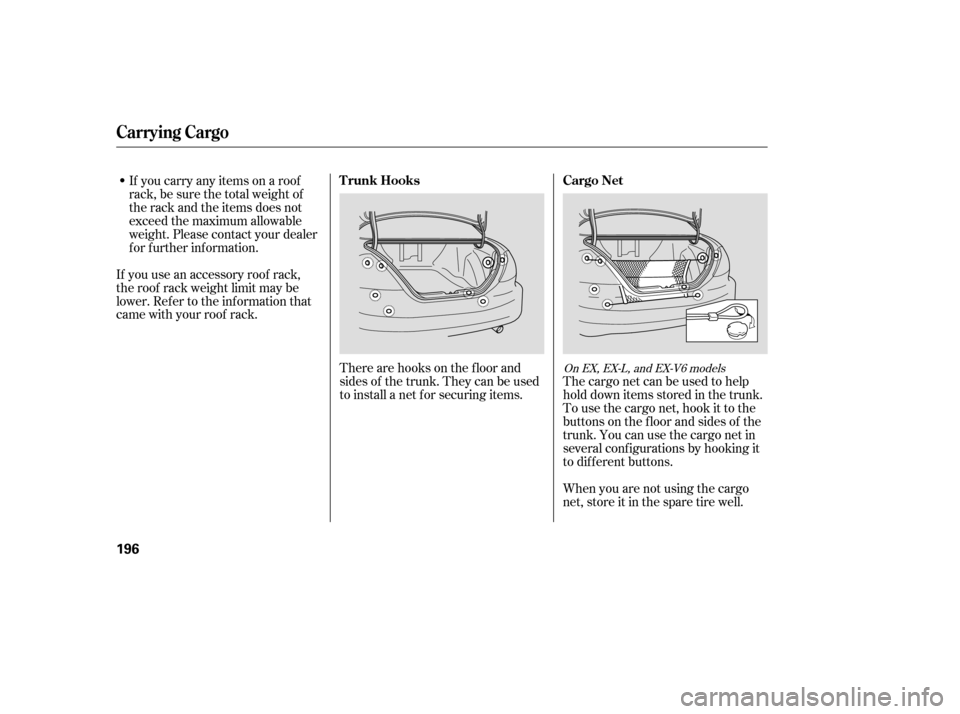
The cargo net can be used to help
hold down items stored in the trunk.
To use the cargo net, hook it to the
buttons on the f loor and sides of the
trunk. You can use the cargo net in
several conf igurations by hooking it
to dif f erent buttons.
When you are not using the cargo
net,storeitinthesparetirewell.
There are hooks on the f loor and
sides of the trunk. They can be used
to install a net f or securing items.
If you carry any items on a roof
rack,besurethetotalweightof
the rack and the items does not
exceed the maximum allowable
weight. Please contact your dealer
for further information.
If you use an accessory roof rack,
the roof rack weight limit may be
lower. Ref er to the inf ormation that
came with your roof rack.
On EX, EX-L, and EX-V6 models
Carrying Cargo
Cargo Net
T runk Hooks
196
�����—�����—�����y�
���������
���y���
�(���%�������y���
�����y
Page 200 of 319
Youshoulddothefollowingchecks
and adjustments before you d rive
your vehicle.
Make sure all windows, mirrors,
and outside lights are clean and
unobstructed. Remove frost, snow,
or ice.
Check that the hood is fully closed. Check the seat adjustment (see
page ).
Check the adjustment of the
inside and outside mirrors (see
page ).
Check the steering wheel
adjustment (see page ).
Make sure the doors and the
trunk are securely closed and
locked.
Fasten your seat be
lt. Check that
your passengers have fastened their seat belts (see page ).
Wh en you start the engine, check
the gauges and indicato rs in the
instrument panel (see page ).
Check that the trunk is f ully
closed.
Visually check the tires. If a tire
looks low, use a gauge to check its
pressure.
Check that any items you may be
carrying are stored properly or
f astened down securely.
2.
1.
6.
7.
8.
9.
14
3.
4.
5.
10.
11. 55
95
82
73
Preparing to Drive
198
�����—�����—�����y�
�������������y���
�(���%�������y�������
�y
Page 209 of 319

Always use the parking brake when
you park your vehicle. Make sure
the parking brake is set f irmly, or
your vehicle may roll if it is parked
on an incline.
If your vehicle has an automatic
transmission, set the parking brake
bef ore you put the transmission in
Park. This keeps the vehicle f rom
moving and putting pressure on the
parking mechanism in the
transmission.If the vehicle is f acing uphill, turn
the front wheels away from the
curb. If you have a manual
transmission, put it in f irst gear.
If the vehicle is f acing downhill,
turn the front wheels toward the
curb. If you have a manual
transmission, put it in reverse gear.
Make sure the parking brake is
f ully released bef ore driving away.
Driving with the parking brake
partially set can overheat or
damage the rear brakes.
Make sure the moonroof (if
equipped) and the windows are
closed.
Turn of f the lights.
Place any packages, valuables, etc.,
in the trunk or take them with you.
Lock the doors.
Check the indicator on the
instrument panel to verif y that the
security system is set.
Never park over dry leaves, tall
grass, or other f lammable
materials. The hot three way
catalytic converter could cause
these materials to catch on fire.
Parking T ips
Parking
Driving
207
�����—�����—�����y�
�������������y���
�(���%�������y�����
���y
Page 217 of 319

Towing can require a variety of
equipment, depending on the size of
your trailer, how it will be used, how
much load you are towing, and
where you tow.
Discuss your needs with your trailer
sales or rental agency, and f ollow the
guidelines in this section. Also make
sure that all equipment is properly
installed and maintained, and that it
meets f ederal, state, province, and
local regulations.
Any hitch used on your vehicle must
be properly bolted to the underbody.Always use saf ety chains when you
tow a trailer. Make sure the chains
are secured to the trailer and hitch,
and that they cross under the tongue
and can catch the trailer if it
becomes unhitched. Leave enough
slack to allow the trailer to turn
corners easily, but do not let the
chains drag on the ground.
Seeyourtrailerdealerformore
inf ormation on installing electric
brakes.
Trailer lights and equipment must
comply with f ederal, state, province,
and local regulations. Check the
requirements f or the areas where
you plan to tow, and use only
equipment designed f or your vehicle.
Since lighting and wiring vary by
trailer type and brand, you should
have a qualif ied technician install a
suitable connector between the
vehicle and the trailer. Improper
equipment or installation can cause
damage to your vehicle’s electrical
system and af f ect your vehicle
warranty.
Honda requires that any trailer with
a total weight of 1,000 lbs (455 kg) or
more be equipped with its own
electric or surge-type brakes.
If you choose electric brakes, be
sure they are electrically actuated.
Do not attempt to tap into your
vehicle’s hydraulic system. No
matter how successf ul it may seem,
any attempt to attach trailer brakes
to your vehicle’s hydraulic system
will lower braking ef f ectiveness and
create a potential hazard.
T owing Equipment and
A ccessories
Hitches
Saf et y Chains
Trailer Brakes T railer L ights
Towing a Trailer
Driving
215
�����—�����—�����y�
������
������y���
�(���%�������y�����
���y
Page 218 of 319

Many states and Canadian provinces
require special outside mirrors when
towing a trailer. Even if they don’t,
you should install special mirrors if
you cannot clearly see behind you, or
if the trailer creates a blind spot.
Askyourtrailersalesorrental
agency if any other items are
recommended or required f or your
towing situation.When preparing to tow, and bef ore
driving away, be sure to check the
f ollowing:
The vehicle has been properly
serviced, and the tires, brakes,
suspension, cooling system, and
lights are in good operating
condition.
All weights and loads are within
limits.
Thehitch,safetychains,andany
other attachments are secure.
All items in or on the trailer are
properly secured and cannot shif t
while you drive.
The lights and brakes on your
vehicle and the trailer are working
properly. Your vehicle tires and spare are
properly inf lated, and the trailer
tires and spare are inflated as
recommended by the trailer
maker.
A ddit ional T owing EquipmentPre-T ow Checklist
Towing a Trailer
216
�����—�����—�����y�
������
������y���
�(���%�������y�����
���y
Page 234 of 319
Unscrew and remove the engine oil
fill cap on top of the valve cover.
Pour in the oil slowly and caref ully so
you do not spill. Clean up any spills
immediately. Spilled oil could
damage components in the engine
compartment.Install the engine oil f ill cap, and
tighten it securely. Wait a f ew
minutes, and recheck the oil level.
Do not f ill above the upper mark; you
could damage the engine.Oil is a major contributor to your
engine’s perf ormance and longevity.
Always use a premium-grade 5W-20
detergent oil displaying the API
Certif ication Seal. This seal indicates
the oil is energy conserving, and that
it meets the American Petroleum
Institute’s latest requirements. Recommended Engine Oil
A dding Engine Oil
232
ENGINE OIL FILL CAP
4-cylinder models 6-cylinder models
ENGINE OIL FILL CAPAPI CERTIFICATION SEAL
�����—�����—�����y�
�������������y���
�(���%�������y���������y
Page 241 of 319
CONT INUED
4-cylinder models
Check the f luid level with the engine
at normal operating temperature.Park the vehicle on level ground.
Shut of f the engine.
Remove the dipstick (yellow loop)
f rom the transmission, and wipe it
with a clean cloth. Insert the dipstick all the way into
the transmission securely as
shown in the illustration.
Make sure the notch in the rubber
cap f its in the dipstick guide and
that you push the dipstick in all
the way.
1.
2. 3.
Automatic Transmission
Windshield Washers, T ransmission Fluid
Maint enance
239
6-cylinder models
LEVEL GAUGE
DIPSTICKDIPSTICK
GUIDE
UPPER MARK
LOWER MARK
Do not use engine antif reeze or a
vinegar/water solution in the
windshield washer reservoir. Antif reeze
can damage your vehicle’s paint, while
a vinegar/water solution can damage
the windshield washer pump. Use only
commercially-available windshield
washer f luid.
�����—�����—�����y�
�������������y���
�(���%�������y���������y