2006 GREAT WALL HOVER ECU
[x] Cancel search: ECUPage 366 of 425

CD Player and Air Conditioning System-13
1 .CC6460K air conditioning system is designed with SD7V16 compressor, whose refrigeration oil type as
specified is SP-10P AG; hence application of other type of refrigeration oil may damage the parts and compo
nents of the compressor. When the
air conditioning system goes through maintenance and replacement of
parts, it should be added with new refrigeration oil, whose volume is listed as follows: the evaporator and
condenser: 30ml; the drier: 20ml; the pipeline: 10ml.
Addition of refrigeration oil can be available with two methods: The direct addition and the vacuum suction
2 .D irect addition method
a. remove the oil filler plug and fill with the specified SP-10P AG refrigeration oil.
b. observe through the hole of oil filter plug and rotate front plate of clutch to make the piston connecting rod right positio n in the
center of the hole of oil filter plug.
c. insert the dipstick along the right side of piston connecting rod till the top of dipstick touches the case of the compresso
r
d. pull out the dipstick and examine the graduations (grooves) of refrigeration oil, the readings shall be within the range of 4-6
scales
.
e. screw firmly the oil filter plug with the fastening torque of 14.7± 4.9N
.m
3. Vacuum suction method:
Firstly pump out the refrigerating system to the vacuum of 0.2x10⁵Pa, and then fill with the specified 0.2x10 5 Pa refrigeration oil;
the detailed steps are as follows:
a. switch off the high-pressure manual valve and the auxiliary valve.
b. dismantle the high-pressure side hose from the manifold pressure gauge and insert it into the oil cu
p
c. open the auxiliary valve and have the refrigeration oil sucked into the refrigerating system from the oil cup.
d. when the refrigeration oil in the oil cup is almost pumped out to the vacuum, then immediately turn off the auxiliary valve
to
prevent the air from being sucked into the system
.
e. secure the hose adapter at high-pressure side to the manifold pressure gauge, start the vacuum pump and turn on the high-
pressure manual valve, then turn on the auxiliary valve to pump the system to the vacuum state of 0.2x10
5Pa, keep such state
for 15mins so as to discharge out the air flowing into the system along with the oil.
V ol ume of Refrigeration Oil Addition and its Methods
2.ai r h eating system
T r oubl e Cau ses o f the trouble
H e ati n g n otsuppl i ed or
no t s
uf f i cientl y suppl i ed 1.
blow erof air c ondition erf ai l u re 2.relay o f the blow erdamage
d
3. heati n g w ater pipe bloc k e d 4 . coo ling water p i pe b lock ed
5. col d/h ot damp erexecutor damage d 6. ins
uf f i cien t c oo ling l iqu id
N o rotation ofblow er 1.
f use burned
down orpoor contac t o f the switch
2. mo tor o f the blowe r burne d d ow
n
3. op en circ uit o f h igh- sp eed relay o f the blow er
4. speed-ad j usti n g m odule d am aged
5. short c ircu it
leak age o f w ater W ater p ipe o f ai rhe ati n g a ged, inse cu re j oi nt
O v erhe at 1.
speed-ad j usti n g r esi sto r o f the f an d am aged
2. col d/h ot damp erexecutor damaged
I nsu f f i cien t h otair
vo lume f or d efro stin
g 1.
mode executor dama ge
d
2. f al li n g o f fof the d riv e ro
d
3. damp ernot in p osi ti o
n
4. air v ent b l ock ed
5. inad equa te heatin g s
upply
6. inst
alla tion ofwind tunn elno t fi t
7. circ uit d i sco nn ecte
d
Page 370 of 425

CD Player and Air Conditioning System-17
Daily Maintenance of Air Conditioning System
In order to ensure normal operation of air conditioning system, maintenance and care services shall be frequently performed for the
air conditioning system. The daily maintenance of air conditioning system is illustrated as follows:
1. Inspect, wash and clean the condenser of air conditioning system, requiring that radiator pins are clean and there is no dirt
between the pins. After the car runs in the rain or on the muddy road, the fan of the condenser should be inspected to find
whether it bears the earth, sand, stone and etc, and remove them if any.
2. Check the quantity of the working media of the refrigerating system; when the compressor set works normally, observe the
liquid viewing glass, under the normal circumstance, there shall be not air bubbles in the glass.
3. Inspect the drive belt. The belt between the compressor and the engine should be tensioned.
4. Check if there is any abnormal noise or odor in the air conditioning system.
5. Check if the temperature difference between the air inlet and outlet of the compressor is normal.
6. Check if the hose of the refrigerating system is in an apparent good condition and connections of all joints are secure.
7. Check if the pipeline of the refrigerating system collides with other parts and components, and if there is any oil leakage trace
left at each joint.
8. Check if the circuit connection of the refrigerating system is secure and if there is an occurrence of short circuit and falling off
9. Check if fastening bolts of the compressor are firmly secured or broken. d. When connecting the pipe, apply little compressor oil to the O-ring and fasten the nut with two wrenches. Attention: never
spatter the compressor oil to the painted parts or the plastic components to avoid the corrosion. If these components are
spattered with the oil, please clean it immediately.
e. When connecting the pipe, please follow the torque listed in the following table to fasten the screws or the nuts:
Diameter of Pipe Fastening Torque (N·m)
¢8mm 12-15
¢16mm 30-35 30-35
At ends of each pipe the protective caps should be installed till the pipe is connected to the refrigerating system.
compressor oil fasten it by using two wrenches at the same time
Page 372 of 425
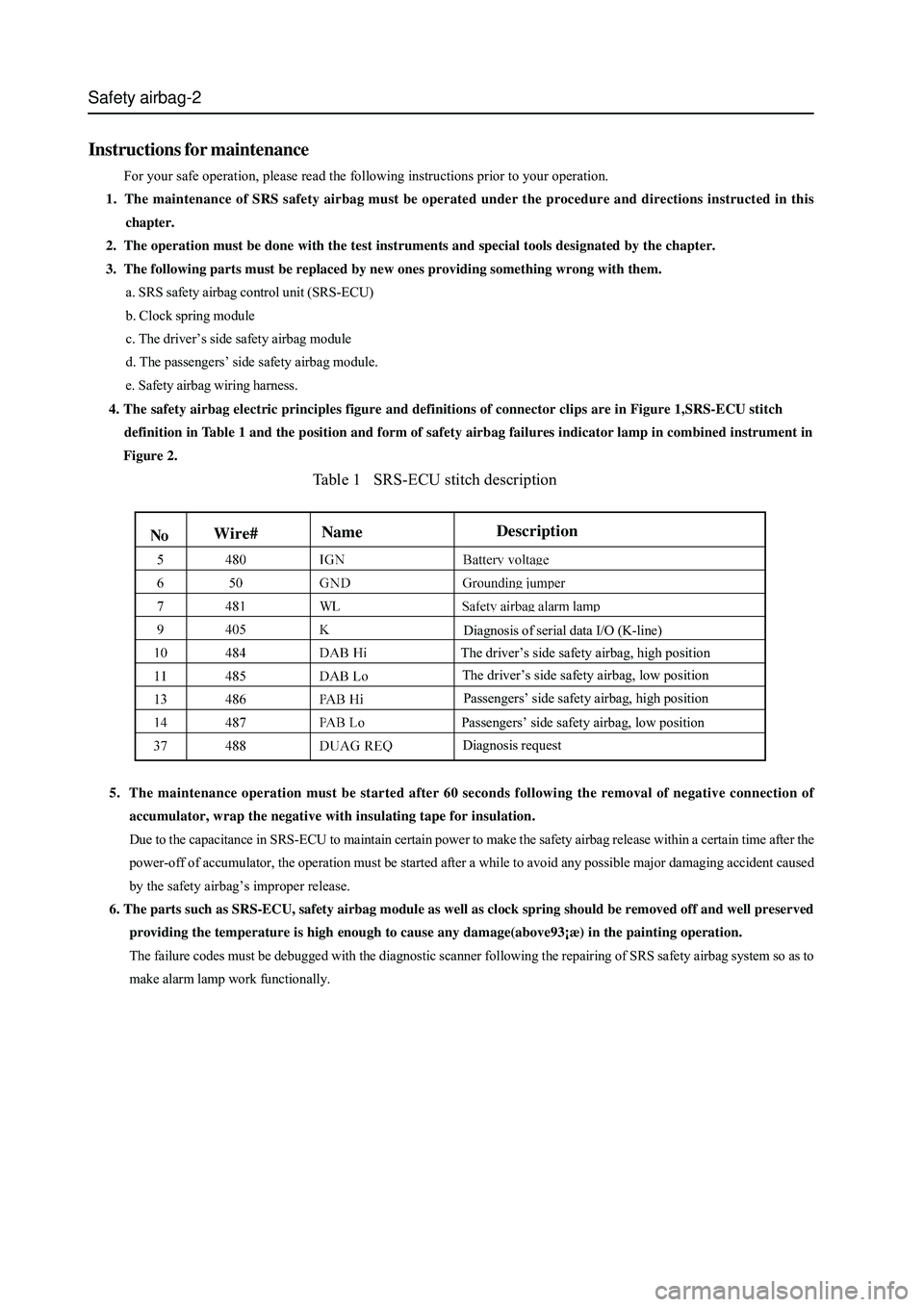
Safety airbag-2
Table 1 SRS-ECU stitch description
5. The maintenance operation must be started after 60 seconds following the removal of negative connection of
accumulator, wrap the negative with insulating tape for insulation.
Due to the capacitance in SRS-ECU to maintain certain power to make the safety airbag release within a certain time after the
power-off of accumulator, the operation must be started after a while to avoid any possible major damaging accident caused
by the safety airbag’s improper release.
6. The parts such as SRS-ECU, safety airbag module as well as clock spring should be removed off and well preserved
providing the temperature is high enough to cause any damage(above93¡æ) in the painting operation.
The failure codes must be debugged with the diagnostic scanner following the repairing of SRS safety airbag system so as to
make alarm lamp work functionally.
Instructions for maintenance
For your safe operation, please read the following instructions prior to your operation.
1. The maintenance of SRS safety airbag must be operated under the procedure and directions instructed in this
chapter.
2. The operation must be done with the test instruments and special tools designated by the chapter.
3. The following parts must be replaced by new ones providing something wrong with them.
a. SRS safety airbag control unit (SRS-ECU)
b. Clock spring module
c. The driver’s side safety airbag module
d. The passengers’ side safety airbag module.
e. Safety airbag wiring harness.
4. The safety airbag electric principles figure and definitions of connector clips are in Figure 1,SRS-ECU stitch
definition in Table 1 and the position and form of safety airbag failures indicator lamp in combined instrument in
Figure 2.
The driver’s side safety airbag, low position
Wire#Description
Name
Diagnosis request
The driver’s side safety airbag, high position
Passengers’ side safety airbag, high position
Passengers’ side safety airbag, low position
Diagnosis of serial data I/O (K-line)
Page 375 of 425

Safety airbag-5
Test instrument
InstrumentNameUtility
diagnostic scanner
The alarm lamp
keeps illuminating.Failure
handlingDebug the
failure codes
Test the systematic failures in
SRS safety airbag system, debug
ECU. failure codes.
The basic failure diagnosis process
The failure code DTC of both present and history-accumulated failures may co-exist.
Caution
The safety airbag alarm lamp flashes for 6 times and then extinguishes when the ignition switch is in ON
position after the installation of new safety airbag system electronic control unit, which demonstrates the
normal function of SRS safety airbag system. In this case the system does not need to be tested, otherwise it
should be diagnosed and repaired.
If the alarm lamp does not illuminate when the ignition switch is in ON position, repair the alarm lamp relevant
circuit and, then further operate to get it into work.
Scan the ECU by connecting
the scanner with k-lineFailure detection
The test for SRS safety airbag alarm lamp
SRS-ECU will execute a series of diagnosis and test to check whether the function of airbag system is prepares. The check can
prevent the restriction system from mis-explosion and ensure the necessary explosion during collision. If found the failure,
SRS-ECU will save a proper failure code and light the alarm lamp to indicate a failure status for the convenience of maintenance.
If connect the pin 2# wire 488# (diagnosis request wire) on the diagnosis port to the ground (wire 50#) for more than 2s, the
safety airbag alarm lamp will flash the code. For detailed position refer to following figure.safety airbag system alarm lamp
Page 376 of 425

Safety airbag-6
brown whitered
diagnosis plug
black
Failure judgment
1. Failure record (failure code storage)
When ECU determines the error through the cyclic diagnosis and test, SRS-ECU should saves the corresponding code, first
judgment time, final judgment time and number of occurrence in EEPROM.
RS-ECU can stores 6 failures at most, under voltage failure and two collision records (front and side).
Failure code approved by SRS-ECU
Serial No. Failure description Debugging
1 Ignition loop 1 (driver ’s front airbag), resistance is too high or open-circuit. Can
2 Ignition loop 1 (driver ’s side front airbag), resistance is too low or short-circuit Can
3 Ignition loop 1 (driver ’s side front airbag), grounding Can
4 Ignition loop 1 (driver’s side front airbag), connected to power supply Can
5 Ignition loop 2 (passenger side front airbag), resistance is too high or open-circuit. Can
6 Ignition loop 2 (passenger side front airbag), resistance is too low or short-circuit Can
7 Ignition loop 2 (passenger side front airbag), connect ed t o power supply Can
8 Ignition loop 2 (passenger side front airbag), connect ed t o power supply Can
9 Power voltage is high Can
10 Power voltage is low Can
11 Alarm light failure, connect ed to power supply or lamp is short-circuit Can
12 Alarm lamp is failure- grounding or filament is open-circuit. Can
13 Shortage/failure of algorithm parameter Cannot (replace the
SRS-ECU)
14 The front collision is recorded Cannot (replace the
SRS-ECU)
15 Communication failure Can
16 Internal failure (refer to following table) Cannot (replace the
SRS-ECU)
Page 377 of 425

Safety airbag-7
Description of flash code
The failure code transmission is completed by SRS-ECU’s input to the defined diagnostic scanner through the maintenance system’s
serial data interface. (X-431 diagnostic scanner) Failure code of diagnosis
Failure Failure code Flash code
1 No storage error $12
2 Front airbag driver’s, high resistance $9,021 $21
3 Front airbag driver’s , low resistance $9,022 $22
4 Front airbag driver ’s, short-circuit of GND $9,024 $24
5 front airbag driver ’s , short –circuit of VBATT $9,025 $25
6 front airbag passenger, high resistance $9,015 $15
7 front airbag passenger, low resistance $9,016 $16
8 front airbag passenger , short-circuit of GND $9,018 $18
9 Front airbag passenger , short-circuit of VBTT $9,019 $19
10 High voltage of battery $9,031 $31
11 Low voltage of battery $9,032 $32
12 Failure of alarm lamp $9,061 $61
13 Internal failure (replace SDM) $9,071 $71
14 Front collision record $9,051 $51
15 Side collision driver’s record $9,056 $56
16 Side collision passenger record $9,057 $57
17 Retightened safety belt collision $9,058 $58
18 Beyond the allowable repeat usage times $9,054 $54
3. Interior failure
The micro controller can test the following items not only in starting detection but also in cyclic diagnosis detection.
a. Ignition circuit triggers the transistor: The high-side transistor is detected not only in the starting detection but also in the
circulation diagnosis. But for the low-side transistor is opened when is connected to power supply directly, so the low-side
transistor only can be detected in the starting detection to avoid the misexplosion.
b. The ignition voltage is provided by the booster transformer.
c. The acceleration sensor is detected by itself when start the detection.
d. Allowable deviation scope of acceleration sensor in circulation diagnosis.
e. Micro controller includes (AD converter, ROM, RAM etc.)
f. Status of safety sensor
Cautions:
Connector of explosion tube circuit has the short-circuit bar. When the connector is not connected, the end (+) of
explosion tube is connected to end (-) directly to prevent the failure outspread caused by static. When the connector
is bas and short-circuit bar is connected, the failure may not be eliminated.
An external watch dog can detect the operating status of micro controller. It can trigger the watchdog when the micro con
troller has failure. The watch dog will reset the micro-controller and light the alarm lamp.
Page 378 of 425

Safety airbag-8
Internal failure determined by SRS-ECU
Serial
No. List of failure Description of failure
1 Micro-controller AD converter or EEPROM is faulty (the micro controller will be reset
and alarm lamp is light when the RAM has failure.)
2 Driver’s front airbag ignition loop Enable the failure
Measure the failure of loop
3 Passenger front airbag ignition loop
(if realized) Enable the failure
Measure the failure of loop
4 Seat safety belt preloaded ignition loop
(if realized) Enable the failure
Measure the failure of loop
5 Passenger side safety belt preloaded
ignition loop (if realized) Enable the failure
Measure the failure of loop
6 Driver’s side airbag ignition loop
(if realized) Enable the failure
Measure the failure of loop
7 Passenger side airbag ignition loop
(if realized ) Enable the failure
Measure the failure of loop
8 Maximum times of explosion of safet y
belt pre-tightener Reach the maximum value 6
9 Holding time of ECU ener gy
(self-supply time) Too short
10 Accelerometer Deviation range
Sensor not in constant, stable model
Sensor tests the failure itself
11 The measurement of ignition loop is
rejected continuously No cycling diagnosis test (duplicated calculation)
12 Safety sensor Calculate the safety sensor open-loop using the method that power-off
for 2 or more than 2 seconds is considered as passing
13 Initial firing current All initial firing current in normal status when the front airbag releases.
14 The ignition of side airbag is not
determined. Though SRS-ECU has received ignition information for 5 times during
HSIS cycling ignition, the ignition can not be determined due to the side
safety..
Debug the failure codes
Approach 1. The failure codes will be debugged following the ECU’s receipt from the X-431 diagnostic tester of the debugging
failure codes order through the serial interface, however, if an internal failure code is recorded or one impact is
recorded, the debugging will not be executed.
Approach 2. Ground 488# line for 5 times in 10 seconds to debug the failure codes.
Failure status display (alarm lamp keeps illuminating).
1. Bulb test
SRS-ECU will light the alarm lamp in order to test the bulb after working voltage is provided to it through the battery. The lamp
will flash for 6 times and then extinguish at 1HZ in the initial phase. The alarm lamp will keep illuminating after the working
voltage is provided in order to inform the driver’s system failures. The alarm lamp will keep illuminating for 6 seconds after the
ignition on and then be extinguished if the history-accumulated failures are less than five times. In the initial phase, SRS-ECU will
not prepare to test impact and stop release till the circuit is stable. Therefore, alarm lamp’s display manner will be one of
following projects in the initial phase. (Table 4.9).
Project 1. If the impact is recorded or the number of history accumulated failures is or more than 5,the alarm lamp will keep
illuminating, simultaneously, it will also keep illuminating if there is a possible explosion failure.
Page 379 of 425

Safety airbag-9
Project 3 functional working (neither possible explosion failure or historical failure).
Table 4.9 indicator lamp’s activities after ignition
2.Failure indication
The alarm lamp will indicate it in case any failure arises. If the external failure is a historical one, the indication will be called off. If
the number of history-accumulated failures is or more than 5, the alarm lamp will keep illuminating albeit no failure emerges. The
case of low power will be excluded.
A displayed or historical failure can but only be reconfigured by the service personnel. An internal failure or impact record can not
be reconfigured, in these cases, SRS-ECU must be replaced.
3.Micro controller-independent alarm lamp illumination
The micro-controller in clear failure status can not work therefore can not control the alarm lamp. In this case, the alarm lamp
will be directly lighted via suitable circuit despite of the micro-controller. As following,
The battery for SRS-ECU fails, the alarm lamp will be continuously lighted through the lamp drive function.
b. No internal working voltage, the alarm lamp keeps illuminating
c. Reconfiguration caused by watchdog’s trigging failure, the alarm lamp flashes.
d. No work of micro-controller, the alarm lamp keeps illuminating
e. Incomplete plugging-in of SRS-ECU connector, the alarm lamp keeps illuminating via shoring bar Next explain the diagnostic
procedure by taking some examples
If the alarm lamp is found keeping illuminating, please test it according to the following procedure even it extinguishes finally.
First test the failure region with the scanner followed by the test in the failure region with the corresponding approaches and
steps.
a If an internal failure or the explosion of safety airbag is scanned, replace the SRS-ECU
b.Troubleshooting Project 2. The number of history- accumulated failures is or more than one and less than 5. (The case of low power is excluded)