Page 163 of 425
f. Make the installation of oil bottom shell is proper for transfer case and the tighten the safety valve according to the
specification and sequence (Refer to Figure 8.61). do not distort it.
16.Torque converter and support sleeve assembly
Install the hydraulic torque converter and housing assembly, the procedure is shown as follows:
a. Install the hydraulic torque converter housing on the main case.
Caution:
All hardware should be installed correctly and comply with the specification.
b. Use the Loctite243 or equivalent to fix the torque converter housing; install and tighten it to standard specification.
c. Install the torque converter; ensure the pump gear sealing is installed correctly.
17. Rear wheel drive mode of output ring flange assembly
Assemble the output shaft assembly, the procedure is shown as follows:
a. Place the paw of transmission operating rod on the parking position and lock the output shaft.
b. Wash the output shaft upper line; use the loctite243 or equivalent.
c. Install and tighten the ring flange, O-ring and nut.
Caution: In the heavy steel slide plate, place the ring flange on the upper nut; avoid the damage of bearing.
d. Tighten the nut on the output shaft
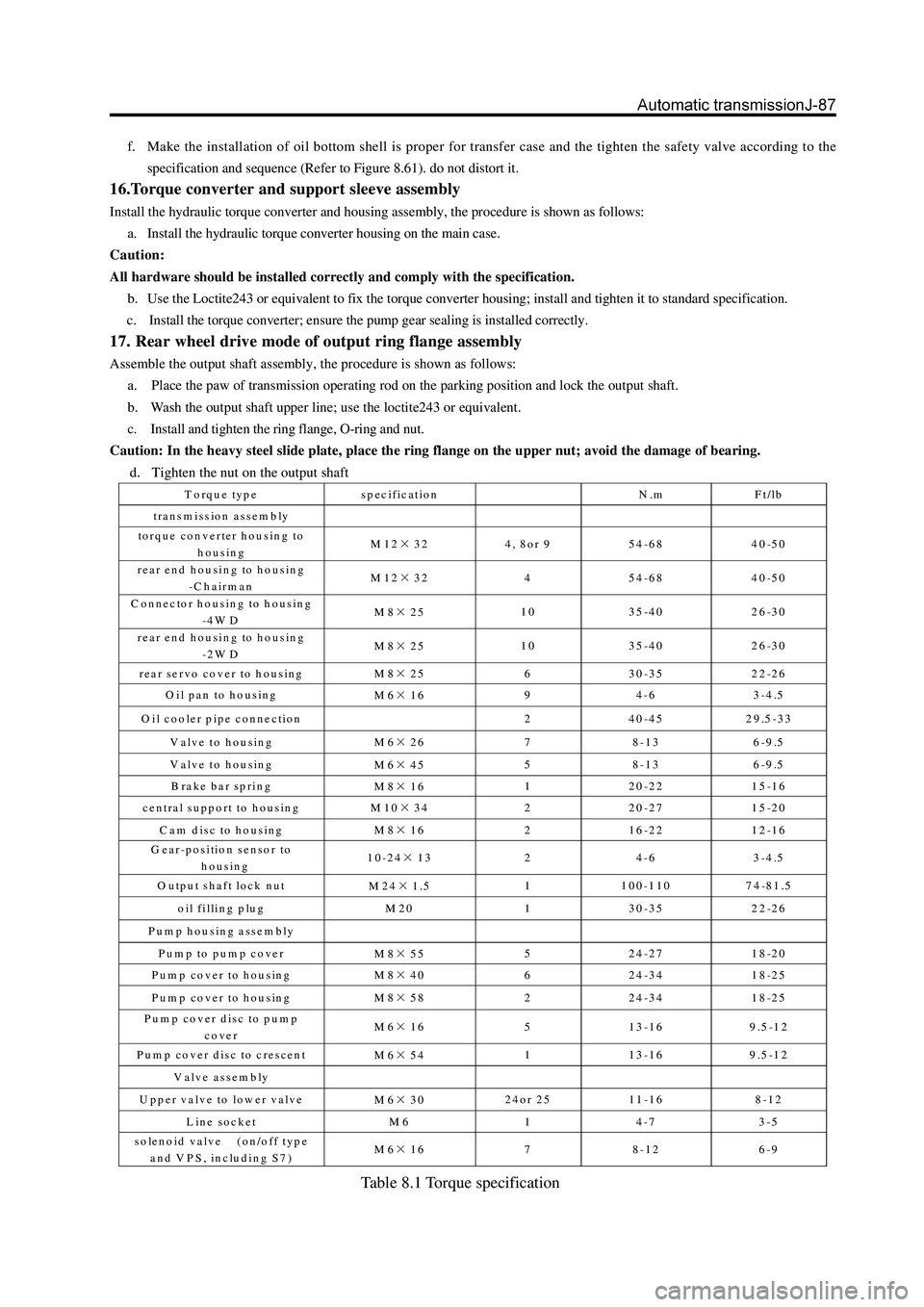
Torque type specification N.m Ft/lb
tra n s m iss io n as se m b ly
torque converter housing to
housing M12×32 4, 8or 9 54-68 40-50
rear end housing to housing
-C h a irm a n M12×32 4 54-68 40-50
C onnector housing to housing
-4 W D M8×25 10 35-40 26-30
rear end housing to housing
-2 W D M8×25 10 35-40 26-30
rear servo cover to housing
M8×25 6 30-35 22-26
O il pan to housing
M6×16 9 4-6 3-4.5
O il cooler pipe connection
2 40-45 29.5-33
V alve to housing
M6×26 7 8-13 6-9.5
V alve to housing
M6×45 5 8-13 6-9.5
B rake bar spring
M8×16 1 20-22 15-16
central support to housing
M10×34 2 20-27 15-20
C am disc to housing
M8×16 2 16-22 12-16
G ear-position sensor to
housing 10-24×13 2 4-6 3-4.5
O utput shaft lock nut
M24×1.5 1 100-110 74-81.5
oil filling plug M 20 1 30-35 22-26
Pump housing assembly
Pump to pump cover
M8×55 5 24-27 18-20
Pum p cover to housing
M8×40 6 24-34 18-25
Pum p cover to housing
M8×58 2 24-34 18-25
Pum p cover disc to pum p
cover M6×16 5 13-16 9.5-12
Pum p cover disc to crescent
M6×54 1 13-16 9.5-12
Valve assem bly
U p p e r v a lv e to lo w e r v a lv e
M6×30 24or 25 11-16 8-12
Line socket M 6 1 4-7 3-5
solenoid valve (on/off type
and VPS, including S7) M6×16 7 8-12 6-9
Table 8.1 Torque specification
Page 177 of 425
6. Adjust the wheel toe
Adjust the wheel toe according to the following method
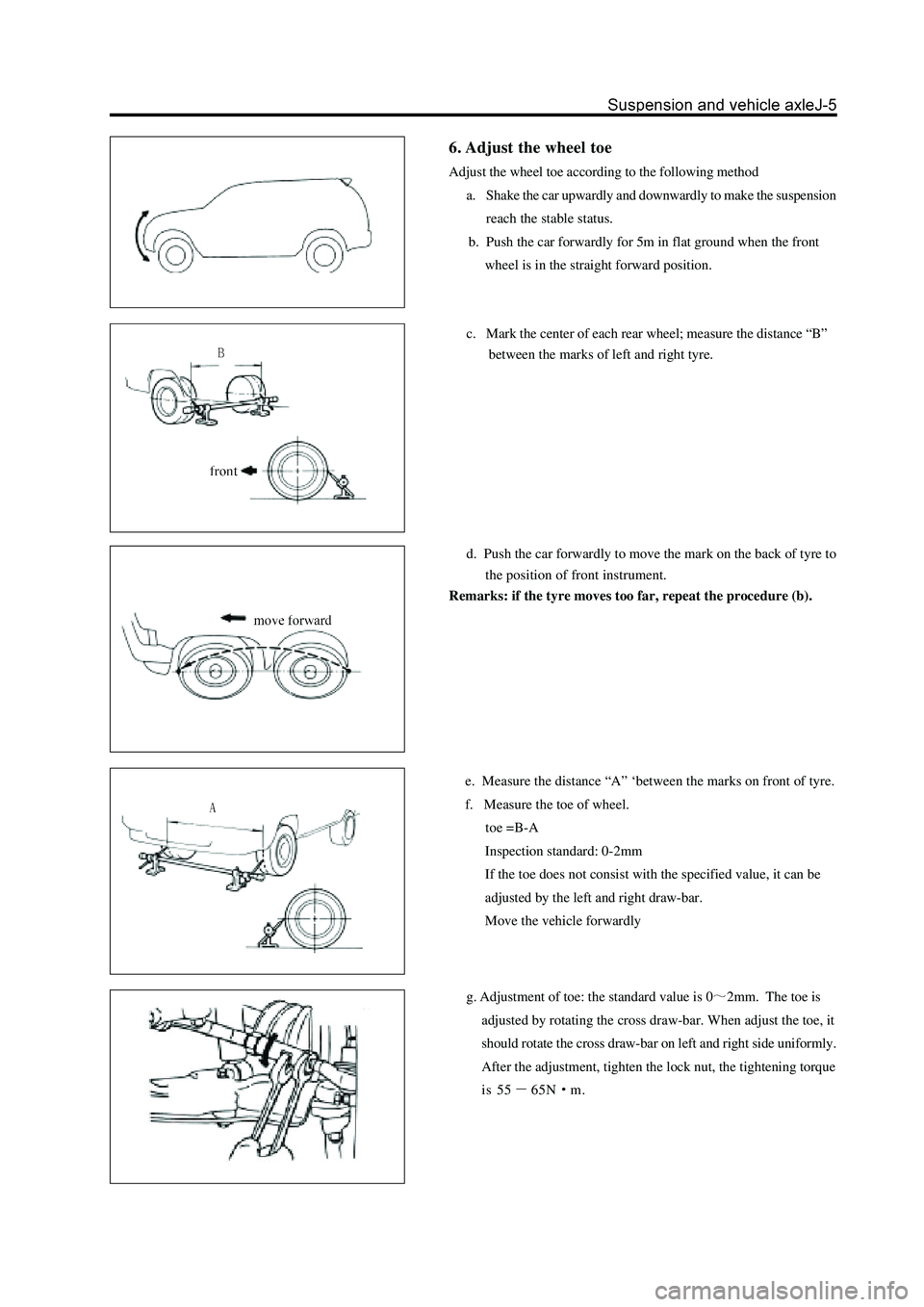
a. Shake the car upwardly and downwardly to make the suspension
reach the stable status.
b. Push the car forwardly for 5m in flat ground when the front
wheel is in the straight forward position.
c. Mark the center of each rear wheel; measure the distance “B”
between the marks of left and right tyre.
d. Push the car forwardly to move the mark on the back of tyre to
the position of front instrument.
Remarks: if the tyre moves too far, repeat the procedure (b).
e. Measure the distance “A” ‘between the marks on front of tyre.
f. Measure the toe of wheel.
toe =B-A
Inspection standard: 0-2mm
If the toe does not consist with the specified value, it can be
adjusted by the left and right draw-bar.
Move the vehicle forwardly
g. Adjustment of toe: the standard value is 02mm. The toe is
adjusted by rotating the cross draw-bar. When adjust the toe, it
should rotate the cross draw-bar on left and right side uniformly.
After the adjustment, tighten the lock nut, the tightening torque
is 55
65Nm.
Page 187 of 425
Front suspension (2WD)
front stabilizer bar
rubber cover
clip
connecting rod of
stabilizer bar
flat shim
front shaft of
lower arm
split pin
adjusting bolt
lower adjusting block
fixed arm
upper adjusting block
lower arm
rear shaft of lower arm
torsion bar base
torsion bar
lower arm long bushsplit pin
upper ball pin
upper arm shaft
upper arm bush
flat shim
lower arm
short bush
eccentric shim
disk shim
fill block
fill block
disk shim shim
shock absorbershimshim
upper arm bush
upper arm shaft
lower ball arm
front wheel hub
and steering
knuckle assy
N m: specified torque
Used component which can not be used any more.
Pregummed component N m: specified torque
Page 188 of 425
Ball pin
Inspection of ball pin
1. Check the lower ball pin for loose
a. Raise the front of the car by jack and support it by the frame.
b. Ensure the front wheel is in straight advancing position and
step down the brake pedal.
c. Move the arm upwardly and downwardly; check the
clearance of lower ball pin.
Max. vertical clearance: 0mm
2. Check the upper ball pin for loose;
move the wheel upwardly and downwardly and check the gap of
upper ball pin.
Max. vertical clearance: 0mm
3. Check the rotation of ball pin
a. Remove the ball pin.
b. Shown as figure, shake the ball pin stud forwardly and
backwardly for several times before install the nut.
c. Rotate the nut continuously by torsion meter and 2-4s for a
cycle; record the readout of torsion meter in the fifth cycle.
tightening torque (for rotary):
lower ball pin 0.1
4Nm
upper ball pin 0.1
4Nm
Disassembly of ball pin
1.Take down the steering knuckle and front wheel hub assy.
Page 191 of 425
d. Tighten the adjusting bolt to make the extension length of the bolt
equal to the length before remove.
2. For new torsion bar spring
a. Remove the wheel.
b. Coat thin grease on the spline of the torsion bar spring.
c. Install the torsion bar spring on the torsion bar base.
d. Lower the lower arm to the lower limitation position; install the
adjusting arm in the torsion bar spring with the angle that the
adjusting bolt just can be screwed on the upper adjusting block.
e. Tighten the adjusting bolt to the specified torque.
Nut tightening limitation: A is about 30-35mm; if A>
35mm, then it is adjusted through height of adjusting arm.
f. Install the wheel; remove the bracket; bounce the vehicle for
several times to make the suspension enters into the stable
status.
g. Rotate the adjusting bolt and adjust the ground clearance of
chassis (Refer to 4-Wheel Alignment).
Page 195 of 425
5. Install the torsion bar spring
(Refer to “Torsion Bar Spring”)
6. Tighten the nut of front shaft of lower arm to
specified torque
a. Install the wheel, remove the bracket and bounce the vehicle for
several times to make the vibration damper enters into the
stable status.
b. Align the assembly mark and tighten the nut to specified torque.
Tightening force: 240
20Nm
7. Check the wheel alignment parameter
(Refer to 4-Wheel Alignment)
Page 199 of 425
Connect the copper gasket seal and tighten the hollowbolttospecified
torque.
Tightening force: 50
5Nm
6. Discharge the air in front brake system
(refer to relevant chapter)
Remarks: It must discharge the air in the rear brake system if
disassemble the right upper arm.
7. Check the brake fluid for leakage
8. Tighten the upper arm front shaft nut to the specified
torque
Install the wheel, remove the bracket and bounce the vehicle for
several times to make the vibration damper enters into the stable
status.
9. Check the wheel alignment parameter
(Refer to 4-Wheel Alignment)
Page 211 of 425

Ball pin
Check of ball pin
1. Check the lower ball pin for loose
a. Raise the front of the car by jack and support it by the frame.
b. Ensure the front wheel is in straight advancing position and step
down the brake pedal.
c. Move the arm upwardly and downwardly; check
the clearance of lower ball pin.
Max. vertical clearance: 0mm
2. Check the upper ball pin for loose move the wheel
upwardly and downwardly and check the gap of
upper ball pin.
Max. vertical clearance: 0mm
3. Check the rotation of ball pin
a. Remove the ball pin.
b. Shown as figure, shake the ball pin stud forwardly and backwardly
for several times before install the nut
c. Rotate the nut continuously by torsion meter and 2-4s for a
cycle; record the readout of torsion meter in the fifth cycle.
Tightening torque (for rotary):
Lower ball pin 0.1
4Nm
Upper ball pin 0.1
4Nm
Disassembly of ball pin
1. Remove the steering knuckle and front hub assembly
(Refer to section “Front Hub and Steering Knuckle”)
2. Remove the lower ball pin form the lower arm
3. Remove the upper ball pin from the upper arm


