Page 268 of 425
Axle drving assembly
Removal of semiaxle
1. Remove the wheel.
2. Disconnect the manual brake pull-wire from the
carriage; loose the small bracket.
3. Remove the brake caliper; remove the brake disc .
4. Remove the rear halfaxle assembly from the rear
axle housing
a. Use the bolt to connect the special tools to the semiaxle flange
surface.
b. Use the hammer of special tools to remove the rear axle.
brake caliper assembly
brake disc
circlip
oil seal base
bearing
oil seal
oil seal pressing block
parking brake assembly
rear axle
N
m: Specified torque
Used component which can not be used any more.
pull-wire assembly
5. Remove the circlip from the halfaxle assembly.
Use the circlip pliers to remove the circlip.
Page 290 of 425
Brake-4
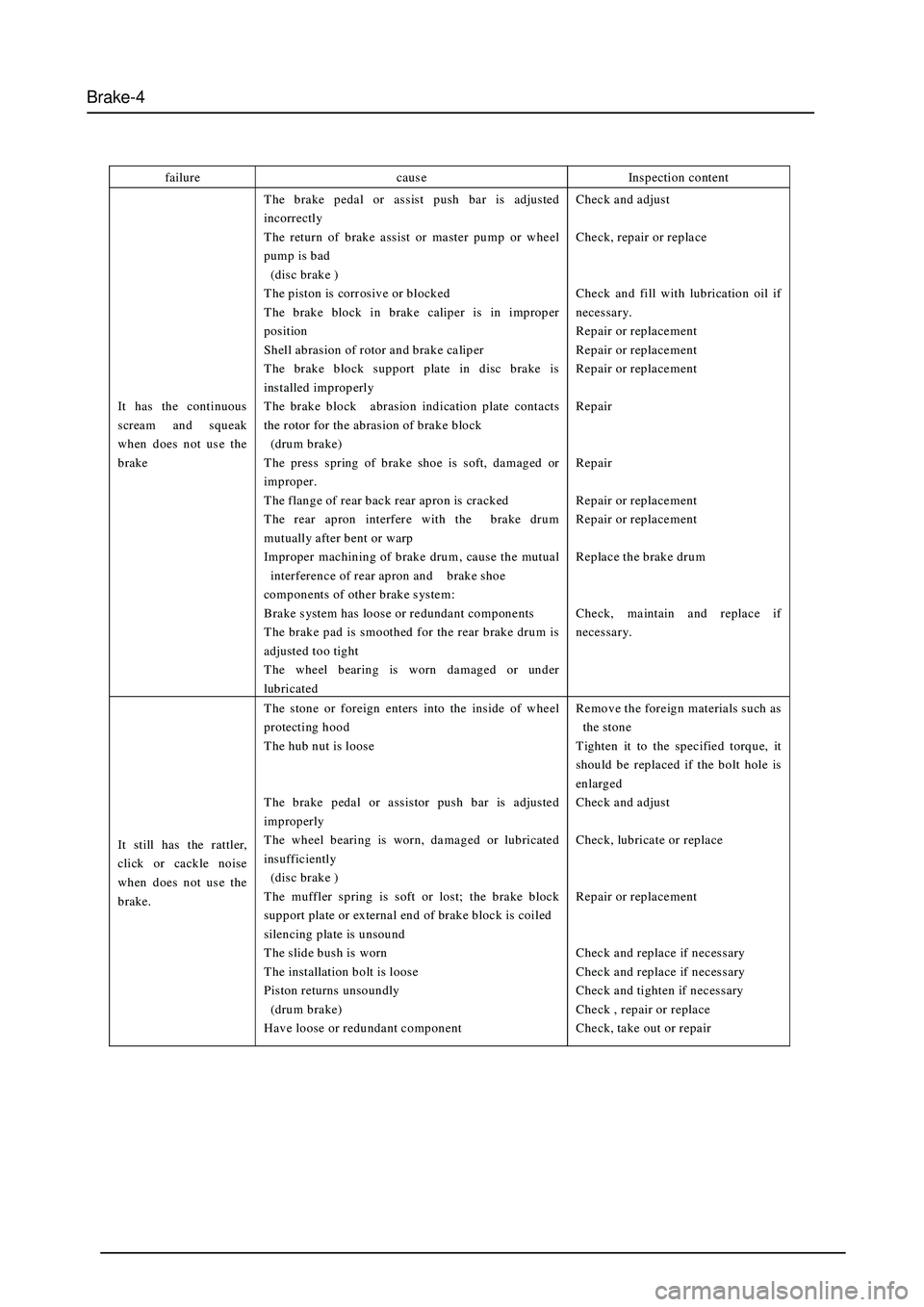
failure caus e Inspection content
It has the continuous
scream and squeak
when does not us e the
brake The brake pedal or assist push bar is adjusted
incorrectly
The return of brake assist or master pump or wheel
pump is bad
(dis c brake )
T he piston is corr osive or blocked
T he brake block in brake calip er is in improp er
position
Shell abrasion of rotor and brake caliper
The brake block support plate in disc brake is
installed improperly
The brake block abrasion indication plate contacts
the rotor for the abrasion of brake block
(drum brake)
The press spring of brake shoe is soft, damaged or
improper.
The flange of rear back rear apron is cracked
T he rear apron interfer e with the brake drum
mutually after bent or warp
Improper machining of brake drum , caus e the mutual
interference of rear apron and brake shoe
components of other brake s ystem :
Brake system has loose or redundant components
T he brake pad is smoothed for the rear brake drum is
adjusted too tight
The wheel bearing is worn damaged or under
lubricated Check and adjust
Check, repair or replace
Check and fill with lubrication oil if
necessary.
Repair or replacement
Repair or replacement
Repair or replacement
Repair
Repair
Repair or replacement
Repair or replacement
Replace the brake drum
Check, maintain and replace if
necessary.
It still has the rattler,
click or cackle noise
when does not us e the
brake. The stone or foreign enters into the inside of wheel
protecting hood
The hub nut is loose
The brake pedal or assistor push bar is adjusted
improperly
The wheel bearing is worn, damaged or lubricated
insufficiently
(dis c brake )
T he muffler spring is soft or lost; the brake block
support plate or external end of brake block is coiled
silencing plate is unsound
T he slide bush is worn
T he installation bolt is loos e
Piston returns unsoundly
(drum brake)
Have loose or redundant component Remove the foreign materials such as
the stone
Tighten it to the specified torque, it
should be replaced if the bolt hole is
enlarged
Check and adjust
Check, lubricate or replace
Repair or replacement
Check and replace if necessary
Check and replace if necessary
Check and tighten if necessary
Check , repair or replace
Check, take out or repair
Page 293 of 425
Brake-7
Air discharge of brake system
Remarks:
It should discharge the air if operate on the brake system or as-
sume the brake system pipeline has the air.
Caution:
Must not keep the brake fluid on the paint surface, wipe off it if
has.
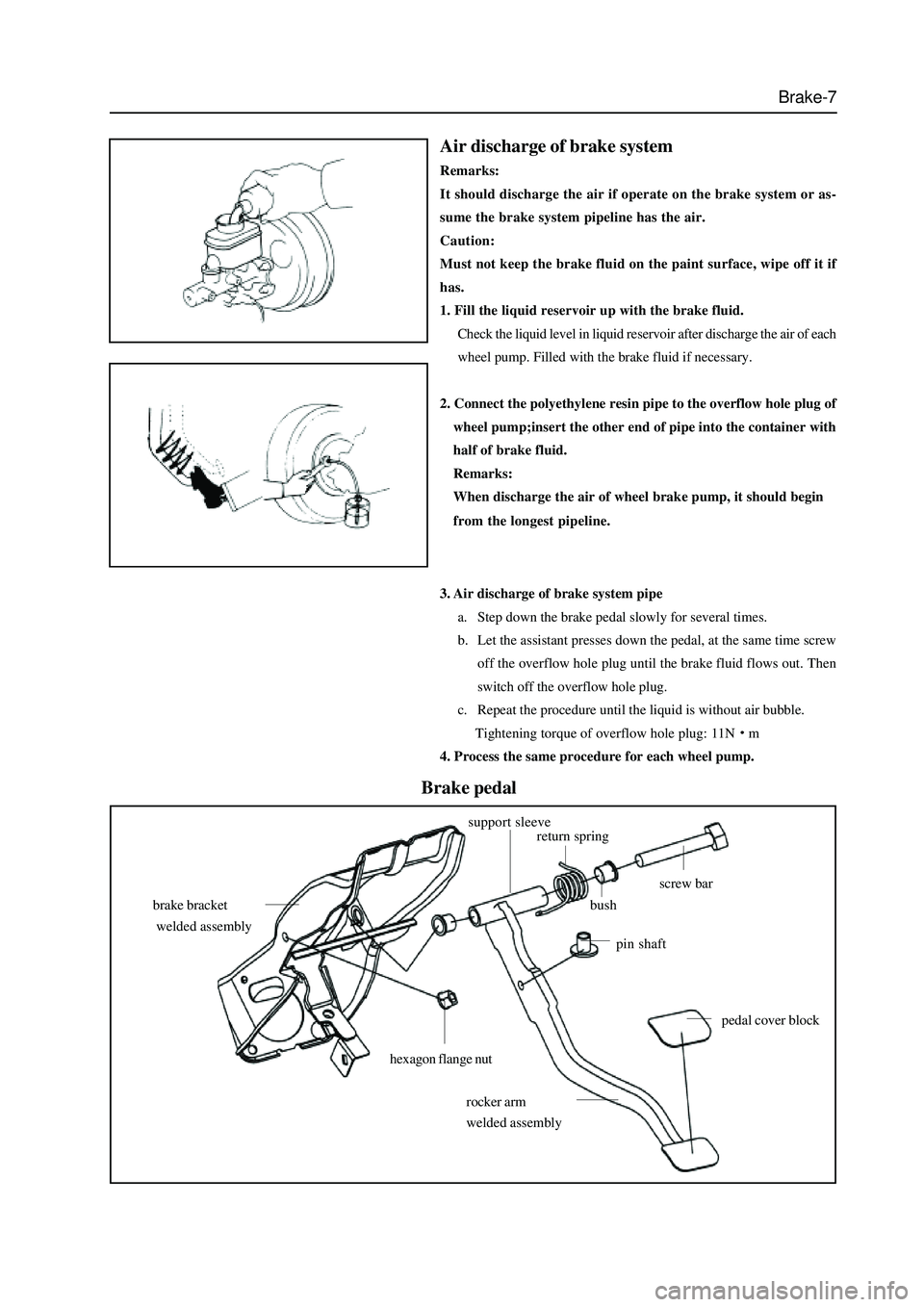
1. Fill the liquid reservoir up with the brake fluid.
Check the liquid level in liquid reservoir after discharge the air of each
wheel pump. Filled with the brake fluid if necessary.
2. Connect the polyethylene resin pipe to the overflow hole plug of
wheel pump;insert the other end of pipe into the container with
half of brake fluid.
Remarks:
When discharge the air of wheel brake pump, it should begin
from the longest pipeline.
3. Air discharge of brake system pipe
a. Step down the brake pedal slowly for several times.
b. Let the assistant presses down the pedal, at the same time screw
off the overflow hole plug until the brake fluid flows out. Then
switch off the overflow hole plug.
c. Repeat the procedure until the liquid is without air bubble.
Tightening torque of overflow hole plug: 11N
m
4. Process the same procedure for each wheel pump.
hexagon flange nut
brake bracket
welded assembly
support sleevereturn spring
bush
screw bar
pin shaft
pedal cover block
rocker arm
welded assembly
Brake pedal
Page 295 of 425
Brake-9
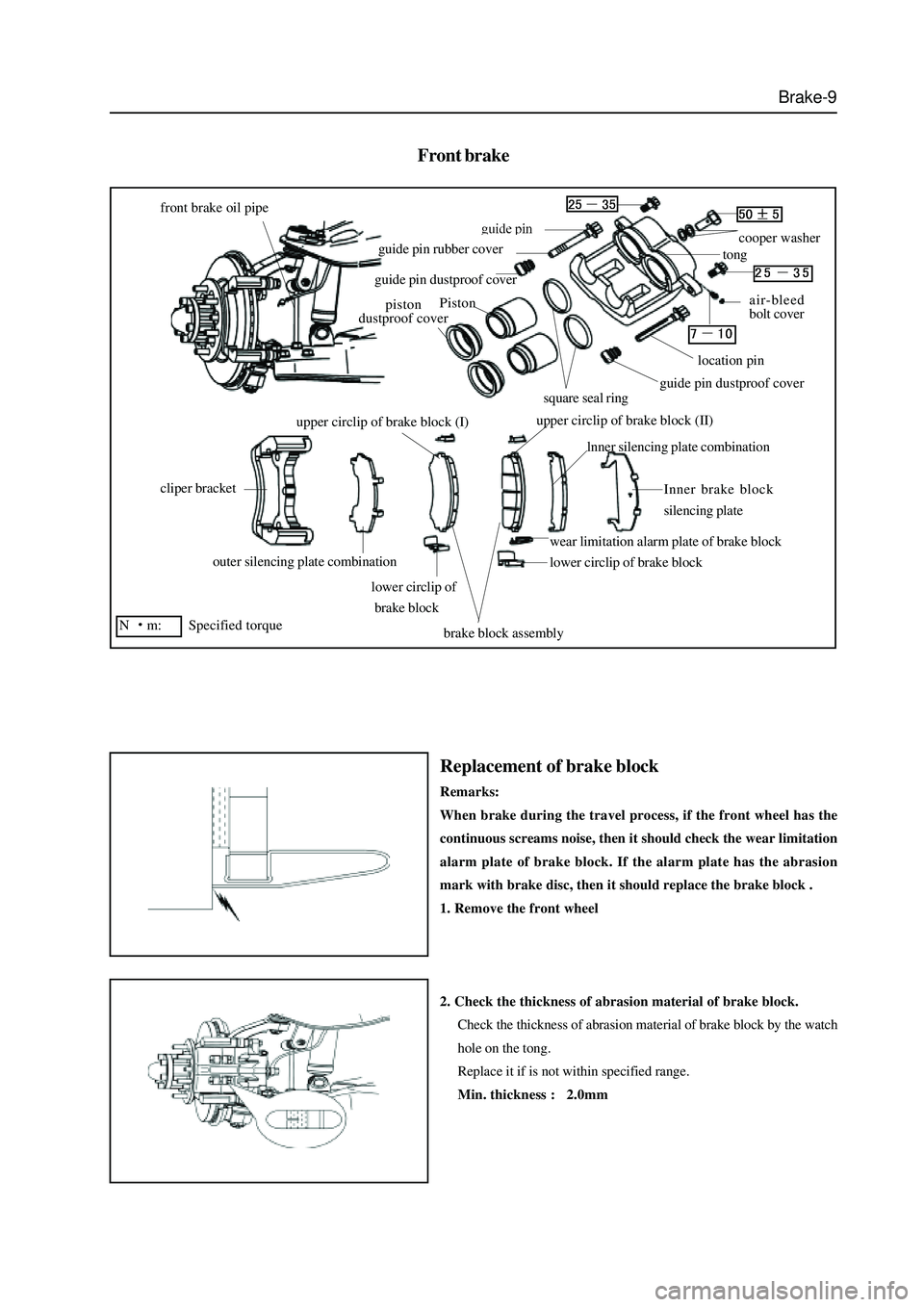
Front brake
front brake oil pipe
cliper bracket
outer silencing plate combination
lower circlip of
brake block
brake block assembly
lower circlip of brake block
wear limitation alarm plate of brake block
lnner silencing plate combination
Inner brake block
silencing plate
upper circlip of brake block (I)upper circlip of brake block (II)
piston
dustproof cover
guide pin dustproof cover
guide pin rubber covercooper washer
tong
air-bleed
bolt cover
location pin
guide pin dustproof coversquare seal ring
N
m: Specified torque
Piston
Replacement of brake block
Remarks:
When brake during the travel process, if the front wheel has the
continuous screams noise, then it should check the wear limitation
alarm plate of brake block. If the alarm plate has the abrasion
mark with brake disc, then it should replace the brake block .
1. Remove the front wheel
2. Check the thickness of abrasion material of brake block.
Check the thickness of abrasion material of brake block by the watch
hole on the tong.
Replace it if is not within specified range.
Min. thickness : 2.0mm
Page 302 of 425

Brake-16
Rear brake (Disk-and-drum type)
tong bracket
pin rubber cover
brake caliper locking bolt 100
silencing plate
combination
outside brake block
inside brake block
brake block wearing
indication plate
cylinder hole
dustproof cover
wire clip
rectangle seal ring
piston
tong body (left)
copper washer
brake oil pipe fastening blot 55
location pin 2530
bleed screw
bleed screw dustproof cover
guide pin 2530
rear brake oil pipeline
N
m: specified torque
peepholesilencing
plate
Replacement of brake block
Remarks: if the rear wheel generates the cheep during the braking,
it should check the abrasion indication plate of brake block. If the
indication plate has the abrasion mark with brake disc, then it
should replace the brake block .
1. Remove the rear wheel
2. Check the thickness of brake block bush.
Measure the thickness of the brake block bush (abrasion material)
from the eyehole of tong. If the thickness is not within the specified
range, then it should replace the brake block.
minimum thickness: 2.0mm.
Page 314 of 425
Brake-28
10. Adjust the clearance between the brake drum and brake shoe.
Poke the adjusting hole plug on the brake drum, insert the screwdriver
into the clearance-adjusting hole; rotate the clearance-adjusting gear
to expand the brake shoe until the brake disc can not be rotated by
hand. Then rotate it for 3-5 teeth in anticlockwise, rotate the brake
disc by hand at the same time, it is proper that it can rotate freely
and without the contact between the abrasion and disc. It is allowable
that the non-running-in brake shoe has the slight abrasion sensing.
When adjust the clearance, the left and right wheel must be adjust at
the same, install the adjusting hole plug after the completion of
adjusting .
11.Rear brake caliper assembly
12.Rear wheel assembly
Tighten torque :120N.m
Page 324 of 425

Steering-5
Technical requirements
1.The fastening torque of the mounting bolts of the integral power
steering gear assembly is
2.The fastening torque of the connecting bolts of the steering drive sub-
assembly and the integral power steering gear assembly is
3. The fastening torque of the connecting bolts of the steering drive
assembly and the left horizontal beam of the frame is
4. The fastening torque of the mounting bolts of the power steering
pump is 40N.m.
5. The tension force of multi-wedge belt 4PK1100 is 4PK1100.
6. Centering fastening of the handwheel: steer the front wheel to the
right front and remove the handwheel without changing the position
of the steering stem, install the handwheel aligning the center, the
radials of the handwheel should be at the left & right centering state;
the symbol of “the Great Wall” on the steering wheel shall be in
driver’s straight view position, secure the nut firmly with the
fastening torque of
7. Inspection of free clearance of the handwheel
Steer the car in a straight direction and stop the engine, apply a 5N force to
the handwheel along the circumference, left turn the handwheel and stop
the turning when the resistance is increasingly felt with each turn; then right
turn the handwheel and stop the turning when the resistance is increasingly
felt with each turn; the angle rotated along the circumference is the free
clearance of the handwheel, whose standard value shall be below 20
, and
the angle from the center to the right shall not be more than 10
Page 409 of 425

Appendix A-3
1. (upper suspension arm steering knuckle ball pin nut) bolt
Locate the rear transverse stabilizer rob in the corresponding
position of carriage, symmetries the left and right during
installation.
Connection of rear transverse
stabilizer rod and rear axleViewing confirmation
the fixed torque of nut 2 in the Figure is 23
3NmTorque wrench
Connection of rear transverse
stabilizer rod and rear transverse
stabilizer robs connecting bar
assembly.the fixed torque of nut 1 in the Figure is 63
5NmTorque wrench
rear transverse stabilizer
rear transverse stabilizer rod connecting bar assembly bush
Upper suspension arm and upper suspension
arm steering knuckle ball pin
Steering gear cross tie ball pin
Lower suspension arm and lower suspension
arm steering knuckle ball pinthe fixed torque of nut 1 in the Figure is
145
15Nm
the fixed torque of nut 2 in the Figure is120
10Nm
the fixed torque of nut 3 in the Figure is 230
20Nm
Torque wrench
Torque wrench
Torque wrench
2. (steering gear cross tie ball pin nut) left steering
knuckle and wheel hub brake assembly
3. (lower suspension arm steering knuckle ball pin nut bolt 4. left steering knuckle and steering knuckle
and wheel hub brake assembly.

