2006 DODGE RAM SRT-10 transmission fluid
[x] Cancel search: transmission fluidPage 3768 of 5267
cuits. If no problems are found, replace and program the ECM per the ServiceInformation. (Refer to 8
- ELECTRICAL/ELECTRONIC CONTROL MODULES/ENGINE CONTROL MODULE - REMOVAL)
Perform RE TRANSMISSION VERIFICATION TEST VER - 1 (DIESEL). (Refer to 21 - TRANSMISSION/
TRANSAXLE/AUTOMATIC - 48RE - STANDARD PROCEDURE)
No>>
Go To 10
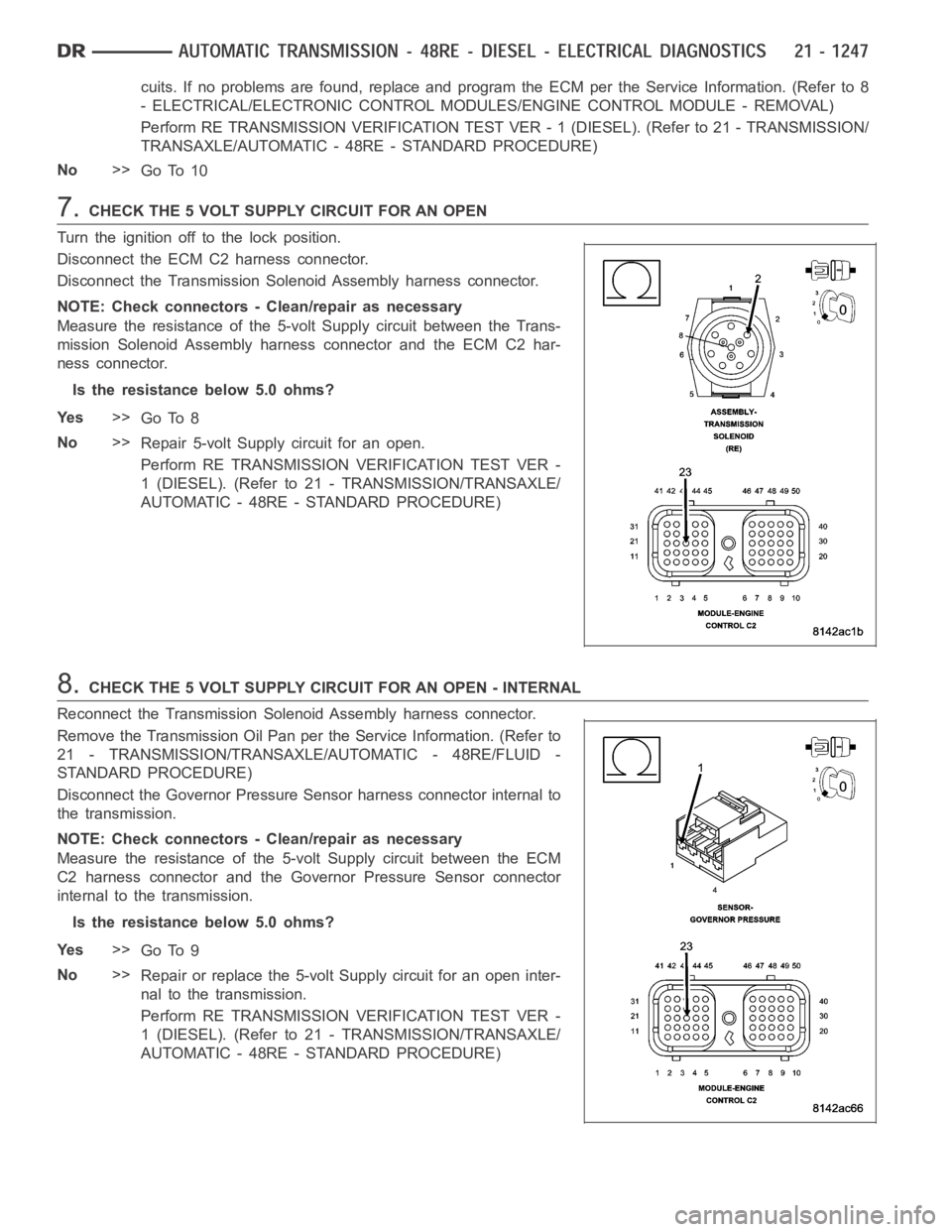
7.CHECK THE 5 VOLT SUPPLY CIRCUIT FOR AN OPEN
Turn the ignition off to the lock position.
Disconnect the ECM C2 harness connector.
Disconnect the Transmission Solenoid Assembly harness connector.
NOTE: Check connectors - Clean/repair as necessary
Measure the resistance of the 5-volt Supply circuit between the Trans-
mission Solenoid Assembly harness connector and the ECM C2 har-
ness connector.
Is the resistance below 5.0 ohms?
Ye s>>
Go To 8
No>>
Repair 5-volt Supply circuit for an open.
Perform RE TRANSMISSION VERIFICATION TEST VER -
1 (DIESEL). (Refer to 21 - TRANSMISSION/TRANSAXLE/
AUTOMATIC - 48RE - STANDARD PROCEDURE)
8.CHECK THE 5 VOLT SUPPLY CIRCUIT FOR AN OPEN - INTERNAL
Reconnect the Transmission Solenoid Assembly harness connector.
Remove the Transmission Oil Pan perthe Service Information. (Refer to
21 - TRANSMISSION/TRANSAXLE/AUTOMATIC - 48RE/FLUID -
STANDARD PROCEDURE)
Disconnect the Governor Pressure Sensor harness connector internal to
the transmission.
NOTE: Check connectors - Clean/repair as necessary
Measure the resistance of the 5-volt Supply circuit between the ECM
C2 harness connector and the Governor Pressure Sensor connector
internal to the transmission.
Is the resistance below 5.0 ohms?
Ye s>>
Go To 9
No>>
Repair or replace the 5-volt Supply circuit for an open inter-
nal to the transmission.
Perform RE TRANSMISSION VERIFICATION TEST VER -
1 (DIESEL). (Refer to 21 - TRANSMISSION/TRANSAXLE/
AUTOMATIC - 48RE - STANDARD PROCEDURE)
Page 3785 of 5267
TRANSMISSION VERIFICATION TEST VER - 1 (DIESEL)
1.
1. Inspect the vehicle to ensure that all engine and transmission components are properly installed and connected.
Reassemble and reconnect components as necessary.
2. If any existing diagnostic trouble codes have not been repaired, go to Symptom List and follow path specified.
3. Connect a scan tool to the data link connector.
4. Ensure the fuel tank has at least a quarter tank of fuel. Turn off all accessories.
5. Start and run the engine until the transmission temperature is above 43°C(110°F).
6. Check the transmission fluid level per the Service Information. Adjustif necessary.
7. Road test the vehicle. Make 15 to 20 1-2, 2-3 and 3-4 up shifts. Perform these shifts from a standing start to 72
Kmh (45 mph) with a constant throttle opening of 20-25%.
8. Below 40 Kmh (25 mph), make 5 to 8 wide open throttle kick downs to 1st gear.Allow at least 5 seconds each
in 2nd and 3rd between each kick down.
9. For a specific DTC, drive the vehicle in accordance with the Symptom’s When Monitored and Set Conditions to
verify the repair.
10. If a DTC sets during the road test, return to the Symptom List and follow the path. If no DTC sets, the repair is
complete.
Are there any DTCs or symptoms remaining?
Ye s>>
Repair is not complete, refer to appropriate symptom.
No>>
Repair is complete.
Page 3786 of 5267
PRE-DIAGNOSTIC CHECKOUT (DIESEL)
For a complete wiring diagramRefer to Section 8W
1.PRE-DIAGNOSTIC CHECKOUT
NOTE: Always perform diagnostics with a fully charged battery to avoid false symptoms.
NOTE: Low fluid level can be the cause of many transmission problems. If thefluid level is low locate and
repair the leak then check and adjust the fluid level per the Service Information.
With the scan tool, read engine DTC’s. Check and repair all engine DTCs prior to performing transmission symptom
diagnostics.
Using the wiring diagram/schematic as a guide, inspect the wiring and connectors. Repair as necessary.
Verify the flash level of the Engine Control Module. Some problems are corrected by software upgrades.
Check for any Service Information Tune-ups or Technical Service Bulletins that may apply.
Did any of the above checks or procedures correct the symptom?
Ye s>>
Repair is complete.
Perform RE TRANSMISSION VERIFICATION TEST VER - 1 (DIESEL). (Refer to 21 - TRANSMISSION/
TRANSAXLE/AUTOMATIC - 48RE - STANDARD PROCEDURE)
No>>
Refer to the Transmission category and perform the appropriate symptom(s).
Page 3787 of 5267
page page
AUTOMATIC TRANSMISSION - 48RE - SERVICE
INFORMATION
DESCRIPTION ............................. 1268
OPERATION ............................... 1271
DIAGNOSIS AND TESTING
AUTOMATIC TRANSMISSION .............. 1277
PRELIMINARY ............................ 1277
ROAD TESTING .......................... 1277
HYDRAULIC PRESSURE TEST . ........... 1278
AIR TESTING TRANSMISSION CLUTCH
AND BAND OPERATION................... 1281
CONVERTER HOUSING FLUID LEAK ...... 1282
DIAGNOSIS CHARTS ..................... 1283
STANDARD PROCEDURE - ALUMINUM
THREAD REPAIR ......................... 1293
REMOVAL ................................. 1294
DISASSEMBLY ............................. 1298
CLEANING ................................. 1306
INSPECTION ............................... 1306
ASSEMBLY . ............................... 1307
INSTALLATION ............................. 1317
SCHEMATICS AND DIAGRAMS
HYDRAULIC SCHEMATICS ................ 1322
SPECIFICATIONS
TRANSMISSION .......................... 1336
SPECIAL TOOLS
RE TRANSMISSION ...................... 1339
ACCUMULATOR
DESCRIPTION ............................. 1341
OPERATION ............................... 1342
INSPECTION ............................... 1342
BANDS
DESCRIPTION ............................. 1343
OPERATION ............................... 1343
ADJUSTMENTS
ADJUSTMENT - BANDS ................... 1344
SYSTEM-BRAKE TRANSMISSION SHIFT
INTERLOCK
DESCRIPTION ............................. 1345
OPERATION ............................... 1345
DIAGNOSIS AND TESTING - BRAKE
TRANSMISSION SHIFT INTERLOCK ........ 1345
ADJUSTMENTS - BRAKE TRANSMISSION
SHIFT INTERLOCK ....................... 1345
GOVERNOR-ELECTRONIC
DESCRIPTION ............................. 1347
OPERATION ............................... 1348
REMOVAL ................................. 1349
INSTALLATION ............................. 1350SEAL-EXTENSION HOUSING
REMOVAL ................................. 1352
INSTALLATION ............................. 1352
FLUID AND FILTER
DIAGNOSIS AND TESTING
EFFECTS OF INCORRECT FLUID LEVEL . . . 1353
CAUSES OF BURNT FLUID ............... 1353
FLUID CONTAMINATION .................. 1353
STANDARD PROCEDURE
FLUID LEVEL CHECK ..................... 1353
FLUID AND FILTER REPLACEMENT ....... 1355
TRANSMISSION FILL ..................... 1357
CLUTCH-FRONT
DESCRIPTION ............................. 1358
OPERATION ............................... 1358
DISASSEMBLY . ............................ 1359
INSPECTION............................... 1360
ASSEMBLY................................ 1360
SERVO-FRONT
DESCRIPTION ............................. 1363
OPERATION ............................... 1363
DISASSEMBLY . ............................ 1364
CLEANING ................................. 1364
INSPECTION ............................... 1365
ASSEMBLY................................ 1365
CABLE-GEARSHIFT
DIAGNOSIS AND TESTING - GEARSHIFT
CABLE ................................... 1366
REMOVAL ................................. 1366
INSTALLATION ............................. 1367
ADJUSTMENTS - GEARSHIFT CABLE ........ 1368
PUMP-OIL
DESCRIPTION ............................. 1369
OPERATION ............................... 1369
DISASSEMBLY ............................. 1370
CLEANING ................................. 1371
INSPECTION ............................... 1371
ASSEMBLY................................ 1373
BEARING-OUTPUT SHAFT FRONT
REMOVAL ................................. 1375
INSTALLATION ............................. 1375
BEARING-OUTPUT SHAFT REAR
REMOVAL ................................. 1376
INSTALLATION ............................. 1376
CLUTCH-OVERDRIVE
DESCRIPTION ............................. 1377
OPERATION ............................... 1377
UNIT-OVERDRIVE
REMOVAL ................................. 1378
DISASSEMBLY ............................. 1379
Page 3791 of 5267
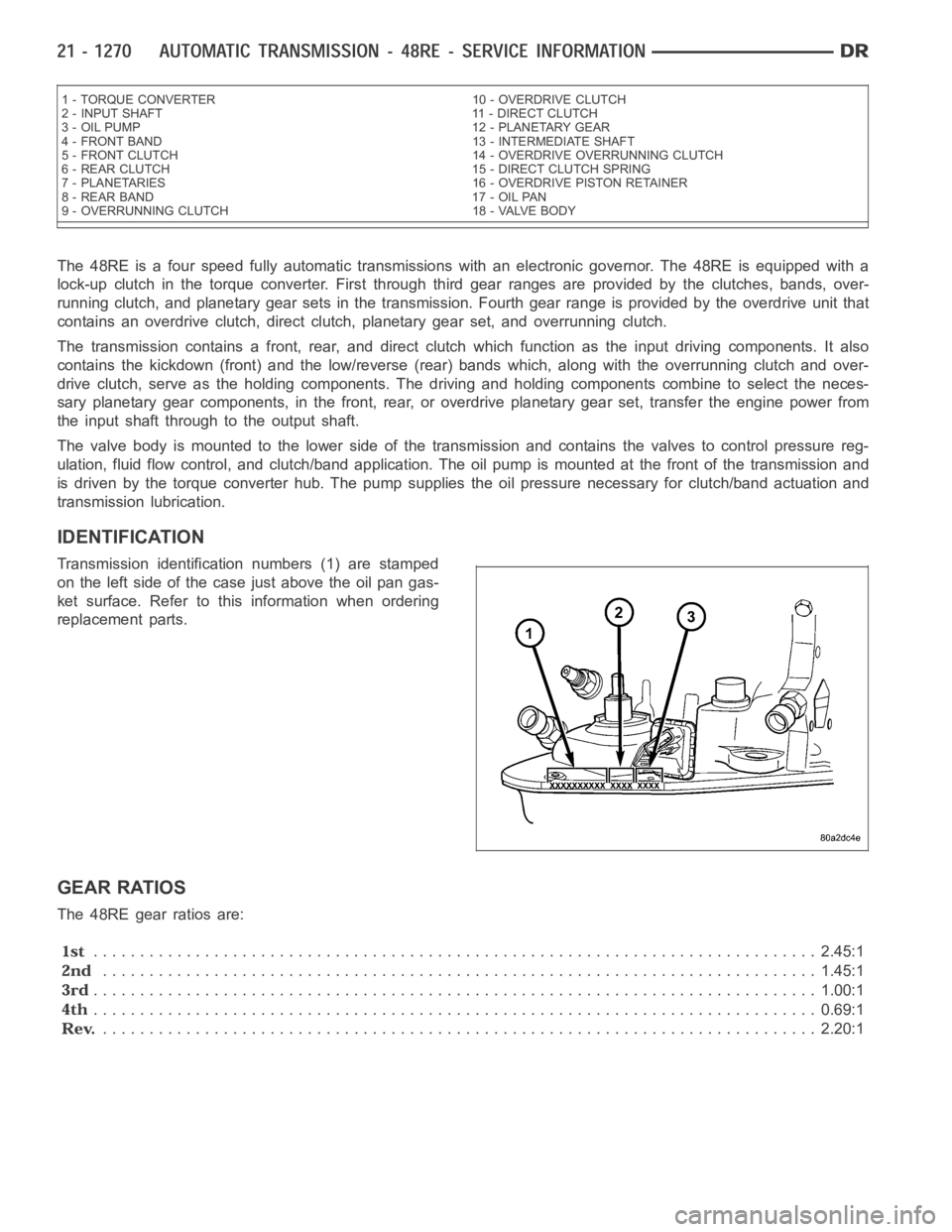
The 48RE is a four speed fully automatic transmissions with an electronic governor. The 48RE is equipped with a
lock-up clutch in the torque converter. First through third gear ranges are provided by the clutches, bands, over-
running clutch, and planetary gear sets in the transmission. Fourth gear range is provided by the overdrive unit that
contains an overdrive clutch, direct clutch, planetary gear set, and overrunning clutch.
The transmission contains a front, rear, and direct clutch which functionas the input driving components. It also
contains the kickdown (front) and the low/reverse (rear) bands which, along with the overrunning clutch and over-
drive clutch, serve as the holding components. The driving and holding components combine to select the neces-
sary planetary gear components, in the front, rear, or overdrive planetary gear set, transfer the engine power from
the input shaft through to the output shaft.
The valve body is mounted to the lower side of the transmission and containsthe valves to control pressure reg-
ulation, fluid flow control, and clutch/band application. The oil pump ismounted at the front of the transmission and
is driven by the torque converter hub. The pump supplies the oil pressure necessary for clutch/band actuation and
transmission lubrication.
IDENTIFICATION
Transmission identification numbers (1) are stamped
on the left side of the case just above the oil pan gas-
ket surface. Refer to this information when ordering
replacement parts.
GEAR RATIOS
The 48RE gear ratios are:
.............................................................................. 2.45:1
............................................................................. 1.45:1
.............................................................................. 1.00:1
.............................................................................. 0.69:1
............................................................................. 2.20:1
1 - TORQUE CONVERTER 10 - OVERDRIVE CLUTCH
2 - INPUT SHAFT 11 - DIRECT CLUTCH
3 - OIL PUMP 12 - PLANETARY GEAR
4 - FRONT BAND 13 - INTERMEDIATE SHAFT
5 - FRONT CLUTCH 14 - OVERDRIVE OVERRUNNING CLUTCH
6 - REAR CLUTCH 15 - DIRECT CLUTCH SPRING
7 - PLANETARIES 16 - OVERDRIVE PISTON RETAINER
8 - REAR BAND 17 - OIL PAN
9 - OVERRUNNING CLUTCH 18 - VALVE BODY
Page 3792 of 5267
OPERATION
The application of each driving or holding component is controlled by the valve body based upon the manual lever
position, throttle pressure, and governor pressure. The governor pressure is a variable pressure input to the valve
body and is one of the signals that a shift is necessary. First through fourth gear are obtained by selectively apply-
ing and releasing the different clutches and bands. Engine power is thereby routed to the various planetary gear
assemblies which combine with the overrunning clutch assemblies to generate the different gear ratios. The torque
converter clutch is hydraulically applied and is released when fluid is vented from the hydraulic circuit by the torque
converter control (TCC) solenoid on the valve body. The torque converter clutch is controlled by the Powertrain
Control Module (PCM). The torque converter clutch engages in fourth gear,and in third gear under various condi-
tions, such as when the O/D switch is OFF, when the vehicle is cruising on a level surface after the vehicle has
warmed up. The torque converter clutch can also be engaged in the MANUAL SECOND gear position if high trans-
mission temperatures are sensed by the PCM. The torque converter clutch will disengage momentarily when an
increase in engine load is sensed by the PCM, such as when the vehicle beginsto go uphill or the throttle pressure
is increased. The torque converter clutch feature increases fuel economyand reduces the transmission fluid tem-
perature.
Since the overdrive clutch is applied in fourth gear only and the direct clutch is applied in all ranges except fourth
gear, the transmission operation for park, neutral, and first through third gear will be described first. Once these
powerflows are described, the third to fourth shift sequence will be described.
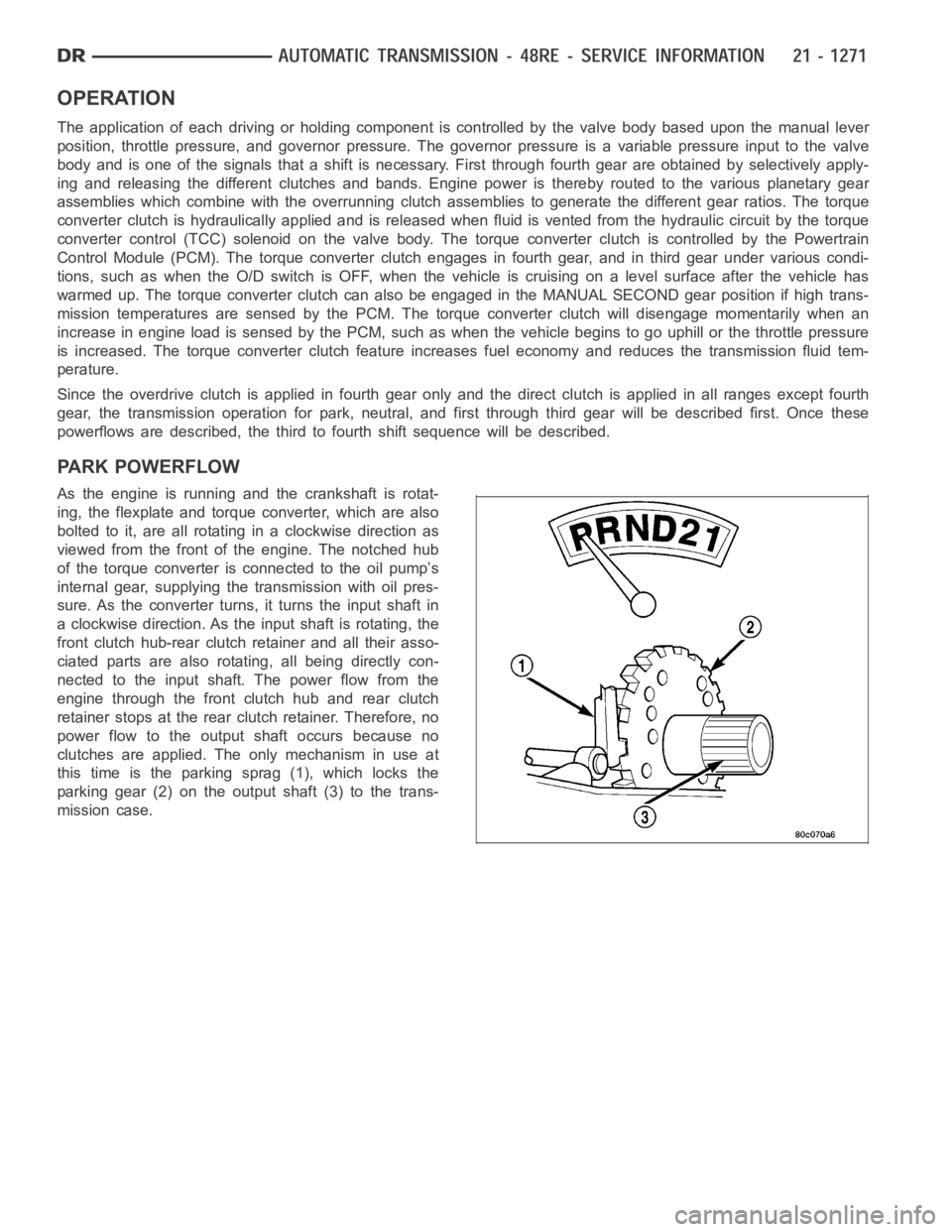
PARK POWERFLOW
As the engine is running and the crankshaft is rotat-
ing, the flexplate and torque converter, which are also
bolted to it, are all rotating in a clockwise direction as
viewed from the front of the engine. The notched hub
of the torque converter is connected to the oil pump’s
internal gear, supplying the transmission with oil pres-
sure. As the converter turns, it turns the input shaft in
a clockwise direction. As the input shaft is rotating, the
front clutch hub-rear clutch retainer and all their asso-
ciated parts are also rotating, all being directly con-
nected to the input shaft. The power flow from the
engine through the front clutch hub and rear clutch
retainer stops at the rear clutch retainer. Therefore, no
power flow to the output shaft occurs because no
clutches are applied. The only mechanism in use at
this time is the parking sprag (1), which locks the
parking gear (2) on the output shaft (3) to the trans-
mission case.
Page 3798 of 5267
pressure to the overdrive clutch during 3-4 upshifts, and when accelerating in fourth gear. The 3-4 accumulator
cushions overdrive clutch engagement to smooth 3-4 upshifts. The accumulator is charged at the same time as
apply pressure acts against the overdrive piston.
DIAGNOSIS AND TESTING
AUTOMATIC TRANSMISSION
Automatic transmission problems can be a result of poor engine performance, incorrect fluid level, incorrect linkage
or cable adjustment, band or hydraulic control pressure adjustments, hydraulic system malfunctions or electrical/
mechanical component malfunctions. Begin diagnosis by checking the easily accessible items such as: fluid level
and condition, linkage adjustments and electrical connections. A road test will determine if further diagnosis is nec-
essary.
PRELIMINARY
Two basic procedures are required. One procedure for vehicles that are drivable and an alternate procedure for
disabled vehicles (will not back up or move forward).
VEHICLE IS DRIVEABLE
1. Check for transmission fault codes using DRBscan tool.
2. Check fluid level and condition.
3. Adjust throttle and gearshift linkage if complaint was based on delayed, erratic, or harsh shifts.
4. Road test and note how transmission upshifts, downshifts, and engages.
5. Perform hydraulic pressure test if shift problems were noted during roadtest.
6. Perform air-pressure test to check clutch-band operation.
VEHICLE IS DISABLED
1. Check fluid level and condition.
2. Check for broken or disconnected gearshift or throttle linkage.
3. Check for cracked, leaking cooler lines, or loose or missing pressure-port plugs.
4. Raise and support vehicle on safety stands, start engine, shift transmission into gear, and note following:
a. If propeller shaft turns but wheels do not, problem is with differentialor axle shafts.
b. If propeller shaft does not turn and transmission is noisy, stop engine.Remove oil pan, and check for debris.
If pan is clear, remove transmission and check for damaged drive plate, converter, oil pump, or input shaft.
c. If propeller shaft does not turn and transmission is not noisy, perform hydraulic-pressure test to determine if
problem is hydraulic or mechanical.
ROAD TESTING
Before road testing, be sure the fluid level and control cable adjustmentshave been checked and adjusted if nec-
essary. Verify that diagnostic trouble codes have been resolved.
Observe engine performance during the road test. A poorly tuned engine will not allow accurate analysis of trans-
mission operation.
Operate the transmission in all gear ranges. Check for shift variations and engine flare which indicates slippage.
Note if shifts are harsh, spongy, delayed, early, or if part throttle downshifts are sensitive.
Slippage indicated by engine flare, usually means clutch, band or overrunning clutch problems. If the condition is
advanced, an overhaul will be necessary to restore normal operation.
A slipping clutch or band can often be determined by comparing which internal units are applied in the various gear
ranges. The Clutch and Band Application chart provides a basis for analyzing road test results.
Clutch and Band Application Chart
Page 3802 of 5267
3. Lower vehicle.
4. Turn OD switch on.
5. Secure test gauge so it can be viewed from drivers seat.
6. Start engine and shift into D range.
7. Increase vehicle speed gradually until 3-4 shift occurs and note gauge pressure.
8. Pressure should be 524-565 kPa (76-82 psi) with closed throttle and increase to 690-896 kPa (100-130 psi) at
1/2to3/4throttle.Notethatpressurecanincreasetoaround965kPa(140psi) at full throttle.
9. Return to shop or move vehicle off chassis dyno.
PRESSURE TEST ANALYSIS CHART
TEST CONDITION INDICATION
Line pressure OK during any one test Pump and regulator valve OK
Line pressure OK in R but low in D, 2, 1 Leakage in rear clutch area (seal rings, clutch seals)
Pressure low in D Fourth Gear Range Overdrive clutch piston seal, or check ball problem
Pressure OK in 1, 2 but low in D3 and R Leakage in front clutch area
Pressure OK in 2 but low in R and 1 Leakage in rear servo
Front servo pressure in 2 Leakage in servo; broken servo ring or cracked servo
piston
Pressure low in all positions Clogged filter, stuck regulator valve, wornor faulty
pump, low oil level
Governor pressure too high at idle speed Governor pressure solenoid valvesystem fault. Refer
to diagnostic book.
Governor pressure low at all mph figures Faulty governor pressure solenoid, transmission
control module, or governor pressure sensor
Lubrication pressure low at all throttle positions Clogged fluid cooler or lines, seal rings leaking, worn
pump bushings, pump, clutch retainer, or clogged filter.
Line pressure high Output shaft plugged, sticky regulator valve
Line pressure low Sticky regulator valve, clogged filter, worn pump
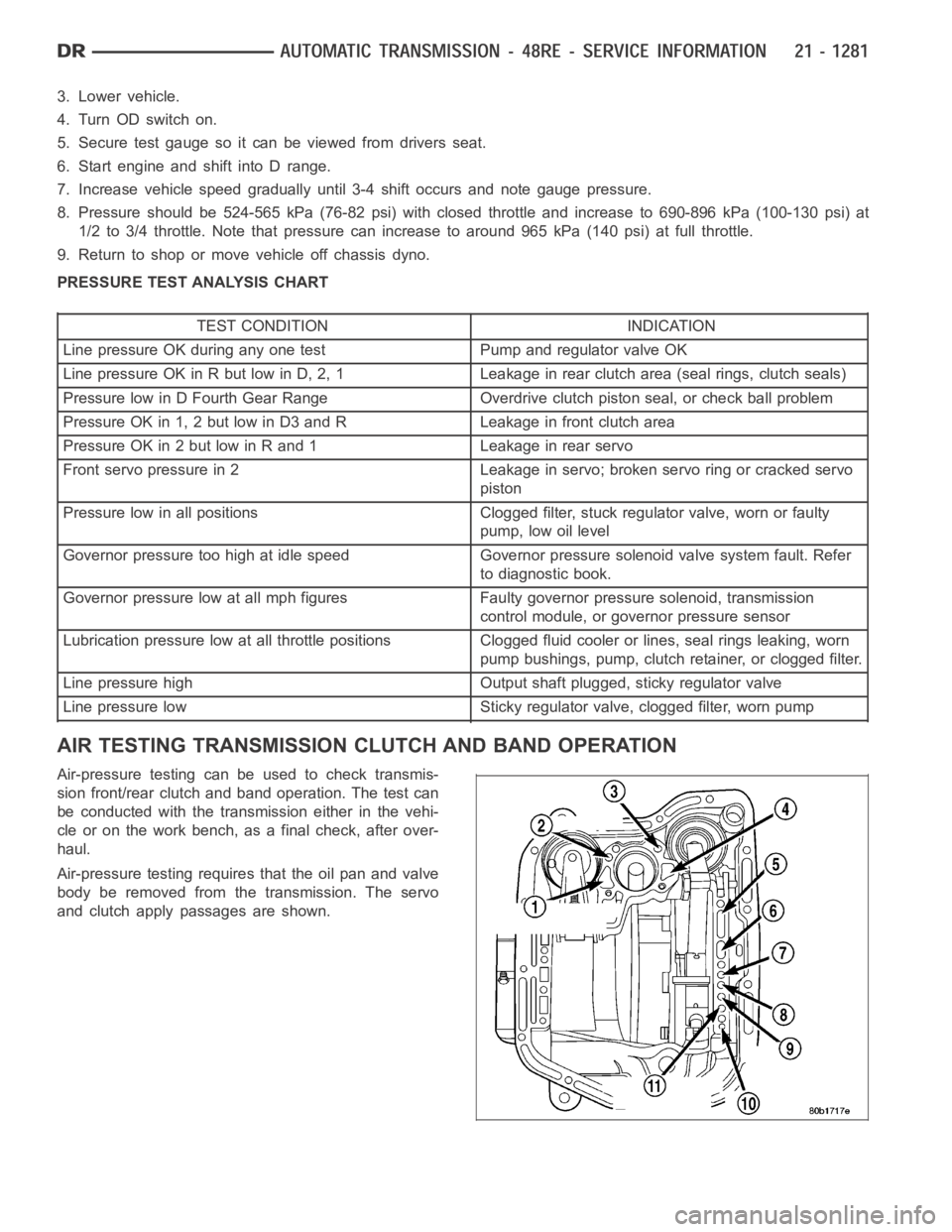
AIR TESTING TRANSMISSION CLUTCH AND BAND OPERATION
Air-pressure testing can be used to check transmis-
sion front/rear clutch and band operation. The test can
be conducted with the transmission either in the vehi-
cle or on the work bench, as a final check, after over-
haul.
Air-pressure testing requires that the oil pan and valve
body be removed from the transmission. The servo
and clutch apply passages are shown.