2005 VOLKSWAGEN GOLF airbag
[x] Cancel search: airbagPage 41 of 444
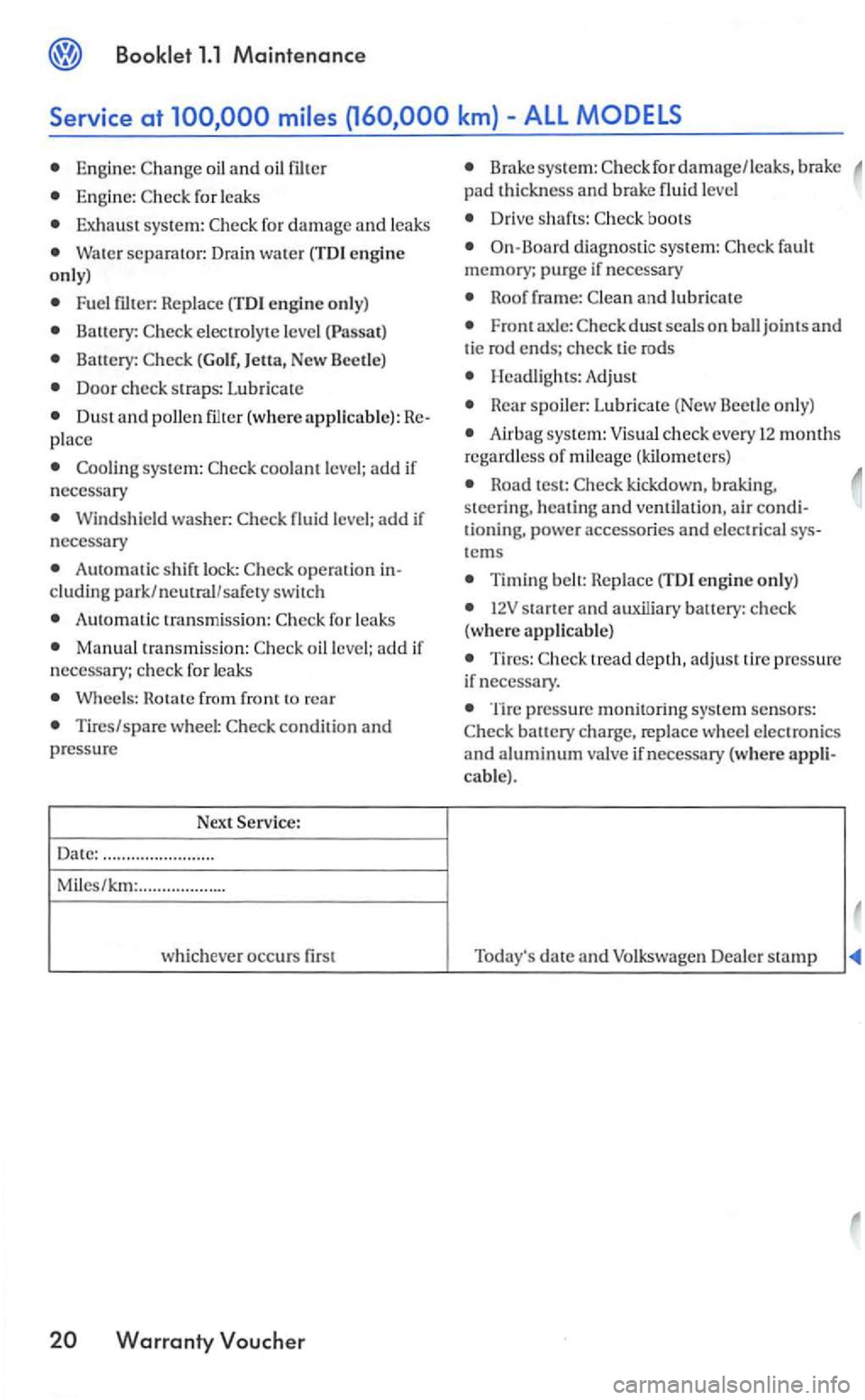
Engine: oil and oil filter
Engine: for leaks
Exhaust system: fo r damage and leaks
Water separator: Drain water (TDI e ngi ne only)
Fuel
electrolyte level
Battery: (Golf, )etta, New
Door check straps: Lubricate
s ystem:
Windshield washer:
Automatic sh ift lock:
Automatic transmiss ion:
Manual transmiss ion:
Wheels:
Tires/spare wheel :
Date: .................. ... ...
Miles/km: .................. .
which ev
er occurs first
Brake system: for damage/leaks, brak e pad thickness and brake fluid
Drive shafts: boots
On-Board diagnos tic system: fault
memory; purge if nece ssary
Roof frame: and lubricate
Front axle: jo int s and tie rod ends; ch eck tie rods
Hea dligh ts : Adjust
Rear sp oile r: Lub ricate (New Beetle only)
Airbag system: Visual check every 12 months regardless of mileage (kilom eters)
Road test: kickdown , braking, steering, heating and ventilation , air conditioning, powe r accessories and electrical systems
Timing belt: Replace (TDI engine only)
starter and auxiliary banery: check
( w here applicable)
T ires: tread dept h, adjust tire pressure
if nec essary _
Tire pressure monitoring system sen sors: battery charge, replace wheel electronics and aluminum valve if necessary (whe re appli
cable) .
date and Volkswagen Dealer stamp
Page 89 of 444
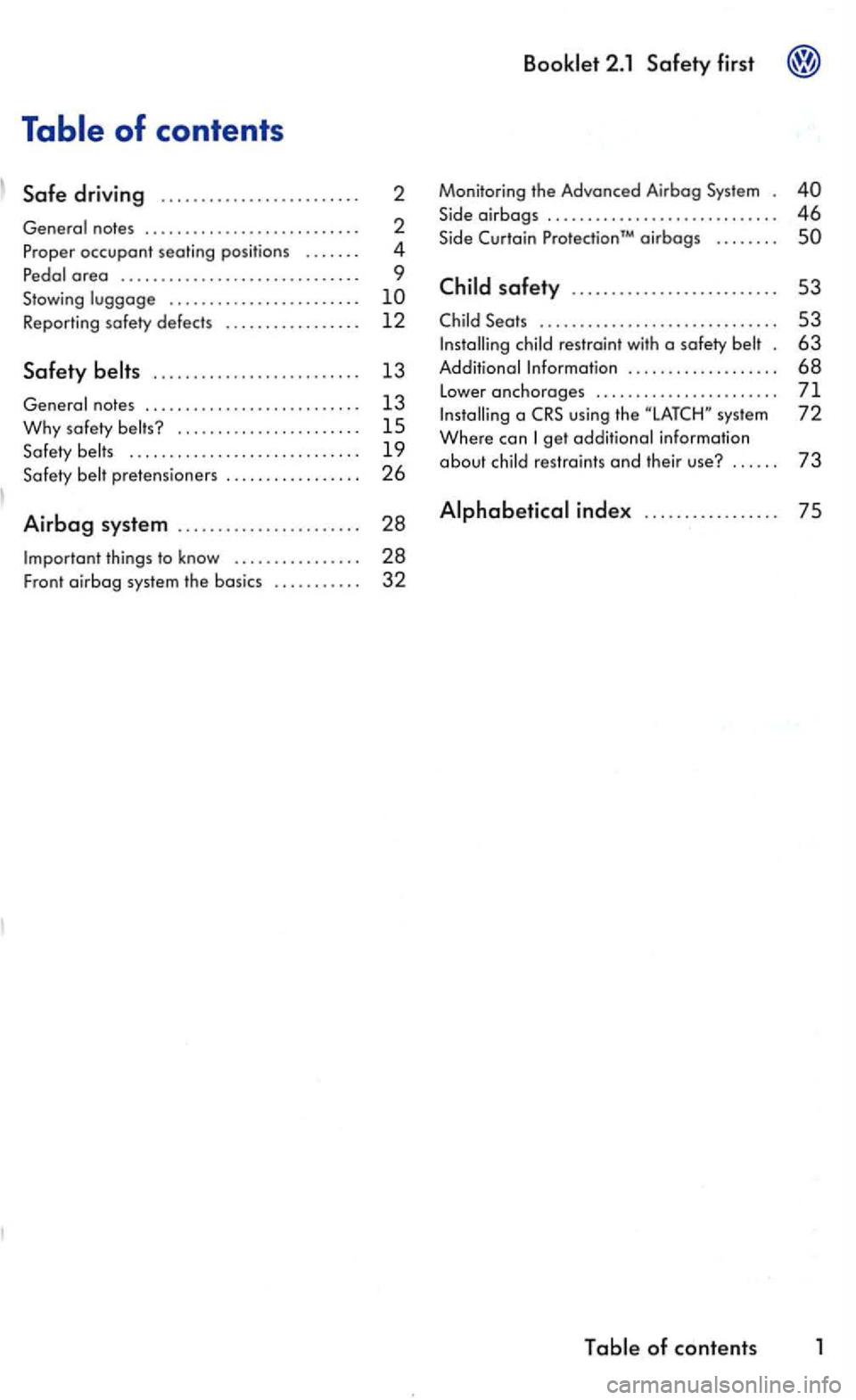
driving ........................ .
occupant seating positions ...... .
a reo ..............................
Stowing ....................... .
Reporting safety defects
............... . .
......................... .
notes ....................... ... .
Why safety ...................... .
Saf ety .................
Safety pretensioners ................ .
Airbag system
28
Front airbog system the basics ..... 32
Boo klet 2.1 first
Monitoring the Advanced Airbog System
46 Side
safety 53
Seats ...... ........... .. 53 restraint with o safety . 63
Inform ation 0................. 68
Lower anchorages .......... .... 7 1 system 72
Where con get additional inform ation
a bout
res traints and their use? . . . . . . 73
Alphabetical index ....
Page 90 of 444
WARNING
Always make sure that you the suggestions and heed th e WARN INGS in this Booklet.
Safety equipment
Additional important information that yo u
need to know fo r you r own safety and the safety of your passengers and others is in the Bookl ets of your Literature.
T his
The safety are part of the occupan t rest rain t system and work together to
help reduce the risk
of injury in accident situation s.
Your safe ty and the safety of your pass enge rs
s houldn 't be left t o chance. Adva n ces in te ch
n ology have mad e variety of feature s available to help red uce the risk of injury in a collisio n.
T he followin g is lis tingofjust a few of th e s afe ty
f e at ures in your Vo lk sw age n:
sophisticate d safe ty belt s for all seating positio n s.
sa fe ty belt force for the front seats
s eati ng po sition s,
safety be lt pre te nsioners for the front seatin g
p ositions and for the outboard rear seating pos i
t io ns in combin ati o n w it h optional re a r s id e air
b ags,
sa fety b elt he ight adjustment for the front s eat s,
fr ont airbags sys te m ,
sid e airb ags for the front seats, optiona l for the outboard re a r seats ( fo u r doors ve hicl e)
2 Safe driving
S id e Protection ai rbags,
h ead res tra in ts fo r ea ch seat in g positi on , and
adjustable s teerin g column.
T he se
individua l sa fety features, wo rk t ogeth er as a syste m to help protect yo u and your passeng ers in a wid e range of collis io ns. T hese features can't work as a sys te m if they are notal
w ays correctJy a dju ste d and correc tl y used!
T
his Bookle t p rov ides important in for matio n
a b out why these features are important, how they w ork to help protect yo u and your passengers and the y m ust be adju ste d and used to get the g re atest ben efit an d reduce the lik eli
h oo d of injury. T he Booklet a ls o conta in s i mpo r
t a nt WARNINGS th a t yo u a nd you r passenge rs mus t alw ays rea d and hee d in order to he lp r e
d uce th e risk o f perso nal inju ry.
Safety is
everybody' s responsibility!
Page 92 of 444
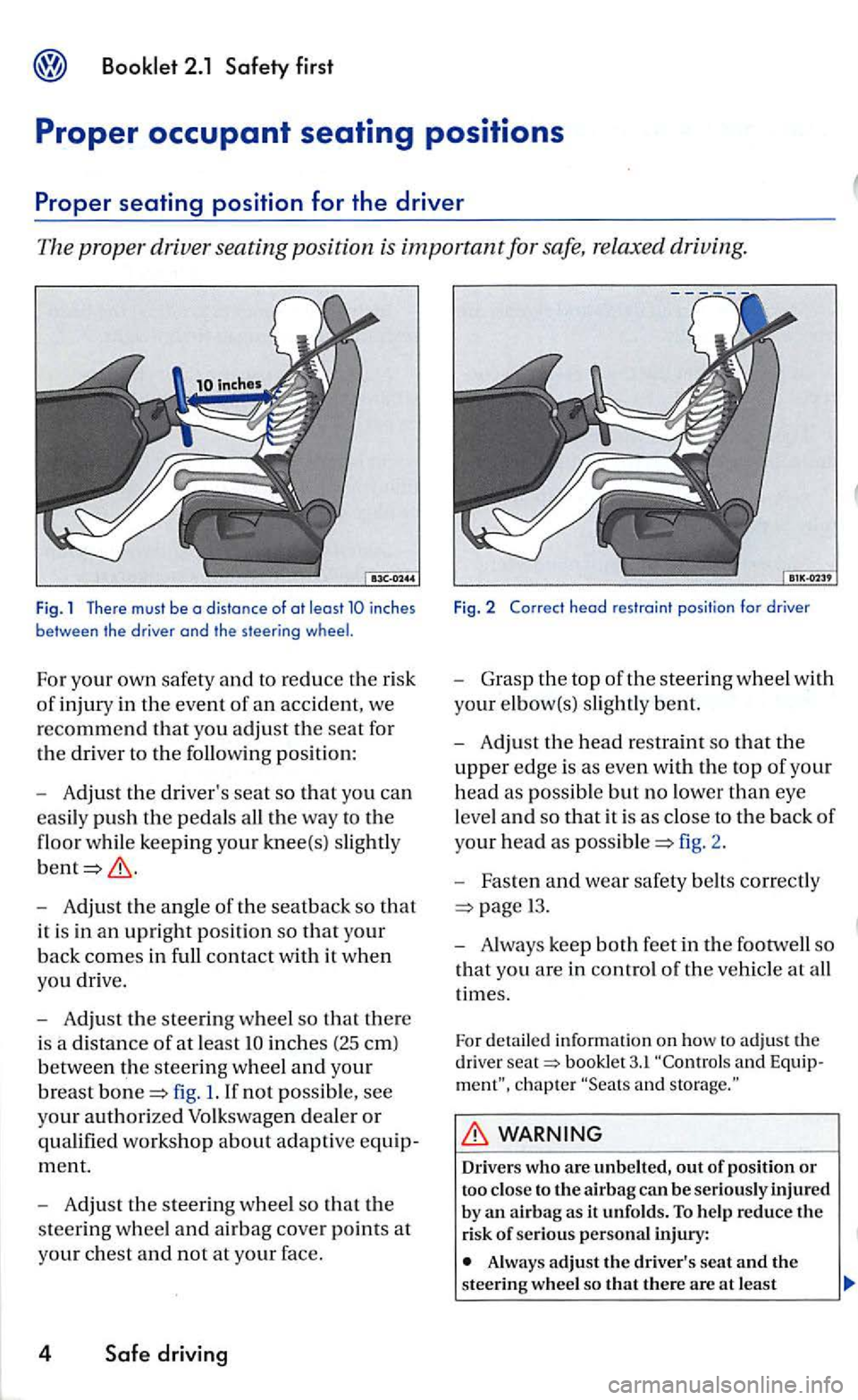
- Adjust the angle of th e seatback so that
it is in an upri ght position so that your
back comes in full contact with it whe n
yo u dri ve.
-
Adju st the s teerin g w heel so that there
i s a dis
tance of at least
fig. 1. If not poss ibl e, see
yo
ur authorized Volksw agen dealer or
qualified workshop about adaptive
fig. 2 .
- Fasten
and wea r safety belts correctly
13.
-Always keep both feet in the footwell so
that yo u are in con trol of the vehicle at all
tim es.
For detailed information on how to adjust th e
d rive r bookle t 3.1 chapter
WARNING
Dr ivers who are unbelted, out of pos itio n or too close to tl1e airbag can be serio usly injured by an airbag as it unfold s. To help reduce the risk of seriou s personal injury:
Page 93 of 444
inches (25 em) between your breastbone and the steering wheel.
Always hold the s teering wheel on the
Never hold the steering wheel at the 12 o'clock position or with your hands at other positions inside the steering wheel rim or on the steering wheel hub. Holding the steering
wheel the wrong way can cause serious
2.1 Safety first
(continued)
Always sit in an upright posit i on and never lean against or place any part of your body too
close to the area where the airbags are located.
strained.
Never adjust the seats the vehicl e is mov ing. Your seat may move unexpecte dly and yo u could lose control of the vehicle.
Never drive wit11 the backrest reclined or tilted far back! The fart her t11e backrests are tilted back, the greater the risk of injury due to
incorrect positionin g ofthe safety belt and
Children must always ride in child seats
page restraints on t11e front seat some important things to
Move the front passenger seat back as
far as possible. There must be a minimum
of
Adjust th e angle of the seat back so that
it is in an upright position and your back
comes in full contact with it whenever the
veh icle is moving.
Adjust the head restra int so that the
upper edge is as eve n with the top of your
h
ead as poss ible but not lower than eye
leve l
and so that it is as close to the back of
your head as
Keep both feet flat on the floor in the
footwell in fron t
of the front passenger
seat.
Fasten and wea r safety belt s co rrectly
13.
For detail ed inform ation on how to adju st the
front passenger bookl et 3.1 and s torage.""
WARNING
Front seat passengers who are unbelted, out of posit ion or too close to the airbag can be
risk of serious
Passengers must always sit in an upright position and nev er lean against or place any part of their body too clos e to the area where the airbags are located.
Passengers who are u nbelted, out
Safe driving 5
Page 94 of 444
Always make sure that there are at least
Each passenger must always sit on a seat of their own and properly fasten and wear the safety belt be longing to that seat.
Before driving , always adjust the front senger seat and head re straint properly.
Alway s keep your feet on the floor in front of the seat. Never rest them on the seat, ment panel, out of the window, etc. The airbag
tect you properly and can even increa se th e
risk of injury in a crash.
Neve r drive with the backre st recl ined or tilted far back! The farth er the b ackrests are
tilted back, the greater the risk ofinjury due to
in correct positioning of the safety belt and
must always ride in seats 53. a child seat on the front passenger page
Mak e sure that the seatback s are
curel y lat ch ed in the upright position.
A djust th e head restraint so that the
upper edge is as even with the top of your
head as possible but no lower than eye
pag e 7. If a passe nger is s ittin g in
the rear center seating pos ition, this
pac t h ead restra int is not h eight
a ble , but it must always bee n rais ed
eve r the center rear seating posit ion is
belt on
page 23
Keep both feet flat in the footwell in
front
of the rear seat.
6 Safe driving
Fasten and wear safe ty belt s properly
13.
Make sure that children are always
prop e
rly restra in ed in a child re str aint that
is appropriate for thei r size and age
5 3 .
WARNING
Pas sengers who are improperly seated on the rear seat can be se riou sly injure d in a crash.
Each passen ge r must always sit on a seat of th eir own and properly fasten and wear the safety belt belonging to that seat.
belt s only offer maximum tion when the seat back is securely latched in
th e upright po siti on and the safety belts are
properly positioned on the body. By not sitting
upright , a re ar seat pass enger increases the risk of personal injury from improperl y
Always adjust the head restraint properly so that it can give maximum
Page 105 of 444
Booklet 2.1 Safety first
Safety
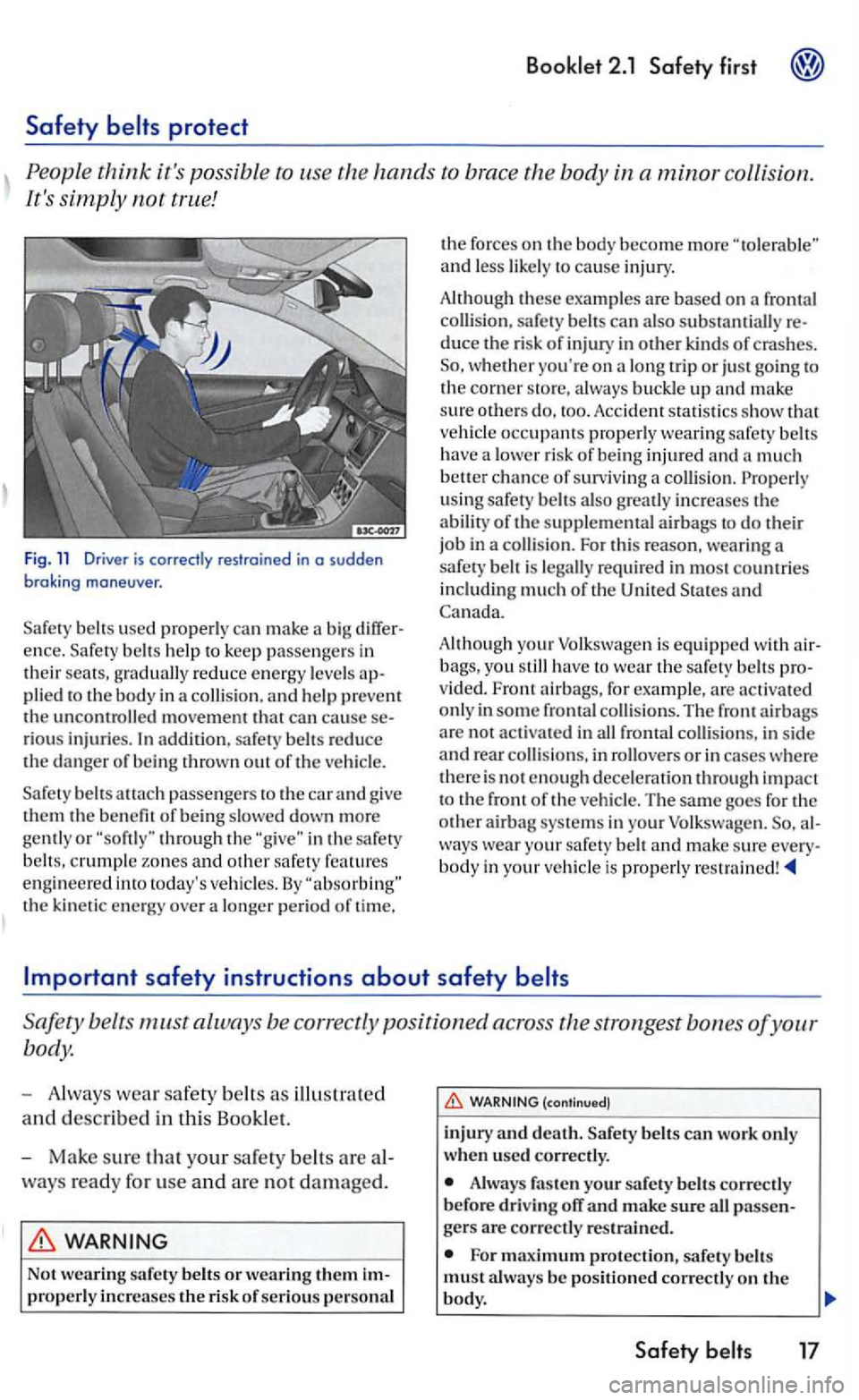
Fig . 11 Driver is correctly restrained in a sudden braking maneu ve r.
used properly can make a big differ
e n ce . help to kee p passenge rs in
t h ei r gradually red uce energy levels applied to the body in a collisio n. an d h elp prevent
t h e uncontrolled movement that can cause se
r ious injuries. additio n, safety reduce the danger of being throw n out of the vehicle.
passengers to the car and give them the benefi t o f being slowed down more ge ntly or t hroug h the c rumple zones and oth er sa fety features engineered today's vehicles. By
hough these examples are based on
Acci dent statist ics show that
veh icle occupants prop erly wearing safety have a lowe r risk of being i n ju red and
pro
v id ed . Fron t airbags, for example, are activated
only in some frontal collisions. The front airbags
are not activated in all frontal collision s, in side and rea r collisions, in rollovers or in cases where
there is not e n ough deceleration through impact
to the front of the ve hicle. The sa me goes for the
o ther airbag systems in your Volk sw age n. al
ways wear your saf ety
safety instructions about safety
Safety belts must always be correctly positioned across
Always wear safety belts as illu strate d
a
nd d esc ribed in thi s Book let.
WARNING
Not wearing safety belt s or w earin g them im
p ro perl y in cre ases the ri sk of serio us pe rso nal
Always fas te n your safety belt s correc tly
before driv ing off and make su re all passen gers are corr ec tly res traine d.
For m aximum protectio n, safe ty belts must a lways be pos itioned correctly on the
Safety belts 17
Page 111 of 444
Safety
sengel:
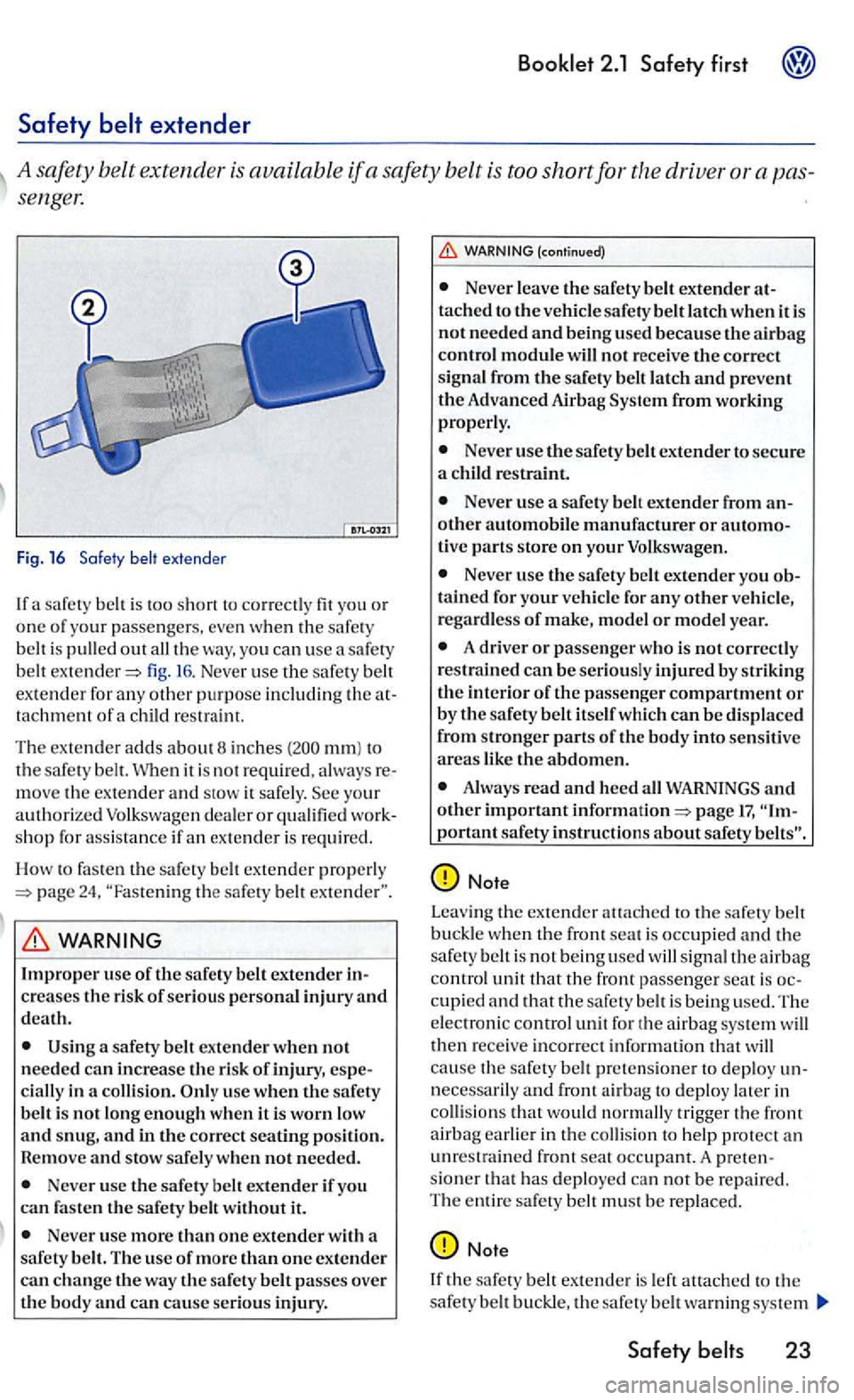
Fig. 16 Safe ty
out fig . 16 . Never use th e safe ty belt
ex tende r for any oth er purpo se includin g th e tachment of a c hild restraint.
Th e
exte nder adds a boutB inches mm) to
the safery belt. Whe n it is not require d , always
s hop for a ss is tan ce if an extende r is requ ired .
H ow to fas te n the s
afety belt extender properly 24, th e sa fe ty belt
crea ses the risk of seriou s personal injury and death.
a safery belt exten de r w hen not needed can increase the risk of injury , cially in a collision. it is worn low
and snug, and in the cor rec t seating position.
R emove and sto w safe ly when not needed.
Never use the safet y belt extender if yo u
ca n fasten the sa fety belt without it.
Never use more than one extender with a
safery be lt. The use of m ore than one extender c a n ch ang e the way the sa fe ty belt passes over
the body and can cause se rious injury .
Never leave the saferybelt extender ta ched to the veh icle safe ty belt latch when it is not needed and being used because th e airbag control module will not re ceive the correc t
s ign al from the safety b elt la tc h and prevent the Advanc ed Airbag from working properly .
Never use the safe ty belt extender to secure
a child restraint.
Never use a safery belt ex tender from
Nev er u se the safery belt extend er yo u tained for your vehicle for any other vehicle,
regardless of make, model or model year.
A driver or pass enger w ho is not correct ly
re strained can be seriously injured b y striki ng the interior of the passe ng er compartment or by the safery b elt its elf whi ch can b e di spla ced
from stronger parts of the body into se nsiti ve areas lik e th e abdomen.
Always read and heed all WARNINGS and other important pa ge
signal th e airbag
co ntrol unit that the front passenge r seat is
ca use the s afery belt prete nsio n er to deploy necessarily and fron t to deplo y la ter in
collision s th at would trigge r the front
a irb ag earlie r in th e to help pro tect an unrestrain ed front seat occ upant. A sioner that has dep loyed can not b e repair ed.
T he entire sa fety belt mu st b e rep laced.
Safety