2005 SUBARU FORESTER wheel
[x] Cancel search: wheelPage 283 of 477
7-26
Starting and operating
Electronic Brake Force Distribution
(EBD) system (if equipped)
The EBD system maximizes the effectiveness of the
brakes by allowing the rear brakes to supply a greater
proportion of the braking force. It functions by adjust-
ing the distribution of braking force to the rear wheels
in accordance with the vehicle’s loading condition and
speed.
The EBD system is an integral part of the ABS system
and uses some of the ABS system’s components to
perform its function of optimizing the distribution of
braking force. If any of the ABS components used by
the EBD function fails, the EBD system also stops
working.
When the EBD system is operating, you may hear a
chattering noise or feel a slight vibration in the brake
pedal. This is normal and does not indicate a malfunc- tion.
„
Steps to take if EBD system fails
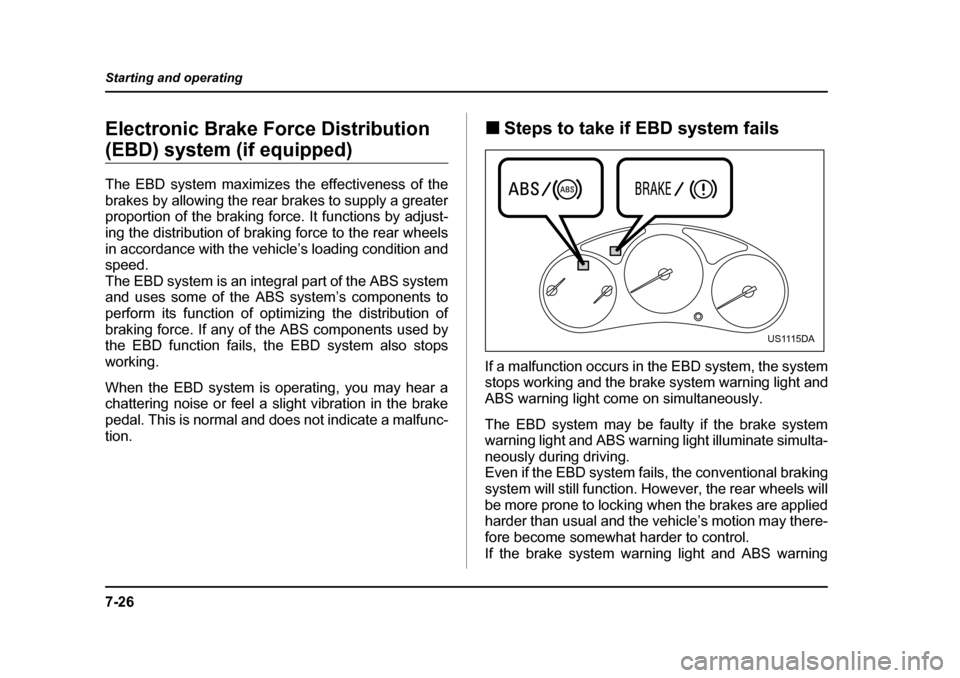
If a malfunction occurs in the EBD system, the system
stops working and the brake system warning light and
ABS warning light come on simultaneously.
The EBD system may be faulty if the brake system
warning light and ABS warning light illuminate simulta-
neously during driving.
Even if the EBD system fails, the conventional braking
system will still function. However, the rear wheels will
be more prone to locking when the brakes are applied
harder than usual and the vehicle’s motion may there-
fore become somewhat harder to control.
If the brake system warning light and ABS warning
US1115DA
Page 285 of 477
7-28
Starting and operating
Vehicle Dynamics Control system (if
equipped)
Always use the utmost care in driving – over-
confidence because you are driving with a Ve-
hicle Dynamics Control system equipped vehi-
cle could easily lead to a serious accident.
y
Even if your vehicle is equipped with Vehicle
Dynamics Control, winter tires or snow chains
should be used when driving on snow-covered
or icy roads; in addition, vehicle speed should
be reduced considerably. Simply having a Vehi-
cle Dynamics Control system does not guaran-
tee that the vehicle will be able to avoid acci-
dents in any situation.y Activation of the Vehicle Dynamics Control
system is an indication that the road being trav-
elled on has a slippery surface; since having
Vehicle Dynamics Control is no guarantee that
full vehicle control will be maintained at all
times and under all conditions, its activation should be seen as a sign that the speed of the
vehicle should be reduced considerably.y
Whenever suspension components, steering
components, or an axle are removed from a ve-
hicle equipped with Vehicle Dynamics Control,
have an authorized SUBARU dealer perform an
inspection of that system. y The following precautions should be ob-
served in order to ensure that the Vehicle Dy-
namics Control system is operating properly: – All four wheels should be fitted with tires of
the same size, type, and brand. Furthermore,
the amount of wear should be the same for all four tires.
– Keep the tire pressure at the proper level as
shown on the placard attached to the vehi-
cle’s door pillar.
– Use only the special temporary spare tire to
replace a flat tire. With a temporary spare tire,
the effectiveness of the Vehicle Dynamics
Control system is reduced and this should be
taken into account when driving the vehicle
in such a condition.
In the event of wheelspin and/or skidding on a slippery
road surface and/or during cornering and/or an eva-
sive maneuver, the Vehicle Dynamics Control system
Page 286 of 477

7-29
Starting and operating
– CONTINUED –
adjusts the engine’s output and the wheels’ respective
braking forces to help maintain traction and directional
control. yTraction Control Function
The traction control function is designed to prevent
spinning of the driving wheels on slippery road surfac-
es, thereby helping to maintain traction and directional
control. Activation of this function is shown by steady
illumination of the Vehicle Dynamics Control operation
indicator light. y Skid Suppression Function
The skid suppression function is designed to help
maintain directional stability by suppressing the
wheels’ tendency to slide sideways during steering op-
erations. Activation of this function is shown by flash-
ing of the Vehicle Dynamics Control operation indica-
tor light.
NOTE y Slight twitching of the brake pedal may be felt
when the Vehicle Dynamics Control system oper-
ates; a small degree of vehicle or steering wheel
shaking may also be noticed in this situation.
These are normal characteristics of Vehicle Dy-
namics Control operation and are no cause for
alarm. y
When driving off immediately after starting the
engine, a short-lived operation noise may be no-
ticed coming from the engine compartment. This
noise is generated as a result of a check being per-
formed on the Vehicle Dynamics Control system
and is normal. y Depending on the timing of activation of the
brakes, certain situations may occur just after
driving off where the brake pedal seems to exhibit
a jolting motion. This too is a consequence of the
Vehicle Dynamics Control operational check and
is normal. y In the circumstances listed below, the vehicle
may be more unstable than it feels to the driver.
The Vehicle Dynamics Control System may there-
fore operate. Such operation does not indicate a system fault. yon gravel-covered or rutted roads
y on unfinished roads
y when the vehicle is towing a trailer
y when the vehicle is fitted with snow tires or
winter tires
y Activation of the Vehicle Dynamics Control sys-
tem will cause operation of the steering wheel to feel slightly different compared to that for normal
conditions.y Even if the vehicle is equipped with a Vehicle
Page 287 of 477
7-30
Starting and operating
Dynamics Control system, it is important that win-
ter tires be used when driving on snow-covered oricy roads. (All four wheels should be fitted with
tires of the same size and brand). Furthermore, if
snow chains are to be used, they should be fitted
on the front wheels. When a vehicle is fitted with
snow chains, however, the effectiveness of the Ve-
hicle Dynamics Control system is reduced and
this should be taken into account when driving the
vehicle in such a condition. y
It is always important to reduce speed when ap-
proaching a corner, even if the vehicle is equipped
with Vehicle Dynamics Control. y All four wheels should be fitted with tires of the
same size, type, and brand; furthermore, the
amount of wear should be the same for all four
tires. If these precautions are not observed and
non-matching tires are used, it is quite possible
that the Vehicle Dynamics Control system will be
unable to operate correctly as intended.y Always turn off the engine before replacing a
tire as failure to do so may render the Vehicle Dy-
namics Control system unable to operate correct-ly. „
Vehicle Dynamics Control system monitor
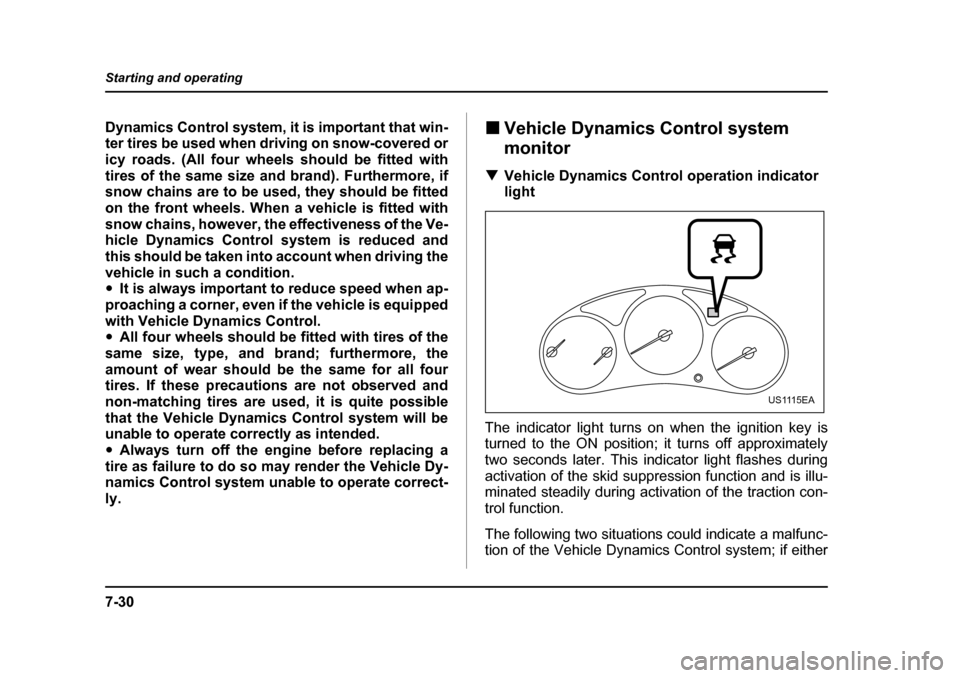
T Vehicle Dynamics Control operation indicator
light
The indicator light turns on when the ignition key is
turned to the ON position; it turns off approximately
two seconds later. This indicator light flashes during
activation of the skid suppression function and is illu-
minated steadily during activation of the traction con-
trol function.
The following two situations could indicate a malfunc-
tion of the Vehicle Dynamics Control system; if either
US1115EA
Page 290 of 477
7-33
Starting and operating
– CONTINUED –
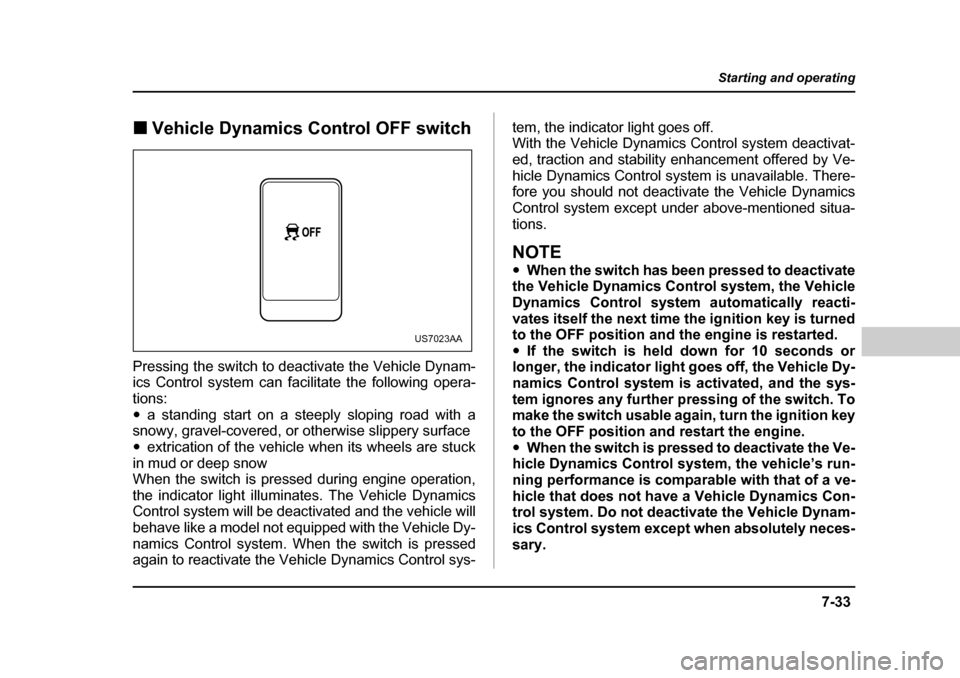
„Vehicle Dynamics Control OFF switch
Pressing the switch to deactivate the Vehicle Dynam-
ics Control system can facilitate the following opera- tions: y a standing start on a steeply sloping road with a
snowy, gravel-covered, or otherwise slippery surface y extrication of the vehicle when its wheels are stuck
in mud or deep snow
When the switch is pressed during engine operation,
the indicator light illuminates. The Vehicle Dynamics
Control system will be deactivated and the vehicle will
behave like a model not equipped with the Vehicle Dy-
namics Control system. When the switch is pressed
again to reactivate the Vehicle Dynamics Control sys- tem, the indicator light goes off.
With the Vehicle Dynamics Control system deactivat-
ed, traction and stability enhancement offered by Ve- hicle Dynamics Control system is unavailable. There-
fore you should not deactivate the Vehicle Dynamics
Control system except under above-mentioned situa-
tions.
NOTE y
When the switch has been pressed to deactivate
the Vehicle Dynamics Control system, the Vehicle
Dynamics Control system automatically reacti-
vates itself the next time the ignition key is turned
to the OFF position and the engine is restarted. y If the switch is held down for 10 seconds or
longer, the indicator light goes off, the Vehicle Dy-
namics Control system is activated, and the sys-
tem ignores any further pressing of the switch. To
make the switch usable again, turn the ignition key
to the OFF position and restart the engine. y When the switch is pressed to deactivate the Ve-
hicle Dynamics Control system, the vehicle’s run-
ning performance is comparable with that of a ve-
hicle that does not have a Vehicle Dynamics Con-
trol system. Do not deactivate the Vehicle Dynam-
ics Control system except when absolutely neces-
sary.
US7023AA
Page 292 of 477
7-35
Starting and operating
– CONTINUED –
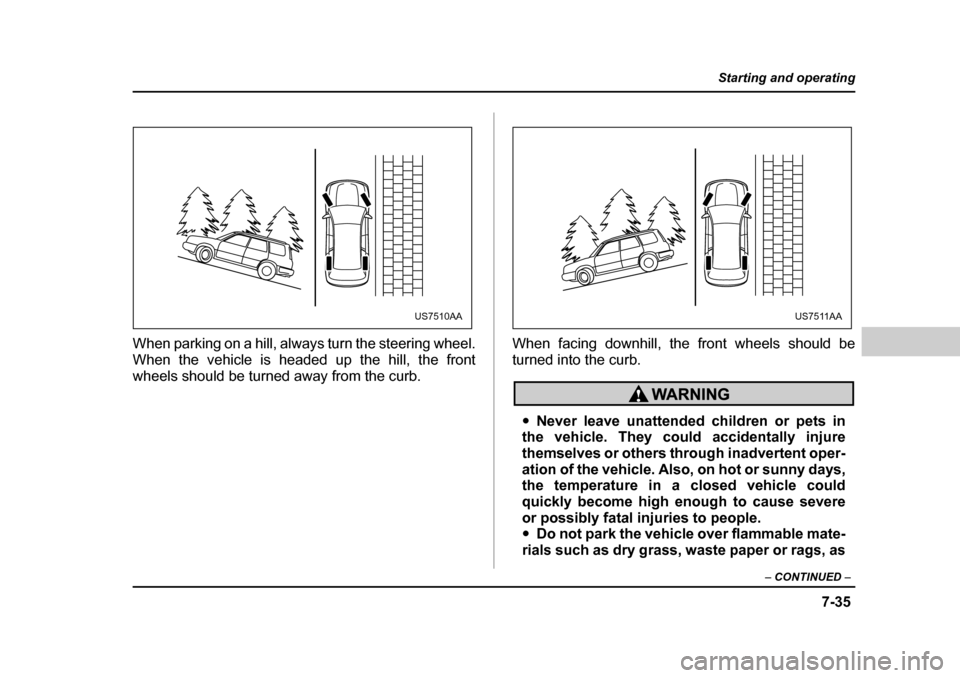
When parking on a hill, always turn the steering wheel.
When the vehicle is headed up the hill, the front
wheels should be turned away from the curb. When facing downhill, the front wheels should be
turned into the curb.
y
Never leave unattended children or pets in
the vehicle. They could accidentally injure
themselves or others through inadvertent oper-
ation of the vehicle. Also, on hot or sunny days,
the temperature in a closed vehicle could
quickly become high enough to cause severe
or possibly fatal injuries to people.y Do not park the vehicle over flammable mate-
rials such as dry grass, waste paper or rags, as
US7510AAUS7511AA
Page 303 of 477

8-2
Driving tips
Driving tipsNew vehicle break-in driving – the
first 1,000 miles (1,600 km)
The performance and long life of your vehicle are de-
pendent on how you handle and care for your vehicle
while it is new. Follow these instructions during the
first 1,000 miles (1,600 km):y
Do not race the engine. And do not allow engine
speed to exceed 4,000 rpm except in an emergency.y Do not drive at one constant engine or vehicle
speed for a long time, either fast or slow. y Avoid starting suddenly and rapid acceleration, ex-
cept in an emergency. y Avoid hard braking, except in an emergency.
The same break-in procedures should be applied to
an overhauled engine, newly mounted engine or when
brake pads or brake linings are replaced with new
ones.
Fuel economy hints
The following suggestions will help to save your fuel. y Select the proper gear position for the speed and
road conditions. y Avoid sudden acceleration or deceleration. Always
accelerate gently until you reach the desired speed.
Then try to maintain that speed for as long as possible. y Do not pump the accelerator and avoid racing the
engine. y Avoid unnecessary engine idling.
y Keep the engine properly tuned.
y Keep the tires inflated to the correct pressure shown
on the tire placard, which is located under the door
latch on the driver’s side. Low pressure will increase
tire wear and fuel consumption.y Use the air conditioner only when necessary.
y Keep the front and rear wheels in proper alignment.
y Avoid carrying unnecessary cargo.
Page 307 of 477
8-6
Driving tips
Driving in foreign countries
When planning to use your vehicle in another country: y
Confirm the availability of the correct fuel. (Refer to
the “Fuel requirements” section in chapter 7.) y Comply with all regulations and requirements of
each country.Driving tips for AWD vehicles
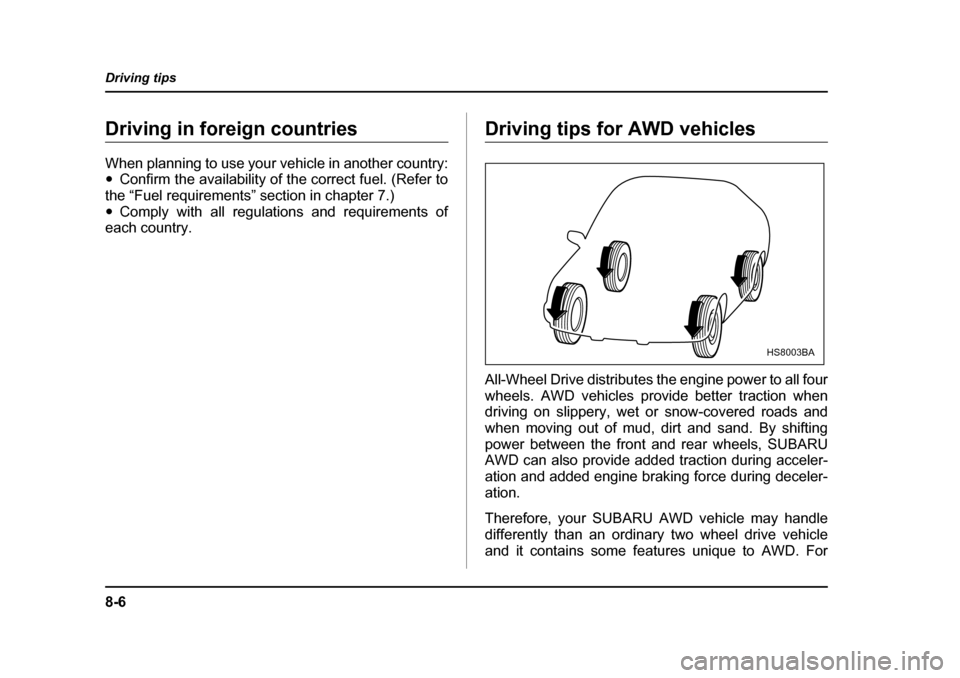
All-Wheel Drive distributes the engine power to all four
wheels. AWD vehicles provide better traction when
driving on slippery, wet or snow-covered roads and
when moving out of mud, dirt and sand. By shifting
power between the front and rear wheels, SUBARU
AWD can also provide added traction during acceler-
ation and added engine braking force during deceler-
ation.
Therefore, your SUBARU AWD vehicle may handle
differently than an ordinary two wheel drive vehicle
and it contains some features unique to AWD. For
HS8003BA