2005 SKODA OCTAVIA ECU
[x] Cancel search: ECUPage 248 of 315

Inspecting and Replenishing247
Using the systemSafetyDriving TipsGeneral MaintenanceBreakdown assistanceTechnical Data
Inspecting and Replenishing
Engine compartment
Bonnet remote release
Bonnet remote release
– Pull the unlocking lever below the dash panel on the driver's
side ⇒fig. 189 .
The bonnet jumps out of its lock as a result of the spring force. A handle
appears at the same time in the radiator grille.
Opening and closing the bonnet.
Fig. 189 Bonnet
release lever
Fig. 190 Radiator
grille: handle
Fig. 191 Securing the
bonnet with the bonnet
support
s24s.book Page 247 Thursday, November 24, 2005 12:27 PM
Page 250 of 315

Inspecting and Replenishing249
Using the systemSafetyDriving TipsGeneral MaintenanceBreakdown assistanceTechnical Data
•Allow the engine to cool down.
•Keep children clear of the engine compartment.
•Never spill oil and other fluids over the hot engine. Such fluids
(e.g. the antifreeze contained in the coolant) may ignite!
•Avoid short circuits in the electrical system - particularly on the
battery.
•Never place your hand into the radiator fan as long as the
engine is still warm. The fan might suddenly start running!
•Never open the cap of the coolant expansion bottle as long as
the engine is still warm. The cooling system is pressurized!
•Cover over the cap of the coolant expansion reservoir with a
large cloth when opening it as protection for your face, hands and
arms from hot steam or hot coolant.
•Do not let objects, such as e.g cleaning cloth or tools lie in the
engine compartment.
•If you wish to work under the vehicle, you must secure the
vehicle from rolling away and support it with suitable supporting
blocks: the car jack is not sufficient for this - risk of injury!
•In cases where it be necessary to carry out inspection work
when the engine is running there is an additional risk from rotating
parts (e.g. the V-ribbed belt, alternator, radiator fan) and from the
high-voltage ignition system. Please observe in addition the
following:
−Never touch the electrical cables of the ignition system.
− Absolutely avoid any jewellery, loose items of clothing or
long hair from getting into the rotating parts of the engine -
Hazard! Therefore remove any jewellery beforehand, tie up your
hair and wear tight fitting clothing.
•Please also comply with the warning instructions stated below
when carrying out any essential work on the fuel system or on the
electrical system:
−Always separate the car battery from the electrical system.
− Do not smoke.
− Never carry out any work close to naked flames.
− Always keep a working fi re extinguisher at hand.
Caution
When replenishing fluids in the engine, always ensure that the fluids are
on no account mixed up. This may result in major operating problems and
also vehicle damage!
WARNING (continued)WARNING (continued)
s24s.book Page 249 Thursday, November 24, 2005 12:27 PM
Page 276 of 315
Breakdown assistance275
Using the systemSafetyDriving TipsGeneral MaintenanceBreakdown assistanceTechnical Data
•Adapter for the wheel bolts lock,
After using the lifting jack, screw in the arm of the lifting jack fully before
placing it back in its stowage area.
WARNING
•The factory-supplied lifting jack is only intended for your model
of vehicle. On no account attempt to lift a heavier vehicle or other
loads - risk of injury!
•Ensure that the vehicle tool kit is safely attached in the luggage
compartment.
Note
Ensure that the box is always secured with the strap.
Tyre repair kit*
The tyre repair kit is intended for the repair of minor tyre defects. The tyre
repair kit contains a compressor, inflation bottle, operating instructions
and accessories.
The repair with the tyre repair kit is not at all intended to replace a
permanent repair on the tyre, this repair only serves to reach the next
specialist garage. The repair can be undertaken on the vehicle immedi-
ately. Please read the attached instructions carefully before the
repair.
The tyre repair kit is located in a well under the floor covering in the
luggage compartment.
Spare wheel
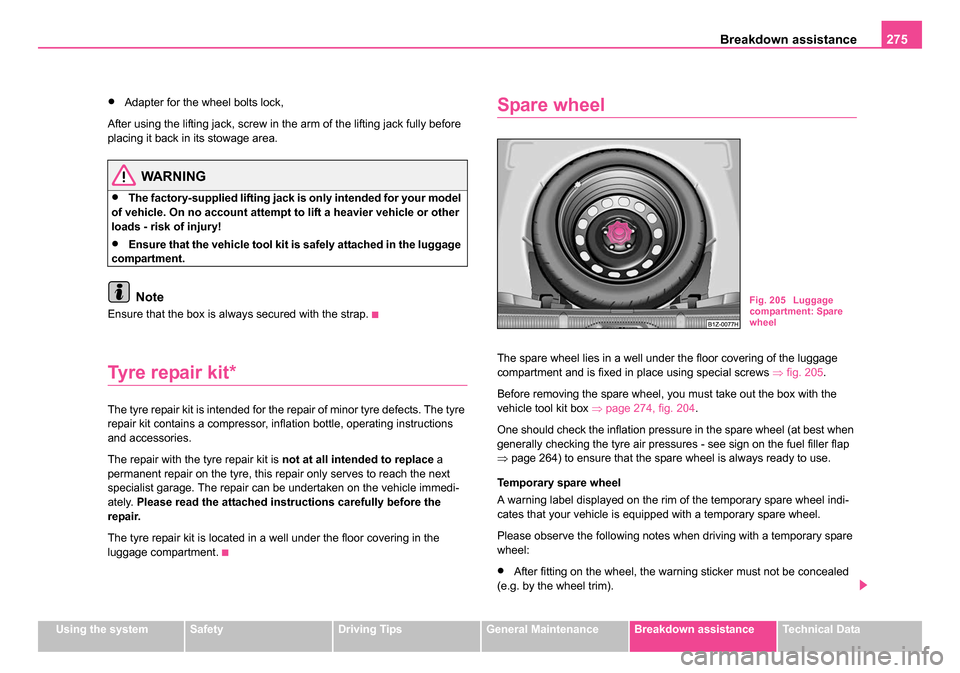
The spare wheel lies in a well under the floor covering of the luggage
compartment and is fixed in place using special screws ⇒fig. 205 .
Before removing the spare wheel, you must take out the box with the
vehicle tool kit box ⇒page 274, fig. 204 .
One should check the inflation pressure in the spare wheel (at best when
generally checking the tyre air pressures - see sign on the fuel filler flap
⇒ page 264) to ensure that the spare wheel is always ready to use.
Temporary spare wheel
A warning label displayed on the rim of the temporary spare wheel indi-
cates that your vehicle is equipped with a temporary spare wheel.
Please observe the following notes when driving with a temporary spare
wheel:
•After fitting on the wheel, the warning sticker must not be concealed
(e.g. by the wheel trim).
Fig. 205 Luggage
compartment: Spare
wheel
s24s.book Page 275 Thursday, November 24, 2005 12:27 PM
Page 277 of 315

Breakdown assistance
276
•Do not drive with this spare wheel at more than 80 km/h - risk of acci-
dent. Avoid accelerating at full throttle, sharp braking and fast cornering.
•The inflation pressure for this spare wheel is identical to the inflation
pressure of the standard tyres. The temporary spare wheel R 18 must
have an inflation pressure of 420 kPa (4.2 bar)!
•Use this spare wheel only to reach the nearest specialist garage as it
is not intended for continuous use.
•No other summer or winter tyres must be mounted on the rim of the
spare wheel R 18.
Changing a wheel
Preliminary work
The following steps should be carried out before actually
changing the wheel.
– If it is necessary to change a wheel, park the vehicle as far away as possible from the traffic flow. The place you choose
should be level.
–Have all the occupants get out. While changing a wheel, the
occupants of the vehicle should not stand on the road (it is
better behind a crash barrier).
– Apply the handbrake firmly.
– Engage 1st gear or if your vehicle is fitted with an automatic
gearbox, position the selector lever into position P .
– If a trailer is coupled, uncouple it. – Take the
vehicle tool kit ⇒ page 274 and the spare wheel
⇒ page 275 out of the luggage compartment.
WARNING
•If you find yourself in flowing traffic switch on the hazard
warning lights system and place the warning triangle on the side of
the road at the prescribed distance from your vehicle while
observing all national legal provisions. In this way you are
protecting not only yourself but also other road users.
•Never start the engine with the vehicle sitting on the raised jack
- danger of suffering injury!
Caution
If you have to change a wheel on a slope first block the opposite wheel
with a stone or similar object in order to secure the vehicle from unexpect-
edly rolling away.
Note
Comply with the national legal regulations.
Changing a wheel
Always change a wheel on a level surface as far as possible.
– Take off the full wheel trim* ⇒page 278 or the caps
⇒ page 278.
– In the case of light alloy wheels remove the wheel trim cap ⇒page 279.
s24s.book Page 276 Thursday, November 24, 2005 12:27 PM
Page 279 of 315

Breakdown assistance
278
Full wheel trim*
Removing
– Hook the clamp found in the vehicle tool kit into the reinforced
edge of the full wheel trim.
– Push the wheel key through the clamp, support the wheel key on the tyre and pull off the wheel trim ⇒fig. 206.
Installing
– First press the full wheel trim onto the wheel at the valve opening provided. Then press the full wheel trim into the
wheel in such a way that its entire circumference locks
correctly in place. Caution
•Use the pressure of your hand, do not knock on the full wheel trim!
Heavy knocks mainly on the points where the full wheel trim has not been
inserted into the wheel, can result in damage to the guide and centering
elements of the full wheel trim.
•First check for yourself that the theft-deterrent wheel bolt is located
⇒ page 281, “Securing wheels against being stolen*” in the hole in the
area of the valve before fitting the full wheel trim onto a steel wheel which
is attached with a theft-deterrent wheel bolt.
Wheel bolts with caps*
Removing
– Push the plastic clip sufficiently far onto the cap until the inner catches of the clip are positioned at the collar of the cap and
detach the cap.
Fig. 206 Removing the
full wheel trim
Fig. 207 Removing the
cap.
s24s.book Page 278 Thursday, November 24, 2005 12:27 PM
Page 282 of 315

Breakdown assistance281
Using the systemSafetyDriving TipsGeneral MaintenanceBreakdown assistanceTechnical Data
Securing wheels against being stolen*
You need a special adapter for slackening the safety
wheel bolts.
– Pull off the full wheel trim/cap from the wheel hub or cap from
the safety wheel bolt.
– Push the adapter with its toothed side into the inner toothing of the safety wheel bolt right down in such a way
that only the outer hexagon is jutting out ⇒fig. 211.
– Push the wheel wrench fully onto the adapter .
– Slacken the wheel bolt, or tighten it firmly ⇒page 279.
– Reinstall the full wheel trim/wheel cap after removing the adapter or place the cap onto the safety wheel bolt. – Have the
tightening torque checked with a torque wrench as
soon as possible. Steel and light alloy wheels must be tight-
ened to a tightening torque of 120 Nm.
The safety wheel bolts on vehicles fitted with them (one safety wheel bolt
per wheel) can only be loosened or tighten up by using the adapter
provided.
It is meaningful to note the code number hammered into the rear side of
the adapter or the rear side of the safety wheel bolts. You can obtain a
replacement adapter from a Škoda dealer, if necessary, by quoting this
number.
We recommend that you always carry the adapter for the wheel bolts with
you in the vehicle. It should be stowed in the vehicle tool kit.
Caution
Damage can occur to the adapter and safety wheel bolt if the safety wheel
bolt is tightened up too much.
Note
The set of safety wheel bolts can be obtained from your Škoda dealer.
Jump-starting
Initial steps
You can use the battery of another vehicle for jump-starting yours if the
engine does not start because the battery on your vehicle is flat. You will
require jump-start cables for this purpose.
Fig. 211 Safety wheel
bolt with adapter
AB
AA
AB
s24s.book Page 281 Thursday, November 24, 2005 12:27 PM
Page 301 of 315

Fuses and light bulbs
300
Turn signal light (at the front)
Changing light bulb for turn signal light (at the front)
– Switch the ignition and all lights off.
– Remove the headlight ⇒page 296.
– Turn the socket in the direction of arrow OPEN (open) and
take it out together with the light bulb for the turn signal light
⇒ fig. 229.
– Press the defective light bulb into the socket, turn to the left and remove.
– Press a new light bulb into the socket and turn the light bulb to the right as far as the stop. – Insert the socket with the changed light bulb into the headlight
and secure it by turning in the direction of arrow CLOSE
(close) to the right.
Note
We recommend that you have the headlight setting checked by a
specialist garage after installing the headlight.
Fig. 229 Removing the
light bulb for the turn
signal light
s24s.book Page 300 Thursday, November 24, 2005 12:27 PM
Page 310 of 315

Index309
Phone . . . . . . . . . . . . . . . . . . . . . . . . . . . . . 165
Polishing . . . . . . . . . . . . . . . . . . . . . . . . . . . 235
Power steering . . . . . . . . . . . . . . . . . . . . . . 219
Warning light . . . . . . . . . . . . . . . . . . . . . . 33
Power windows Buttons on the driver's door . . . . . . . . . . . 56
Central locking system . . . . . . . . . . . . . . . 58
Operational problems . . . . . . . . . . . . . . . . 59
Switches in front passenger door and in rear doors . . . . . . . . . . . . . . . . . . . . . . . . . . . 57
R
Rear fog light . . . . . . . . . . . . . . . . . . . . . . . . . 65
Warning light . . . . . . . . . . . . . . . . . . . . . . 32
Rear window Heating . . . . . . . . . . . . . . . . . . . . . . . . . . . 72
Rear window heater . . . . . . . . . . . . . . . . . . . 72
Rear-view mirror Exterior mirrors . . . . . . . . . . . . . . . . . . . . 80
Interior rear-view mirror . . . . . . . . . . . . . . 79
Recharge battery . . . . . . . . . . . . . . . . . . . . . 260
Refuelling . . . . . . . . . . . . . . . . . . . . . . . . . . 245
Remote control . . . . . . . . . . . . . . . . . . . . . . . 52 Synchronisation . . . . . . . . . . . . . . . . . . . . 53
Replacing fuses . . . . . . . . . . . . . . . . . . . . . . 288
Replacing the wiper blades . . . . . . . . . . . . . . 77
Roof aerial . . . . . . . . . . . . . . . . . . . . . . . . . . 234
Running in the car . . . . . . . . . . . . . . . . . . . . 221
S
Safe securing . . . . . . . . . . . . . . . . . . . . . . . . . 47
Safety . . . . . . . . . . . . . . . . . . . . . . . . . . . . . . 177
Safety instructions Engine compartment . . . . . . . . . . . . . . . 248
Safety wheel bolts . . . . . . . . . . . . . . . . . . . . 281
Saving electrical energy . . . . . . . . . . . . . . . . 223
Seat belt height adjuster . . . . . . . . . . . . . . . 187
Seat belt warning light . . . . . . . . . . . . . . . . . 186
Seat belts . . . . . . . . . . . . . . . . . . . . . . . 183, 188 Belt tensioners . . . . . . . . . . . . . . . . . . . . 188
Cleaning . . . . . . . . . . . . . . . . . . . . . . . . . 240
fasten . . . . . . . . . . . . . . . . . . . . . . . . . . . 186
Height adjustment . . . . . . . . . . . . . . . . . 187
Safety instructions . . . . . . . . . . . . . . . . . 185
taking off . . . . . . . . . . . . . . . . . . . . . . . . . 187
Seats . . . . . . . . . . . . . . . . . . . . . . . . . . . . . . . 82
Selector lever . . . . . . . . . . . . . . . . . . . . 150, 157
Selector lever positions . . . . . . . . . . . . 150, 157
Selector lever-emergency unlocking . . . . . . 154
Selector lever-emergency unlocking (DSG) 162
Service Display . . . . . . . . . . . . . . . . . . . . . . . 16
Service Interval Display . . . . . . . . . . . . . . . . . 16
Setting temperature Heating . . . . . . . . . . . . . . . . . . . . . . . . . . 119
Setting the clock . . . . . . . . . . . . . . . . . . . . . . 17
Shifting of gears . . . . . . . . . . . . . . . . . . . . . . 142
Side airbags . . . . . . . . . . . . . . . . . . . . . . . . . 195
Snow chains . . . . . . . . . . . . . . . . . . . . . . . . 269 Spare wheel . . . . . . . . . . . . . . . . . . . . . . . . . 275
Speedometer . . . . . . . . . . . . . . . . . . . . . . . . . 15
Stability system . . . . . . . . . . . . . . . . . . . . . . 213
Starting engine
after fuel tank has run empty . . . . . . . . . 141
Petrol engines . . . . . . . . . . . . . . . . . . . . . 141
Starting the engine . . . . . . . . . . . . . . . . . . . . 140 Diesel engines . . . . . . . . . . . . . . . . . . . . 141
Steering Driver-steering recommendation . . . . . . 216
Steering force assistance . . . . . . . . . . . . . . . 219
Storage compartment Lighting . . . . . . . . . . . . . . . . . . . . . . . . . . . 70
Storage compartments . . . . . . . . . . . . . . . . . 108
Storage facilities . . . . . . . . . . . . . . . . . . . . . . 108
Sun screen . . . . . . . . . . . . . . . . . . . . . . . . . . . 74
Sun visors . . . . . . . . . . . . . . . . . . . . . . . . . . . 73
Switching lights on and off . . . . . . . . . . . . . . . 63
Switching off the engine . . . . . . . . . . . . . . . . 141
T
Taking care of your vehicle . . . . . . . . . . . . . 233
TCS . . . . . . . . . . . . . . . . . . . . . . . . . . . . . . . 215 Warning light . . . . . . . . . . . . . . . . . . . . . . . 39
Temperature Outside . . . . . . . . . . . . . . . . . . . . . . . . . . . 20
Temporary spare wheel . . . . . . . . . . . . . . . . 275
s24s.book Page 309 Thursday, November 24, 2005 12:27 PM