Page 16 of 364
ENGINE – CAMSHAFT, VALVE STEM SEAL11-10
� �
B� �
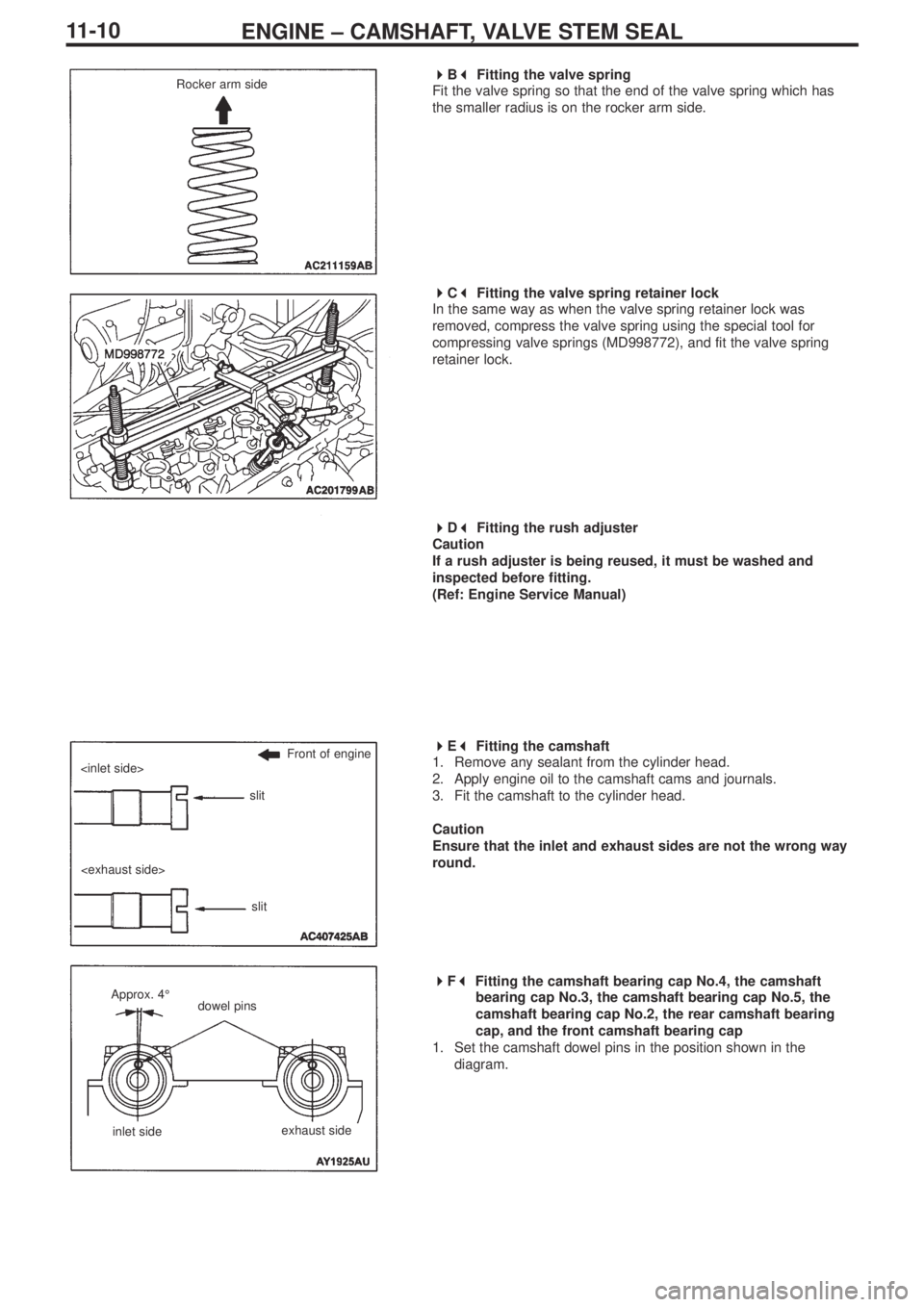
Fitting the valve spring
Fit the valve spring so that the end of the valve spring which has
the smaller radius is on the rocker arm side.
� �
C� �
Fitting the valve spring retainer lock
In the same way as when the valve spring retainer lock was
removed, compress the valve spring using the special tool for
compressing valve springs (MD998772), and fit the valve spring
retainer lock.
� �
D� �
Fitting the rush adjuster
Caution
If a rush adjuster is being reused, it must be washed and
inspected before fitting.
(Ref: Engine Service Manual)
� �
E� �
Fitting the camshaft
1. Remove any sealant from the cylinder head.
2. Apply engine oil to the camshaft cams and journals.
3. Fit the camshaft to the cylinder head.
Caution
Ensure that the inlet and exhaust sides are not the wrong way
round.
� �
F� �
Fitting the camshaft bearing cap No.4, the camshaft
bearing cap No.3, the camshaft bearing cap No.5, the
camshaft bearing cap No.2, the rear camshaft bearing
cap, and the front camshaft bearing cap
1. Set the camshaft dowel pins in the position shown in the
diagram.Rocker arm side
Front of engine
slit
slit
Approx. 4°dowel pins
inlet sideexhaust side
Page 17 of 364

ENGINE – CAMSHAFT, VALVE STEM SEAL
11 - 11
2. Because camshaft bearing caps Nos. 2~5 are the same shape,
check the identification marks on them so that the bearing cap
number and the inlet and exhaust sides are not mistaken. Then
fit them in the direction shown in the diagram.
Identification marks (stamped on the front bearing cap, and on
bearing cap Nos. 2~5).
I: inlet side
E: exhaust side
3. Apply sealant at the 8 places shown in the diagram of the top
view of the cylinder head.
Semi-dry sealant: Three bond 1207D
4. Fit the rear camshaft bearing cap in the direction indicated by
the front mark.
5. In just the same way as for bearing caps Nos. 2~5, check the
identification marks on the front camshaft bearing cap so that
the exhaust side and the inlet side are not mistaken.
6. Tighten the bearing cap mounting bolts gradually, 2~3 turns at a
time, to the specified torque.
Tightening torque: 20 ± 1 N•m
7. Check that the rocker arm has been fitted correctly.
Note
Completely wipe away any sealant that has been squeezed out.
� �
G� �
Fitting the camshaft oil seal
1. Apply engine oil around the entire circumference of the oil seal
lip.
2. Insert the oil seal using the special tool for installing the
camshaft oil seal (MD998713), as shown in the diagram.
Front of
engine
bearing cap No.
mark indicating
inlet side or
exhaust side
Front of engine
Front
of
engine
Front
of
engine
front mark
front mark
camshaft oil seal
(engine oil)
Page 18 of 364
ENGINE – CAMSHAFT, VALVE STEM SEAL11-12
� �
H� �
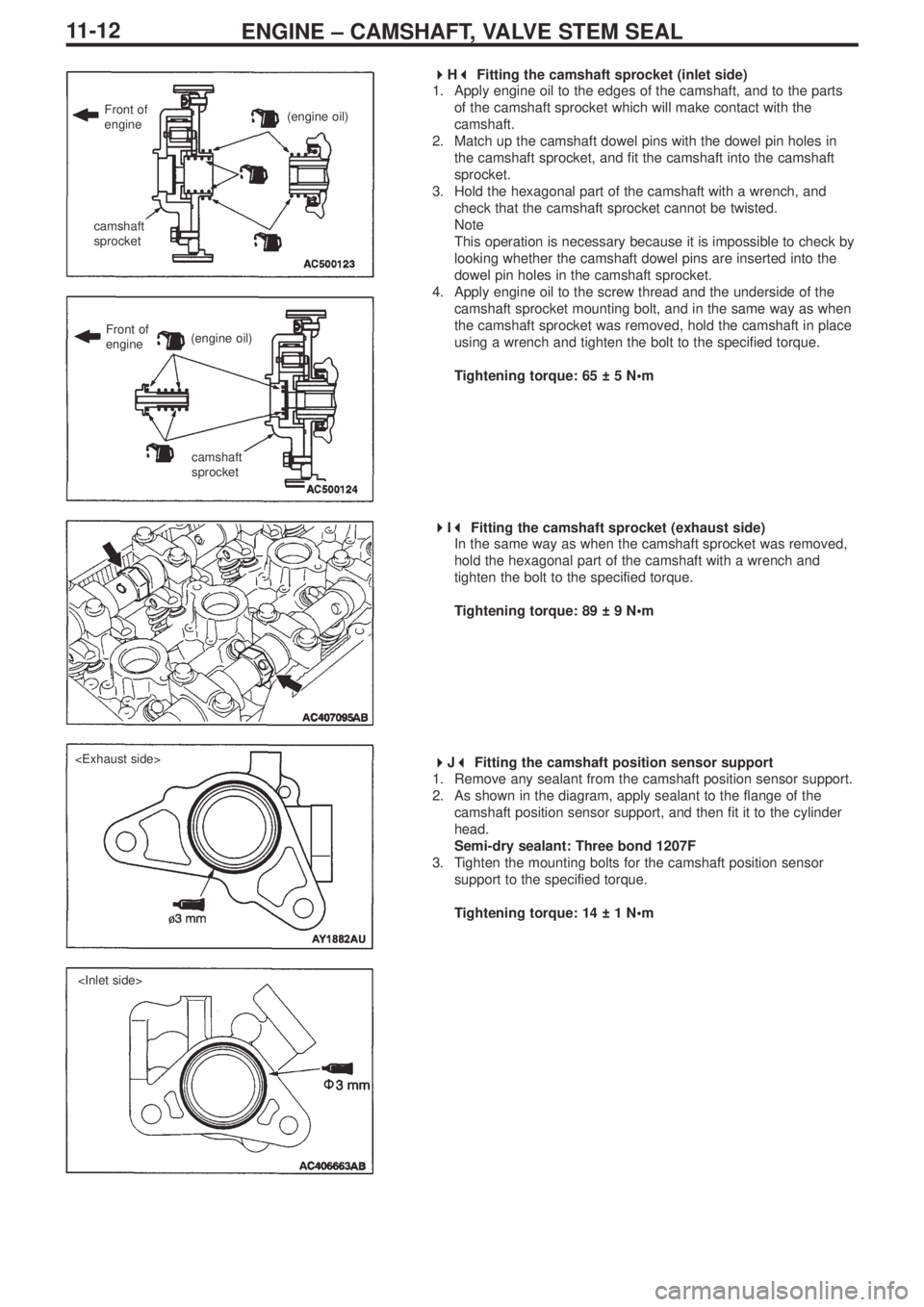
Fitting the camshaft sprocket (inlet side)
1. Apply engine oil to the edges of the camshaft, and to the parts
of the camshaft sprocket which will make contact with the
camshaft.
2. Match up the camshaft dowel pins with the dowel pin holes in
the camshaft sprocket, and fit the camshaft into the camshaft
sprocket.
3. Hold the hexagonal part of the camshaft with a wrench, and
check that the camshaft sprocket cannot be twisted.
Note
This operation is necessary because it is impossible to check by
looking whether the camshaft dowel pins are inserted into the
dowel pin holes in the camshaft sprocket.
4. Apply engine oil to the screw thread and the underside of the
camshaft sprocket mounting bolt, and in the same way as when
the camshaft sprocket was removed, hold the camshaft in place
using a wrench and tighten the bolt to the specified torque.
Tightening torque: 65 ± 5 N•m
� �
I� �
Fitting the camshaft sprocket (exhaust side)
In the same way as when the camshaft sprocket was removed,
hold the hexagonal part of the camshaft with a wrench and
tighten the bolt to the specified torque.
Tightening torque: 89 ± 9 N•m
� �
J� �
Fitting the camshaft position sensor support
1. Remove any sealant from the camshaft position sensor support.
2. As shown in the diagram, apply sealant to the flange of the
camshaft position sensor support, and then fit it to the cylinder
head.
Semi-dry sealant: Three bond 1207F
3. Tighten the mounting bolts for the camshaft position sensor
support to the specified torque.
Tightening torque: 14 ± 1 N•m
Front of
engine(engine oil)
(engine oil)
camshaft
sprocket
camshaft
sprocket
Front of
engine
Page 19 of 364

ENGINE – CAMSHAFT, VALVE STEM SEAL
11-13
� �
K� �
Fitting the camshaft position sensing cylinder (inlet
side)
1. Set the inlet camshaft dowel pin in the position shown in the
diagram (No.1 cylinder compression top dead centre).
2. Tighten the mounting bolts for the camshaft position sensing
cylinder to the specified torque.
Tightening torque: 22 ± 4 N•m
� �
L� �
Fitting the camshaft position sensing cylinder (exhaust
side)
1. Set the exhaust camshaft dowel pin in the position shown in the
diagram (No.1 cylinder compression top dead centre).
Note
Under pressure from the exhaust valve spring, it will turn slightly
in an anti-clockwise direction.
2. As shown in the diagram, fit the pane (small) of the camshaft
position sensing cylinder (exhaust side) so that it is in a position
approximately 45° to the exhaust camshaft dowel pin.
3. Tighten the mounting bolts for the camshaft position sensing
cylinder to the specified torque.
Tightening torque: 22 ± 4 N•m
� �
M� �
Fitting the locker cover assembly
1. Apply sealant to the 8 places on the rocker cover gasket as
shown in the diagram.
Semi-dry sealant: Three bond 1207D
2. Fit the rocker cover assembly onto the cylinder head.
� �
N� �
Connecting the radiator upper hose
1. Insert the radiator upper hose as far as the protrusion on the
water outlet fitting.
2. Match up the indicator marks on the radiator upper hose and the
hose clamp, in order to fit the radiator upper hose. dowel pin
pane
pane (small)
dowel pin approx. 45º
pane (large)
Front of engine
Protrusion
water outlet
fittingindicator marks
Page 20 of 364

ENGINE – CAMSHAFT, VALVE STEM SEAL, CYLINDER HEAD GASKET11-14
� �
O� �
Fitting the O-ring/oil feeder control valve
Caution
1. Do not re-use O-rings.
2. When fitting O-rings, first wind some non-adhesive tape
(seal tape etc) around the oil channel of the oil feeder
control valve, in order to prevent damage to the O-ring.
If the O-ring touches the oil it could start an oil leak.
1. Apply engine oil to the O-ring on the oil feeder control valve.
2. Fit the oil feeder control valve to the cylinder head.
3. Tighten the mounting bolts for the oil feeder control valve to the
specified torque.
Tightening torque: 11 ± 1 N•m
Cylinder head gasket
Removal and fitting
Jobs to be completed before removal and after fitting
•Measures to prevent fuel leaking.
•Check for fuel dripping.
•Removal and refitting of the strut tower bar.
•Removal and refitting of the valence. (Ref Section 51: Front bumper)
•Check the tension of the drive belt.
•Adjustment of the axle letter cable.
•Draining and replacing the engine oil.
•Draining and replacing the coolant.
•Removal and refitting of the air cleaner.
•Removal and refitting of air pipe C.
•Removal and refitting of the battery and the battery tray.
•Removal and refitting of the centre cover. (Ref P11-5)
•Removal and refitting of the axle letter cable.
•Removal and refitting of the radiator.
•Removal and refitting of the front exhaust pipe.
•Removal and refitting of the timing belt. (Ref P11-20)
Tape
Page 21 of 364
ENGINE – CYLINDER HEAD GASKET
11-15
Removal procedure
1. Ignition coil connector
2. O
2sensor connector
3. Oil feeder control valve connector
4. Crank angle sensor connector
5. Manifold absolute pressure sensor
connector
6. Fuel pressure solenoid valve connector
7. Knock sensor connector
8. Purge control solenoid valve connector
9. Throttle position sensor connector
10. Injector connector
11.Exhaust camshaft position sensor
connector12. Inlet camshaft position sensor
connector
13. Water temperature gauge unit
connector
14. Joint control harness and transmission
harness
15. Water temperature sensor connector
16. Secondary air control solenoid valve
connector
17. Vacuum tank, solenoid valve, vacuum
pipe and hose assembly
18. Brake booster vacuum hose connection
19. Oil level gauge and guide assembly
20. O-ring
21. Purge hose connection
(engine oil)
Page 26 of 364

ENGINE – TIMING BELT, TIMING BELT B11-20
TIMING BELT, TIMING BELT B
Removal and fitting
Caution
If Brembo brake callipers are being used take care that they are not scratched by other
components or tools because there is a chance that the paint might peel off. In
addition, if any brake fluid gets on the callipers, it should be wiped off immediately.
Jobs to be completed before removal and after fitting
•Removal and refitting of the valence. (Ref Section 51: Front bumper)
•Removal and refitting of the LH side cover.
•Checking and adjustment of the tension of the drive belt.
•Removal and refitting of the crankshaft pulley.
•Removal and refitting of the cross member bar.
•Removal and refitting of the front exhaust pipe.
Removal procedure
1. Pressure hose connection
2. Timing belt front upper cover
3. Water pump pulley
4. Idler pulley
5. Drive belt auto-tensioner
6. Timing belt front lower cover•Remove the engine mount bracket
•Adjust the tension of the timing belt
7. Timing belt
8. Tensioner pulley
9. Tensioner arm
10. Auto-tensioner
� �
G� �
� �
A� �
�
�
F� �
� �
E� �
� �
D� �
Page 27 of 364
ENGINE – TIMING BELT, TIMING BELT B
11-21
10. Power steering oil pressure switch connector
11.Heat protector
12. Power steering oil pump ASSY
13. Power steering oil pump bracket
14. Idler pulley
15. Crank angle sensor16. Crankshaft sprocket
17. Crankshaft sensing blade
•Adjust the tension of the timing belt B
18. Timing belt B tensioner
19. Timing belt B
Removal guidelines
� �
A� �
Removing the timing belt
1. Turn the crankshaft in a clockwise direction, and match up all
the timing marks until the No.1 cylinder is in the compressor top
dead centre position.
Caution
Turn the crankshaft in the normal way.
2. Remove the rubber plug from the rear cover of the timing belt,
and prepare the special tool for adjusting bolts (MD998738).
� �
C� �
�
�
C� �
� �
C� �
� �
B� �
� �
A� �
� �
D� �
�
�
A� �
�
�
B� �
(engine oil)
Timing marks
Timing belt
valence

