Page 169 of 238
In Case Of An Emergency6-206. For models with alloy wheels, remove the center
cap.
WARNING - Changing a Front
Tire
When one front wheel is lifted off the ground,
neither the automatic transaxle P (Park)
position nor the manual transaxle R (Reverse)
position will prevent the vehicle from moving
and possibly slipping off the jack, even if these
positions are properly engaged. To prevent
vehicle movements while changing a tire,
always set the parking brake fully, and always
block the wheel diagonally opposite the wheel
being changed.
7. Loosen the four lug nuts counterclockwise one turn
each, but do not remove any nut until the tire has
been raised off the ground.
3
2
4
1
1B3106002C
RIO ENG CNA 6.qxd 7/29/05 5:15 PM Page 20
Page 170 of 238
6-21
8. Place the jack at the front or rear jacking position
closest to the tire you are changing. Place the jack
under the side sill at the designated location.
9. Insert the jack handle into the jack and turn it
clockwise, raising the vehicle until the tire just
clears the ground, approximately 30 mm (1.2 in.).
Before removing the lug nuts, make sure the
vehicle is stable and that there is no chance for it to
slip or move.
WARNING -Jack Location
To reduce the possibility of injury, be sure to
use only the jack provided with the vehicle and
in the correct jack position; never use any
other part of the vehicle for jack support.
1S2108008 AS2B06014
Jack handle
RIO ENG CNA 6.qxd 7/29/05 5:15 PM Page 21
Page 172 of 238
6-23
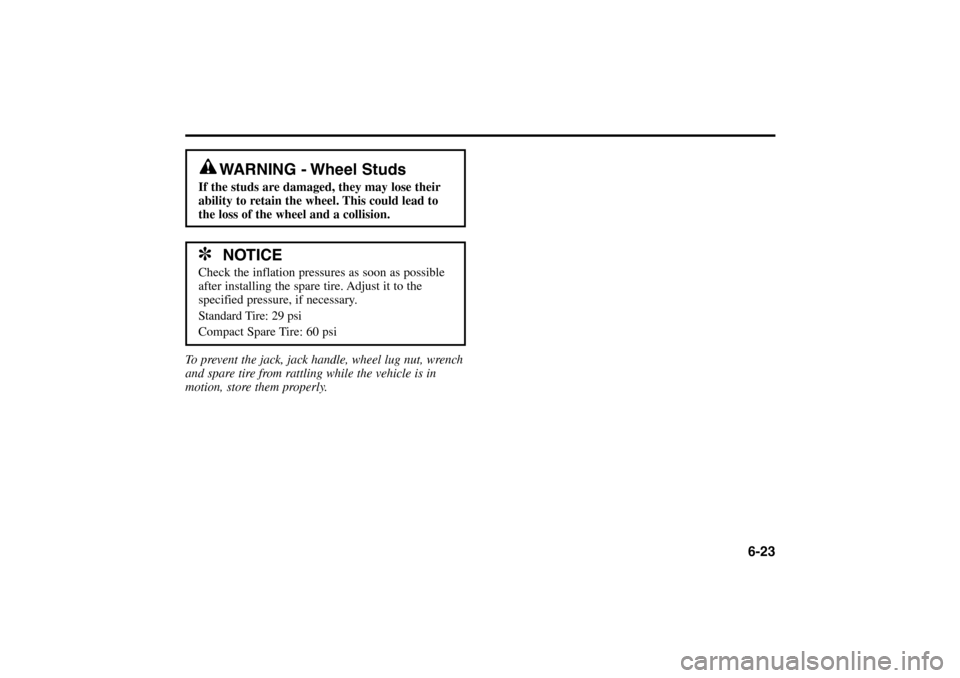
To prevent the jack, jack handle, wheel lug nut, wrench
and spare tire from rattling while the vehicle is in
motion, store them properly.
WARNING - Wheel Studs
If the studs are damaged, they may lose their
ability to retain the wheel. This could lead to
the loss of the wheel and a collision.✽
NOTICE
Check the inflation pressures as soon as possible
after installing the spare tire. Adjust it to the
specified pressure, if necessary.
Standard Tire: 29 psi
Compact Spare Tire: 60 psi
RIO ENG CNA 6.qxd 7/29/05 5:15 PM Page 23
Page 183 of 238
Owner Maintenance PrecautionsImproper or incomplete service may result in
problems. This section gives instructions only for the
maintenance items that are easy to perform.As explained earlier in this section, several procedures
can be done only by an Kia Authorized Dealer with
special tools.
Improper owner maintenance during the warranty
period may affect warranty coverage. For details, read
the separate Kia Warranty and Consumer Information
Manual provided with the vehicle. If you’re unsure
about any servicing or maintenance procedure, have it
done by an Authorized Kia Dealer.
7-11
WARNING -Maintenance Work
Performing maintenance work on a vehicle can
be dangerous. You can be seriously injured
while performing some maintenance
procedures. If you lack sufficient knowledge,
experience or the proper tools and equipment
to do the work, have it done by an Authorized
Kia Dealer.
RIO ENG CNA 7-1.qxd 7/29/05 5:16 PM Page 11
Page 184 of 238
Maintenance7-12
WARNING - Loose Clothing/
Jewelry
Working under the hood with the engine
running is dangerous. It is even more
dangerous when you wear jewelry, long hair or
loose clothing. These can become entangled in
moving parts and result in injury. Therefore, if
you must run the engine while working under
the hood, make certain that you pull hair back,
remove all jewelry (especially rings, bracelets,
watches, and necklaces) and all neckties,
scarves, and similar loose clothing before
getting near the engine or cooling fans.
WARNING - Engine Cooling
Fans
Because your engine cooling fans are
electrically controlled, they will run if the
ignition switch is on, even if the engine is not
running. This could cause serious injury. To
prevent this, be sure the ignition is off, unless
you must run the engine while performing
maintenance or an inspection.
RIO ENG CNA 7-1.qxd 7/29/05 5:16 PM Page 12
Page 187 of 238

Changing the Engine Oil and FilterChange engine oil and filter according to the
Scheduled Maintenance earlier in this section.
1. Warm the engine up for a few minutes and then
turn it off. Remove the oil filler cap.
2. Drain the oil into a suitable container after
removing the oil filler cap and drain plug.
3. Remove the engine oil filter with an oil filter
wrench.4. Use a clean rag to clean the oil filter mounting
surface on the engine.
5. Apply a small amount of engine oil to the new oil
filter O-ring seal.
6. Install the oil filter and tighten it. (Refer to
the oil filter caution label for tightening
instructions.)
7. Replace the drain plug tightly after the oil has
thoroughly drained.
8. Refill the engine with new oil to the F mark on the
dipstick. Do not overfill.
7-15
WARNING - Engine Oil
Continuous contact with USED engine oil
has caused skin cancer in laboratory mice.
Protect your skin by washing with soap and
water.
Keep all engine oil out of the reach of
children.
CAUTION
Both the oil and engine are hot. Do not burn
yourself.
✻ ✻
NOTICE
When installing the replacement oil filter, do not
allow the oil filter gasket to remain on the oil
filter mounting surface. This will cause oil
leakage and engine damage. Remove the old
gasket completely so that a new gasket will
properly seat and seal.
RIO ENG CNA 7-1.qxd 7/29/05 5:16 PM Page 15
Page 189 of 238

Checking the Coolant Level
Check the condition and connections of all cooling
system hoses and heater hoses. Replace any swollen or
deteriorated hoses.
The coolant level should be full in the radiator
and between F (Full) and L (Low) on the coolant
reservoir dipstick when the engine is cool.
Check the coolant level using the dipstick attached to
the reservoir cap.
7-17
WARNING -Removing
Radiator Cap
Never attempt to remove the radiator cap
while the engine is operating. Doing so
might lead to cooling system and/or engine
damage and could result in serious personal
injury from escaping hot coolant or steam.
Turn the engine off and wait until it has
cooled. Even then, use extreme care when
removing the radiator cap. Wrap a thick
towel around it, and turn it
counterclockwise slowly to the first stop.
Step back while the pressure is released
from the cooling system. When you are sure
all the pressure has been released, press
down on the cap, using a thick towel, and
continue turning counterclockwise to
remove it.
Even if the engine is not operating, do not
remove the radiator cap or the drain plug
while the engine and radiator are hot. Hot
coolant and steam may still blow out under
pressure, causing serious injury.
AS2B07003
Coolant reservoir dipstickLow OK Full
RIO ENG CNA 7-1.qxd 7/29/05 5:16 PM Page 17
Page 195 of 238
The volume of the transaxle fluid changes with
temperature. For that reason, it is best to check
the level after having driven the vehicle for
30 minutes. If necessary, however, the fluid can also be
checked when the vehicle has not been driven.
7-23
CAUTION
• Low fluid level causes transaxle slippage.
Overfilling can cause foaming, loss of fluid,
and transaxle malfunction.
The use of a non-specified fluid could result in
transaxle malfunction and failure.
WARNING - Parking Brake
To avoid sudden movement of the vehicle, set
the parking brake and depress the brake pedal
while shifting the shift lever.
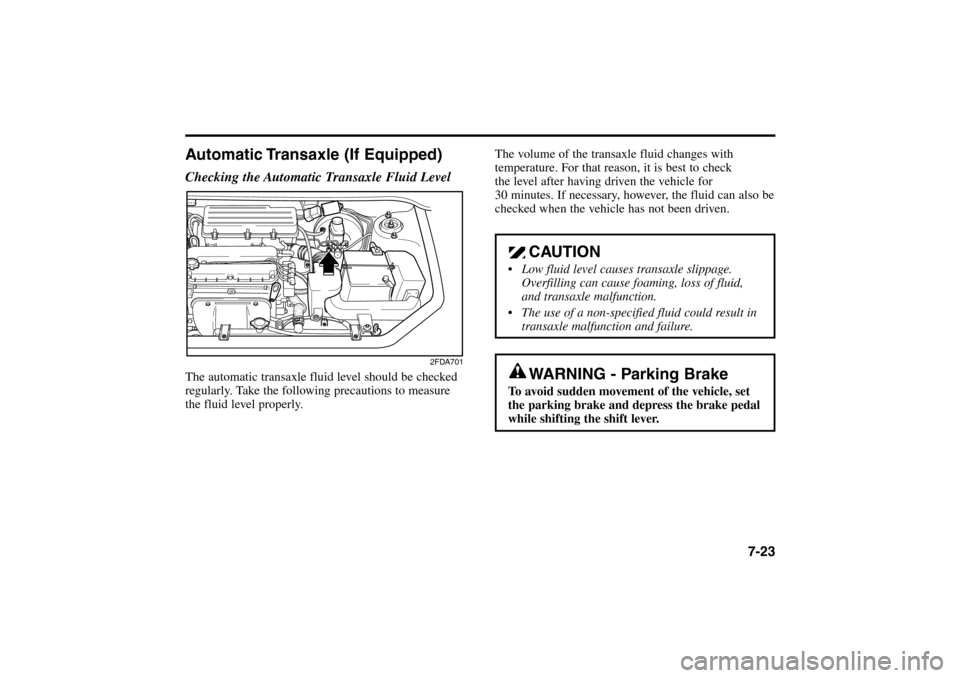
Automatic Transaxle (If Equipped)Checking the Automatic Transaxle Fluid LevelThe automatic transaxle fluid level should be checked
regularly. Take the following precautions to measure
the fluid level properly.
2FDA701
RIO ENG CNA 7-2.qxd 7/29/05 5:18 PM Page 23