Page 123 of 238
Driving Your Vehicle4-42Glove Box
To open the glove box door, pull the latch toward you.
CAUTION
To reduce the risk of injury in case of an accident
or sudden stop, always keep the glove box door
closed while driving.
1B3104019B
AshtrayTo remove the ashtray, pull it out to the normal posi-
tion, push down on the lock spring plate, and pull the
ashtray out.
WARNING -Ashtray Use
Do not use the vehicle’s ashtrays as waste
receptacles.
Putting lit cigarettes or matches in an ash-
tray with other combustible materials may
cause a fire.
1B3104018E
RIO ENG CNA 4.qxd 7/29/05 5:06 PM Page 42
Page 127 of 238

Driving Your Vehicle4-46Face - floor position
Air flow is directed towards the face and the
floor. The air to the floor is warmer than the
air to the face (except when the temperature
control is set to the extreme cold position).
(outlet port: , , )
Floor position
Most of the air flow is directed to the floor,
with a small amount of the air being directed
to the windshield and side window defroster.
(outlet port: , )
Floor - defrost position
Most of the air flow is directed to the floor
and the windshield with a small amount
directed to the side window defrosters.
(outlet port: , , )
Defrost position
Most of the air flow is directed to the wind-
shield with a small amount of air directed to
the side window defrosters.
(outlet port: , )Air Flow Control Button
It is recommended that under normal conditions the
outside (fresh) air position be selected.
Recirculated air position If you press the air intake control button once (recircu-
late), almost all outside air flow into the vehicle is shut
off, and air within the vehicle will be recirculated.
This position can be used temporarily for maximum
heating or cooling (if equipped with an air condition-
ing) and to help prevent undesirable outside air flow
into the vehicle.
BC
C
D
D
A
C
D
A
D
CAUTION
Continued climate control system operation in the
recirculated air position may allow humidity to
increase inside the vehicle which may fog the
glass and obscure visibility
WARNING
Don’t sleep in a vehicle with air conditioning
system or heating system on. It may cause seri-
ous harm or death to passengers due to a drop
in the oxygen level and/or body temperature.
RIO ENG CNA 4.qxd 7/29/05 5:06 PM Page 46
Page 133 of 238
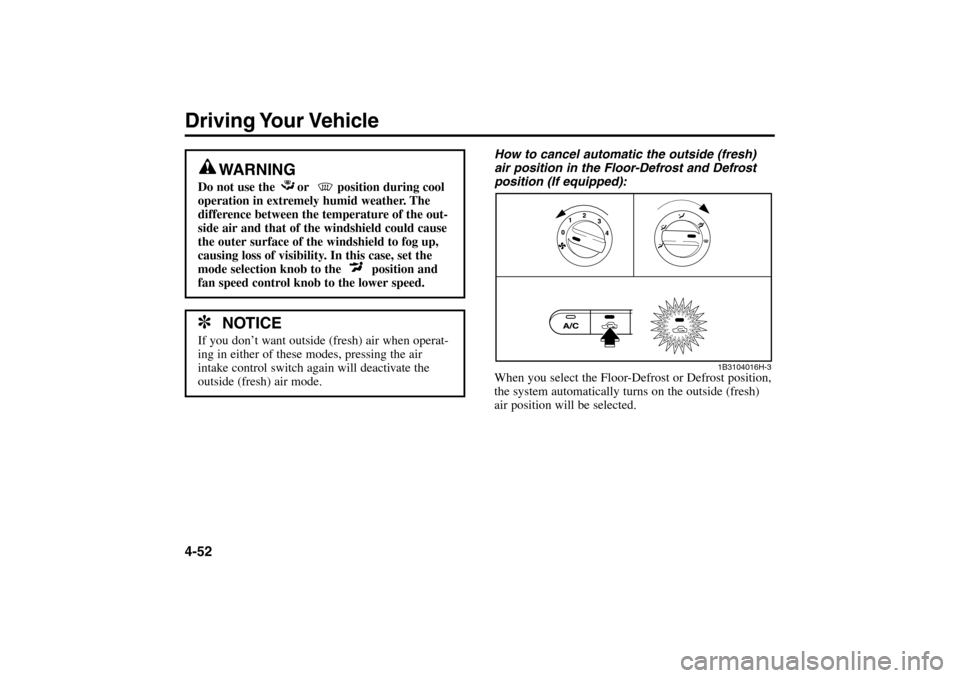
How to cancel automatic the outside (fresh)
air position in the Floor-Defrost and Defrost
position (If equipped):
When you select the Floor-Defrost or Defrost position,
the system automatically turns on the outside (fresh)
air position will be selected.
Driving Your Vehicle4-52
WARNING
Do not use the or position during cool
operation in extremely humid weather. The
difference between the temperature of the out-
side air and that of the windshield could cause
the outer surface of the windshield to fog up,
causing loss of visibility. In this case, set the
mode selection knob to the position and
fan speed control knob to the lower speed.✽
NOTICE
If you don’t want outside (fresh) air when operat-
ing in either of these modes, pressing the air
intake control switch again will deactivate the
outside (fresh) air mode.
1B3104016H-3
RIO ENG CNA 4.qxd 7/29/05 5:06 PM Page 52
Page 139 of 238

Necessary InspectionsFluid levels, such as engine oil, engine coolant,
brake/clutch fluid, and washer fluid should be checked
on a regular basis, with the exact interval depending on
the fluid. Further details are provided in Maintenance,
Section 7.Before Starting Close and lock all doors.
Position the seat so that all controls are easily
reached.
Adjust the inside and outside rearview mirrors.
Be sure that all lights work.
Check all gauges.
Check the operation of warning lights when the
ignition switch is turned to the ON position.
Release the parking brake and make sure the brake
warning light goes out.
For safe operation, be sure you are familiar with your
vehicle and its equipment.
Drunk DrivingDrinking and driving is dangerous. Drunk driving is
the number one contributor to the highway death toll
each year. Alcohol impairs a driver’s judgment, vision
and muscular coordination. Even a small amount of
alcohol will affect a driver’s reflexes, perceptions and
judgment.
Please don’t drink and drive, or ride with a driver who
has been drinking. Choose a designated driver if you’re
with a group, or if you’re alone, call a cab.Drugs and DrivingDriving while under the influence of drugs is as
dangerous or more dangerous than driving under the
influence of alcohol, depending on the drug(s) used
and the quantity consumed. Don’t take drugs and drive.
If you are taking a prescription medicine, check with
your doctor or pharmacist regarding whether you may
operate a motor vehicle.
5-5
RIO ENG CNA 5.qxd 7/29/05 5:07 PM Page 5
Page 141 of 238
Keeping a vehicle in good operating condition is
important both for economy and safety. Therefore,
have an Authorized Kia Dealer perform scheduled
inspections and maintenance.
Special Driving ConditionsHazardous DrivingWhen hazardous driving is encountered because of
water, snow, ice, mud, sand, or similar hazard, follow
these suggestions:
Drive cautiously and allow extra distance for
braking.
Avoid sudden movements in braking or steering.
When braking in vehicles without anti-lock brakes,
depress the brake pedal with a controlled up-and-
down motion until the vehicle is stopped.
5-7
WARNING - Engine OFF Motion
Never turn the engine OFF to coast down hills
or anytime the vehicle is in motion. The power
steering and power brakes will not function
without the engine running. Instead, downshift
to any appropriate gear for engine braking
effect.
✽
NOTICE
Do not pump the brake pedal on ABS equipped
vehicle.
RIO ENG CNA 5.qxd 7/29/05 5:07 PM Page 7
Page 142 of 238

Driving Tips5-8Rocking the Vehicle
If it is necessary to rock the vehicle to free it from
snow, sand, or mud, move the shift lever of an
automatic transaxle from D (Drive) to R (Reverse) in a
repeat pattern while depressing the accelerator gently.
With a manual transaxle, move the shift lever back and
forth from 1 (First) to R (Reverse).
Do not race the engine. If you are still stuck after a
couple minutes of rocking, have the vehicle pulled out
by a tow vehicle to avoid engine overheating and
possible damage to the transaxle.
✽
NOTICE
Prolonged rocking may cause engine overheating,
transaxle damage or failure, and tire damage.
WARNING - Spinning Tires
Do not spin the wheels especially at speeds
more than 56 km/h (35 mph). Spinning the
wheels at high speeds when the vehicle is
stationary could cause a tire to overheat,
explode and injure bystanders.
When starting from a stop in snow, mud, or sand,
use second gear and accelerate slowly to avoid
spinning the front wheels. Low gear may be used, if
necessary.
Use sand, rock salt, tire chains, or other non-slip
material under the front wheels to provide traction
when stalled on ice, snow, or mud.
WARNING - Downshifting
Downshifting into first gear with a manual
transaxle or into low with an automatic
transaxle while driving on slippery surfaces
can cause an accident. The sudden change in
tire speed could cause the tires to skid. Be
careful when downshifting on slippery
surfaces.
RIO ENG CNA 5.qxd 7/29/05 5:07 PM Page 8
Page 144 of 238

Driving Tips5-10
Snow Tires
When snow tires are used, select the size and
construction specified on the Tire Pressure Label. It is
strongly recommended that snow tires be used on all
four wheels, or poor handling may result. Snow tires
should not be operated at speeds exceeding 75 mph
(120 km/h).
These tires should be inflated 4 psi (28 kPa,
0.3 kg/cm
2) above the recommended pressures shown
on the Tire Specification/Pressure Label, but inflation
should never exceed the maximum cold-tire pressure
shown on the tire sidewalls.
Do not install studded tires without first checking
local, provincial and municipal regulations for
possible restrictions against their use.
WARNING - Snow Tire Size
Snow tires should be equivalent in size and
type to the vehicle’s standard tires. Otherwise,
the safety and handling of your vehicle may be
adversely affected.
Winter Driving We recommend that you carry emergency
equipment. Some things you might include are tire
chains, a window scraper, windshield de-icer, a bag
of sand or salt, flares, a small shovel and jumper
cables.
Make sure you have sufficient ethylene glycol
coolant in the radiator.
Check the battery condition and cables. Cold
temperatures reduce the capacity of any battery, so it
must be in top shape to provide enough winter
starting power.
Make sure the engine oil viscosity is suitable for
cold weather.
Check the ignition system for loose connections and
damage.
Use antifreeze-formulated windshield washer fluid
and make sure you have sufficient fluid for your
trip. (Do not use engine coolant antifreeze.)
Do not use the parking brake if it might freeze. This
is most likely to happen after driving in slushy or
wet conditions and temperatures drop into the
freezing range. When parking, shift to P (Park) with
automatic transaxle, or to 1 (First) or R (Reverse)
with a manual transaxle and block the rear wheels.
RIO ENG CNA 5.qxd 7/29/05 5:07 PM Page 10
Page 145 of 238

5-11
Tire Chains
Tire Chain Selection
Regulations regarding the use of tire chains vary
according to location or type of road, so always check
them before installing chains.
Use only SAE Class “S’’ tire chains. Chains must be
the proper size for the vehicle, as recommended by the
chain manufacturer.
Chain Installation
When installing chains on your tires, carefully follow
the instructions of the chain manufacturer.
The chain bands will scratch the wheel covers.
Remove the covers before installing the chains.
WARNING - Tire Chains
The use of chains may adversely affect
vehicle handling.
Do not exceed 50 km/h (30 mph) or the
chain manufacturer’s recommended speed
limit, whichever is lower.
Drive carefully and avoid bumps, holes,
sharp turns and other road hazards, which
may cause the vehicle to bounce.
Avoid sharp turns or locked-wheel braking.
Do not attempt to use a tire chain on the
temporary spare tire because it may impair
vehicle handling and result in damage to the
vehicle and the tire.
RIO ENG CNA 5.qxd 7/29/05 5:07 PM Page 11