Page 43 of 414

Of the different seats available, we
recommend those that have a f ive-
point harness system as shown.
In any situation, we strongly
recommend that you install the child
seat directly behind the f ront
passenger’s seat, move the seat as
f ar f orward as needed, and leave it
unoccupied. Or, you may wish to get
a smaller rear-f acing child seat.
A child who is at least one year old,
and who fits within the child seat
maker’s weight and height limits,
should be restrained in a f orward-
f acing, upright child seat.We strongly recommend placing a
forward-facing child seat in a back
seat, not the f ront.
Even with advanced front airbags,
which can automatically turn the
passenger’s f ront airbag of f (see
page ), a back seat is the saf est
place f or a small child.
29
Protecting Small Children
Child Seat T ype Child Seat Placement
Protecting Inf ants and Small Children
42
Placing a rear-facing child seat
in the front seat can result in
serious injury or death during a
collision.
Always place a rear-facing child
seat in the back seat, not the
front.
Page 50 of 414
To remove slack, it may help to put
weight on the child seat, or push on
the back of the seat while pulling up
on the belt.Push and pull the child seat
f orward and f rom side-to-side to
verif y that it is f irmly secured. If
the child seat is not secure,
unlatch the belt, allow it to retract
f ully, then repeat these steps.
To deactivate the locking
mechanism and remove a child seat,
unlatch the buckle, unroute the seat
belt, and let the belt f ully retract.
Af ter conf irming that the belt is
locked, grab the shoulder part of
the belt near the buckle, and pull
up to remove any slack from the
lap part of the belt. Remember, if
the lap part of the belt is not tight,
the child seat will not be secure.
5.
4.
Installing a Child Seat
Driver and Passenger Saf ety
49
Page 52 of 414
Attach the tether strap hook to the
anchor, making sure the strap is
not twisted.
Tighten the strap according to the
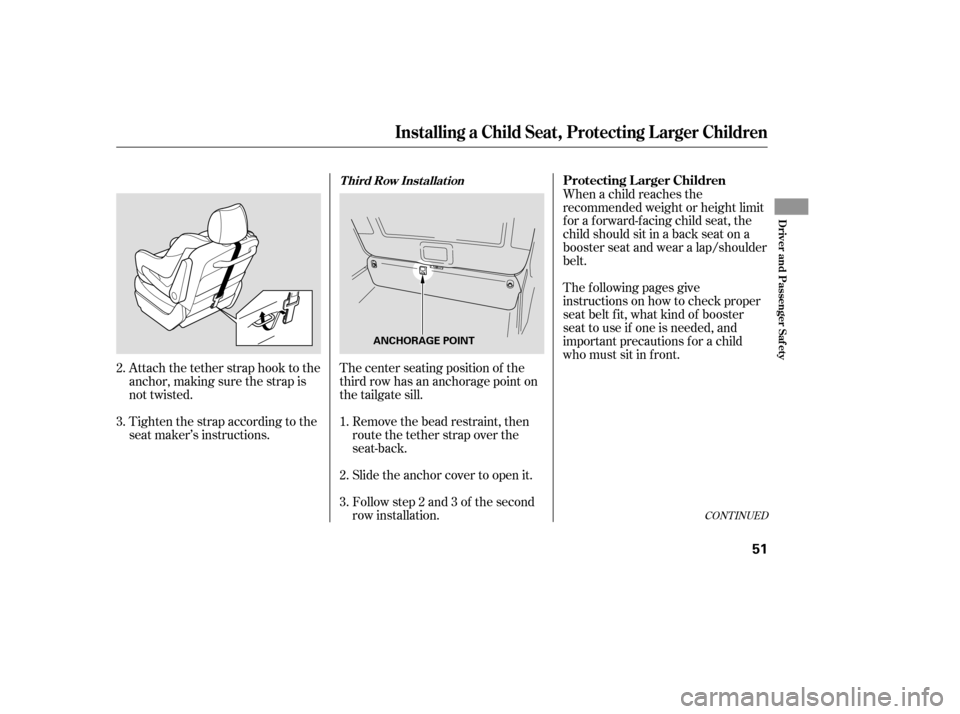
seat maker’s instructions.The center seating position of the
third row has an anchorage point on
the tailgate sill.
Remove the bead restraint, then
route the tether strap over the
seat-back.
Slide the anchor cover to open it. When a child reaches the
recommended weight or height limit
for a forward-facing child seat, the
child should sit in a back seat on a
booster seat and wear a lap/shoulder
belt.
The f ollowing pages give
instructions on how to check proper
seat belt f it, what kind of booster
seat to use if one is needed, and
important precautions f or a child
who must sit in f ront.
Follow step 2 and 3 of the second
row installation.
2.
1.
3.
2.
3.
CONT INUED
T hird Row Inst allat ionProtecting L arger Children
Installing a Child Seat, Protecting L arger Children
Driver and Passenger Saf ety
51
ANCHORAGE POINT
Page 54 of 414
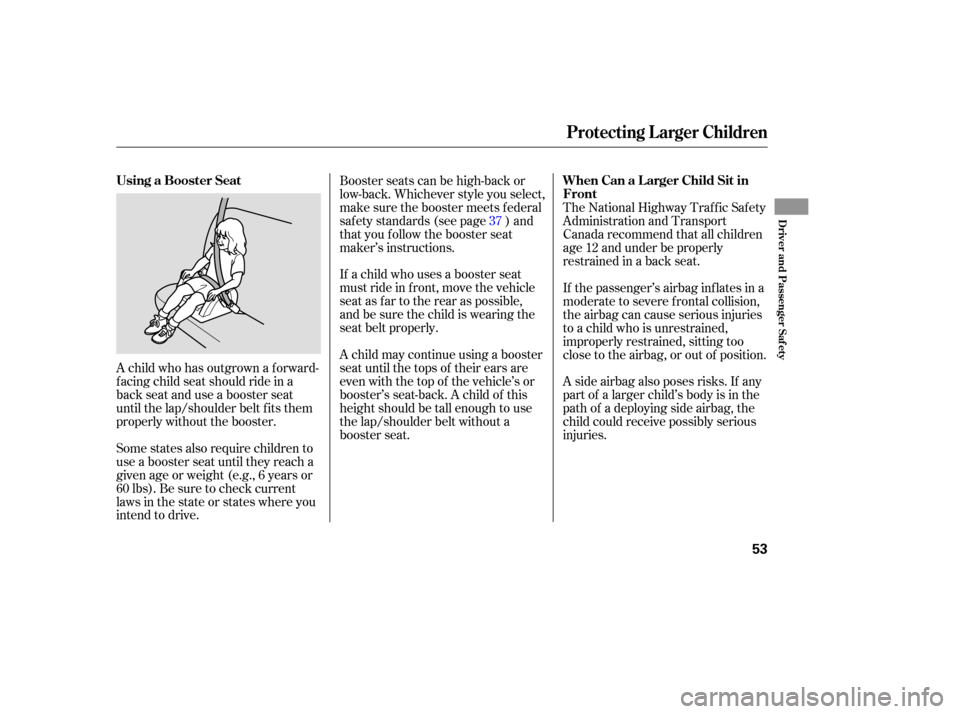
A child who has outgrown a forward-
f acing child seat should ride in a
back seat and use a booster seat
until the lap/shoulder belt f its them
properly without the booster.
Some states also require children to
use a booster seat until they reach a
given age or weight (e.g., 6 years or
60lbs).Besuretocheckcurrent
laws in the state or states where you
intend to drive.If a child who uses a booster seat
must ride in f ront, move the vehicle
seat as far to the rear as possible,
and be sure the child is wearing the
seat belt properly.
A child may continue using a booster
seat until the tops of their ears are
even with the top of the vehicle’s or
booster’s seat-back. A child of this
height should be tall enough to use
the lap/shoulder belt without a
booster seat. Booster seats can be high-back or
low-back. Whichever style you select,
make sure the booster meets f ederal
saf ety standards (see page ) and
that you f ollow the booster seat
maker’s instructions.
The National Highway Traffic Safety
Administration and Transport
Canada recommend that all children
age 12 and under be properly
restrained in a back seat.
If the passenger’s airbag inf lates in a
moderate to severe frontal collision,
the airbag can cause serious injuries
to a child who is unrestrained,
improperly restrained, sitting too
close to the airbag, or out of position.
A side airbag also poses risks. If any
part of a larger child’s body is in the
path of a deploying side airbag, the
child could receive possibly serious
injuries.
37
Protecting L arger Children
Using a Booster Seat
When Can a L arger Child Sit in
Front
Driver and Passenger Saf ety
53
Page 65 of 414

This indicator comes on when you
turn the ignition switch to ON (II). If
it comes on at any other time, it
indicates that the passenger’s side
airbag has automatically shut off.
For more inf ormation, see page .
On the Touring model, you will also
see a ‘‘PASSENGER SIDE AIRBAG
OFF’’ message in the multi-
inf ormation display.
On the Touring model, you will also
see a ‘‘CHECK AIRBAG SYSTEM’’
message in the multi-inf ormation
display. This indicator comes on brief ly when
you turn the ignition switch to ON
(II). If it comes on at any other time,
it indicates a potential problem with
your f ront airbags. This indicator will
also alert you to a potential problem
with your side airbags, passenger’s
side airbag automatic cutoff system,
side curtain airbags, automatic seat
belt tensioners, driver’s seat position
sensor, or the f ront passenger’s
weight sensors. For more
inf ormation, see page .
This indicator comes on when you
turn the ignition switch to ON (II). It
reminds you and your passengers to
f asten your seat belts. A beeper also
sounds if you have not f astened your
seat belt.
If you turn the ignition switch to ON
(II) bef ore f astening your belt, the
beeper sounds and the indicator
f lashes. If you do not f asten your
seat belt bef ore the beeper stops, the
indicator stops f lashing but remains
on.
If you continue driving without
f astening your seat belt, the beeper
sounds and the indicator f lashes
again at regular intervals. On the
Touring model, you will also see a
‘‘FASTEN SEAT BELT’’ message in
the multi-information display.
32
33
Instrument Panel Indicators
Side A irbag Of f
Indicator
Supplemental Restraint
System Indicator
Seat Belt Reminder
Indicator
64
U.S. Canada
Page 179 of 414
You can store items in the f loor
storageareaupto22lbs(10kg).Do
not exceed this weight limit, or you
may damage the floor storage area.
Theinsideof thestorageareacan
get very hot. Do not store any items
that should be kept cool, or items
that can be easily damaged, warped,
or def ormed by heat.
Dust, sand, etc., can accumulate in
the f loor storage area. If you spill
liquid on the f loor around the f loor
storage area, it can get inside the
storage area, and the moisture can
be trapped inside. Always keep the
inside of the storage area dry and
clean.To prevent items f rom being thrown
about the vehicle and possibly
hurting someone in an accident or
sudden stop, be sure the storage
area lids are securely closed bef ore
driving away.
To lock the small lid, open the large
lid, and turn the lock knob clockwise.
Interior Convenience Items
178
Page 284 of 414
Combine several short trips into
one.
The air conditioning puts an extra
load on the engine which makes it
usemorefuel.Usethefresh-air
ventilation when possible.
Always maintain your vehicle
according to the maintenance
messages. See
(page ).
an underinf lated tire
causes more ‘‘rolling resistance,’’
which uses more f uel.
The build-up of snow or mud on
your vehicle’s underside adds
weight and rolling resistance.
Frequent cleaning helps your f uel
mileage and reduces the chance of
corrosion.
Drive moderately. Rapid
acceleration, abrupt cornering,
and hard braking use more f uel.
Always drive in the highest gear
possible. Try to maintain a constant speed.
Everytimeyouslowdownand
speed up, your vehicle uses extra
f uel. Use cruise control when
appropriate.
323For example,
Fuel Economy
Improving Fuel Economy
Owner’s
Maintenance Checks
Bef ore Driving
283
Page 288 of 414
�·�µ
The resulting f igure equals the
available amount of cargo and
luggage load capacity.
If your vehicle will be towing a
trailer, the load f rom your trailer
will be transf erred to your vehicle.
Consult this manual to determine
how this reduces the available
cargo and luggage load capacity of
your vehicle.
The maximum load f or your vehicle
is:
Subtract the combined weight of
the driver and passengers f rom
the maximum load.
For example, If your vehicle is the
Touring model, and if there will be
f ive 150 lbs (70 kg) occupants in
your vehicle, the amount of available
cargo and luggage load capacity is
458 lbs (198 kg).
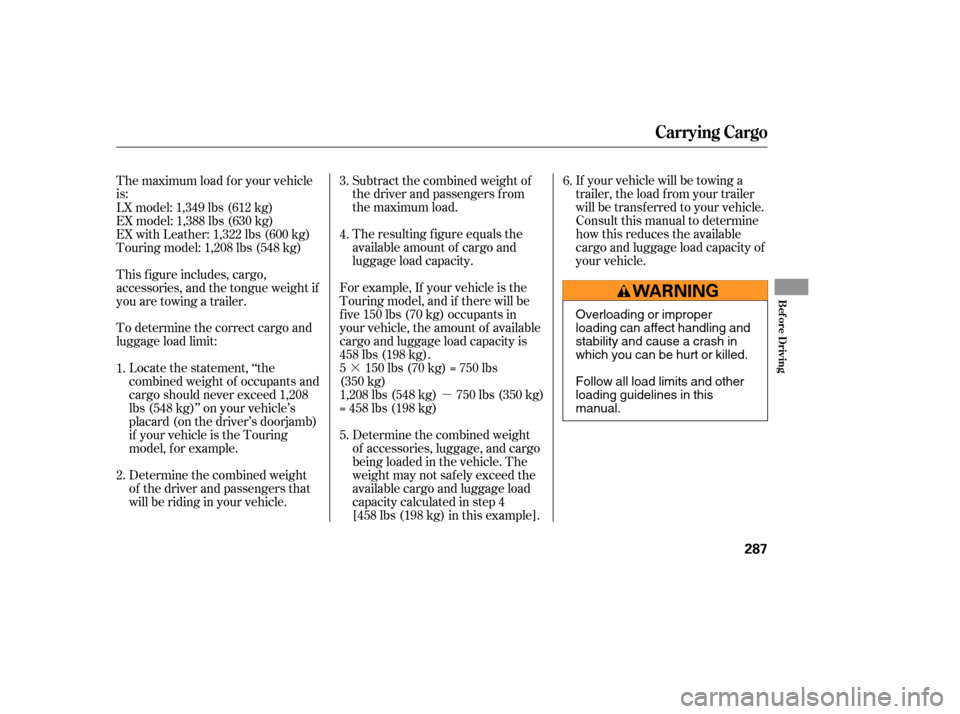
5 150 lbs (70 kg) = 750 lbs
(350 kg)
1,208 lbs (548 kg) 750 lbs (350 kg)
= 458 lbs (198 kg) Determine the combined weight
of accessories, luggage, and cargo
beingloadedinthevehicle.The
weight may not saf ely exceed the
available cargo and luggage load
capacity calculated in step 4
[458 lbs (198 kg) in this example].
This f igure includes, cargo,
accessories, and the tongue weight if
you are towing a trailer.
To determine the correct cargo and
luggage load limit:
Determine the combined weight
of the driver and passengers that
will be riding in your vehicle. Locate the statement, ‘‘the
combined weight of occupants and
cargo should never exceed 1,208
lbs (548 kg)’’ on your vehicle’s
placard (on the driver’s doorjamb)
if your vehicle is the Touring
model, f or example.
1.
2. 3.
4.
5.
6.
LX model: 1,349 lbs (612 kg)
EX model: 1,388 lbs (630 kg)
EX with Leather: 1,322 lbs (600 kg)
Touring model: 1,208 lbs (548 kg)
Carrying Cargo
Bef ore Driving
287
Overloading or improper
loading can affect handling and
stability and cause a crash in
which you can be hurt or killed.
Follow all load limits and other
loading guidelines in this
manual.