Page 289 of 414

Store or secure all items that could
be thrown around and hurt
someone during a crash.
Be sure items placed on the f loor
behind the f ront seats cannot roll
under the seats and interf ere with
the pedals or seat operation.Distribute cargo evenly on the
f loor of the cargo area, placing the
heaviest items on the bottom and
as f ar f orward as possible. Tie
down items that could be thrown
about the vehicle during a crash or
sudden stop.
If you carry large items that
prevent you f rom closing the
tailgate, exhaust gas can enter the
passenger area. To avoid the
possibility of
, f ollow the instructions
on page .
Keep the glove boxes closed while
driving. If either are open, a
passenger could be injured during
a crash or sudden stop.
If you place items near the rear
windows, be sure they are below
the bottom of the windows. If
cargo is higher, it could interf ere
with proper operation of the side
curtain airbags.If you carry any items on a roof
rack,besurethetotalweightof
the rack and the items does not
exceed 150 lb (68 kg).
If you use an accessory roof rack,
the roof rack weight limit may be
lower. Ref er to the inf ormation that
came with your roof rack.
56
Carrying Items in the Passenger
Compartment
carbon monoxide
poisoning
Carrying Cargo in the Cargo A rea
or on a Roof Rack
Carrying Cargo
288
Page 307 of 414
Your vehicle has been designed to
primarily carry passengers and their
cargo. You can also use it to tow a
trailer if you caref ully observe the
load limits, use the proper equipment,
and f ollow the guidelines in this
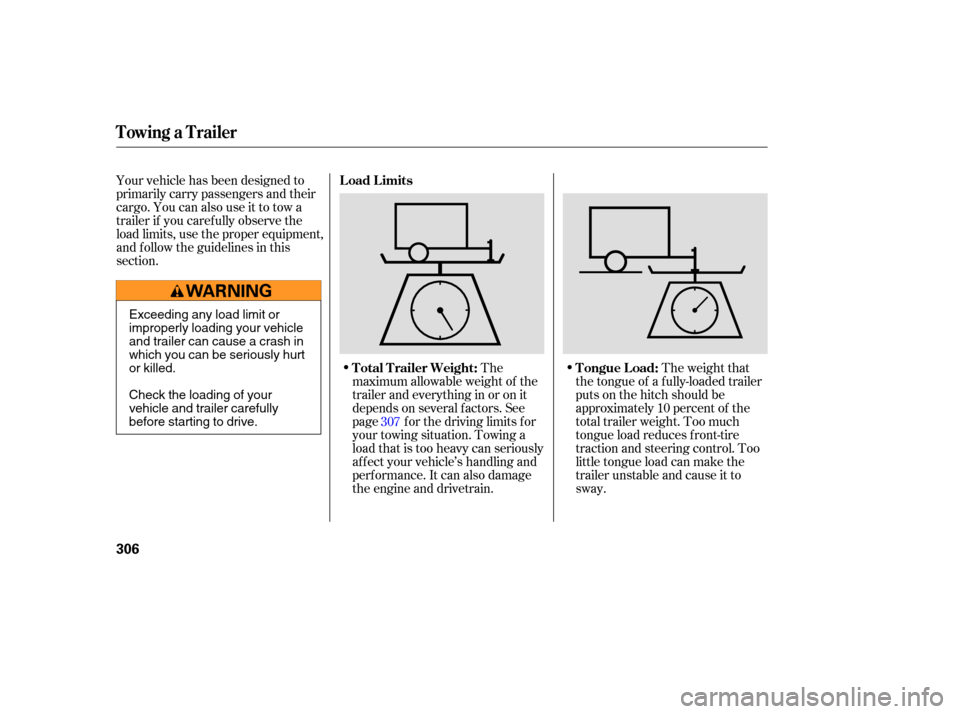
section.The
maximum allowable weight of the
trailer and everything in or on it
depends on several f actors. See
page f or the driving limits f or
your towing situation. Towing a
load that is too heavy can seriously
af f ect your vehicle’s handling and
perf ormance. It can also damage
the engine and drivetrain. The weight that
the tongue of a f ully-loaded trailer
puts on the hitch should be
approximately 10 percent of the
total trailer weight. Too much
tongue load reduces f ront-tire
traction and steering control. Too
little tongue load can make the
trailer unstable and cause it to
sway.
307
Towing a Trailer
Load Limits
T otal T railer Weight: T ongue L oad:
306
Exceeding any load limit or
improperly loading your vehicle
and trailer can cause a crash in
which you can be seriously hurt
or killed.
Check the loading of your
vehicle and trailer carefully
beforestartingtodrive.
Page 308 of 414
�Î
�Î �Î
�Î�Î
�Î
�Î
�Î
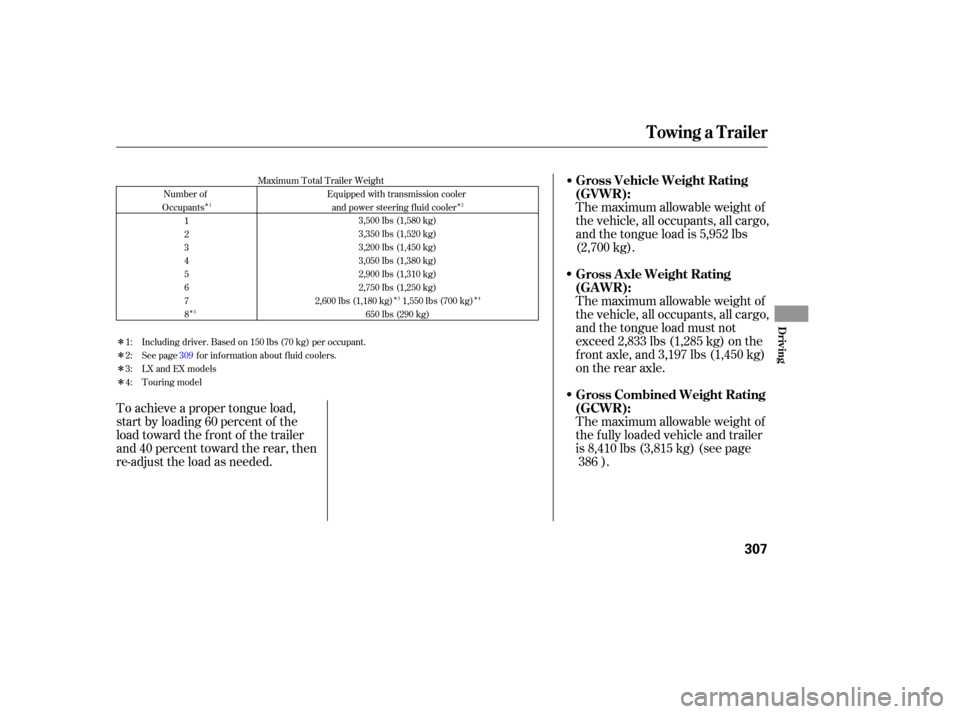
�ΠMaximum Total Trailer Weight
Including driver. Based on 150 lbs (70 kg) per occupant. Number of
Occupants 1
2
3
4
5
6
7
8
See page for information about fluid coolers. Equipped with transmission cooler
and power steering fluid cooler 3,500 lbs (1,580 kg)
3,350 lbs (1,520 kg)
3,200 lbs (1,450 kg)
3,050 lbs (1,380 kg)
2,900 lbs (1,310 kg)
2,750 lbs (1,250 kg)
2,600 lbs (1,180 kg) 1,550 lbs (700 kg) 650 lbs (290 kg)
1:
2:
3:
4: LX and EX models
Touring model 309
The maximum allowable weight of
the vehicle, all occupants, all cargo,
and the tongue load is 5,952 lbs
(2,700 kg).
The maximum allowable weight of
the f ully loaded vehicle and trailer
is 8,410 lbs (3,815 kg) (see page
).
To achieve a proper tongue load,
start by loading 60 percent of the
load toward the front of the trailer
and 40 percent toward the rear, then
re-adjust the load as needed. The maximum allowable weight of
the vehicle, all occupants, all cargo,
and the tongue load must not
exceed 2,833 lbs (1,285 kg) on the
f ront axle, and 3,197 lbs (1,450 kg)
on the rear axle.
3861
3 2
34
Towing a Trailer
Gross Vehicle Weight Rating
(GVWR):
Gross Combined Weight Rating
(GCWR): Gross Axle Weight Rating
(GA WR):
Driving
307
Page 309 of 414

The best way to conf irm that vehicle
and trailer weights are within limits
is to have them checked at a public
scale.
Using a suitable scale or a special
tongue load gauge, check the tongue
load the f irst time you set up a
towing combination (a f ully-loaded
vehicle and trailer), then recheck the
tongue load whenever the conditions
change.If the total trailer weight is more
than 1,850 lbs (840 kg), you must
also use a weight distributing hitch.
This device transf ers weight f rom
the vehicle’s rear wheels to the f ront
wheels, and to the trailer’s wheels.
Caref ully f ollow the hitch maker’s
instructions f or proper installation
and adjustment.
Always use saf ety chains when you
tow a trailer. Make sure the chains
are secured to the trailer and hitch,
and that they cross under the tongue
and can catch the trailer if it
becomes unhitched. Leave enough
slack to allow the trailer to turn
corners easily, but do not let the
chains drag on the ground.
Towing generally requires a variety
of supplemental equipment,
depending on the size of your trailer,
how much load you are towing, and
where you tow. To ensure the best
quality, we recommend that you
purchase Honda equipment
whenever possible.
Discuss your needs with your trailer
sales or rental agency, and f ollow the
guidelines in this section. Also make
sure that all equipment is properly
installed and meets f ederal, state,
province, and local regulations.
Any hitch used on your vehicle must
be properly bolted to the underbody,
using the six threaded holes
provided. A hitch and the required
f luid coolers designed especially f or
your Odyssey can be obtained f rom
your Honda dealer.
Towing a Trailer
Checking L oads
T owing Equipment and
A ccessoriesWeight Distributing Hitch
Saf et y Chains
Hitches
308
Page 310 of 414

CONT INUED
If you choose electric brakes, be
sure they are electrically actuated.
Do not attempt to tap into your
vehicle’s hydraulic system. No
matter how successf ul it may seem,
any attempt to attach trailer brakes
to your vehicle’s hydraulic system
will lower braking ef f ectiveness and
create a potential hazard.Trailer lights and equipment must
comply with f ederal, state, province,
and local regulations. Check the
requirements f or the areas where
you plan to tow, and use only
equipment designed f or your vehicle.
If the total trailer weight exceeds
2,000 lbs (900 kg), you should install
a sway control device to minimize
swaying that can occur in crosswinds
and in normal and emergency
driving maneuvers. Your trailer
maker can tell you what kind of sway
control you need and how to install it.
To help prevent overheating, a
transmission f luid cooler and a
power steering f luid cooler are
required f or trailer towing. These
coolers are available only f rom your
Honda dealer. Honda recommends that any trailer
having a total weight of 1,000 lbs
(450 kg) or more be equipped with
its own electric or surge-type brakes.
Seeyourtrailerdealerformore
inf ormation on installing electric
brakes.
Towing a Trailer
Trailer Brakes
Trailer Lights
Sway Cont rol
T ransmission Fluid Cooler andPower St eering Fluid Cooler
Driving
309
Page 312 of 414

When preparing to tow, and bef ore
driving away, be sure to check the
f ollowing:The vehicle has been properly
serviced, and the tires, brakes,
suspension, cooling system, and
lights are in good operating
condition.
The trailer has been properly
serviced and is in good condition.
All weights and loads are within
limits.
Thehitch,safetychains,andany
other attachments are secure. All items in or on the trailer are
properly secured and cannot shif t
while you drive.
Your vehicle tires and spare are
properly inf lated, and the trailer
tires and spare are inf lated as
recommended by the trailer
maker.
The added weight, length, and
height of a trailer will af f ect your
vehicle’s handling and perf ormance,
so driving with a trailer requires
some special driving skills and
techniques.
Foryoursafetyandthesafetyof
others,taketimetopracticedriving
maneuvers bef ore heading f or the
open road, and f ollow the guidelines
below.
Drive slower than normal in all
driving situations, and obey posted
speed limits f or vehicles with trailers.
Use the D position when towing a
trailer on level roads. Do not exceed
55 mph (88 km/h). At higher speeds,
the trailer may sway or affect vehicle
handling.
Towing a Trailer
Pre-T ow Checklist
Driving Saf ely With a T railer
T owing Speeds and Gears
Driving
311
Page 329 of 414
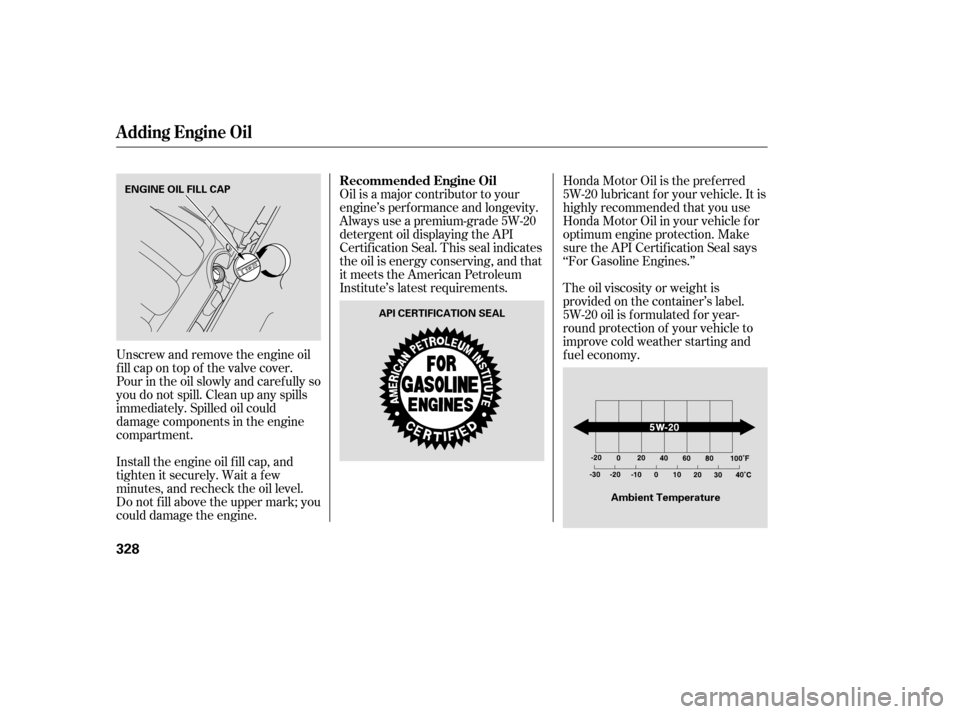
Unscrew and remove the engine oil
fill cap on top of the valve cover.
Pour in the oil slowly and caref ully so
you do not spill. Clean up any spills
immediately. Spilled oil could
damage components in the engine
compartment.
Install the engine oil f ill cap, and
tighten it securely. Wait a f ew
minutes, and recheck the oil level.
Do not f ill above the upper mark; you
could damage the engine.Oil is a major contributor to your
engine’s perf ormance and longevity.
Always use a premium-grade 5W-20
detergent oil displaying the API
Certif ication Seal. This seal indicates
the oil is energy conserving, and that
it meets the American Petroleum
Institute’s latest requirements.
Honda Motor Oil is the pref erred
5W-20 lubricant f or your vehicle. It is
highly recommended that you use
Honda Motor Oil in your vehicle f or
optimum engine protection. Make
sure the API Certif ication Seal says
‘‘For Gasoline Engines.’’
The oil viscosity or weight is
provided on the container’s label.
5W-20 oil is f ormulated f or year-
round protection of your vehicle to
improve cold weather starting and
f uel economy.
Recommended Engine Oil
A dding Engine Oil
328
ENGINE OIL FILL CAP
Ambient Temperature
API CERTIFICATION SEAL
Page 330 of 414
You may use a synthetic motor oil if
it meets the same requirements
given f or a conventional motor oil: it
displays the API Certif ication Seal,
and it is the proper weight. You must
f ollow the oil and f ilter change
intervals shown on the odometer/
trip meter display or on the multi-
inf ormation display.Always change the oil and f ilter
according to the maintenance
messages shown on the odometer/
trip meter display or on the multi-
inf ormation display. The oil and f ilter
collect contaminants that can dam-
age your engine if they are not
removed regularly.
Changing the oil and f ilter requires
special tools and access f rom
underneath the vehicle. The vehicle
should be raised on a service station-
type hydraulic lif t f or this service.
Unless you have the knowledge and
proper equipment, you should have
this maintenance done by a skilled
mechanic.
Run the engine until it reaches
normal operating temperature,
then shut it off.
Your vehicle’s engine does not
require any oil additives. Additives
may adversely af f ect engine or
transmission perf ormance and
durability.
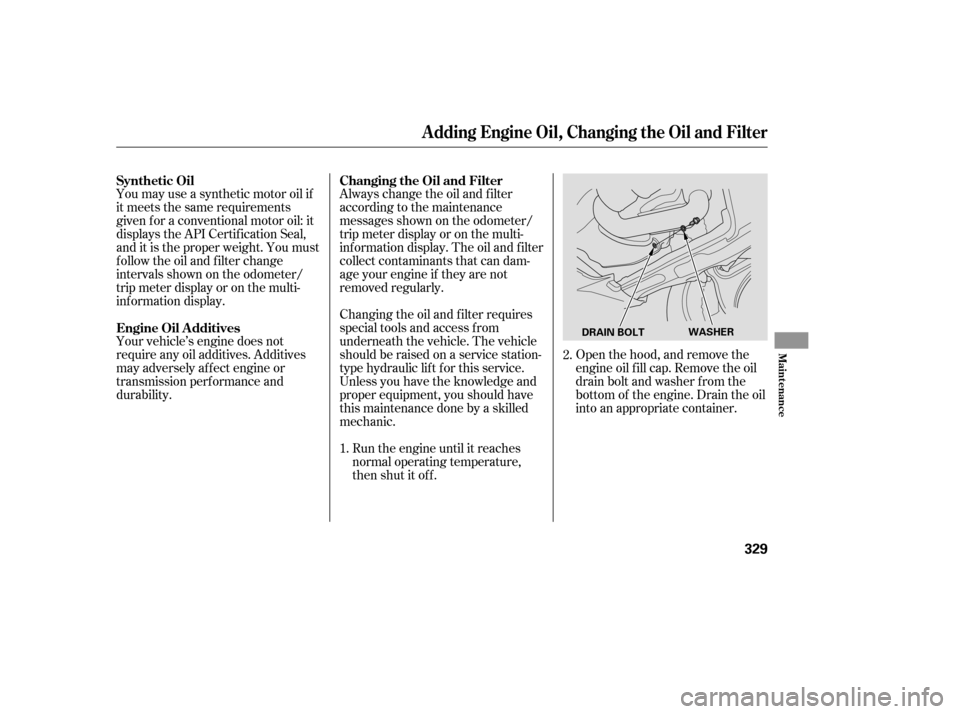
Open the hood, and remove the
engine oil f ill cap. Remove the oil
drain bolt and washer f rom the
bottom of the engine. Drain the oil
into an appropriate container.
1. 2.
Synthetic Oil
Changing the Oil and Filter
Engine Oil A dditives
A dding Engine Oil, Changing the Oil and Filter
Maint enance
329
WASHER
DRAIN BOLT