Page 23 of 72
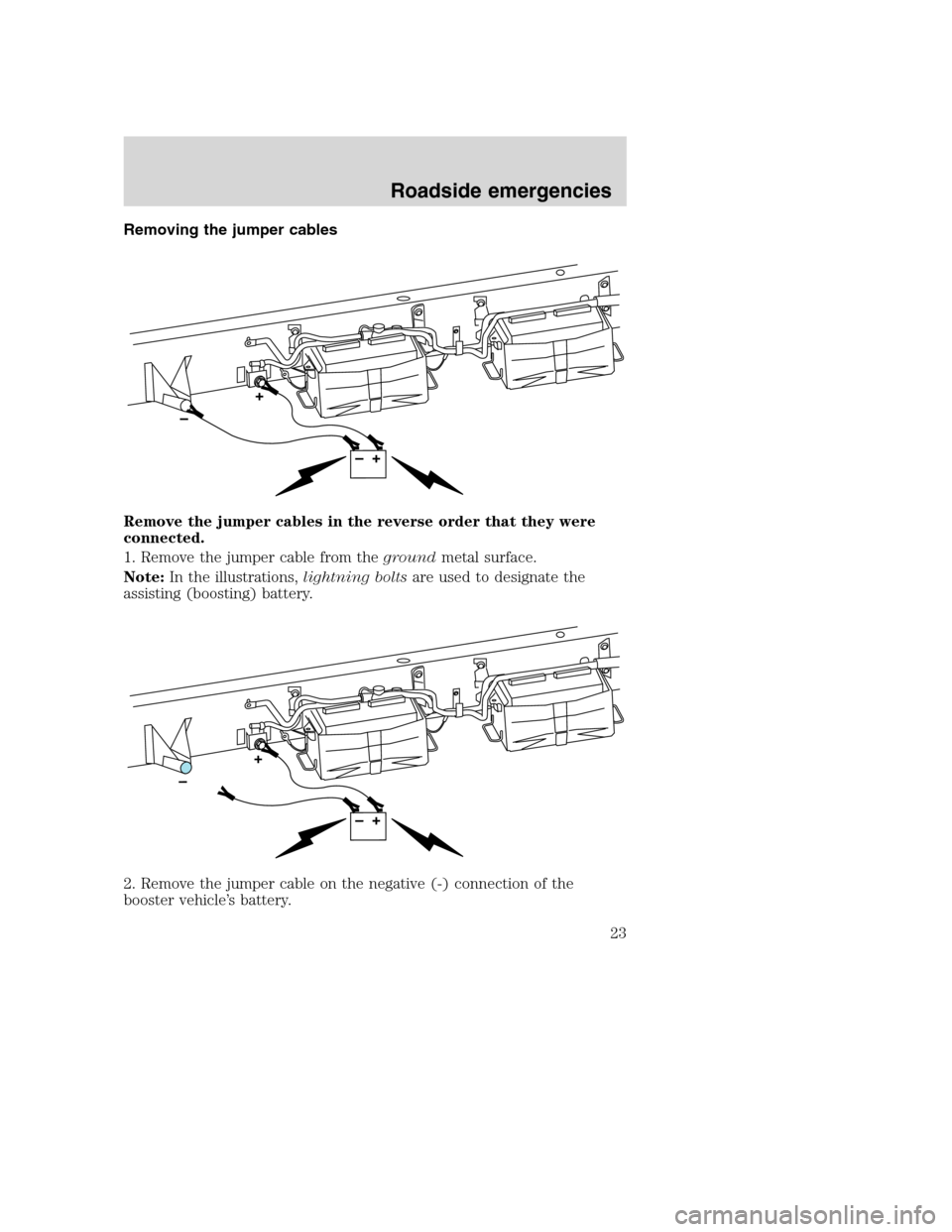
Removing the jumper cables
Remove the jumper cables in the reverse order that they were
connected.
1. Remove the jumper cable from thegroundmetal surface.
Note:In the illustrations,lightning boltsare used to designate the
assisting (boosting) battery.
2. Remove the jumper cable on the negative (-) connection of the
booster vehicle’s battery.
Roadside emergencies
23
Page 25 of 72
ENGINE
Engines are more efficient when they are clean because grease and dirt
buildup keep the engine warmer than normal. When washing:
•Take care when using a power washer to clean the engine. The
high-pressure fluid could penetrate the sealed parts and cause
damage.
•Do not spray a hot engine with cold water to avoid cracking the
engine block or other engine components.
•Spray Motorcraft Engine Shampoo and Degreaser (ZC-20) on all parts
that require cleaning and pressure rinse clean.
•Never wash or rinse the engine while it is running; water in the
running engine may cause internal damage.
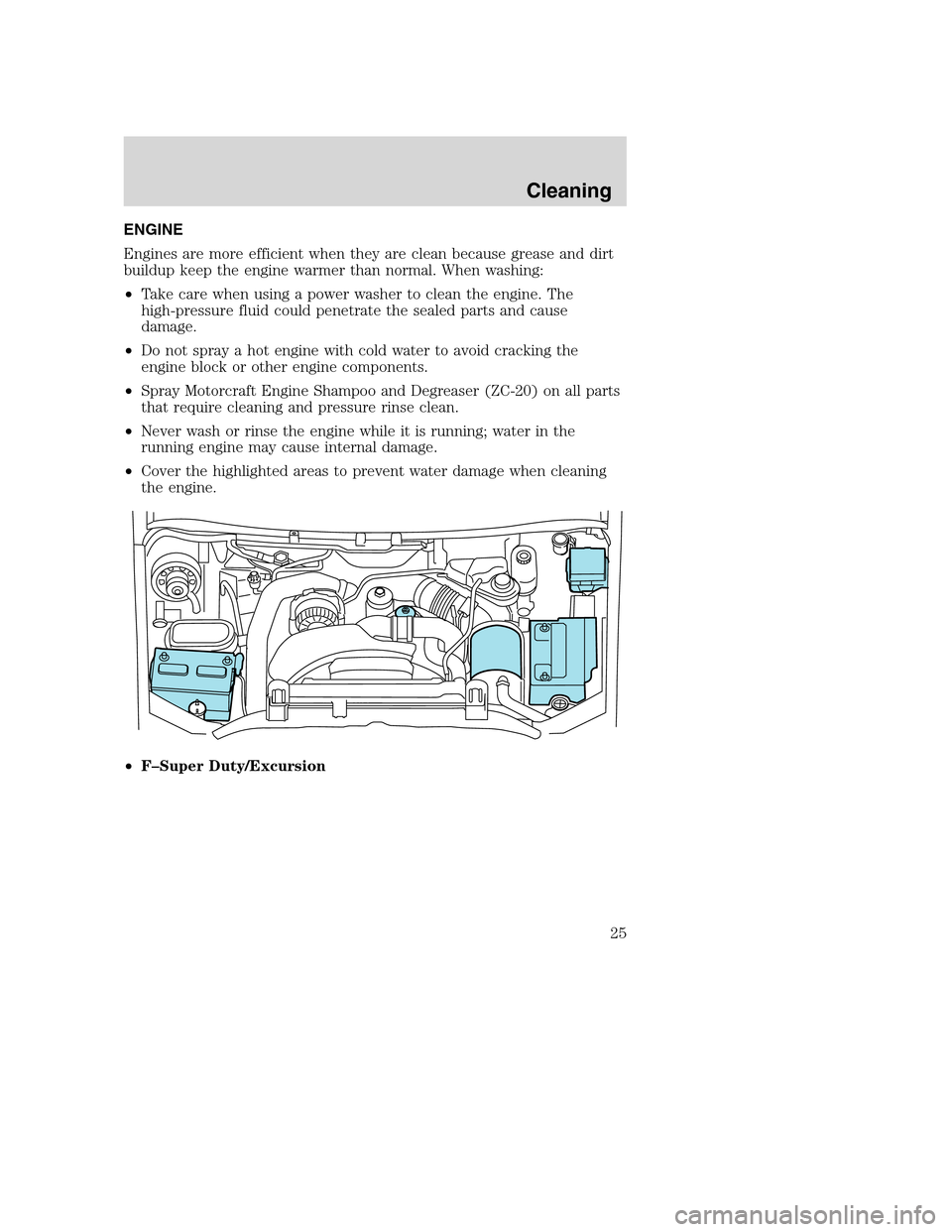
•Cover the highlighted areas to prevent water damage when cleaning
the engine.
•F–Super Duty/Excursion
Cleaning
Cleaning
25
Page 31 of 72
FUEL CONDITIONER MODULE (FCM - E-SERIES)/HORIZONTAL
FUEL CONDITIONING MODULE (HFCM - F-SUPER
DUTY/EXCURSION) - FUEL FILTER/WATER SEPARATOR
HFCM - F-Super Duty/Excursion
The vehicle is equipped with a Horizontal Fuel Conditioning Module
(HFCM) located on the frame-rail under the driver-side floorboard near
the transmission.
Water should be drained from the
module assembly whenever the
warning light comes on. The WATER
IN FUEL light will come on when
approximately 100 cc (0.2 pints) of water accumulates in the module.
Replace the fuel filters with Ford Part No. FD–4604. This part number
includes filters and seals for both the engine-mounted and
frame-mounted filters.
FCM - E-Series
The vehicle is equipped with a Fuel Conditioning Module (FCM) located
on the driver-side of the vehicle next to the transmission case.
Water should be drained from the
module assembly whenever the
warning light comes on. The WATER
IN FUEL light will come on when
approximately 100 cc (0.2 pints) of water accumulates in the module.
Replace the fuel filters with Ford Part No. FD–4604. This part number
includes filters and seals for both the engine-mounted filter and the FCM
filter.
DRAINING THE FCM/HFCM AND CHANGING THE FUEL FILTERS
Your vehicle is equipped with two fuel filters; one is mounted on top of
the engine.On F-Super Duty and Excursion vehicles,the second
filter, inside the HFCM, is mounted inside the frame rail under the
driver-side floorboard near the transmission.On E-Series vehicles,the
second filter, inside the FCM, is mounted on the driver-side of the
vehicle next to the transmission case.On all vehicles,both filters
should be replaced at the same time. The Motorcraft part number for the
replacement filters is FD-4604.
Maintenance and Specifications
31
Page 32 of 72
FCM/HFCM drain procedure
1. Stop the vehicle andshut offthe engine.
The vehicle must be stopped with the engine off when draining
the HFCM/FCM. Fuel may ignite if the separator is drained while
the engine is running or vehicle is moving.
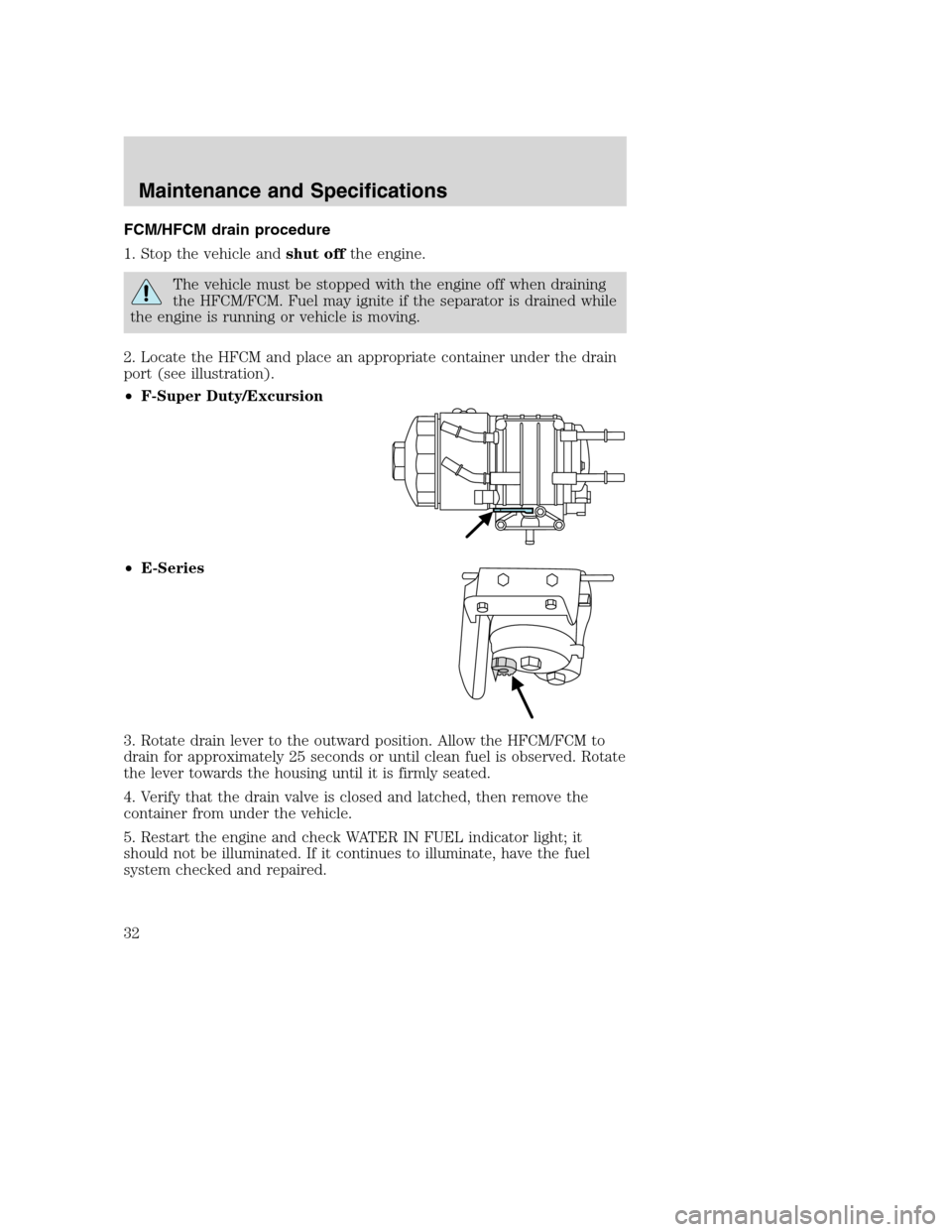
2. Locate the HFCM and place an appropriate container under the drain
port (see illustration).
•F-Super Duty/Excursion
•E-Series
3. Rotate drain lever to the outward position. Allow the HFCM/FCM to
drain for approximately 25 seconds or until clean fuel is observed. Rotate
the lever towards the housing until it is firmly seated.
4. Verify that the drain valve is closed and latched, then remove the
container from under the vehicle.
5. Restart the engine and check WATER IN FUEL indicator light; it
should not be illuminated. If it continues to illuminate, have the fuel
system checked and repaired.
Maintenance and Specifications
32
Page 42 of 72
remove the coolant pressure relief cap on the radiator of a vehicle with
an overflow system, follow these steps to add engine coolant.
To reduce the risk of personal injury, make sure the engine is
cool before unscrewing the coolant pressure relief cap. The
cooling system is under pressure; steam and hot liquid can come out
forcefully when the cap is loosened slightly.
1. Before you begin, turn the engine off and let it cool.
2. When the engine is cool, wrap a thick cloth around the coolant
pressure relief cap on the coolant reservoir (a translucent plastic bottle).
Slowly turn cap counterclockwise (left) until pressure begins to release.
3. Step back while the pressure releases.
4. When you are sure that all the pressure has been released, use the
cloth to turn it counterclockwise and remove the cap.
5. Fill the coolant reservoir slowly with the proper coolant mixture (see
above), to within the“COLD FILL RANGE”or the“FULL COLD”level on
the reservoir. If you removed the radiator cap in an overflow system, fill
the radiator until the coolant is visible and radiator is almost full.
6. Replace the cap. Turn until tightly installed. (Cap must be tightly
installed to prevent coolant loss.)
After any coolant has been added, check the coolant concentration (refer
toChecking engine coolant). If the concentration is not 50/50
(protection to–34°F/–36°C), drain some coolant and adjust the
concentration. It may take several drains and additions to obtain a 50/50
coolant concentration.
Whenever coolant has been added, the coolant level in the coolant
reservoir should be checked the next few times you drive the vehicle. If
necessary, add enough 50/50 concentration of engine coolant and
distilled water to bring the liquid level to the proper level.
If you have to add more than 1.0 quart (1.0 liter) of engine coolant per
month, have your dealer check the engine cooling system. Your cooling
system may have a leak. Operating an engine with a low level of coolant
can result in engine overheating and possible engine damage.
Recycled engine coolant
Ford Motor Company does NOT recommend the use of recycled engine
coolant in vehicles originally equipped with Motorcraft Premium Gold
Engine Coolant since a Ford-approved recycling process is not yet
available.
Maintenance and Specifications
42
Page 45 of 72
The complexity of the diesel engine makes it so the owner is discouraged
from attempting to perform maintenance other than the services
described in this supplement.
If you experience difficult starting, rough idling, excessive exhaust
smoke, a decrease in engine performance or excess fuel consumption,
perform the following checks:
•a plugged air inlet system or engine air filter element.
•water in the fuel filter/water separator.
•a clogged fuel filter.
•contaminated fuel.
•air in the fuel system, due to loose connections.
•an open or pinched sensor hose.
•low engine oil level.
•wrong fuel or oil viscosity for climactic conditions.
If these checks do not help you correct the engine performance problem
you are experiencing, consult an authorized dealer.
FUELING
Do not use starting fluid such as ether or gasoline in the diesel
air intake system. Such fluids can cause immediate explosive
damage to the engine and possible personal injury.
If you fuel your vehicle at a truck stop, you may notice that the fuel
nozzle may shut off every 5–10 seconds. This is due to the flow rates
being designed for larger heavy duty trucks. You may have to fuel at a
slower rate (don’t depress the nozzle trigger fully).
Do not run your diesel vehicle out of fuel as this will allow air to enter
the fuel system which will make restarting difficult. Longer engine
cranking time may be required once air is in the fuel system. If air enters
the fuel system (either through running the fuel tank(s) empty or during
a fuel filter change), the engine will self-purge the trapped air once it
starts running. The engine may run roughly and produce white smoke
while air is in the fuel system; this is normal and should stop after a
short time.
MINOR TROUBLESHOOTING GUIDE
If the engine won’t crank
Turn on the headlights. If the lights are dim, do not go on at all or if
when the ignition is turned to 5 (START) the lights become dim or go
Maintenance and Specifications
45
Page 48 of 72
REFILL CAPACITIES
Component Capacity
Cooling system127.5 quarts (26.0L)
Engine oil215.0 quarts (14.2L)
Fuel tank (F-250/350/450/550) Refer to yourOwner’s
Guide
Fuel tank (Excursion) 44.0 gallons (166.6L)
Fuel tank (E-Series) Refer to yourOwner’s
Guide
Radiator cap 16 psi (110 kPa)
Manual transmission
35.8 quarts (5.5L)
Automatic transmission Refer to yourOwner’s
Guide
1Includes heater and 5.0 quarts (4.7L) in coolant recovery.
2Includes 1 quart (1.0L) in engine oil filter.
3Use Motorcraft MERCON�ATF, Motorcraft part number XT-2–QDX,
meeting Ford specification MERCON�.
BULB SPECIFICATIONS
Lamp descriptionNumber of bulbs
requiredTrade number
Wait to Start Light 1 194
Water-in-Fuel Light 1 194
Engine Temp. Light 1 194
Maintenance and Specifications
48
Page 52 of 72
Company’s specifications, and we stand behind them. Maintenance parts
installed at your Ford or Lincoln Mercury dealership carry a nationwide,
12 months, 12,000 mile parts and labor limited warranty. Your dealer can
give you details.
Value Shopping for Your Vehicle’s Maintenance Needs
Your dealership recognizes the competitive landscape of maintenance and
light repair automotive services. With factory-trained technicians, and
one-stop service from routine maintenance like oil changes and tire
rotations to repairs like brake service, check out the value your Ford and
Lincoln Mercury dealers can offer.
WHICH MAINTENANCE SCHEDULE SHOULD YOU FOLLOW?
Owner Checks and Services
Refer to Mileage Intervals for Additional Checks and Services
Certain basic maintenance checks and inspections should be performed
by the owner or a service technician at the intervals indicated. Service
information and supporting specifications are provided in the Owner’s
Guide.
Any adverse condition should be brought to the attention of your dealer
or qualified service technician as soon as possible for the proper service
advice. The owner maintenance service checks are generally not covered
by warranties so you may be charged for labor, parts or lubricants used.
Maximum Oil Change Interval:
Normal Schedule: 7,500 miles or 6 months, whichever occurs first.
Special Operating Conditions: 5,000 miles, 6 months or 200 hours of
engine operation, see appropriate schedule.
Check every month:
•Check function of all interior and exterior lights
•Check tires for wear and adjust air pressure (including spare tire)
•Check engine oil level
•Check windshield washer fluid level
•Check and drain fuel filter/water separator
Check every six months:
•Check lap/shoulder belts and seat latches for wear and function
•Check that externally-mounted spare tire is tight (see Owner’s Guide)
General Owner’s Information
52