2005 FORD SUPER DUTY maintenance schedule
[x] Cancel search: maintenance schedulePage 1 of 72
Introduction
2
Instrumentation
6
Driving
12
Roadside emergencies
19
Cleaning
25
Maintenance and Specifications
27
General Owner’s Information
50
Normal Scheduled Maintenance and Log 54
Exceptions 64
Special Operating Conditions and Log 65
Motorcraft Premium Gold Coolant Change Record 69
All rights reserved. Reproduction by any means, electronic or mechanical
including photocopying, recording or by any information storage and retrieval
system or translation in whole or part is not permitted without written
authorization from Ford Motor Company. Ford may change the contents without
notice and without incurring obligation.
Copyright © 2004 Ford Motor Company
Table of Contents
1
Table of Contents
Page 29 of 72
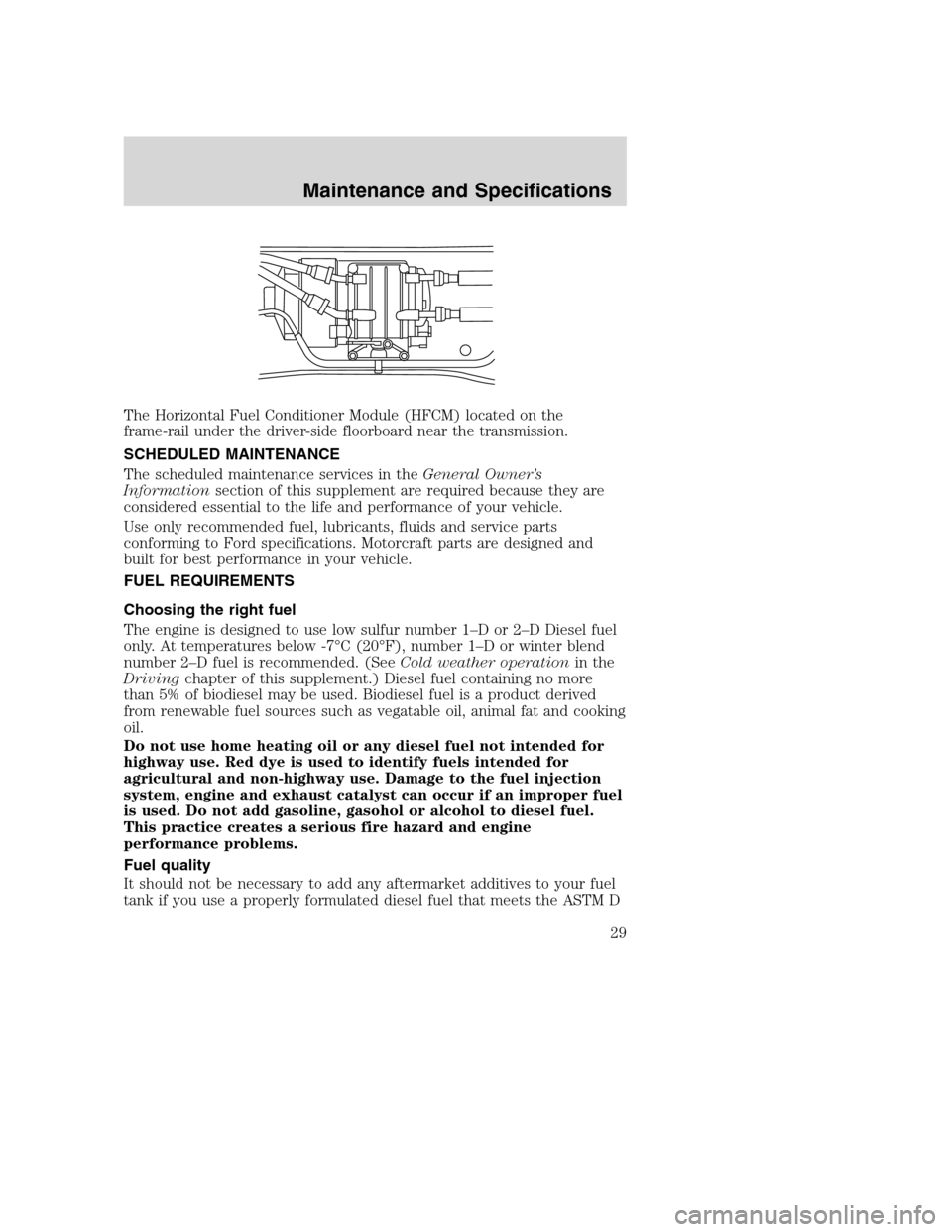
The Horizontal Fuel Conditioner Module (HFCM) located on the
frame-rail under the driver-side floorboard near the transmission.
SCHEDULED MAINTENANCE
The scheduled maintenance services in theGeneral Owner’s
Informationsection of this supplement are required because they are
considered essential to the life and performance of your vehicle.
Use only recommended fuel, lubricants, fluids and service parts
conforming to Ford specifications. Motorcraft parts are designed and
built for best performance in your vehicle.
FUEL REQUIREMENTS
Choosing the right fuel
The engine is designed to use low sulfur number 1–Dor2–D Diesel fuel
only. At temperatures below -7°C (20°F), number 1–D or winter blend
number 2–D fuel is recommended. (SeeCold weather operationin the
Drivingchapter of this supplement.) Diesel fuel containing no more
than 5% of biodiesel may be used. Biodiesel fuel is a product derived
from renewable fuel sources such as vegatable oil, animal fat and cooking
oil.
Do not use home heating oil or any diesel fuel not intended for
highway use. Red dye is used to identify fuels intended for
agricultural and non-highway use. Damage to the fuel injection
system, engine and exhaust catalyst can occur if an improper fuel
is used. Do not add gasoline, gasohol or alcohol to diesel fuel.
This practice creates a serious fire hazard and engine
performance problems.
Fuel quality
It should not be necessary to add any aftermarket additives to your fuel
tank if you use a properly formulated diesel fuel that meets the ASTM D
Maintenance and Specifications
29
Page 39 of 72
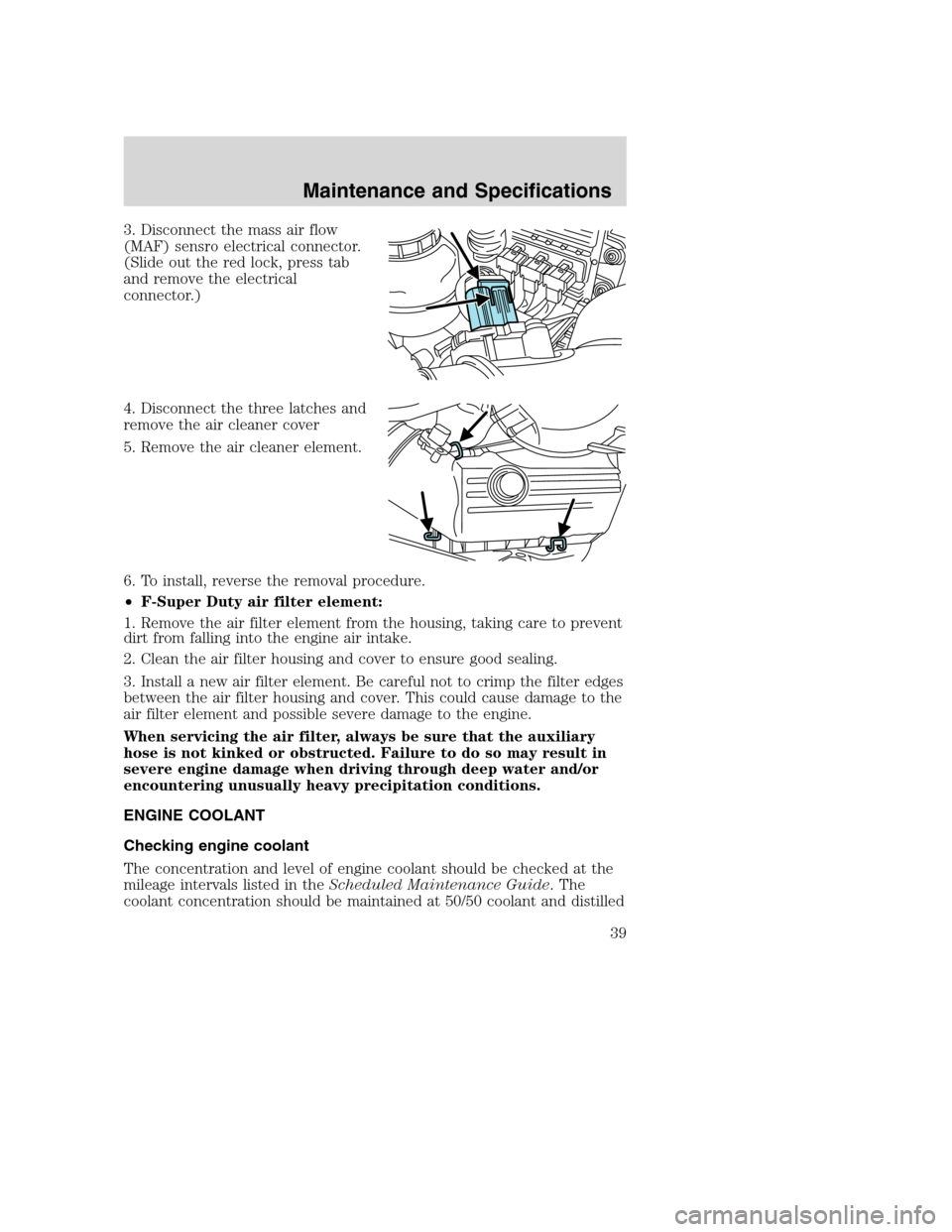
3. Disconnect the mass air flow
(MAF) sensro electrical connector.
(Slide out the red lock, press tab
and remove the electrical
connector.)
4. Disconnect the three latches and
remove the air cleaner cover
5. Remove the air cleaner element.
6. To install, reverse the removal procedure.
•F-Super Duty air filter element:
1. Remove the air filter element from the housing, taking care to prevent
dirt from falling into the engine air intake.
2. Clean the air filter housing and cover to ensure good sealing.
3. Install a new air filter element. Be careful not to crimp the filter edges
between the air filter housing and cover. This could cause damage to the
air filter element and possible severe damage to the engine.
When servicing the air filter, always be sure that the auxiliary
hose is not kinked or obstructed. Failure to do so may result in
severe engine damage when driving through deep water and/or
encountering unusually heavy precipitation conditions.
ENGINE COOLANT
Checking engine coolant
The concentration and level of engine coolant should be checked at the
mileage intervals listed in theScheduled Maintenance Guide. The
coolant concentration should be maintained at 50/50 coolant and distilled
Maintenance and Specifications
39
Page 40 of 72
water, which equates to a freeze point of -34°F (-36°C). Coolant
concentration testing is possible with a hydrometer or antifreeze tester
(such as the Rotunda Battery and Antifreeze Tester, 014–R1060). The
level of coolant should be maintained at the“FULL COLD”level or
within the“COLD FILL RANGE”in the coolant reservoir. If the level falls
below, add coolant per the instructions in theAdding engine coolant
section of this supplement.
Your vehicle was factory-filled with a 50/50 engine coolant and water
concentration. If the concentration of coolant falls below 40% or above
60%, the engine parts could become damaged or not work properly.A
50–50 mixture of coolant and water provides the following:
•Freeze protection down to -34°F (-36°C).
•Boiling protection up to 265°F (129°C).
•Protection against rust and other forms of corrosion.
•Enables calibrated gauges to work properly.
When the engine is cold, check the level of the engine coolant in the
reservoir.
•The engine coolant should be at the“FULL COLD”level or within the
“COLD FILL RANGE”as listed on the engine coolant reservoir
(depending upon application).
•Refer to theGeneral Owner’s Informationfor service interval
schedules.
•Be sure to read and understandPrecautions when servicing your
vehiclein yourOwner’s Guide.
If the engine coolant has not been checked at the recommended interval,
the engine coolant reservoir may become low or empty. If the reservoir is
low or empty, add engine coolant to the reservoir. Refer toAdding
engine coolantin this section of this supplement.
Note:Automotive fluids are not interchangeable; do not use engine
coolant, antifreeze or windshield washer fluid outside of its specified
function and vehicle location.
Adding engine coolant
When adding coolant, make sure it is a 50/50 mixture of engine coolant
and distilled water. Add the mixture to the coolant reservoir,when the
engine is cool, until the appropriate fill level is obtained.
Maintenance and Specifications
40
Page 50 of 72
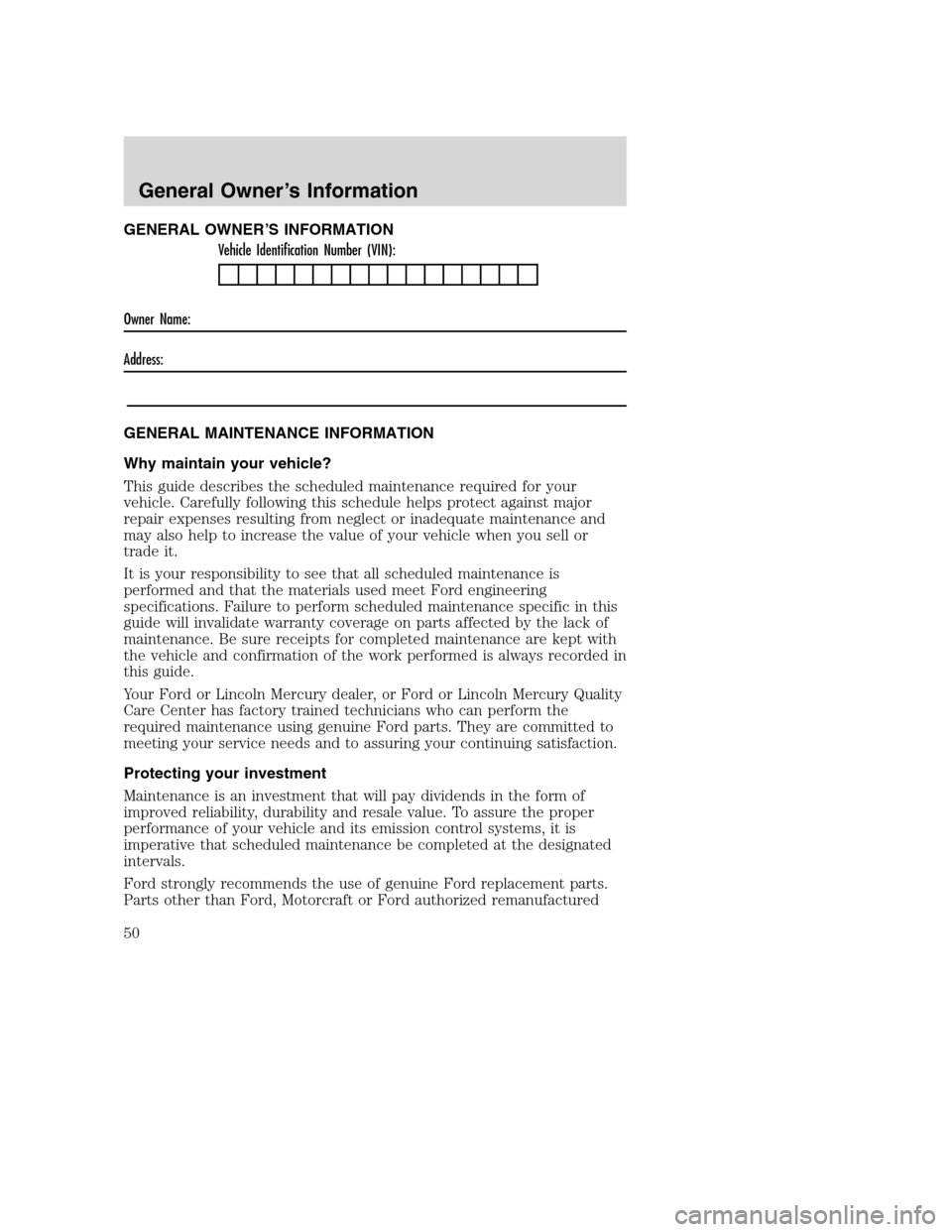
GENERAL OWNER’S INFORMATION
Vehicle Identification Number (VIN):
Owner Name:
Address:
GENERAL MAINTENANCE INFORMATION
Why maintain your vehicle?
This guide describes the scheduled maintenance required for your
vehicle. Carefully following this schedule helps protect against major
repair expenses resulting from neglect or inadequate maintenance and
may also help to increase the value of your vehicle when you sell or
trade it.
It is your responsibility to see that all scheduled maintenance is
performed and that the materials used meet Ford engineering
specifications. Failure to perform scheduled maintenance specific in this
guide will invalidate warranty coverage on parts affected by the lack of
maintenance. Be sure receipts for completed maintenance are kept with
the vehicle and confirmation of the work performed is always recorded in
this guide.
Your Ford or Lincoln Mercury dealer, or Ford or Lincoln Mercury Quality
Care Center has factory trained technicians who can perform the
required maintenance using genuine Ford parts. They are committed to
meeting your service needs and to assuring your continuing satisfaction.
Protecting your investment
Maintenance is an investment that will pay dividends in the form of
improved reliability, durability and resale value. To assure the proper
performance of your vehicle and its emission control systems, it is
imperative that scheduled maintenance be completed at the designated
intervals.
Ford strongly recommends the use of genuine Ford replacement parts.
Parts other than Ford, Motorcraft or Ford authorized remanufactured
General Owner’s Information
General Owner’s Information
50
Page 52 of 72
Company’s specifications, and we stand behind them. Maintenance parts
installed at your Ford or Lincoln Mercury dealership carry a nationwide,
12 months, 12,000 mile parts and labor limited warranty. Your dealer can
give you details.
Value Shopping for Your Vehicle’s Maintenance Needs
Your dealership recognizes the competitive landscape of maintenance and
light repair automotive services. With factory-trained technicians, and
one-stop service from routine maintenance like oil changes and tire
rotations to repairs like brake service, check out the value your Ford and
Lincoln Mercury dealers can offer.
WHICH MAINTENANCE SCHEDULE SHOULD YOU FOLLOW?
Owner Checks and Services
Refer to Mileage Intervals for Additional Checks and Services
Certain basic maintenance checks and inspections should be performed
by the owner or a service technician at the intervals indicated. Service
information and supporting specifications are provided in the Owner’s
Guide.
Any adverse condition should be brought to the attention of your dealer
or qualified service technician as soon as possible for the proper service
advice. The owner maintenance service checks are generally not covered
by warranties so you may be charged for labor, parts or lubricants used.
Maximum Oil Change Interval:
Normal Schedule: 7,500 miles or 6 months, whichever occurs first.
Special Operating Conditions: 5,000 miles, 6 months or 200 hours of
engine operation, see appropriate schedule.
Check every month:
•Check function of all interior and exterior lights
•Check tires for wear and adjust air pressure (including spare tire)
•Check engine oil level
•Check windshield washer fluid level
•Check and drain fuel filter/water separator
Check every six months:
•Check lap/shoulder belts and seat latches for wear and function
•Check that externally-mounted spare tire is tight (see Owner’s Guide)
General Owner’s Information
52
Page 53 of 72
•Check power steering fluid level
•Check washer spray, wiper operation and clean all wiper blades
(replace as necessary)
•Check parking brake for proper operation
•Check and lubricate all hinges, latches and outside locks
•Check and lubricate door rubber weatherstrips
•Check and clean body and door drain holes
•Check safety warning lamps (brake, ABS, air bag, safety belt) for
operation
•Check cooling system fluid level and coolant strength
•Check battery connections and clean if necessary
•Check clutch fluid level, if equipped
Multi-point Inspection
In order to keep your vehicle running right, it is important that you have
the systems on your vehicle checked regularly. This can help identify any
potential issue before there are any problems. Ford Motor Company
suggests the following multi-point inspection to be performed at every
scheduled maintenance as the way to ensure your vehicle keeps running
right.
Multi-point inspection - Recommended at every visit
•Check and top up fluid levels: brake, coolant recovery reservoir,
manual and automatic transmission, power steering and window
washer.
•Inspect tires for wear and check air pressure, including spare.
•Check exhaust system for leaks, damage, loose parts and foreign
materials.
•Check battery performance.
•Check operation of horn, exterior lamps, turn signals and hazard
warning lights.
•Check radiator, coolers and heater and air conditioning hoses.
•Inspect windshield washer spray and wiper operation.
•Check windshield for cracks, chips and pitting.
•Inspect for oil and fluid leaks.
•Inspect air cleaner filter.
General Owner’s Information
53
Page 54 of 72
•Check shocks and struts and other suspension components for leaks
and damage.
NORMAL SCHEDULED MAINTENANCE AND LOG
The following section contains the“Normal Schedule.”This schedule is
presented at specific mileage intervals with exceptions noted.
Additional information available on the Web
To learn more about the importance of routine and dealer-performed
maintenance on your vehicle, please visit the Ford Customer Service
website. You’ll also find important warranty information, customer
assistance, technical expertise, frequently asked questions and much
more. The website location is at: www.ford.com/
Then go to the vehicles and service pick at the web site.
7,500 miles (12,000 km)
•Change engine oil and replace oil filter
•Perform multi-point inspection (recommended)
•Inspect tires for wear and rotate
•Inspect air filter restriction gauge, replace filter as required
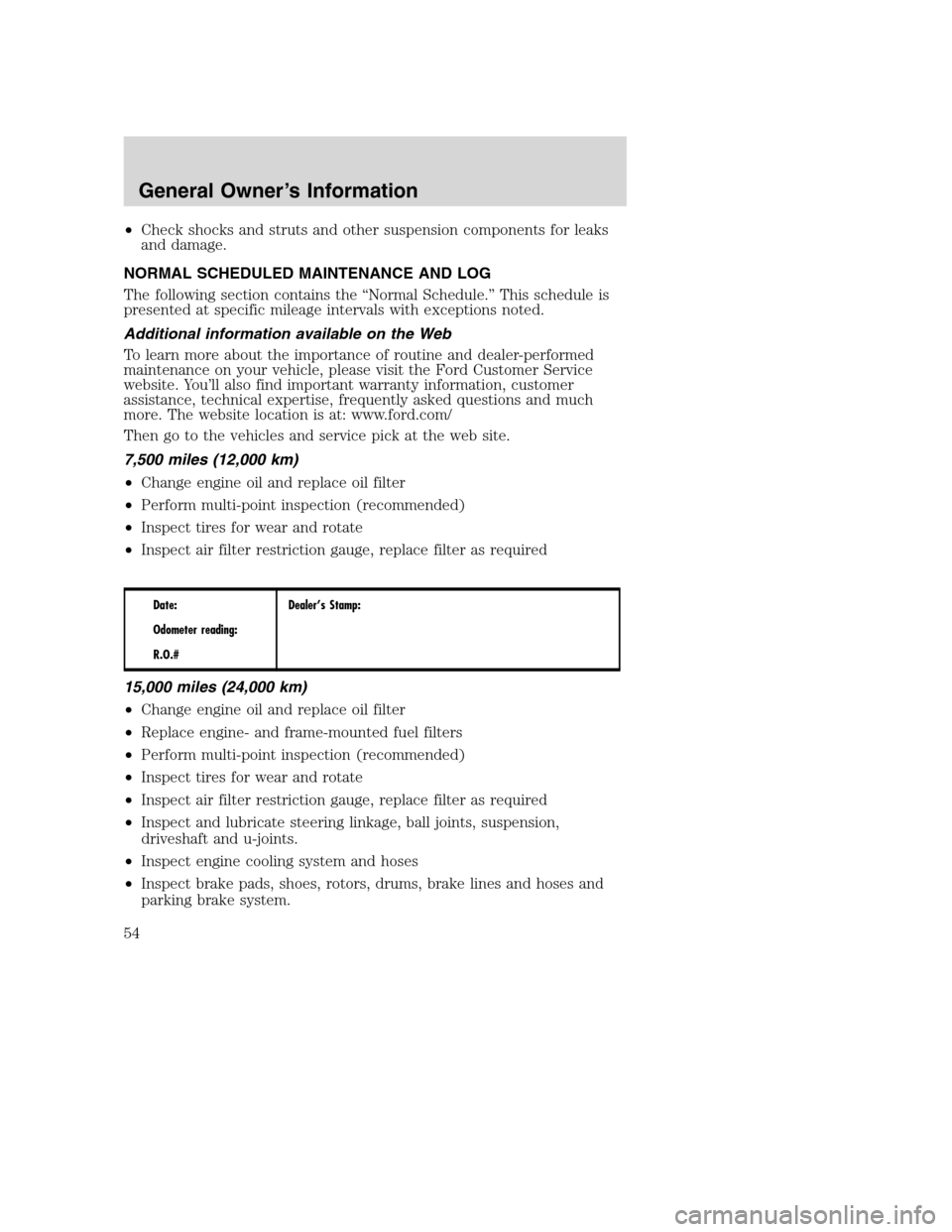
Date:
Odometer reading:
R.O.#Dealer’s Stamp:
15,000 miles (24,000 km)
•Change engine oil and replace oil filter
•Replace engine- and frame-mounted fuel filters
•Perform multi-point inspection (recommended)
•Inspect tires for wear and rotate
•Inspect air filter restriction gauge, replace filter as required
•Inspect and lubricate steering linkage, ball joints, suspension,
driveshaft and u-joints.
•Inspect engine cooling system and hoses
•Inspect brake pads, shoes, rotors, drums, brake lines and hoses and
parking brake system.
General Owner’s Information
54