2005 FORD SUPER DUTY change time
[x] Cancel search: change timePage 4 of 72
The FCM/HFCM should be drained
at regular intervals or when the
WATER IN FUEL light illuminates in
the instrument cluster.
The fuel injectors are located in the center of the combustion chambers
in the cylinder head between the rocker arm assemblies. The glow plug
system and fuel injection system are controlled through the Powertrain
Control Module (PCM) and Fuel Injection Control Module (FICM).
Fuel is drawn from the fuel tank by a frame-mounted electric fuel pump.
The fuel pump provides pressurized fuel to the engine and is
electronically controlled by the fuel pump PCM relay. The fuel pump
contains a pressure relief valve for overpressure protection in the event
of restricted flow.
Lubrication system
It is important to change the engine oil at the recommended service
intervals, because oil viscosity is important in maintaining the oil
pressure required to actuate the fuel injectors. Extended oil change
intervals can negatively affect engine performance, fuel economy and
engine life. Refer to the engine oil specification chart located under
Engine oil specificationsin theMaintenance and Specifcations
section of this supplement.
Fast start glow plug system
The glow plug system consists of:
•eight glow plugs
•the glow plug control module (GPCM)
•engine oil temperature (EOT) sensor
•barometric pressure (BARO) sensor
The glow plug system is
electronically controlled by the
PCM. The GPCM energizes the glow
plugs immediately after the ignition
is placed in the ON position, then determines how long the glow plugs
will be on according to the EOT and BARO sensors. The required time
for the glow plugs to be energized decreases as the engine oil
temperature and barometric pressure increase.
Introduction
4
Page 30 of 72
975 industry specification. Aftermarket additives can damage the injector
system or engine. Repairs to correct the effects of using an aftermarket
product in your fuel may not be covered by your warranty.
Do not blend used engine oil with diesel fuel under any
circumstances.Blending used oil with the fuel will significantly increase
your vehicle’s exhaust emissions and reduce engine life due to increased
internal wear.
Many of the world’s automakers approved the World-wide Fuel Charter
that recommends diesel fuel specifications to provide improved
performance and emission control system protection for your vehicle.
Diesel fuel that meets the World-wide Fuel Charter should be used when
available. Ask your fuel supplier about fuel that meets the World-wide
Fuel Charter.
Fueling tips
If the engine fails to start in 30 seconds, turn the key to the OFF
position and wait 30 seconds before trying again.
Truck stops have pumps and nozzles designed for larger, heavy-duty
trucks. When refueling at truck stops: if the nozzle shuts off repeatedly
when refueling, wait 5–10 seconds; then use a slower rate of flow (don’t
depress the nozzle trigger as far).
If air is allowed to enter the fuel system (during fuel filter change or if
you run out of fuel) the engine will purge the trapped air as it runs. The
engine may run rough and produce white smoke while air is in the
system. This is normal and should correct itself in a short time.
An engine that suddenly becomes noisy or operates poorly after a fuel fill
could be using substandard fuel (i.e., high water content, low cetane
rating or gasoline in the fuel). Diesel fuel should be purchased from a
reputable station which sells a large amount of diesel fuel.
Care should be taken whenever diesel fuel is stored. Use only clean,
approved containers which will prevent the entry of dirt or water.
Diesel fuel must not be stored in a galvanized container. The fuel will
dissolve the zinc in a galvanized container. The zinc will then remain in
solution until it is run through the engine where it will be deposited in
the fuel injectors causing expensive-to-repair damage.
Diesel fuel dispensing nozzle fill rate
This truck is equipped with a fuel fill pipe which is able to accept fuel up
to 20 gallons per minute from an 1 1/8 inch fuel dispensing nozzle.
Pumping fuel at greater flow rates may result in premature nozzle
shut-off or spitback.
Maintenance and Specifications
30
Page 35 of 72
2. Remove and discard the old fuel filter element.
3. Carefully clean the mating surfaces.
Installation - both
The engine will not run properly if the fuel filter is not installed
in housing.
1. Install the new fuel filter and cap seal (from Ford Part No. FD–4604)
into the fuel filter housing.
2. Tighten cap onto fuel filter housing slowly, allowing fuel to soak into
the fuel filter element. Tighten cap until it contacts the housing.
After replacing the fuel filter, the engine will purge the trapped
air as it runs. The engine may run roughly and smoke until the air
is completely eliminated.
Using a fuel which has more than average impurities may require
the fuel filter to be replaced more frequently than the service
interval specifies.
ENGINE OIL
Checking the engine oil level
Because it is normal to add some oil between oil changes, check your
engine oil level each time you stop for fuel. To check the engine oil level
consistently and accurately, the following procedure is recommended:
1. Have engine at normal operating temperature (at least into the
NORMAL range on the engine coolant temperature gauge).
2. Park the vehicle on a level surface, then turn off the engine and open
the hood.
3. Allow at least20 minutesafter engine shutdown to assure that the oil
contained in the upper parts of the engine has returned to the oil pan.
4. Protecting yourself from engine heat, pull out the dipstick, wipe it
clean and reinsert fully.
5. Read oil level on both sides of dipstick and use highest level (reading)
for the actual engine oil level.
6. Maintain the oil level between ADD and OPERATING RANGE on the
dipstick by adding oil as required. The distance from ADD to
OPERATING RANGE on the dipstick represents 1.9L (2 quarts). Do not
overfill. If the oil level exceeds OPERATING RANGE, oil consumption
may result.
Maintenance and Specifications
35
Page 37 of 72
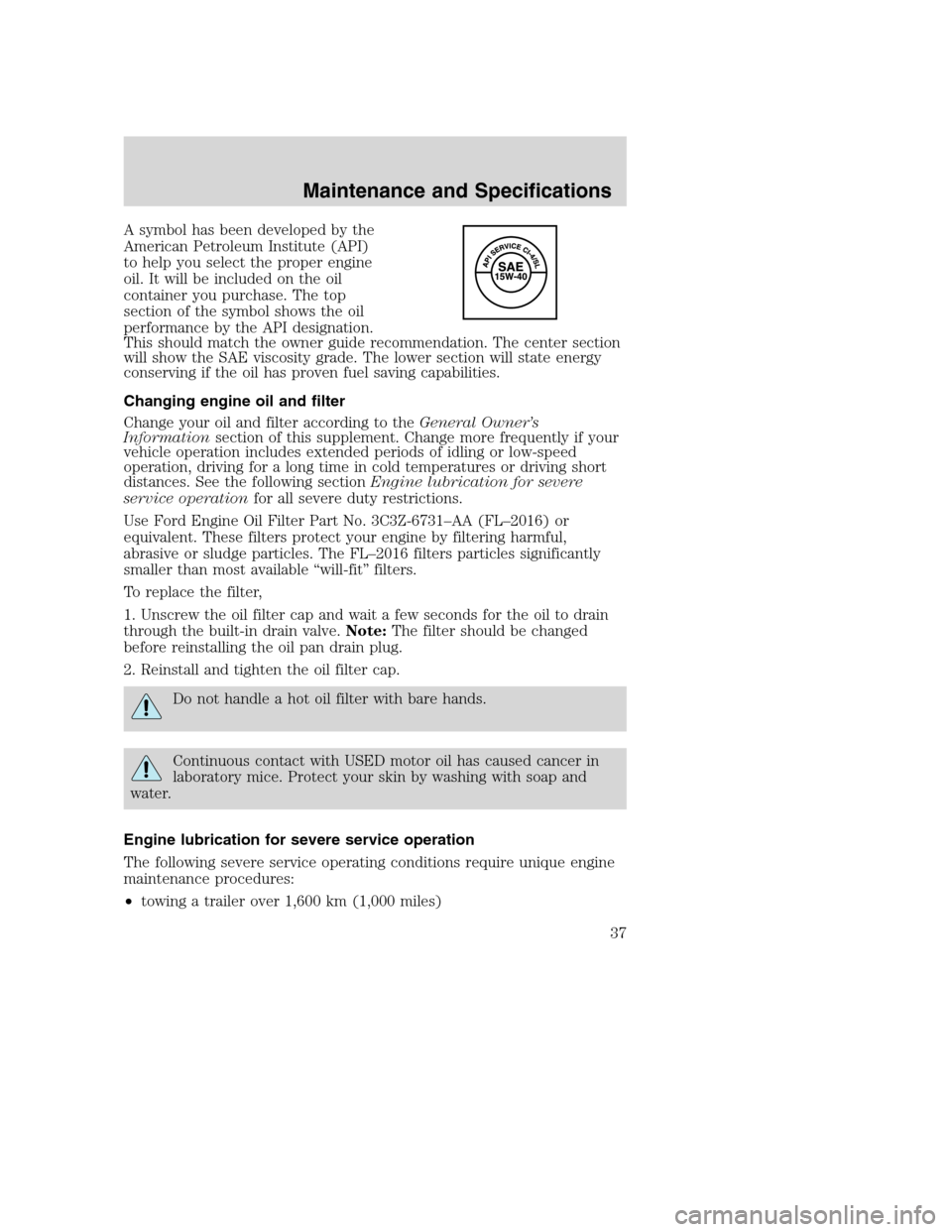
A symbol has been developed by the
American Petroleum Institute (API)
to help you select the proper engine
oil. It will be included on the oil
container you purchase. The top
section of the symbol shows the oil
performance by the API designation.
This should match the owner guide recommendation. The center section
will show the SAE viscosity grade. The lower section will state energy
conserving if the oil has proven fuel saving capabilities.
Changing engine oil and filter
Change your oil and filter according to theGeneral Owner’s
Informationsection of this supplement. Change more frequently if your
vehicle operation includes extended periods of idling or low-speed
operation, driving for a long time in cold temperatures or driving short
distances. See the following sectionEngine lubrication for severe
service operationfor all severe duty restrictions.
Use Ford Engine Oil Filter Part No. 3C3Z-6731–AA (FL–2016) or
equivalent. These filters protect your engine by filtering harmful,
abrasive or sludge particles. The FL–2016 filters particles significantly
smaller than most available“will-fit”filters.
To replace the filter,
1. Unscrew the oil filter cap and wait a few seconds for the oil to drain
through the built-in drain valve.Note:The filter should be changed
before reinstalling the oil pan drain plug.
2. Reinstall and tighten the oil filter cap.
Do not handle a hot oil filter with bare hands.
Continuous contact with USED motor oil has caused cancer in
laboratory mice. Protect your skin by washing with soap and
water.
Engine lubrication for severe service operation
The following severe service operating conditions require unique engine
maintenance procedures:
•towing a trailer over 1,600 km (1,000 miles)
Maintenance and Specifications
37
Page 45 of 72
The complexity of the diesel engine makes it so the owner is discouraged
from attempting to perform maintenance other than the services
described in this supplement.
If you experience difficult starting, rough idling, excessive exhaust
smoke, a decrease in engine performance or excess fuel consumption,
perform the following checks:
•a plugged air inlet system or engine air filter element.
•water in the fuel filter/water separator.
•a clogged fuel filter.
•contaminated fuel.
•air in the fuel system, due to loose connections.
•an open or pinched sensor hose.
•low engine oil level.
•wrong fuel or oil viscosity for climactic conditions.
If these checks do not help you correct the engine performance problem
you are experiencing, consult an authorized dealer.
FUELING
Do not use starting fluid such as ether or gasoline in the diesel
air intake system. Such fluids can cause immediate explosive
damage to the engine and possible personal injury.
If you fuel your vehicle at a truck stop, you may notice that the fuel
nozzle may shut off every 5–10 seconds. This is due to the flow rates
being designed for larger heavy duty trucks. You may have to fuel at a
slower rate (don’t depress the nozzle trigger fully).
Do not run your diesel vehicle out of fuel as this will allow air to enter
the fuel system which will make restarting difficult. Longer engine
cranking time may be required once air is in the fuel system. If air enters
the fuel system (either through running the fuel tank(s) empty or during
a fuel filter change), the engine will self-purge the trapped air once it
starts running. The engine may run roughly and produce white smoke
while air is in the fuel system; this is normal and should stop after a
short time.
MINOR TROUBLESHOOTING GUIDE
If the engine won’t crank
Turn on the headlights. If the lights are dim, do not go on at all or if
when the ignition is turned to 5 (START) the lights become dim or go
Maintenance and Specifications
45
Page 64 of 72
•Inspect air filter restriction gauge, replace filter as required
•Inspect and lubricate steering linkage, ball joints, suspension,
driveshaft and u-joints.
•Inspect engine cooling system and hoses
•Inspect brake pads, shoes, rotors, drums, brake lines and hoses and
parking brake system.
•Inspect exhaust system and heat shields
•Check wheels for end play and noise
•Inspect and lubricate 4x4 front axle u-joints
Date:
Odometer reading:
R.O.#Dealer’s Stamp:
Exceptions
In addition, there are several exceptions to the Normal Schedule. They
are listed below:
Normal vehicle axle maintenance
Rear axles and power take off (PTO) units containing synthetic lubricant
and light duty trucks equipped with Ford-design axles are lubricated for
life. These lubricants are not to be checked or changed unless a leak is
suspected, service is required or the axle assembly has been submerged
in water. The axle and PTO lubricant should be changed anytime the
axle and PTO have been submerged in water. Non-synthetic rear axle
lubricants should be replaced every 3,000 miles or 3 months, whichever
occurs first, during extended trailer tow operation above 21 Celsius (70
degrees Fahrenheit) ambient and wide open throttle for extended
periods above 45 mph. The 3,000 mile lube change interval may be
waived if the axle was filled with 75W140 synthetic gear lubricant
meeting Ford specification WSL-M2C192-A, part number F1TZ-19580-B
or equivalent. Add four ounces of additive friction modifier
C8AZ-19B546-A (EST-M2C118-A) or equivalent for complete refill of
Traction-Lok rear axles. The axle lubricant should be changed anytime
an axle has been submerged in water.
E-450, F-450 and F-550 Series axle maintenance
Replace rear axle lubricant every 100,000 miles under normal driving
conditions on all F-450 and F-550 commercial applications. For F-450
General Owner’s Information
64
Page 69 of 72
Date:
Odometer reading:
R.O.#Dealer’s Stamp:
See corresponding mileage in maintenance schedule for services performed.
Date:
Odometer reading:
R.O.#Dealer’s Stamp:
See corresponding mileage in maintenance schedule for services performed.
MAINTENANCE AND SERVICE RECORD
See an authorized dealer
This section of the guide is designed to allow your Ford or Lincoln
Mercury dealer, or Ford or Lincoln Mercury Auto Care service center or
other qualified service technician to record that the recommended
service was completed at the appropriate mileage intervals. Be sure to
ask your service provider to record the type of service rendered (Normal
or Special Operating Conditions—SOC) each time service is performed.
Date:
Odometer reading:
R.O.#Dealer’s Stamp:
See corresponding mileage in maintenance schedule for services performed.
MOTORCRAFT PREMIUM GOLD COOLANT CHANGE RECORD
Premium Gold coolant
•5 years or 100,000 miles - change Premium Gold coolant (whichever
comes first)
•After initial change - change Premium Gold coolant every 3 years or
50,000 miles
General Owner’s Information
69