2005 FORD ESCAPE brake
[x] Cancel search: brakePage 151 of 272

When climbing a steep slope or hill,
start in a lower gear rather than
downshifting to a lower gear from a
higher gear once the ascent has
started. This reduces strain on the
engine and the possibility of stalling.
If you do stall out, Do not try to
turnaround because you might roll
over. It is better to back down to a
safe location.
Apply just enough power to the wheels to climb the hill. Too much
power will cause the tires to slip, spin or lose traction, resulting in loss of
vehicle control.
Descend a hill in the same gear you
would use to climb up the hill to
avoid excessive brake application
and brake overheating. Do not
descend in neutral; instead,
disengage overdrive or manually
shift to a lower gear. When
descending a steep hill, avoid
sudden hard braking as you could
lose control. When you brake hard,
the front wheels can’t turn and if
they aren’t turning, you won’tbe
able to steer. The front wheels have to be turning in order to steer the
vehicle. Rapid pumping of the brake pedal will help you slow the vehicle
and still maintain steering control.
If your vehicle has anti-lock brakes, apply the brakes steadily. Do not
“pump”the brakes.
Driving on snow and ice
4WD vehicles have advantages over 2WD vehicles in snow and ice but
can skid like any other vehicle.
Should you start to slide while driving on snowy or icy roads, turn the
steering wheel in the direction of the slide until you regain control.
Avoid sudden applications of power and quick changes of direction on
snow and ice. Apply the accelerator slowly and steadily when starting
from a full stop.
Avoid sudden braking as well. Although a 4WD vehicle may accelerate
better than a two-wheel drive vehicle in snow and ice, it won’t stop any
2005 Escape(204)
Owners Guide (post-2002-fmt)
USA English(fus)
Driving
151
Page 152 of 272
faster, because as in other vehicles, braking occurs at all four wheels. Do
not become overconfident as to road conditions.
Make sure you allow sufficient distance between you and other vehicles
for stopping. Drive slower than usual and consider using one of the lower
gears. In emergency stopping situations, avoid locking of the wheels. Use
a“squeeze”technique, push on the brake pedal with a steadily increasing
force which allows the wheels to brake yet continue to roll so that you
may steer in the direction you want to travel. If you lock the wheels,
release the brake pedal and repeat the squeeze technique. If your vehicle
is equipped with a Four Wheel Anti-Lock Brake System (ABS), apply the
brake steadily. Do not“pump”the brakes. Refer to theBrakessection of
this chapter for additional information on the operation of the anti-lock
brake system.
Never drive with chains on the front tires of 4WD vehicles without also
putting them on the rear tires. This could cause the rear to slide and
swing around during braking.
Tires, Replacement Requirements
Do not use a size and type of tire and wheel other than that
originally provided by Ford Motor Company because it can affect
the safety and performance of your vehicle, which could result in an
increased risk of loss of vehicle control, vehicle rollover and/or serious
personal injury or death.
Do not use a size and type of tire and wheel other than that originally
provided by Ford Motor Company because it can affect the safety and
performance of your vehicle, which could lead to loss of vehicle control
or rollover and serious injury. Make sure all tires and wheels on the
vehicle are of the same size, type, tread design and load-carrying
capacity. If you have questions regarding tire replacement, see an
authorized Ford or Lincoln/Mercury dealer.
If you nevertheless decide to equip your 4WD for off-road use with tires
larger than what Ford Motor Company recommends, you should not use
these tires for highway driving.
If you use any tire/wheel combination not recommended by Ford Motor
Company, it may adversely affect vehicle handling and could cause
steering, suspension, axle or transfer case failure as well as the increased
risk of loss of vehicle control.
Do not use“aftermarket lift kits”or other suspension modifications,
whether or not they are used with larger tires and wheels.
2005 Escape(204)
Owners Guide (post-2002-fmt)
USA English(fus)
Driving
152
Page 156 of 272

DRIVING THROUGH WATER
If driving through deep or standing water is unavoidable, proceed very
slowly especially if the depth is not known. Never drive through water
that is higher than the bottom of the hubs (for trucks) or the bottom of
the wheel rims (for cars). Traction or brake capability may be limited
and your vehicle may stall. Water may also enter your engine’s air intake
and severely damage your engine.
Once through the water, always dry the brakes by moving your vehicle
slowly while applying light pressure on the brake pedal. Wet brakes do
not stop the vehicle as quickly as dry brakes.Driving through deep
water where the transaxle is submerged may allow water into the
transaxle and cause internal damage. Have the fluid checked and,
if water is found, replace the fluid.
VEHICLE LOADING–WITH AND WITHOUT A TRAILER
This section will guide you in the proper loading of your vehicle and/or
trailer, to keep your loaded vehicle weight within its design rating
capability, with or without a trailer. Properly loading your vehicle will
provide maximum return of vehicle design performance. Before loading
your vehicle, familiarize yourself with the following terms for determining
your vehicle’s weight ratings, with or without a trailer, from the vehicle’s
Safety Certification Label and Tire Label:
Base Curb Weight–is the weight of the vehicle including a full tank of
fuel and all standard equipment. It does not include passengers, cargo, or
optional equipment.
Vehicle Curb Weight–is the weight of your new vehicle when you
picked it up from your dealer plus any aftermarket equipment.
2005 Escape(204)
Owners Guide (post-2002-fmt)
USA English(fus)
Driving
156
Page 160 of 272
GCWR (Gross Combined Weight Rating)–is the maximum allowable
weight of the vehicle and the loaded trailer–including all cargo and
passengers–that the vehicle can handle without risking damage.
(Important: The towing vehicle’s braking system is rated for operation at
GVWR, not at GCWR. Separate functional brakes should be used for safe
control of towed vehicles and for trailers where the GCW of the towing
vehicle plus the trailer exceed the GVWR of the towing vehicle.The
GCW must never exceed the GCWR.
Maximum Loaded Trailer Weight–is the highest possible weight of a
fully loaded trailer the vehicle can tow. It assumes a vehicle with only
mandatory options, no cargo (internal or external), a tongue load of
10–15% (conventional trailer) or king pin weight of 15–25% (fifth wheel
trailer), and driver only (68 kg [150 lbs]).Consult your dealership (or
theRV and Trailer Towing Guideprovided by your dealership) for
more detailed information.
Tongue Load or Fifth Wheel King Pin Weight–refers to the amount
of the weight that a trailer pushes down on a trailer hitch.
Examples:For a 2268 kg (5000 lbs.) conventional trailer, multiply 5000
by 0.10 and 0.15 to obtain a proper tongue load range of 227 to 340 kg
(500 to 750 lbs.). For an 5216 kg (11,500 lbs.) fifth wheel trailer,
multiply by 0.15 and 0.25 to obtain a proper king pin load range of 782
to 1304 kg (1,725 to 2,875 lbs.)
Do not exceed the GVWR or the GAWR specified on the
certification label.
Do not use replacement tires with lower load carrying capacities
than the originals because they may lower the vehicle’s GVWR
and GAWR limitations. Replacement tires with a higher limit than the
originals do not increase the GVWR and GAWR limitations.
Exceeding any vehicle weight rating limitation could result in
serious damage to the vehicle and/or personal injury.
Steps for determining the correct load limit:
1. Locate the statement“The combined weight of occupants and cargo
should never exceed XXX pounds”on your vehicle’s label.
2. Determine the combined weight of the driver and passengers that will
be riding in your vehicle.
2005 Escape(204)
Owners Guide (post-2002-fmt)
USA English(fus)
Driving
160
Page 162 of 272
TRAILER TOWING
Trailer towing with your vehicle may require the use of a trailer tow
option package.
Trailer towing puts additional loads on your vehicle’s engine, transaxle,
axle, brakes, tires, and suspension. For your safety and to maximize
vehicle performance, be sure to use the proper equipment while towing.
Follow these guidelines to ensure safe towing procedure:
•Stay within your vehicle’s load limits.
•Thoroughly prepare your vehicle for towing. Refer toPreparing to
towin this chapter.
•Use extra caution when driving while trailer towing. Refer toDriving
while you towin this chapter.
•Service your vehicle more frequently if you tow a trailer. Refer to the
severe duty schedule in the scheduled maintenance guide.
•Do not tow a trailer until your vehicle has been driven at least 800 km
(500 miles).
•Refer to the instructions included with towing accessories for the
proper installation and adjustment specifications.
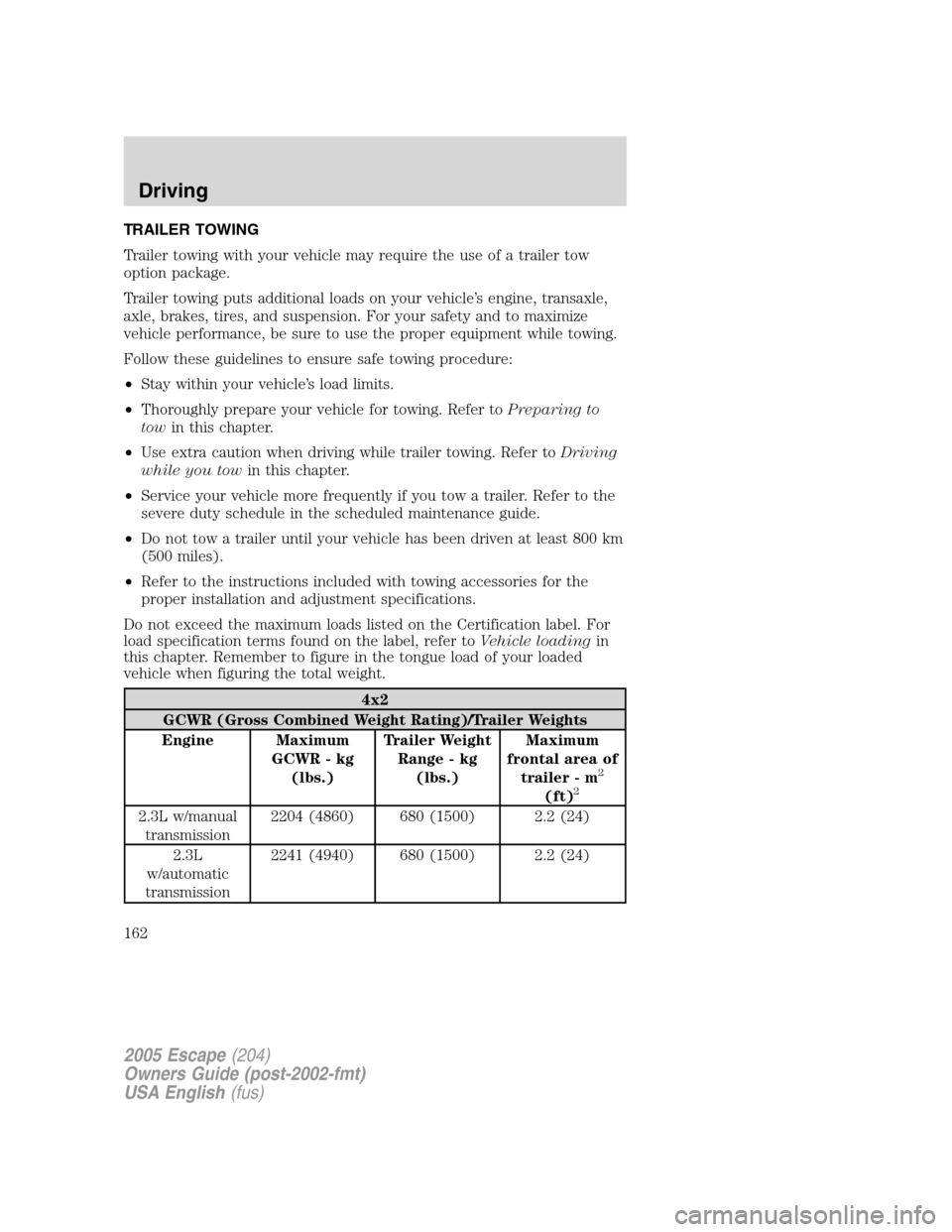
Do not exceed the maximum loads listed on the Certification label. For
load specification terms found on the label, refer toVehicle loadingin
this chapter. Remember to figure in the tongue load of your loaded
vehicle when figuring the total weight.
4x2
GCWR (Gross Combined Weight Rating)/Trailer Weights
Engine Maximum
GCWR - kg
(lbs.)Trailer Weight
Range - kg
(lbs.)Maximum
frontal area of
trailer - m
2
(ft)2
2.3L w/manual
transmission2204 (4860) 680 (1500) 2.2 (24)
2.3L
w/automatic
transmission2241 (4940) 680 (1500) 2.2 (24)
2005 Escape(204)
Owners Guide (post-2002-fmt)
USA English(fus)
Driving
162
Page 163 of 272
4x2
GCWR (Gross Combined Weight Rating)/Trailer Weights
3.0L
w/automatic
transmission2495 (5500) 907 (2000) 2.2 (24)
3.0L
w/automatic
transmission and
towing package3211 (7080) 1587 (3500) 2.8 (30)
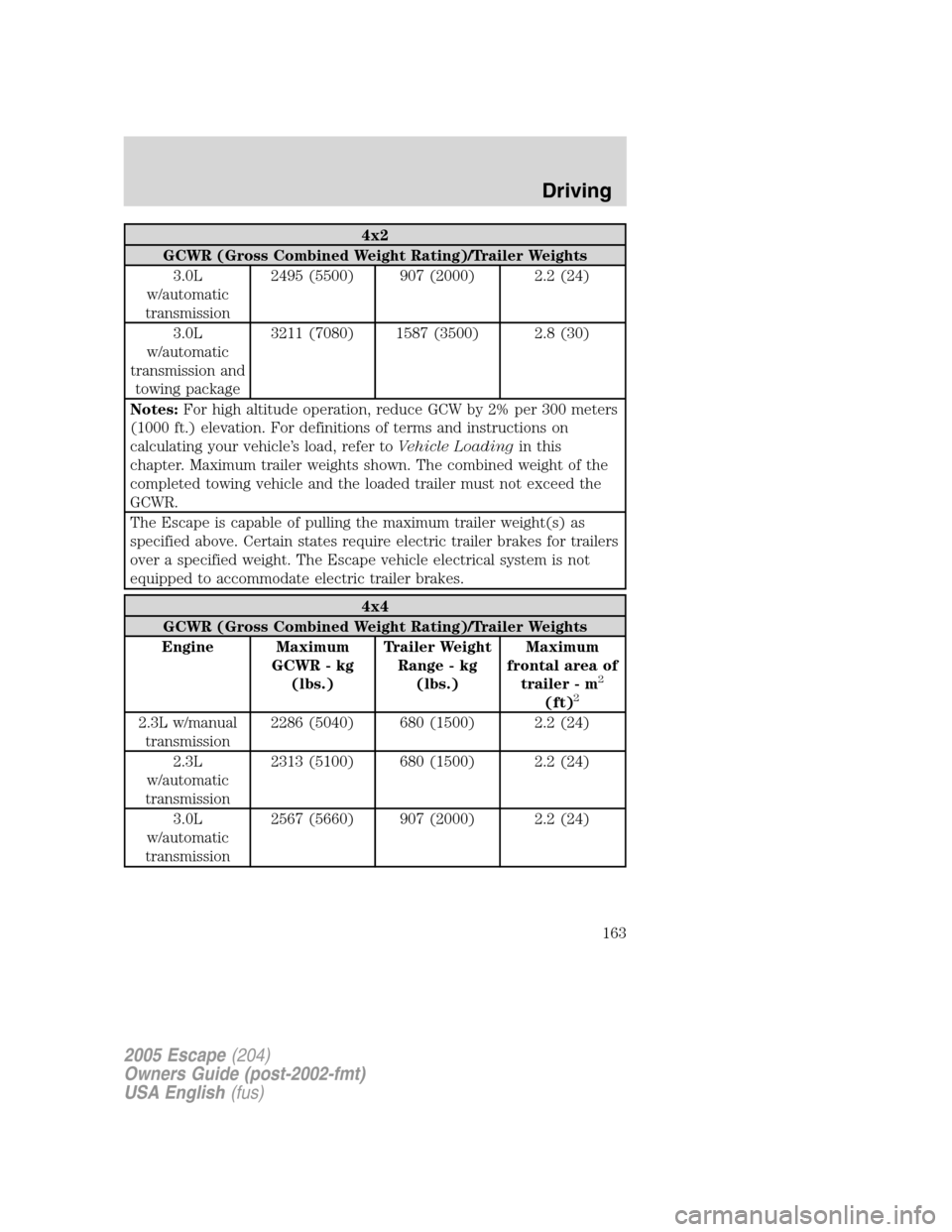
Notes:For high altitude operation, reduce GCW by 2% per 300 meters
(1000 ft.) elevation. For definitions of terms and instructions on
calculating your vehicle’s load, refer toVehicle Loadingin this
chapter. Maximum trailer weights shown. The combined weight of the
completed towing vehicle and the loaded trailer must not exceed the
GCWR.
The Escape is capable of pulling the maximum trailer weight(s) as
specified above. Certain states require electric trailer brakes for trailers
over a specified weight. The Escape vehicle electrical system is not
equipped to accommodate electric trailer brakes.
4x4
GCWR (Gross Combined Weight Rating)/Trailer Weights
Engine Maximum
GCWR - kg
(lbs.)Trailer Weight
Range - kg
(lbs.)Maximum
frontal area of
trailer - m
2
(ft)2
2.3L w/manual
transmission2286 (5040) 680 (1500) 2.2 (24)
2.3L
w/automatic
transmission2313 (5100) 680 (1500) 2.2 (24)
3.0L
w/automatic
transmission2567 (5660) 907 (2000) 2.2 (24)
2005 Escape(204)
Owners Guide (post-2002-fmt)
USA English(fus)
Driving
163
Page 164 of 272
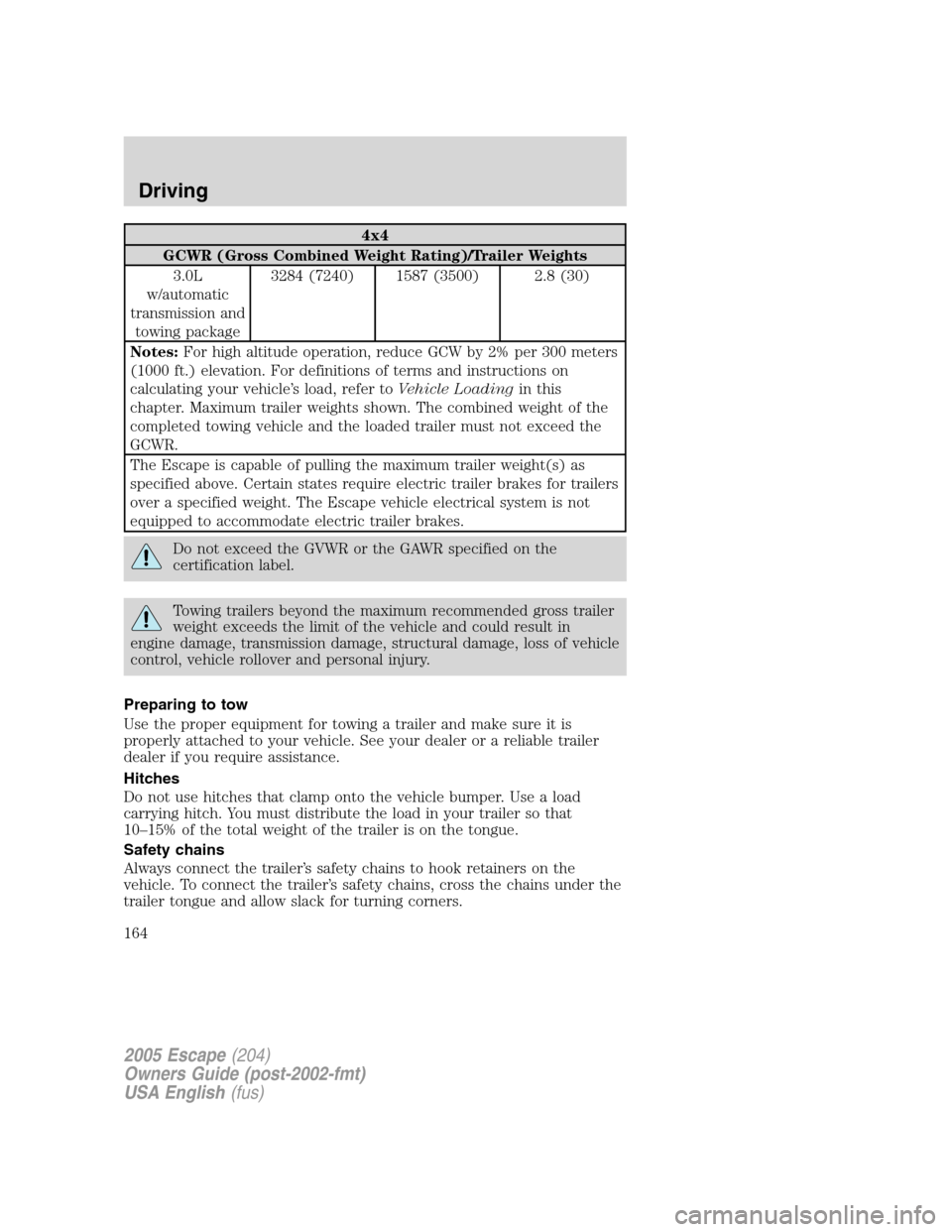
4x4
GCWR (Gross Combined Weight Rating)/Trailer Weights
3.0L
w/automatic
transmission and
towing package3284 (7240) 1587 (3500) 2.8 (30)
Notes:For high altitude operation, reduce GCW by 2% per 300 meters
(1000 ft.) elevation. For definitions of terms and instructions on
calculating your vehicle’s load, refer toVehicle Loadingin this
chapter. Maximum trailer weights shown. The combined weight of the
completed towing vehicle and the loaded trailer must not exceed the
GCWR.
The Escape is capable of pulling the maximum trailer weight(s) as
specified above. Certain states require electric trailer brakes for trailers
over a specified weight. The Escape vehicle electrical system is not
equipped to accommodate electric trailer brakes.
Do not exceed the GVWR or the GAWR specified on the
certification label.
Towing trailers beyond the maximum recommended gross trailer
weight exceeds the limit of the vehicle and could result in
engine damage, transmission damage, structural damage, loss of vehicle
control, vehicle rollover and personal injury.
Preparing to tow
Use the proper equipment for towing a trailer and make sure it is
properly attached to your vehicle. See your dealer or a reliable trailer
dealer if you require assistance.
Hitches
Do not use hitches that clamp onto the vehicle bumper. Use a load
carrying hitch. You must distribute the load in your trailer so that
10–15% of the total weight of the trailer is on the tongue.
Safety chains
Always connect the trailer’s safety chains to hook retainers on the
vehicle. To connect the trailer’s safety chains, cross the chains under the
trailer tongue and allow slack for turning corners.
2005 Escape(204)
Owners Guide (post-2002-fmt)
USA English(fus)
Driving
164
Page 165 of 272
If you use a rental trailer, follow the instructions that the rental agency
gives to you.
Do not attach safety chains to the bumper.
Trailer brakes
Electric, manual, automatic or surge-type brakes, if compatible with the
vehicle, are safe if installed properly and adjusted to the manufacturer’s
specifications. The trailer brakes must meet local and Federal
regulations.
Do not connect a trailer’s hydraulic brake system directly to your
vehicle’s brake system. Your vehicle may not have enough
braking power and your chances of having a collision greatly increase.
The braking system of the tow vehicle is rated for operation at the
GVWR not GCWR.
Trailer lamps
Trailer lamps are required on most towed vehicles. Make sure all running
lights, brake lights, turn signals and hazard lights are working. See your
dealer or trailer rental agency for proper instructions and equipment for
hooking up trailer lamps.
Driving while you tow
When towing a trailer:
•Turn off the speed control. The speed control may shut off
automatically when you are towing on long, steep grades.
•Consult your local motor vehicle speed regulations for towing a trailer.
•To eliminate excessive shifting, use a lower gear. This will also assist
in transmission cooling. (For additional information, refer to the
Understanding the positions of the 4–speed automatic
transmissionsection in this chapter.
•Anticipate stops and brake gradually.
•Do not exceed the GCWR rating or transmission damage may occur.
Servicing after towing
If you tow a trailer for long distances, your vehicle will require more
frequent service intervals. Refer to your Scheduled Maintenance Guide
for more information.
2005 Escape(204)
Owners Guide (post-2002-fmt)
USA English(fus)
Driving
165