Page 209 of 374
Towing
Towing Your Vehicle
Consult your dealer or a professional towing service if
you need to have your disabled vehicle towed. See
Roadside Assistance Program on page 7-5.
Releasing Air-Operated Parking Brakes
If your vehicle has air brakes, you could have a
special towing problem. If your vehicle has to be towed
because of a complete loss of air pressure from
both systems, the parking brakes will have automatically
engaged. The tow operator can release the brakes
manually by using the following steps. Then your vehicle
can be towed with all wheels or only the rear wheels
on the ground.
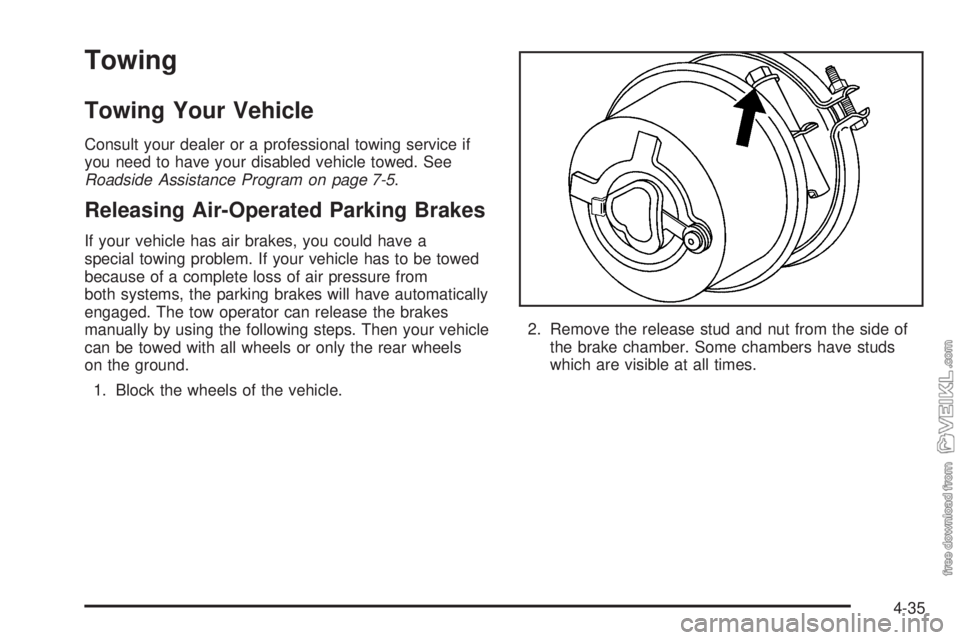
1. Block the wheels of the vehicle.2. Remove the release stud and nut from the side of
the brake chamber. Some chambers have studs
which are visible at all times.
4-35
Page 210 of 374
3. Remove the rubber
cap from the rear of
the chamber.
4. Put the release stud, nut and flat washer into
the chamber.
5. Turn the stud clockwise a quarter of a turn.6. Turn the stud nut
clockwise several turns
to release the brakes.
Follow the same
procedure to release
the other brake
or brakes.
7. At the repair facility, apply air pressure of at least
70 psi (480 kPa) to the brake chambers, either
from an external air supply or the vehicle’s
air system.
8. Turn the stud nut counterclockwise several turns.
Remove the stud from the chamber.
9. Replace the stud and washer and tighten the nut
into the side of the chamber.
10. Replace the rubber cap.
4-36
Page 214 of 374

Other Service Items........................................5-66
Fuel Filter....................................................5-66
Primary Fuel Filter and Water Separator..........5-67
Secondary Fuel Filter and Water Separator/
Heater (Caterpillar
®Diesel)..........................5-68
Automatic Ether Injection System
(Caterpillar
®Diesel)....................................5-68
Front Wheel Bearings with Oil-Filled Hubs........5-69
Air Conditioning System.................................5-70
Tires..............................................................5-70
Inflation - Tire Pressure.................................5-71
Wheel Loading.............................................5-71
Dual Tire Operation.......................................5-72
When It Is Time for New Tires.......................5-72
Wheel Alignment and Tire Balance..................5-73
Tightening the Wheel Nuts.............................5-73
Wheel Replacement......................................5-77
If a Tire Goes Flat........................................5-78
Appearance Care............................................5-79
Cleaning the Inside of Your Vehicle.................5-80
Fabric/Carpet...............................................5-81
Instrument Panel, Vinyl, and Other
Plastic Surfaces........................................5-82
Care of Safety Belts......................................5-82
Weatherstrips...............................................5-82Washing Your Vehicle...................................5-83
Cleaning Exterior Lamps/Lenses.....................5-83
Finish Care..................................................5-83
Windshield and Wiper Blades.........................5-84
Aluminum or Chrome-Plated Wheels................5-84
Tires...........................................................5-85
Sheet Metal Damage.....................................5-85
Finish Damage.............................................5-85
Underbody Maintenance................................5-85
Chemical Paint Spotting.................................5-85
Vehicle Identication......................................5-87
Vehicle Identification Number (VIN).................5-87
Service Statement.........................................5-87
Service Parts Identification Label.....................5-88
Electrical System............................................5-88
Add-On Electrical Equipment..........................5-88
Headlamp Wiring..........................................5-88
Windshield Wiper Fuses................................5-88
Fusible Links................................................5-89
Power Windows and Other Power Options.......5-89
Fuses and Circuit Breakers............................5-89
Instrument Panel Fuse Block..........................5-89
Underhood Fuse Block..................................5-92
Capacities and Specications..........................5-95
Normal Maintenance Replacement Parts.........5-100
Section 5 Service and Appearance Care
5-2
Page 225 of 374
Priming the 6.6L DURAMAX®Diesel
Engine
If your vehicle is equipped with the 6.6L DURAMAX®
diesel engine, it has a priming pump which is part of the
engine mounted fuel filter. The vent valve and the
fuel filter primer pump are located on top of the fuel filter
housing. The priming pump is hand operated and is
designed to bring fuel to the engine to eliminate any air
that may be in the fuel lines.
To prime the 6.6L DURAMAX
®diesel engine,
do the following:
1. Make sure there is fuel in the tank.
2. Make sure the fuel filter had been installed and
properly tightened.
3. Make sure the fuel lines are properly connected
and the fuel filter is cool enough to touch.4. Remove any dirt from the fuel filter head and vent
valve by wiping with a cloth.
5. Open the fuel filter vent
valve by turning the
screw counterclockwise
several full turns.
5-13
Page 227 of 374

6. Use the palm of your hand to repeatedly press and
release the plunger (1) at the top of the fuel filter
priming pump. Continue until the plunger resistance
becomes firm. This may take from 20 to 100 times,
depending upon fuel tank location.
7. Turn the fuel filter breather valve screw (2)
counterclockwise several turns to open the
breather valve.
8. Use the palm of your hand to repeatedly press and
release the plunger (1) at the top of the fuel filter
priming pump until fuel begins to seep from
the breather valve.
9. Tighten the fuel filter breather screw (2) to the
specified torque, 4.9Y(43 in. lbs).
10. Use the palm of your hand to press and release the
plunger (1) at the top of the fuel filter priming pump
about 20 more times. This sends fuel to the engine.
11. Use a clean cloth to remove any fuel from the fuel
filter and surrounding area.
12. Start the engine and allow it to idle for a few minutes.
13. Check the fuel filter for leakage.Running Out of Fuel
If the diesel engine stalls and you think that you have
run out of fuel, do this to restart your engine:
{CAUTION:
Diesel fuel is ammable. It could start a re if
it gets on hot engine parts. You could be
burned. Do not let too much fuel ow from the
air bleed valve, and wipe up any spilled fuel
with a cloth.
1. If you are parked on a level surface, add at least
2 gallons (7.6 liters) of fuel. However, if you are
parked on a slope, you may need to add up
to 5 gallons (18.9 liters) of fuel.
2. Follow the fuel priming procedure earlier in this
section to prime the fuel filter.
3. Close the air bleed valve.
4. Turn the ignition key to START for 10 to 15 seconds
at a time until your engine starts. If the engine tries
to run, but does not run smoothly, increase the
rpm a little using the accelerator pedal. This will help
force air through the system.
5-15
Page 229 of 374

3. Remove the filter element. If there is any dirt on the
filter sealing surface, clean it off. Remove and
reuse the water sensor float switch located on the
bottom of the fuel filter.
4. Install the new filter element.
5. Reinstall and tighten the filter container and
reconnect the water sensor wire to the filter.
6. Use the fuel filter priming procedure earlier in this
section to prime the fuel filter.
7. Tighten the air bleed valve by turning it clockwise
until hand-tight.
8. Start your engine and let it idle for five minutes.
Check your fuel filter and air bleed valve for leaks.Fuels in Foreign Countries
If you plan on driving in another country outside the
United States or Canada, the proper fuel may be
hard to find. Never use leaded gasoline or any other
fuel not recommended in the previous text on fuel.
Costly repairs caused by use of improper fuel wouldn’t
be covered by your warranty.
To check on fuel availability, ask an auto club, or
contact a major oil company that does business in the
country where you’ll be driving.
5-17
Page 230 of 374
Filling the Tank
{CAUTION:
Fuel vapor is highly ammable. It burns
violently, and that can cause very bad injuries.
Do not smoke if you are near fuel or refueling
your vehicle. Keep sparks, ames and smoking
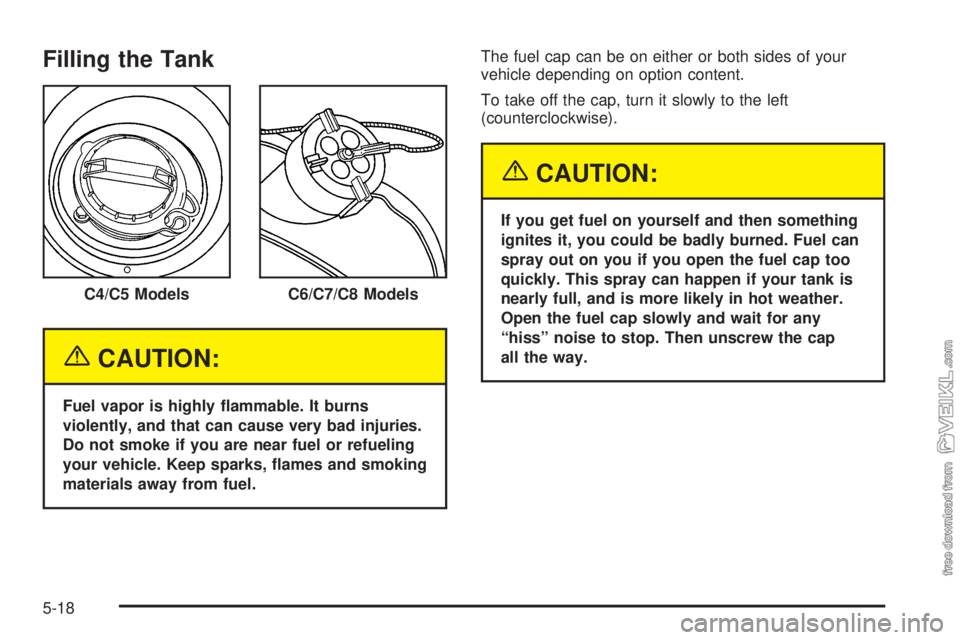
materials away from fuel.The fuel cap can be on either or both sides of your
vehicle depending on option content.
To take off the cap, turn it slowly to the left
(counterclockwise).
{CAUTION:
If you get fuel on yourself and then something
ignites it, you could be badly burned. Fuel can
spray out on you if you open the fuel cap too
quickly. This spray can happen if your tank is
nearly full, and is more likely in hot weather.
Open the fuel cap slowly and wait for any
“hiss” noise to stop. Then unscrew the cap
all the way. C4/C5 Models
C6/C7/C8 Models
5-18
Page 231 of 374

When you put the cap back on, turn it to the right
(clockwise) until it is tight.
Notice:If you need a new fuel cap, be sure to get
the right type. Your dealer can get one for you.
If you get the wrong type, it may not t properly.
This may cause your malfunction indicator lamp to
light and may damage your fuel tank and emissions
system. SeeMalfunction Indicator Lamp on
page 3-36.
If you have dual tanks, fill the driver’s side tank, or
forward tank, first. The fuel gage will give better
readings this way. Your gage will show the total fuel
left in both tanks.Filling a Portable Fuel Container
{CAUTION:
Never ll a portable fuel container while it is in
your vehicle. Static electricity discharge from
the container can ignite the gasoline vapor.
You can be badly burned and your vehicle
damaged if this occurs. To help avoid injury to
you and others:
Dispense gasoline only into approved
containers.
Do not ll a container while it is inside a
vehicle, in a vehicle’s trunk, pickup bed, or
on any surface other than the ground.
Bring the ll nozzle in contact with the
inside of the ll opening before operating
the nozzle. Contact should be maintained
until the lling is complete.
Do not smoke while pumping gasoline.
5-19