Page 309 of 491
7-40
Starting and operating
"
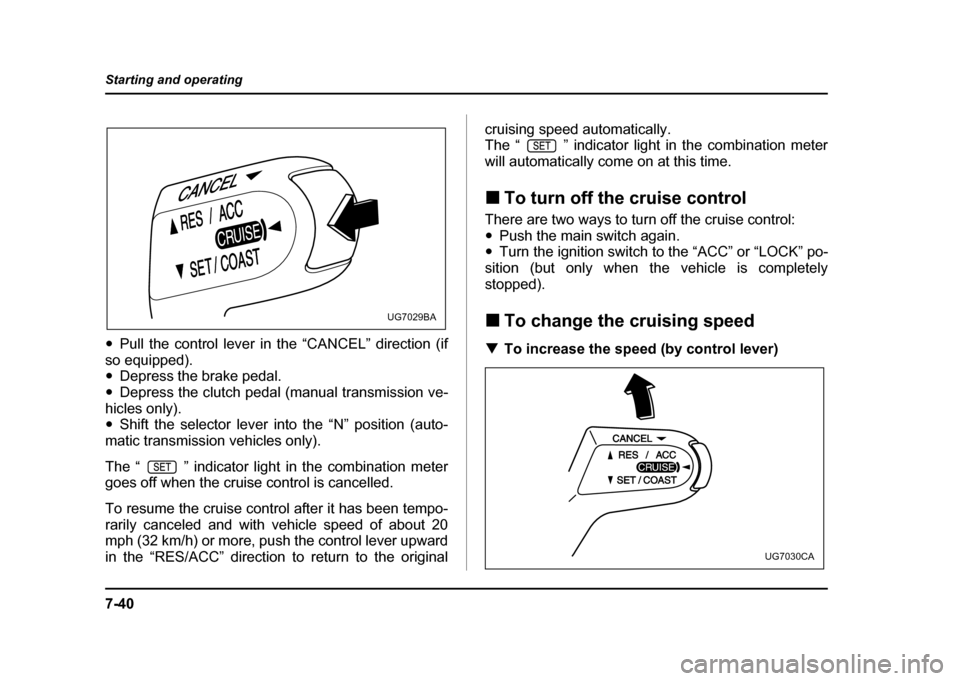
Pull the control lever in the “CANCEL” direction (if
so equipped). " Depress the brake pedal.
" Depress the clutch pedal (manual transmission ve-
hicles only)." Shift the selector lever into the “N” position (auto-
matic transmission vehicles only).
The “ ” indicator light in the combination meter
goes off when the cruise control is cancelled.
To resume the cruise control after it has been tempo-
rarily canceled and with vehicle speed of about 20
mph (32 km/h) or more, push the control lever upward
in the “RES/ACC” direction to return to the original cruising speed automatically.
The “ ” indicator light in the combination meter
will automatically come on at this time. !
To turn off the cruise control
There are two ways to turn off the cruise control: " Push the main switch again.
" Turn the ignition switch to the “ACC” or “LOCK” po-
sition (but only when the vehicle is completely
stopped). ! To change the cruising speed
! To increase the speed (by control lever)
UG7029BA
UG7030CA
Page 316 of 491
8-5
Driving tips
– CONTINUED –
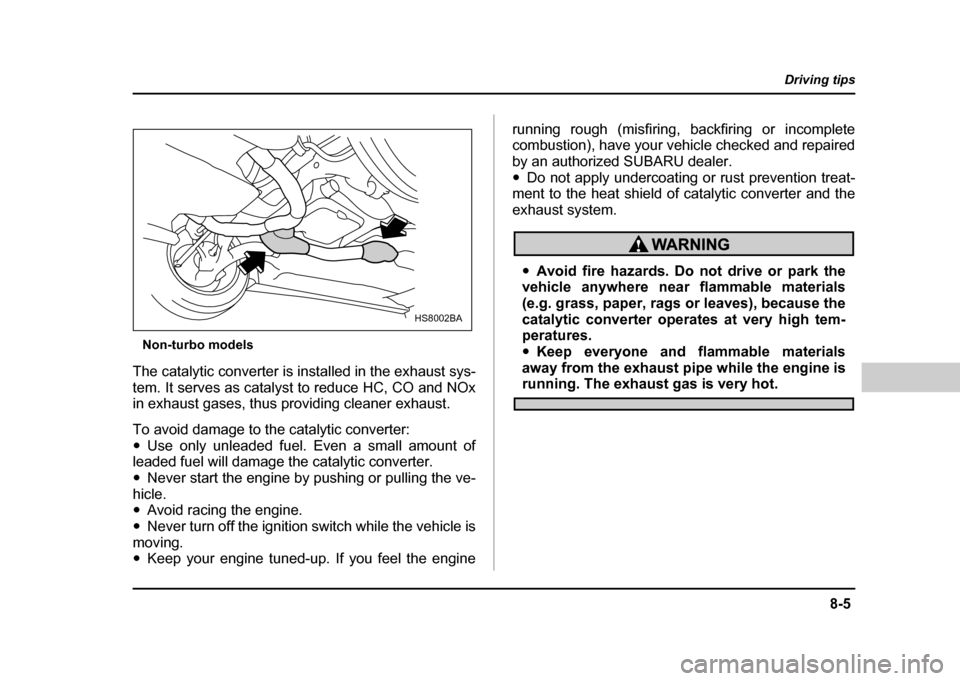
Non-turbo models
The catalytic converter is installed in the exhaust sys-
tem. It serves as catalyst to reduce HC, CO and NOx
in exhaust gases, thus providing cleaner exhaust.
To avoid damage to the catalytic converter: " Use only unleaded fuel. Even a small amount of
leaded fuel will damage the catalytic converter." Never start the engine by pushing or pulling the ve-
hicle. " Avoid racing the engine.
" Never turn off the ignition switch while the vehicle is
moving." Keep your engine tuned-up. If you feel the engine running rough (misfiring, backfiring or incomplete
combustion), have your vehicle checked and repaired
by an authorized SUBARU dealer."
Do not apply undercoating or rust prevention treat-
ment to the heat shield of catalytic converter and the
exhaust system.
" Avoid fire hazards. Do not drive or park the
vehicle anywhere near flammable materials
(e.g. grass, paper, rags or leaves), because the
catalytic converter operates at very high tem-
peratures. " Keep everyone and flammable materials
away from the exhaust pipe while the engine is
running. The exhaust gas is very hot.
HS8002BA
Page 350 of 491
8-39
Driving tips
– CONTINUED –
tance is required because of the added weight and
length caused by attaching the trailer to your vehicle.
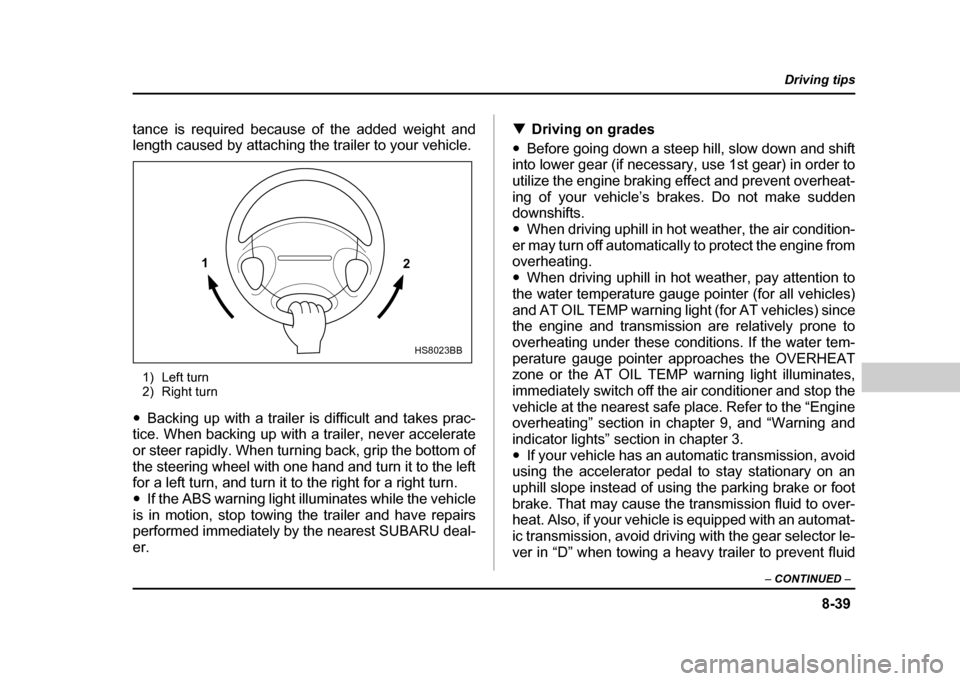
1) Left turn
2) Right turn
" Backing up with a trailer is difficult and takes prac-
tice. When backing up with a trailer, never accelerate
or steer rapidly. When turning back, grip the bottom of
the steering wheel with one hand and turn it to the left
for a left turn, and turn it to the right for a right turn." If the ABS warning light illuminates while the vehicle
is in motion, stop towing the trailer and have repairs
performed immediately by the nearest SUBARU deal-er. !
Driving on grades
" Before going down a steep hill, slow down and shift
into lower gear (if necessary, use 1st gear) in order to
utilize the engine braking effect and prevent overheat-
ing of your vehicle’s brakes. Do not make sudden
downshifts. " When driving uphill in hot weather, the air condition-
er may turn off automatically to protect the engine from
overheating. " When driving uphill in hot weather, pay attention to
the water temperature gauge pointer (for all vehicles)
and AT OIL TEMP warning light (for AT vehicles) since
the engine and transmission are relatively prone to
overheating under these conditions. If the water tem-
perature gauge pointer approaches the OVERHEAT
zone or the AT OIL TEMP warning light illuminates,
immediately switch off the air conditioner and stop the
vehicle at the nearest safe place. Refer to the “Engine
overheating” section in chapter 9, and “Warning and
indicator lights” section in chapter 3." If your vehicle has an automatic transmission, avoid
using the accelerator pedal to stay stationary on an
uphill slope instead of using the parking brake or foot
brake. That may cause the transmission fluid to over-
heat. Also, if your vehicle is equipped with an automat-
ic transmission, avoid driving with the gear selector le-
ver in “D” when towing a heavy trailer to prevent fluid
1 2
HS8023BB
Page 353 of 491
9-2
In case of emergency
In case of emergencyIf you park your vehicle in case of an
emergency
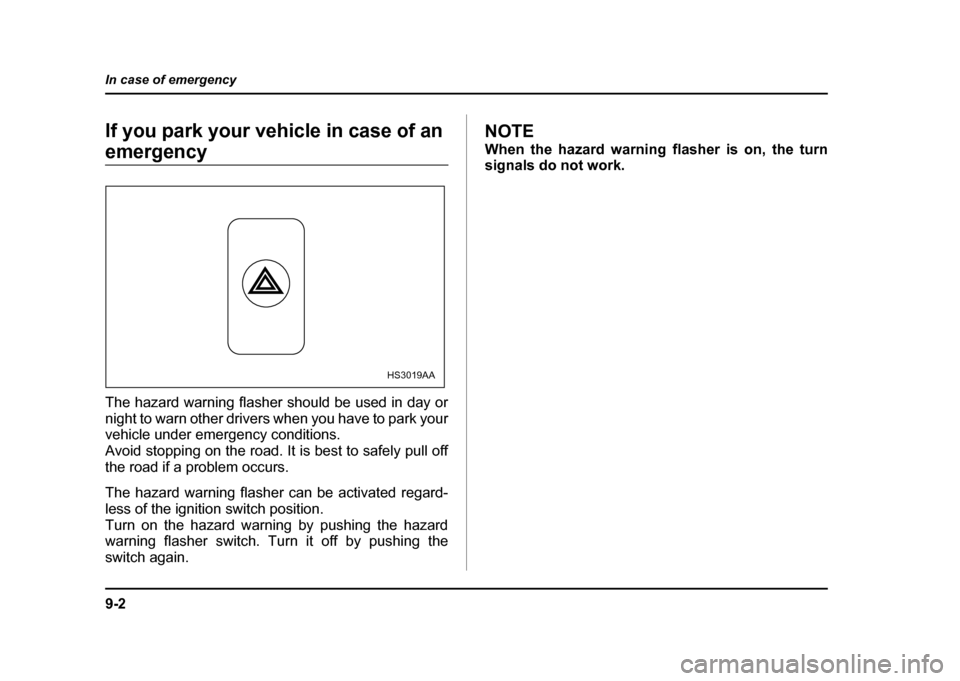
The hazard warning flasher should be used in day or
night to warn other drivers when you have to park your
vehicle under emergency conditions.
Avoid stopping on the road. It is best to safely pull off
the road if a problem occurs.
The hazard warning flasher can be activated regard-
less of the ignition switch position.
Turn on the hazard warning by pushing the hazard
warning flasher switch. Turn it off by pushing the
switch again.
NOTE
When the hazard warning flasher is on, the turn
signals do not work.
HS3019AA
Page 372 of 491
9-21
In case of emergency
– CONTINUED –
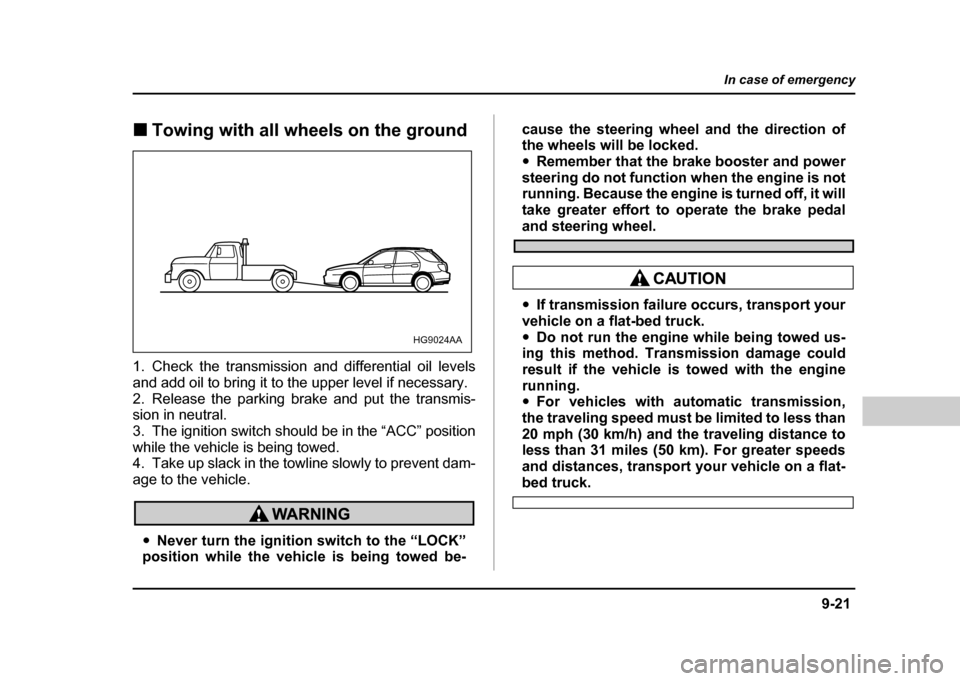
!Towing with all wheels on the ground
1. Check the transmission and differential oil levels
and add oil to bring it to the upper level if necessary.
2. Release the parking brake and put the transmis-
sion in neutral.
3. The ignition switch should be in the “ACC” position
while the vehicle is being towed.
4. Take up slack in the towline slowly to prevent dam-
age to the vehicle.
" Never turn the ignition switch to the “LOCK”
position while the vehicle is being towed be- cause the steering wheel and the direction of
the wheels will be locked. "
Remember that the brake booster and power
steering do not function when the engine is not
running. Because the engine is turned off, it will
take greater effort to operate the brake pedal
and steering wheel.
" If transmission failure occurs, transport your
vehicle on a flat-bed truck. " Do not run the engine while being towed us-
ing this method. Transmission damage could
result if the vehicle is towed with the engine
running. " For vehicles with automatic transmission,
the traveling speed must be limited to less than
20 mph (30 km/h) and the traveling distance to
less than 31 miles (50 km). For greater speeds
and distances, transport your vehicle on a flat-
bed truck.
HG9024AA
Page 373 of 491
9-22
In case of emergency
Rear gate – if the rear gate cannot be
unlocked
In the event that you cannot unlock the rear gate by
operating the power door locking switches or the re-
mote keyless entry system, you can unlock it from in-
side the cargo area.
0
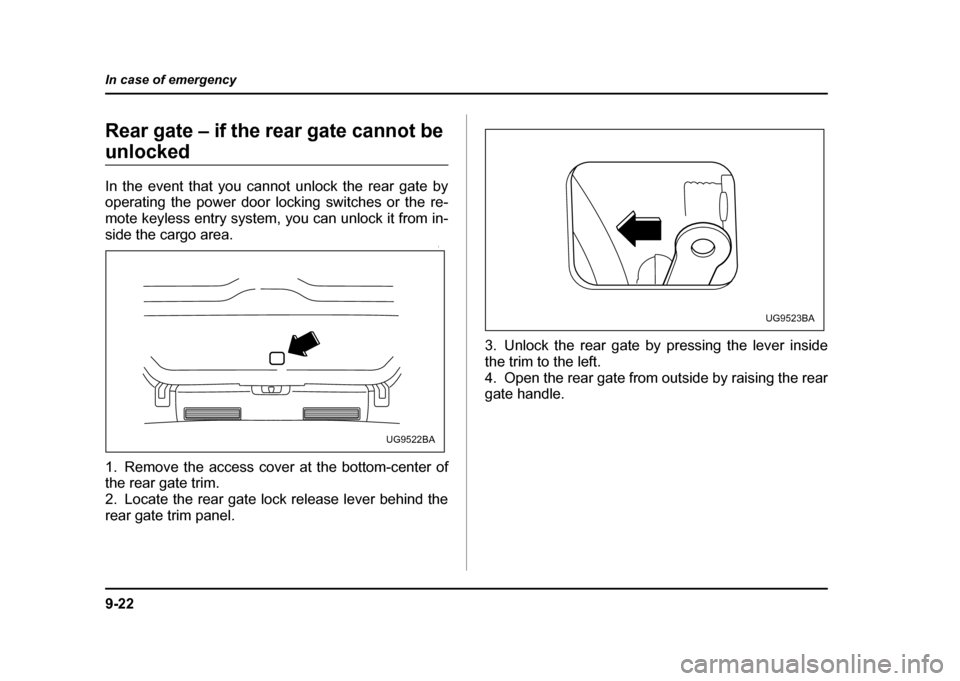
1. Remove the access cover at the bottom-center of
the rear gate trim.
2. Locate the rear gate lock release lever behind the
rear gate trim panel.
3. Unlock the rear gate by pressing the lever inside
the trim to the left.
4. Open the rear gate from outside by raising the rear
gate handle.
UG9522BA
UG9523BA
Page 374 of 491
9-23
In case of emergency
– CONTINUED –
Moonroof – if the moonroof cannot be
closed
If the moonroof cannot be closed with the moonroof
switch, you can close the moonroof manually.
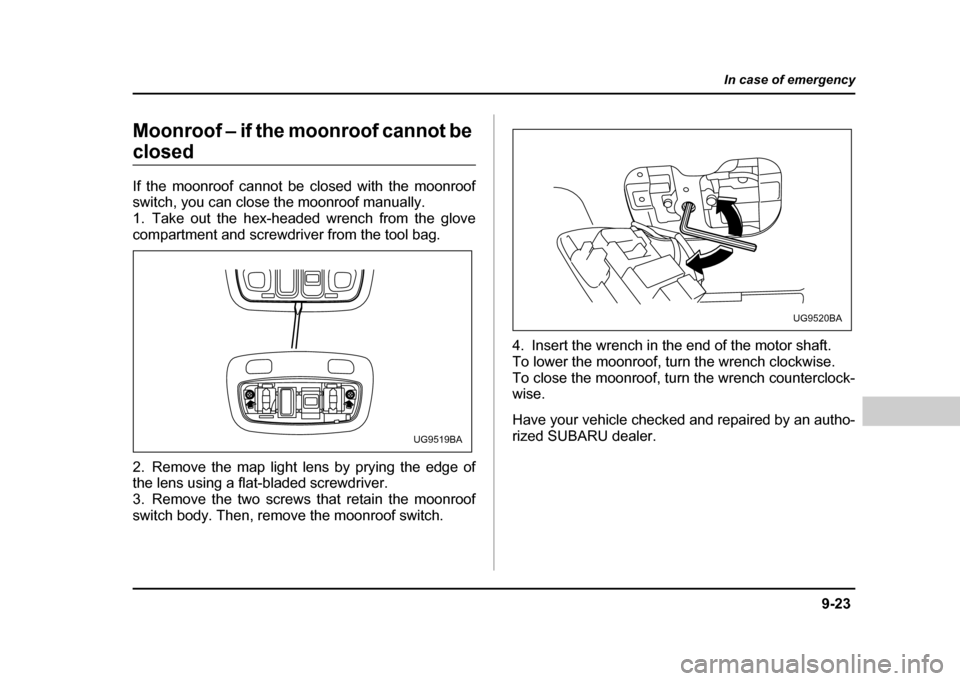
1. Take out the hex-headed wrench from the glove
compartment and screwdriver from the tool bag.
2. Remove the map light lens by prying the edge of
the lens using a flat-bladed screwdriver.
3. Remove the two screws that retain the moonroof
switch body. Then, remove the moonroof switch. 4. Insert the wrench in the end of the motor shaft.
To lower the moonroof, turn the wrench clockwise.
To close the moonroof, turn the wrench counterclock- wise.
Have your vehicle checked and repaired by an autho-
rized SUBARU dealer.
UG9519BA
UG9520BA
Page 378 of 491
10-1
10
Appearance care
Exterior care .................................................. 10-2 Washing ............................................................. 10-2
Waxing and polishing ....................................... 10-3
Cleaning aluminum wheels .............................. 10-3
Corrosion protection .................................... 10-4 Most common causes of corrosion ................ 10-4
To help prevent corrosion ............................... 10-5
Cleaning the interior ..................................... 10-6 Seat fabric ......................................................... 10-6
Leather seat materials ...................................... 10-6
Synthetic leather upholstery ........................... 10-6
Climate control panel, audio panel, instrument panel, console panel, and switches ............. 10-7