Page 261 of 491
6-12
Interior equipment
"
Use of an electric appliance in the socket for
a long period of time while the engine is not
running can cause battery discharge." Before driving your vehicle, make sure that
the plug and the cord on your electrical appli-
ance will not interfere with your shifting gears
and operating the accelerator and brake pedals.
If they do, do not use the electrical appliance
while driving.
If the socket has been used for electrical appliances,
damage may have been done to the internal mecha-
nism that causes a cigarette lighter to “pop out” after
its element has been heated. For that reason, a ciga-
rette lighter, even if it is a genuine part, should not be
used in the socket. If you want to use the socket for a
cigarette lighter again, or to protect your purchaser be-
fore you sell your car, have your SUBARU dealer re-
place the socket with a new one.
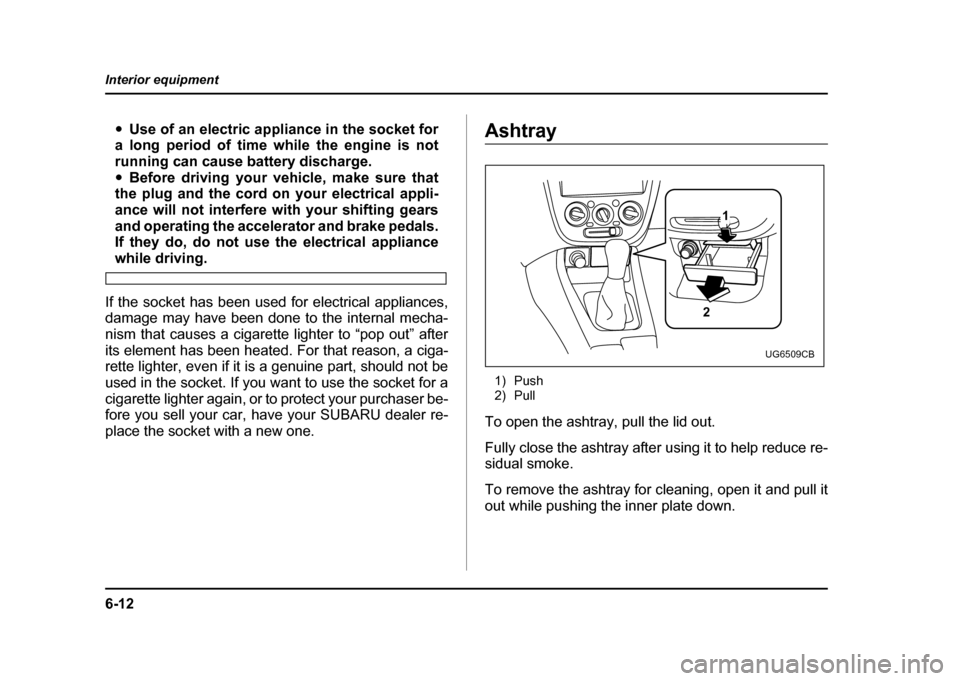
Ashtray
1) Push
2) Pull
To open the ashtray, pull the lid out.
Fully close the ashtray after using it to help reduce re-
sidual smoke.
To remove the ashtray for cleaning, open it and pull it
out while pushing the inner plate down.
2 1
UG6509CB
Page 290 of 491
7-21
Starting and operating
– CONTINUED –
mode.
NOTE "If the differential-limiting factor is large during
cornering maneuvers, a small speed difference
between the front and rear wheels may cause tight
corner braking (a phenomenon accompanied by
vibration and noise). This phenomenon does not
indicate a problem. It will disappear if the differen-
tial-action limiting factor is reduced. " Use the center-differential indicator light only as
a rough indication of the differential-action limit-
ing factor. ! Temporary release
When the driver stop the vehicle and pulls the parking-
brake lever after manually setting the differential-ac-
tion limiting factor, the factor is temporarily minimized.
The indicator in the combination meter continues to
show the driver’s selected differential-action limiting
factor. When the driver releases the parking-brake le-
ver, the factor set by the driver is restored.
Automatic transmission
The automatic transmission is electronically controlled
with 4-forward speeds and 1-reverse speed.
NOTE
Immediately after a disconnected battery is recon-
nected or ATF (automatic transmission fluid) is re-
placed, you may feel that the automatic transmis-
sion operation is somewhat unusual.
This results from erasure or invalidation of data
the on-board computer has collected and stored in
memory to allow the transmission to shift at the
most appropriate times for the current condition
of your vehicle. Optimized shifting will be restored
as the vehicle continues to be driven for a while.
Do not shift from the “P” or “N” position into
the “D”, “3”, “2”, “1” or “R” position while de-
pressing the accelerator pedal. This may cause
the vehicle to jump forward or backward.
" Shift into the “P” or “R” position only after
Page 300 of 491
7-31
Starting and operating
– CONTINUED –
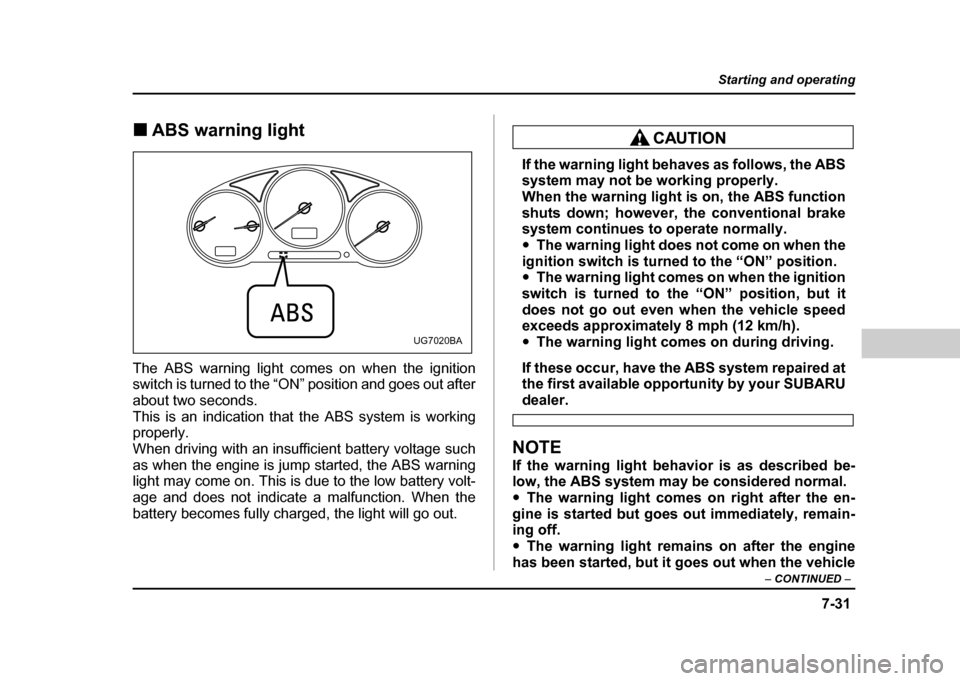
!ABS warning light
The ABS warning light comes on when the ignition
switch is turned to the “ON” position and goes out after
about two seconds.
This is an indication that the ABS system is working
properly.
When driving with an insufficient battery voltage such
as when the engine is jump started, the ABS warning
light may come on. This is due to the low battery volt-
age and does not indicate a malfunction. When the
battery becomes fully charged, the light will go out.
If the warning light behaves as follows, the ABS
system may not be working properly.
When the warning light is on, the ABS function
shuts down; however, the conventional brake
system continues to operate normally. " The warning light does not come on when the
ignition switch is turned to the “ON” position. " The warning light comes on when the ignition
switch is turned to the “ON” position, but it
does not go out even when the vehicle speed
exceeds approximately 8 mph (12 km/h). " The warning light comes on during driving.
If these occur, have the ABS system repaired at
the first available opportunity by your SUBARU
dealer.
NOTE
If the warning light behavior is as described be-
low, the ABS system may be considered normal." The warning light comes on right after the en-
gine is started but goes out immediately, remain-
ing off." The warning light remains on after the engine
has been started, but it goes out when the vehicle
UG7020BA
Page 322 of 491
8-11
Driving tips
– CONTINUED –
operating it off-road and not using common sense pre-
cautions such as those listed above is not eligible for
warranty coverage."Wash the vehicle’s underbody after off-road driving.
Suspension components are particularly prone to dirt
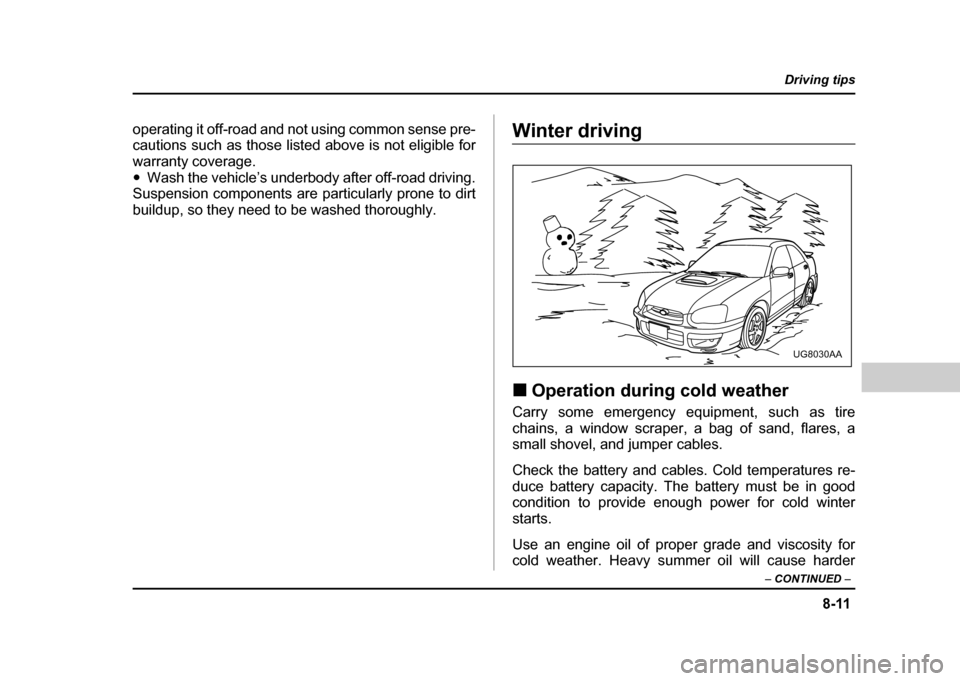
buildup, so they need to be washed thoroughly.Winter driving ! Operation during cold weather
Carry some emergency equipment, such as tire
chains, a window scraper, a bag of sand, flares, a
small shovel, and jumper cables.
Check the battery and cables. Cold temperatures re-
duce battery capacity. The battery must be in good
condition to provide enough power for cold winter starts.
Use an engine oil of proper grade and viscosity for
cold weather. Heavy summer oil will cause harder
UG8030AA
Page 365 of 491
9-14
In case of emergency
Jump starting
"
Battery fluid is SULFURIC ACID. Do not let it
come in contact with the hooks, skin, clothing
or the vehicle.
If battery fluid gets on you, thoroughly flush the
exposed area with water immediately. Get med-
ical help if the fluid has entered your hooks.
If battery fluid is accidentally swallowed, imme-
diately drink a large amount of milk or water,
and obtain immediate medical help.
Keep everyone including children away from the battery. " The gas generated by a battery explodes if a
flame or spark is brought near it. Do not smoke
or light a match while jump starting. " Never attempt jump starting if the discharged
battery is frozen. It could cause the battery to
burst or explode. " Whenever working on or around a battery, al-
ways wear suitablehookprotectors, and remove
metal objects such as rings, bands or other
metal jewelry. " Be sure the jumper cables and clamps on
them do not have loose or missing insulation. Do not jump start unless cables in suitable con-
dition are available. "
A running engine can be dangerous. Keep
your fingers, hands, clothing, hair and tools
away from the cooling fan, belts and any other
moving engine parts. Removing rings, watches
and ties is advisable.
When your vehicle does not start due to a run down
(discharged) battery, the vehicle may be jump started
by connecting your battery to another battery (called
the booster battery) with jumper cables.
Jump starting is dangerous if it done incorrectly. If you
are unsure about the proper procedure for jump start-
ing, consult a competent mechanic. ! How to jump start
1. Make sure the booster battery is 12 volts and the
negative terminal is grounded.
2. If the booster battery is in another vehicle, do not let
the two vehicles touch.
3. Turn off all unnecessary lights and accessories.
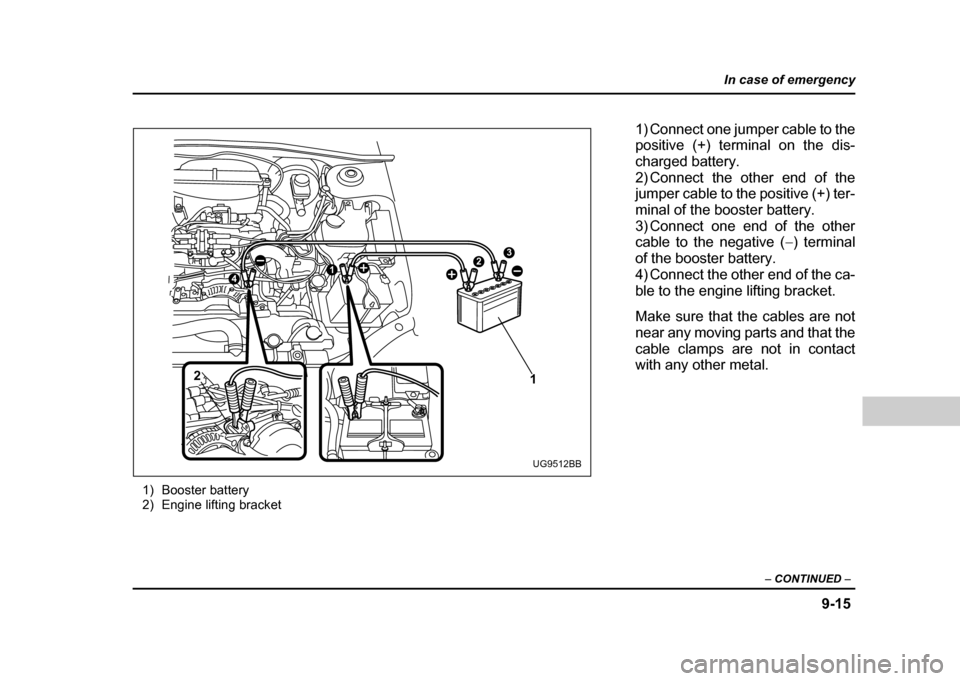
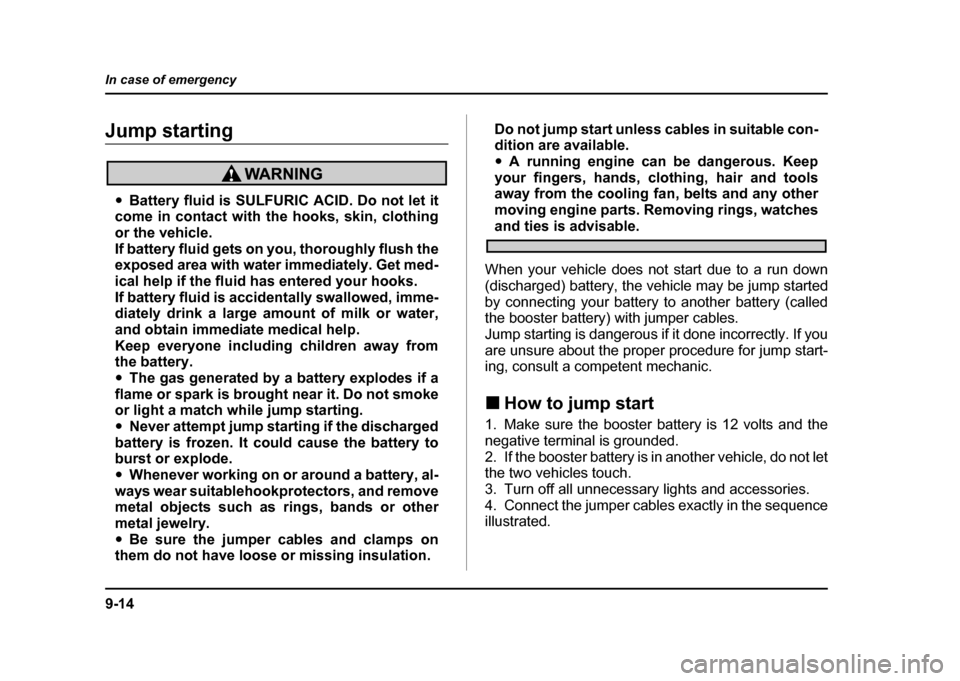
4. Connect the jumper cables exactly in the sequence
illustrated.
Page 366 of 491
9-15
In case of emergency
– CONTINUED –
1) Booster battery
2) Engine lifting bracket
32
2
14
1
UG9512BB
1) Connect one jumper cable to the
positive (+) terminal on the dis-
charged battery.
2) Connect the other end of the
jumper cable to the positive (+) ter-
minal of the booster battery.
3) Connect one end of the other
cable to the negative ( −) terminal
of the booster battery.
4) Connect the other end of the ca-
ble to the engine lifting bracket.
Make sure that the cables are not
near any moving parts and that the
cable clamps are not in contact
with any other metal.
Page 367 of 491
9-16
In case of emergency
5. Start the engine of the vehicle with the booster bat-
tery and run it at moderate speed. Then start the en-
gine of the vehicle that has the discharged battery.
6. When finished, carefully disconnect the cables in
exactly the reverse order.Engine overheating
Never attempt to remove the radiator cap until
the engine has been shut off and has fully
cooled down. When the engine is hot, the cool-
ant is under pressure. Removing the cap while
the engine is still hot could release a spray of
boiling hot coolant, which could burn you very
seriously.
If the engine overheats, safely pull off the road and
stop the vehicle in a safe place. ! If steam is coming from the engine
compartment
Turn the engine off and get everyone away from the
vehicle until it cools down. ! If no steam is coming from the engine
compartment
1. Keep the engine running at idling speed.
2. Open the hood to ventilate the engine compart- ment.
Page 387 of 491

11 - 2
Maintenance and service
Types of tires .................................................... 11-44
Tire inspection .................................................. 11-45
Tire pressures and wear .................................. 11-45
Wheel balance ................................................... 11-48
Wear indicators ................................................. 11-49
Tire rotation ....................................................... 11-50
Tire replacement ............................................... 11-50
Wheel replacement ........................................... 11-51
Wheel covers .................................................... 11-52
Aluminum wheels (If equipped) .................. 11-53
Intercooler water spray ................................ 11-53
Windshield washer fluid .............................. 11-54
Replacement of windshield wiper blades .. 11-55
Battery ........................................................... 11-58
Fuses ............................................................. 11-60
Main fuse ....................................................... 11-63
Installation of accessories .......................... 11-63
Replacing bulbs ............................................ 11-64 Headlights (U.S. spec. WRX-STi) .................... 11-66
Headlight (Except U.S. spec. WRX-STi) .......... 11-66
Front turn signal light bulbs ............................ 11-69
Parking light ...................................................... 11-70
Front fog light ................................................... 11-73
Rear combination lights ................................... 11-74
License plate light ............................................ 11-76
Dome light, map light and cargo area light .... 11-77
Trunk light ......................................................... 11-78
High mount stop light ...................................... 11-78