Page 133 of 491
2-30
Keys and doors
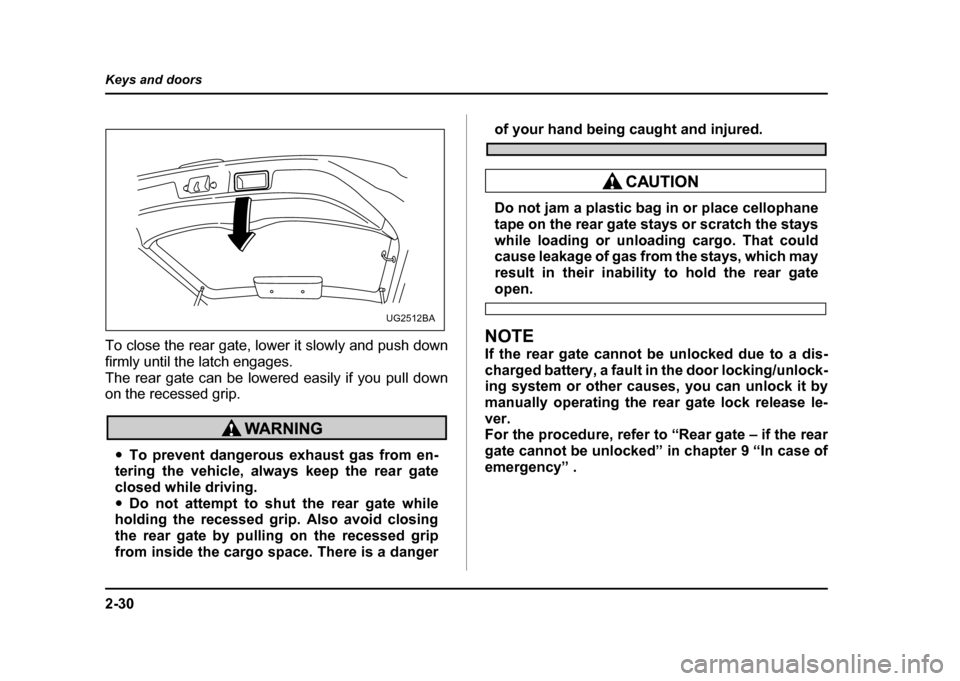
To close the rear gate, lower it slowly and push down
firmly until the latch engages.
The rear gate can be lowered easily if you pull down
on the recessed grip.
"
To prevent dangerous exhaust gas from en-
tering the vehicle, always keep the rear gate
closed while driving." Do not attempt to shut the rear gate while
holding the recessed grip. Also avoid closing
the rear gate by pulling on the recessed grip
from inside the cargo space. There is a danger
of your hand being caught and injured.
Do not jam a plastic bag in or place cellophane
tape on the rear gate stays or scratch the stays
while loading or unloading cargo. That could
cause leakage of gas from the stays, which may
result in their inability to hold the rear gate
open.
NOTE
If the rear gate cannot be unlocked due to a dis-
charged battery, a fault in the door locking/unlock-
ing system or other causes, you can unlock it by
manually operating the rear gate lock release le-
ver.
For the procedure, refer to “Rear gate – if the rear
gate cannot be unlocked” in chapter 9 “In case of
emergency” .
UG2512BA
Page 146 of 491
3-9
Instruments and controls
– CONTINUED –
To set the trip meter to zero, select the A trip or B trip
meter by pushing the knob and keep the knob pushed for more than 2 seconds.
To ensure safety, do not attempt to change the
function of the indicator during driving, as an
accident could result.
NOTE
If the connection between the combination meter
and battery is broken for any reason such as vehi-
cle maintenance or fuse replacement, the data re-
corded on the trip meter will be lost. !Tachometer
The tachometer shows the engine speed in thousands
of revolutions per minute.
Do not operate the engine with the pointer of the tachometer in the red zone. In this range, fuel injection will be cut by the engine control
module to protect the engine from overrevving.
The engine will resume running normally after
the engine speed is reduced below the red
zone.
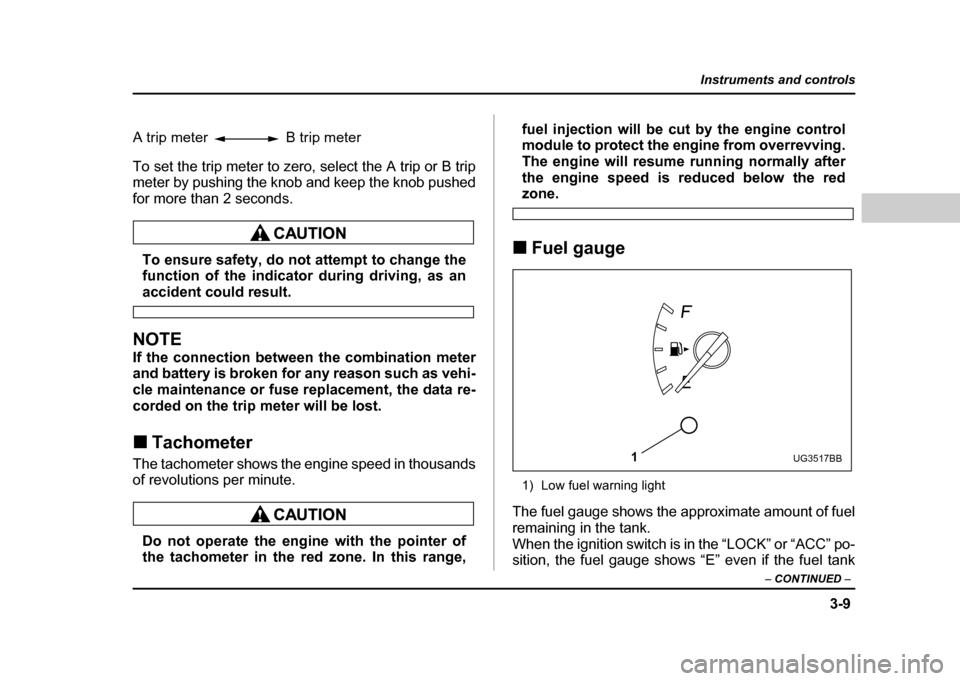
! Fuel gauge
1) Low fuel warning light
The fuel gauge shows the approximate amount of fuel
remaining in the tank.
When the ignition switch is in the “LOCK” or “ACC” po-
sition, the fuel gauge shows “E” even if the fuel tank
A trip meter B trip meter
1UG3517BB
Page 153 of 491
3-16
Instruments and controls
To set the trip meter to zero, select the A trip or B trip
meter by pushing the knob and keep the knob pushed
for more than 2 seconds.
To ensure safety, do not attempt to change the
function of the indicator during driving, as an
accident could result.
NOTE
If the connection between the combination meter
and battery is broken for any reason such as vehi-
cle maintenance or fuse replacement, the data re-
corded on the trip meter will be lost. !
Tachometer
The tachometer shows the engine speed in thousands
of revolutions per minute.
Do not operate the engine with the pointer of
the tachometer in the red zone. In this range, fuel injection will be cut by the engine control
module to protect the engine from overrevving.
The engine will resume running normally after
the engine speed is reduced below the red
zone.
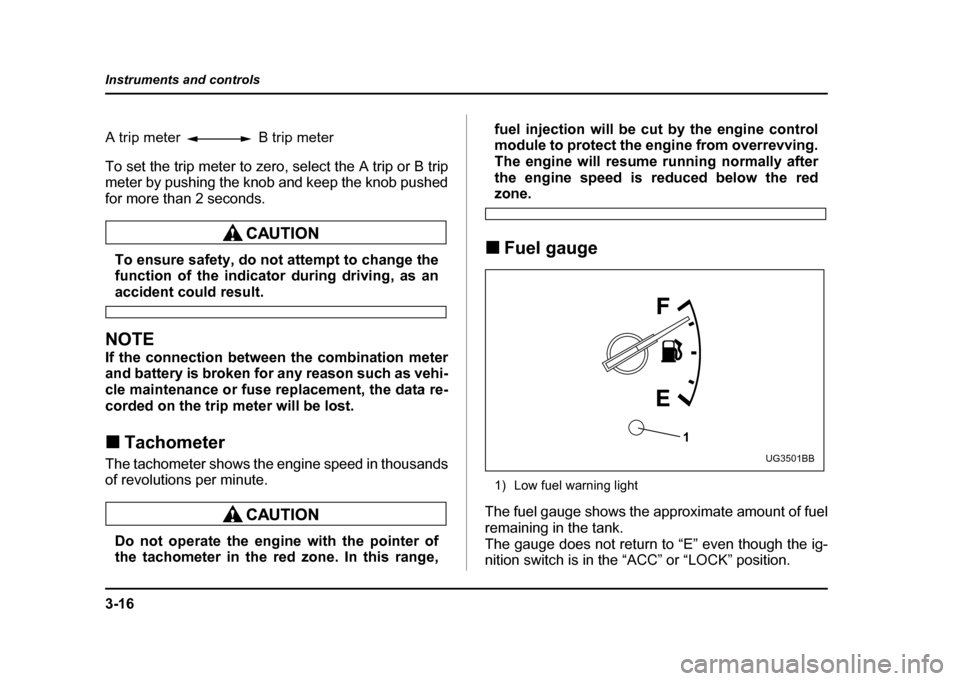
! Fuel gauge
1) Low fuel warning light
The fuel gauge shows the approximate amount of fuel
remaining in the tank.
The gauge does not return to “E” even though the ig-
nition switch is in the “ACC” or “LOCK” position.
A trip meter B trip meter
1
UG3501BB
Page 160 of 491
3-23
Instruments and controls
– CONTINUED –
tires are not all the same size and brand, the rear
differential will be heavily loaded when the vehicle
is driven, resulting in an abnormally high oil tem-
perature. "The rear differential oil will deteriorate if its tem-
perature increases enough for the rear differential
oil temperature warning light to come on. It is ad-
visable to have the rear differential oil replaced as
soon as possible. ! ABS warning light
The ABS warning light comes on when the ignition
switch is turned to the “ON” position and goes out after
about two seconds.
This is an indication that the ABS system is working
properly.
If the warning light behaves as follows, the ABS
system may not work properly.
When the warning light is on, the ABS function
shuts down; however, the conventional brake
system continues to operate normally." The warning light does not come on when the
ignition switch is turned to the “ON” position." The warning light comes on when the ignition switch is turned to the “ON” position, but it
does not go out even when the vehicle speed
exceeds approximately 8 mph (12 km/h)."
The warning light comes on during driving.
If these occur, have the ABS system repaired at
the first available opportunity by your SUBARU
dealer.
With a vehicle equipped with an EBD system, the ABS
warning light comes on together with the brake system
warning light if the EBD system becomes faulty. For
further details of the EBD system fault warning, refer to “Brake system warning light”.
NOTE
If the warning light behavior is as described be-
low, the ABS system may be considered normal." The warning light comes on right after the en-
gine is started but goes out immediately, remain-
ing off." The warning light remains on after the engine
has been started, but it goes out when the vehicle
speed reaches about 8 mph (12 km/h)." The warning light comes on during driving, but
it goes out immediately and remains off.
When driving with an insufficient battery voltage such
(U.S.) (Canada)
Page 161 of 491

3-24
Instruments and controls
as when the engine is jump started, the ABS warning
light may come on. This is due to the low battery volt-
age and does not indicate a malfunction. When the
battery becomes fully charged, the light will go out. !
Brake system warning light
"Driving with the brake system warning light
on is dangerous. This indicates your brake sys-
tem may not be working properly. If the light re-
mains on, have the brakes inspected by a
SUBARU dealer immediately." If at all in doubt about whether the brakes are
operating properly, do not drive the vehicle.
Have your vehicle towed to the nearest
SUBARU dealer for repair.
This light has the following two functions: ! Parking brake warning
The light comes on with the parking brake applied
while the ignition switch is in the “ON” position. It goes
out when the parking brake is fully released. !
Brake fluid level warning
This light comes on when the brake fluid level has
dropped to near the “MIN” level of the brake fluid res-
ervoir with the ignition switch in the “ON” position and
with the parking brake fully released.
If the brake system warning light should come on while
driving (with the parking brake fully released and with
the ignition switch positioned in “ON”), it could be an
indication of leaking of brake fluid or worn brake pads.
If this occurs, immediately stop the vehicle at the near-
est safe place and check the brake fluid level. If the flu-
id level is below the “MIN” mark in the reservoir, do not
drive the vehicle. Have the vehicle towed to the near-
est SUBARU dealer for repair. ! Electronic Brake Force Distribution (EBD) sys-
tem warning (for vehicles with ABS)
The brake system warning light also illuminates if a
malfunction occurs in the EBD system. In that event, it
comes on together with the ABS warning light.
The EBD system may be malfunctioning if the brake
system warning light and ABS warning light illuminate
simultaneously during driving.
Even if the EBD system fails, the conventional braking
system will still function. However, the rear wheels will
be more prone to locking when the brakes are applied
harder than usual and the vehicle’s motion may there-
(U.S.) (Canada)
Page 166 of 491
3-29
Instruments and controls
– CONTINUED –
Light control switch
The light switch operates only when the ignition switch
is in the “ON” position.
To prevent battery discharge resulting from ac-
cidentally leaving your lights on when your ve-
hicle is parked, the light switch operates only
when the ignition switch is in the “ON” posi-
tion. In any other position, the vehicle’s lights
will be out.
If you park your vehicle on a roadside at night,
use the hazard warning flasher to alert the other
drivers. !
Headlights
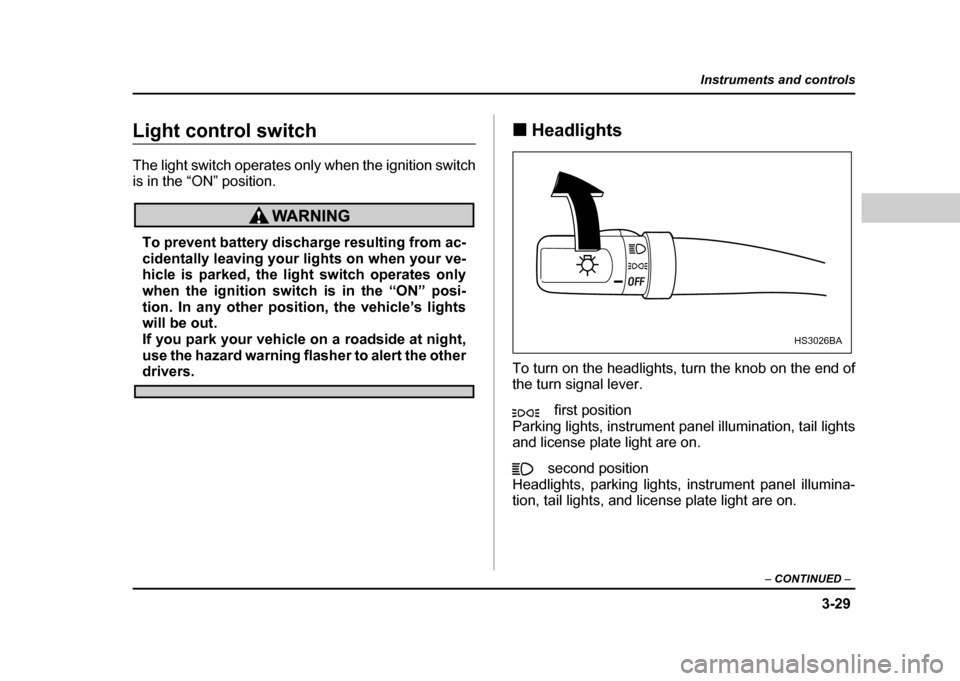
To turn on the headlights, turn the knob on the end of
the turn signal lever. first position
Parking lights, instrument panel illumination, tail lights
and license plate light are on.
second position
Headlights, parking lights, instrument panel illumina-
tion, tail lights, and license plate light are on.
HS3026BA
Page 171 of 491
3-34
Instruments and controls
the beam becomes.Parking light switch
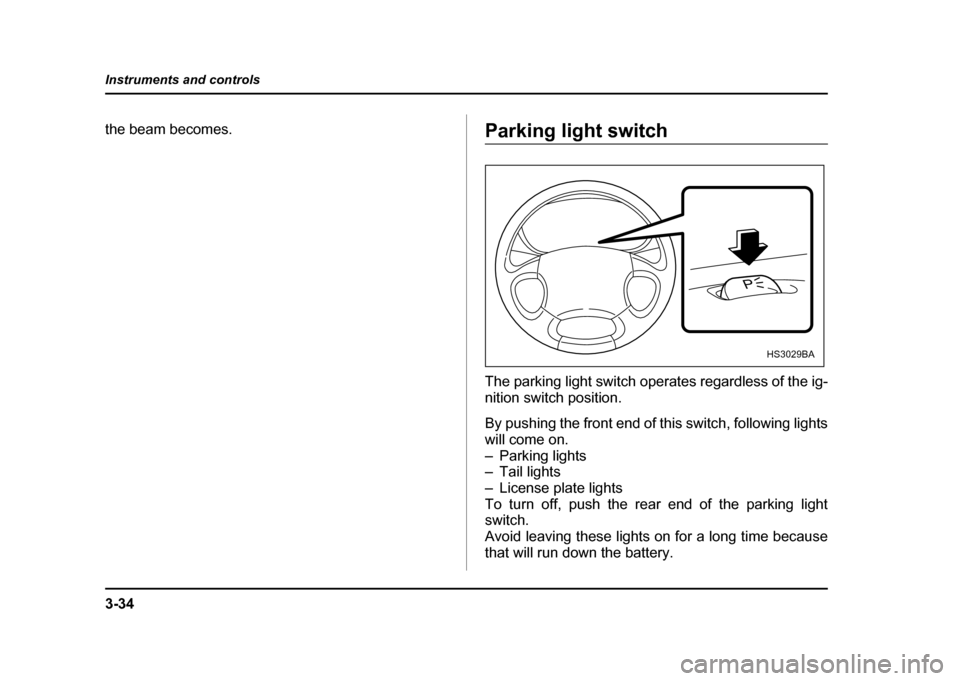
The parking light switch operates regardless of the ig-
nition switch position.
By pushing the front end of this switch, following lights
will come on.
– Parking lights
– Tail lights
– License plate lights
To turn off, push the rear end of the parking lightswitch.
Avoid leaving these lights on for a long time because
that will run down the battery.
P
HS3029BA
Page 178 of 491
3-41
Instruments and controls
– CONTINUED –
Semi-automatic climate control system
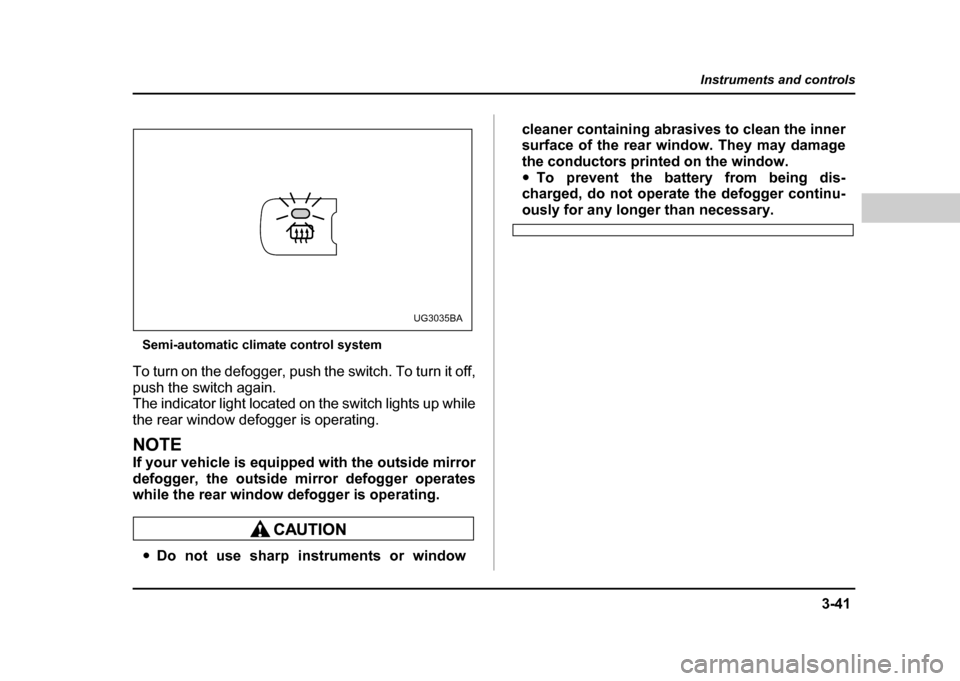
To turn on the defogger, push the switch. To turn it off,
push the switch again.
The indicator light located on the switch lights up while
the rear window defogger is operating.
NOTE
If your vehicle is equipped with the outside mirror
defogger, the outside mirror defogger operates
while the rear window defogger is operating.
" Do not use sharp instruments or window cleaner containing abrasives to clean the inner
surface of the rear window. They may damage
the conductors printed on the window."
To prevent the battery from being dis-
charged, do not operate the defogger continu-
ously for any longer than necessary.
UG3035BA