Page 324 of 491
8-13
Driving tips
– CONTINUED –
pipe and from around your vehicle if you parkthe vehicle in snow with the engine running.
! Refueling in cold weather
To help prevent moisture from forming in the fuel sys-
tem and the risk of its freezing, use of an antifreeze ad-
ditive in the fuel tank is recommended during cold
weather.
Use only additives that are specifically designed for
this purpose. When an antifreeze additive is used, its
effect lasts longer if the tank is refilled whenever the
fuel level reaches half empty.
If your SUBARU is not going to be used for an extend-
ed period, it is best to have the fuel tank filled to capac-
ity. ! Driving on snowy and icy roads
To prevent skidding and slipping, avoid sudden brak-
ing, abrupt acceleration, high-speed driving, and
sharp turning when driving on snowy or icy roads.
Always maintain ample distance between your vehicle
and the vehicle ahead of you to avoid the need for sud-
den braking.
To supplement the foot brake, use the engine brake
effectively to control the vehicle speed. (Shift into a lower gear when necessary.)
Avoid shifting down abruptly. Such behavior can
cause the wheels to lock, possibly leading to loss of
vehicle control.
An anti-lock brake system (ABS) enhances your vehi-
cle’s braking performance on snowy and icy roads.
Refer to the “ABS (Anti-lock Brake System)” section in
chapter 7 for information on braking on slippery sur- faces.
NOTE
The following tires are summer tires. Compared
with winter and all-season tires, summer tires give
significantly less grip on snowy and icy road sur-
faces. Avoid driving on snowy and icy road sur-
face with summer tires."
225/45R17 tires for WRX-STi
" Optional 215/45R17 tires for WRX
Do not use the cruise control on slippery roads
such as snowy or icy roads. This may cause
loss of vehicle control.
Page 336 of 491
8-25
Driving tips
– CONTINUED –
Trailer hitch (if equipped)
The trailer hitch is designed to tow a Class 1 rated
load. A maximum of 2,000 lbs. (906 kg) gross trailer
weight and a maximum of 200 lbs. (90 kg) gross
tongue weight are permissible for the trailer hitch.
When you tow a trailer, follow the instructions in the
section “Trailer towing” in this chapter.
" Never exceed the maximum weight specified
for the trailer hitch. Exceeding the maximum
weight could cause an accident resulting in se-
rious personal injuries. Permissible trailer
weight changes depending on the situation. Re-
fer to the section “Trailer towing” in this chap-
ter for possible recommendations and limita- tions. " Trailer brakes are required when the towing
load exceeds 1,000 lbs. (453 kg). Be sure your
trailer has safety chains and that each chain
will hold the trailer’s maximum gross weight.
Towing trailers without safety chains could cre-
ate a traffic safety hazard if the trailer separates
from the hitch due to coupling damage or hitch
ball damage. "
Be sure to check the hitch pin and safety pin
for positive locking placement before towing a
trailer. If the ball mount comes off the hitch re-
ceiver, the trailer could get loose and create a
traffic safety hazard. " Use only the ball mount supplied with this
hitch. Use the hitch only as a weight carrying
hitch. Do not use with any type of weight dis-
tributing hitch.
! Connecting a trailer
1. Remove the receiver cover from the hitch receiver
tube. Then insert the ball mount into the hitch receiver
tube.
Page 351 of 491
8-40
Driving tips
overheating. A lower gear should be used. !
Parking on a grade
Always block the wheels under both vehicle and trailer
when parking. Apply the parking brake firmly. You
should not park on a hill or slope. But if parking on a
hill or slope cannot be avoided, you should take the
following steps:
1. Apply the brakes and hold the pedal down.
2. Have someone place wheel blocks under both the
vehicle and trailer wheels.
3. When the wheel blocks are in place, release the
regular brakes slowly until the blocks absorb the load.
4. Apply the regular brakes and then apply the park-
ing brake; slowly release the regular brakes.
5. Shift into 1st or reverse gear (manual transmission)
or “P” (automatic transmission) and shut off the en-
gine.
Page 352 of 491

9-1
9
In case of emergency
If you park your vehicle in case of an emergency ............................................ 9-2
Temporary spare tire .................................... 9-3
Flat tires ......................................................... 9-5 Changing a flat tire ........................................... 9-5
Jump starting ................................................ 9-14 How to jump start ............................................. 9-14
Engine overheating ....................................... 9-16 If steam is coming from the engine compartment .................................................. 9-16
If no steam is coming from the engine compartment .................................................. 9-16
Towing ........................................................... 9-17 Towing and tie-down hooks ............................ 9-18
Using a flat-bed truck ....................................... 9-20
Towing with all wheels on the ground ............ 9-21
Rear gate – if the rear gate cannot be unlocked ..................................................... 9-22
Moonroof – if the moonroof cannot be closed ......................................................... 9-23
Maintenance tools ......................................... 9-24 Jack and jack handle ........................................ 9-24
Page 356 of 491
9-5
In case of emergency
– CONTINUED –
Flat tires
If you have a flat tire while driving, never brake sud-
denly; keep driving straight ahead while gradually re-
ducing speed. Then slowly pull off the road to a safe
place. !Changing a flat tire
"Do not jack up the vehicle on an incline or a
loose road surface. The jack can come out of
the jacking point or sink into the ground and
this can result in a severe accident. " Use only the jack provided with your vehicle.
The jack supplied with the vehicle is designed
only for changing a tire. Never get under the ve-
hicle while supporting the vehicle with thisjack. " Always turn the engine off before raising the
flat tire off the ground using the jack. Never
swing or push the vehicle supported with the
jack. The jack can come out of the jacking point
due to a jolt and this can result in a severe acci-
dent. 1. Park on a hard, level surface, whenever possible,
then stop the engine.
2. Set the parking brake securely and shift a manual
transmission vehicle in reverse or an automatic trans-
mission vehicle in the “P” (Park) position.
3. Turn on the hazard warning flasher and have ev-
eryone get out of the vehicle.
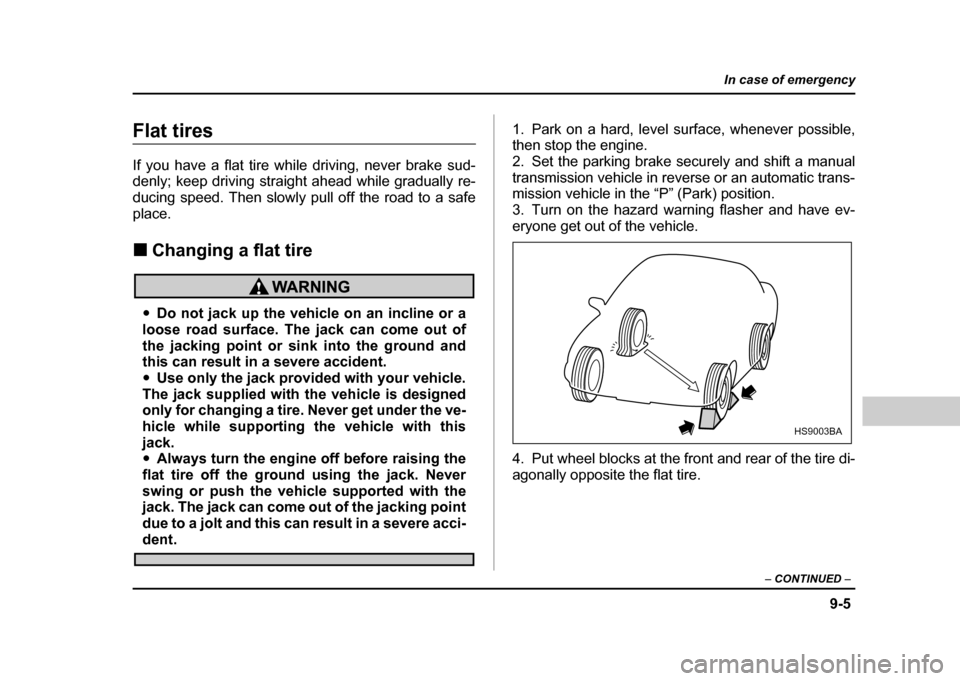
4. Put wheel blocks at the front and rear of the tire di-
agonally opposite the flat tire.
HS9003BA
Page 358 of 491
9-7
In case of emergency
– CONTINUED –
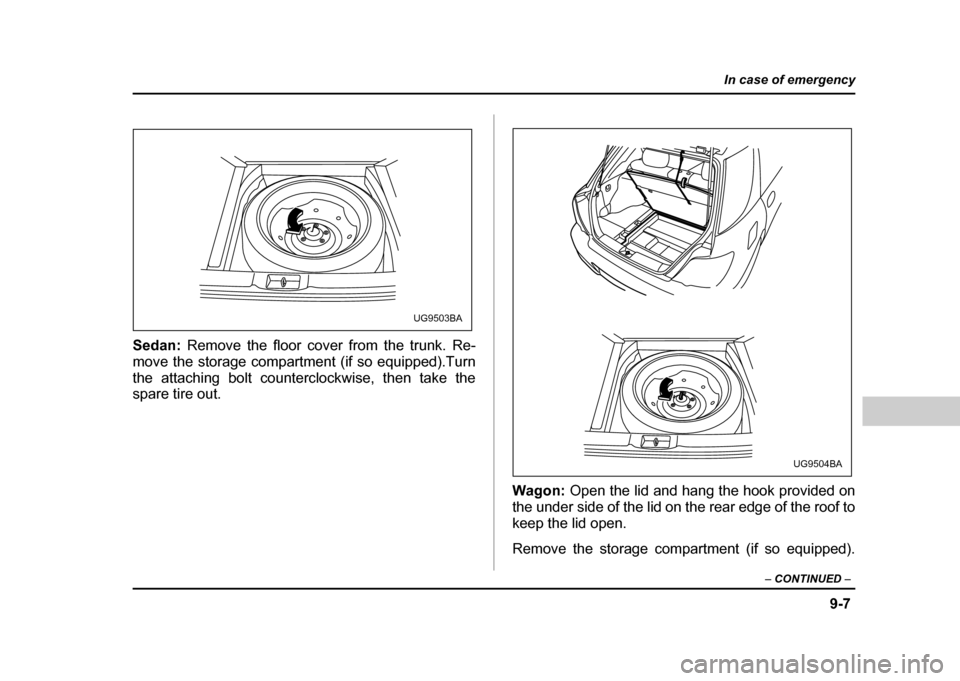
Sedan: Remove the floor cover from the trunk. Re-
move the storage compartment (if so equipped).Turn
the attaching bolt counterclockwise, then take the
spare tire out.
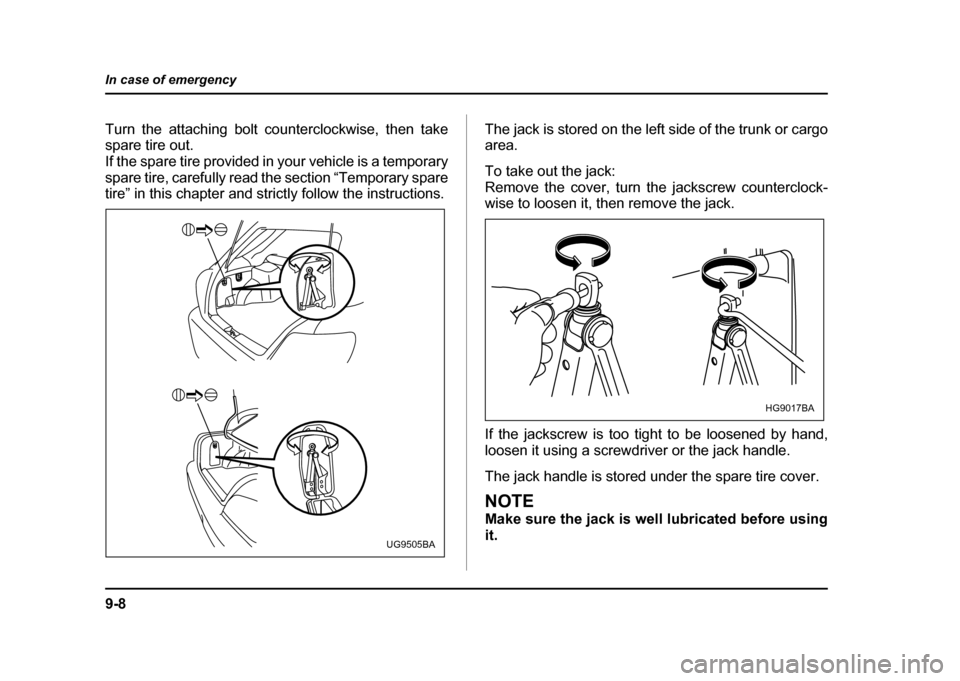
Wagon: Open the lid and hang the hook provided on
the under side of the lid on the rear edge of the roof to
keep the lid open.
Remove the storage compartment (if so equipped).
UG9503BA
UG9504BA
Page 359 of 491
9-8
In case of emergency
Turn the attaching bolt counterclockwise, then take
spare tire out.
If the spare tire provided in your vehicle is a temporary
spare tire, carefully read the section “Temporary spare
tire” in this chapter and strictly follow the instructions.
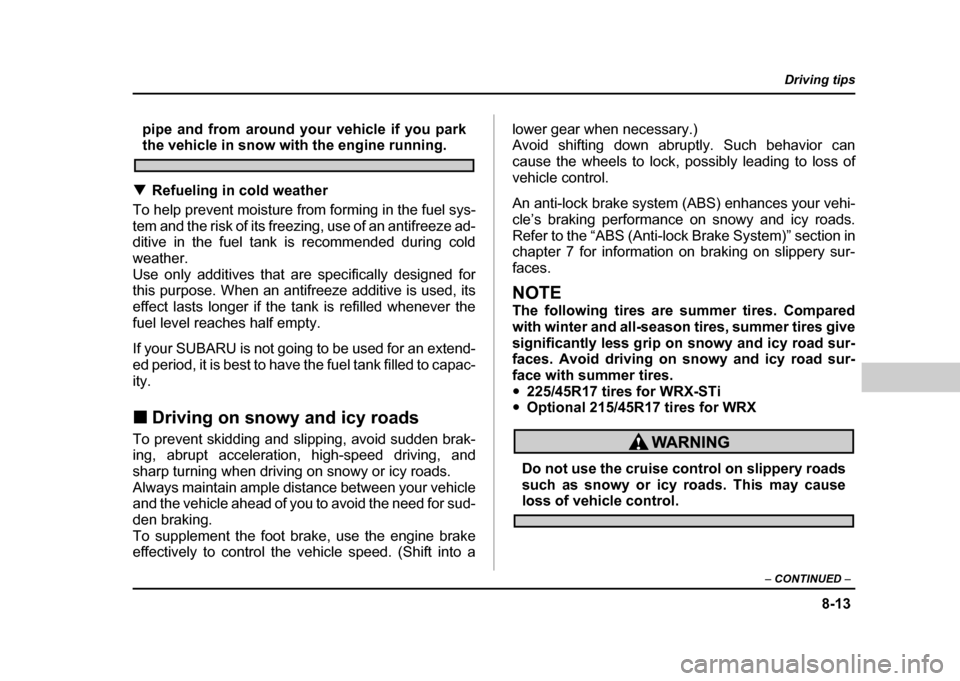
The jack is stored on the left side of the trunk or cargo
area.
To take out the jack:
Remove the cover, turn the jackscrew counterclock-
wise to loosen it, then remove the jack.
If the jackscrew is too tight to be loosened by hand,
loosen it using a screwdriver or the jack handle.
The jack handle is stored under the spare tire cover.
NOTE
Make sure the jack is well lubricated before using it.
UG9505BA
HG9017BA
Page 363 of 491
9-12
In case of emergency
surface of the wheel and hub with a cloth.
12.Put on the spare tire. Replace the wheel nuts.
Tighten them by hand.
Do not use oil or grease on the wheel studs or
nuts when the spare tire is installed. This could
cause the nuts to become loose and lead to an
accident.
13.Turn the jack handle counterclockwise to lower the
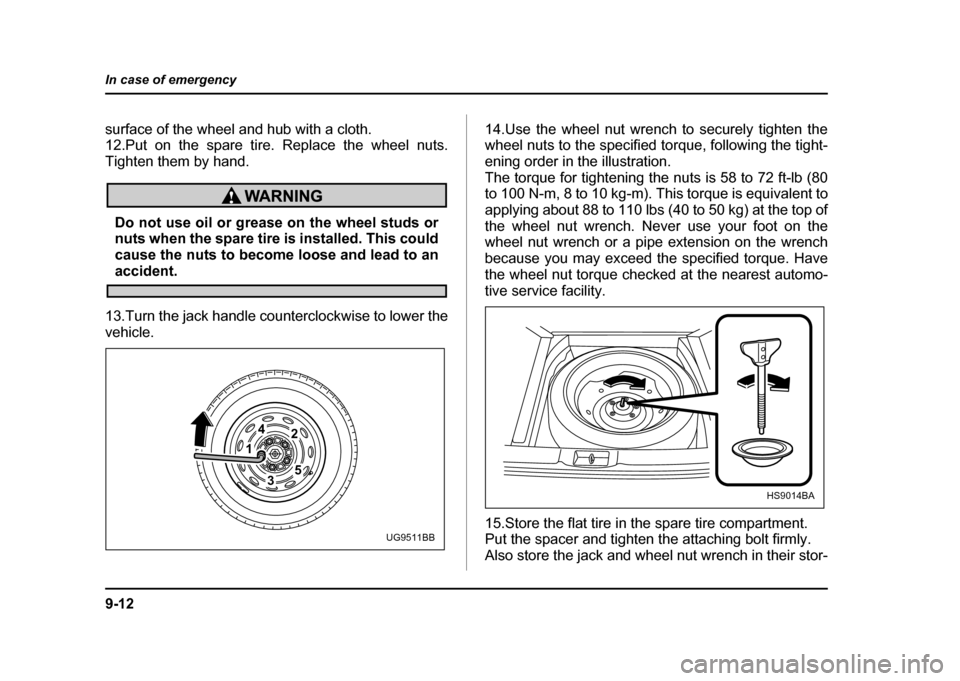
vehicle. 14.Use the wheel nut wrench to securely tighten the
wheel nuts to the specified torque, following the tight-
ening order in the illustration.
The torque for tightening the nuts is 58 to 72 ft-lb (80
to 100 N-m, 8 to 10 kg-m). This torque is equivalent to
applying about 88 to 110 lbs (40 to 50 kg) at the top of
the wheel nut wrench. Never use your foot on the
wheel nut wrench or a pipe extension on the wrench
because you may exceed the specified torque. Have
the wheel nut torque checked at the nearest automo-
tive service facility.
15.Store the flat tire in the spare tire compartment.
Put the spacer and tighten the attaching bolt firmly.
Also store the jack and wheel nut wrench in their stor-
1
42
53
UG9511BB
HS9014BA