2004 Hyundai Getz warning light
[x] Cancel search: warning lightPage 346 of 445

DRIVING YOUR HYUNDAI 2- 3
!
C020A01O-EAT BEFORE STARTING THE EN- GINE Before you start the engine, you should always:
1. Look around the vehicle to be sure
there are no flat tyres, puddles of oil or water or other indications of pos- sible trouble.
2. After entering the car, check to be
sure the parking brake is engaged.
3. Check that all windows, and lights are clean.
4. Check that the interior and exterior
mirrors are clean and in position.
5. Check your seat, seatback and
headrestraint to be sure they are intheir proper positions.
6. Close all the doors.
7. Fasten your seat belt and be sure
that all other occupants have fas- tened theirs.
8. Turn off all lights and accessories that are not needed.
9. When you turn the ignition switch to "ON" check that all appropriate warn-ing lights are operating and that youhave sufficient fuel. 10.Check the operation of warning
lights and all bulbs when key is inthe "ON" position.
WARNING: (DIESEL ENGINE)
To ensure that sufficient vacuum exists within the brake system dur-ing cold weather start-up condi-tions, it is necessary to run theengine at idle for several seconds after starting the engine. SC040A1-F COMBINATION IGNITION SWITCH AND STEERING LOCK To Start the Engine
o If your Hyundai is equipped with a
manual transaxle, place the shift lever in neutral and depress theclutch pedal fully.
o If your Hyundai has an automatic
transaxle, place the shift lever in "P" (park).
o To start the engine, insert the igni-
tion key and turn it to the "START" position. Release it as soon as theengine starts. Do not hold the key inthe "START" position for more that 15 seconds.
NOTE: For safety, the engine will not start if the shift lever is not in "P" or "N"Position (automatic transaxle).
tbuk-2.p65 3/23/04, 4:55 PM
3
Page 347 of 445
2- 4 DRIVING YOUR HYUNDAI
!
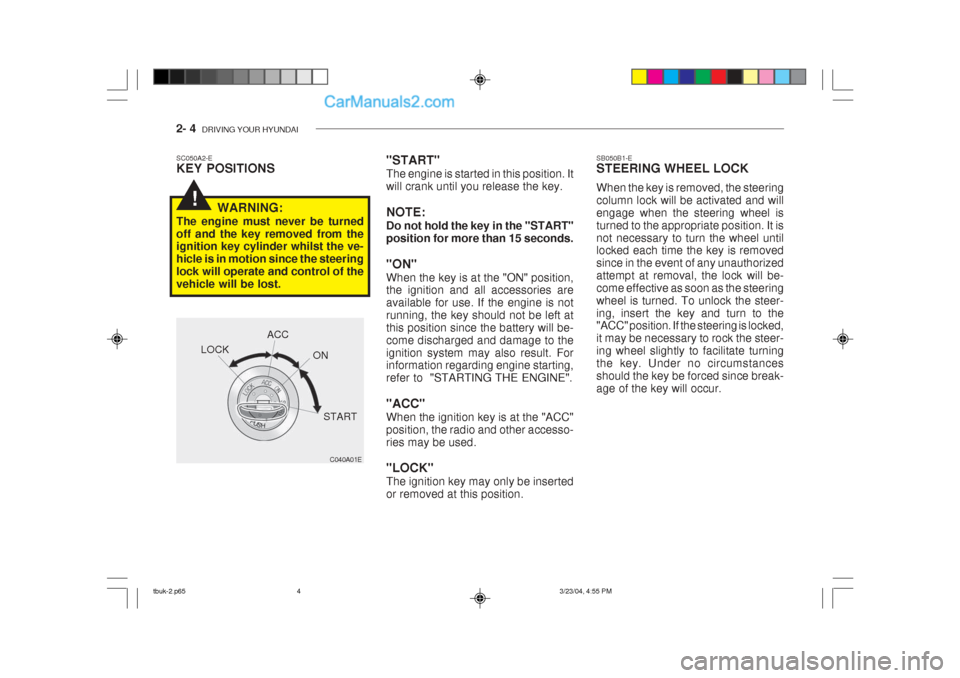
"START" The engine is started in this position. It will crank until you release the key. NOTE: Do not hold the key in the "START" position for more than 15 seconds. "ON" When the key is at the "ON" position, the ignition and all accessories are available for use. If the engine is notrunning, the key should not be left atthis position since the battery will be-come discharged and damage to theignition system may also result. For information regarding engine starting, refer to "STARTING THE ENGINE". "ACC" When the ignition key is at the "ACC" position, the radio and other accesso-ries may be used. "LOCK" The ignition key may only be inserted or removed at this position.SC050A2-E KEY POSITIONS
C040A01E
LOCK
ACC
ON
START
WARNING:
The engine must never be turned off and the key removed from the ignition key cylinder whilst the ve- hicle is in motion since the steeringlock will operate and control of thevehicle will be lost. SB050B1-E STEERING WHEEL LOCK When the key is removed, the steering column lock will be activated and willengage when the steering wheel isturned to the appropriate position. It isnot necessary to turn the wheel until locked each time the key is removed since in the event of any unauthorizedattempt at removal, the lock will be-come effective as soon as the steeringwheel is turned. To unlock the steer-ing, insert the key and turn to the "ACC" position. If the steering is locked, it may be necessary to rock the steer-ing wheel slightly to facilitate turningthe key. Under no circumstancesshould the key be forced since break-age of the key will occur.
tbuk-2.p65
3/23/04, 4:55 PM
4
Page 355 of 445
2- 12 DRIVING YOUR HYUNDAI
HTB217-D
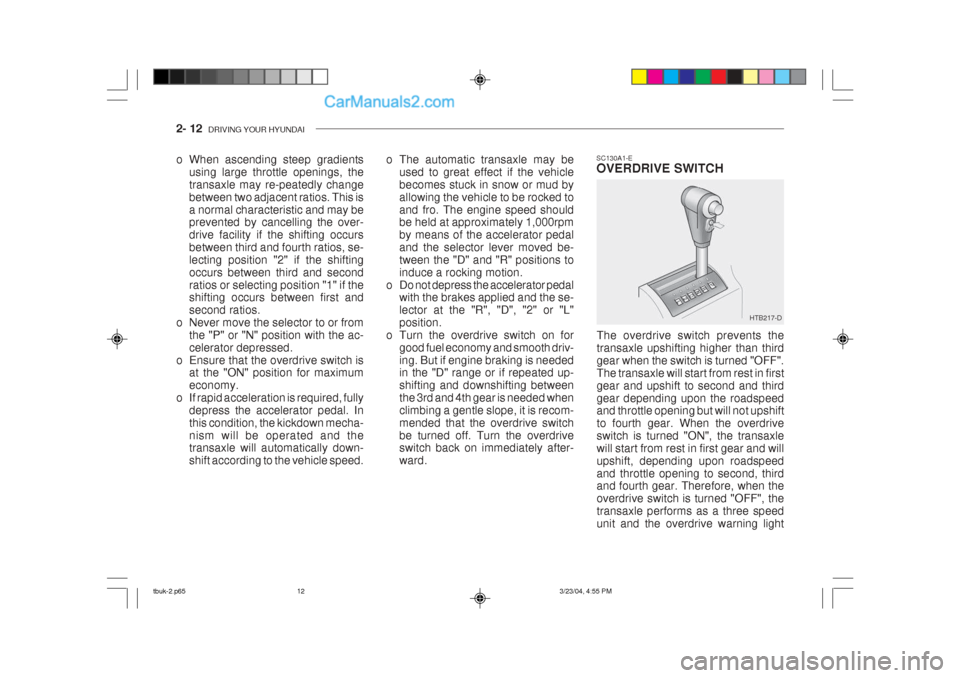
SC130A1-E OVERDRIVE SWITCH
The overdrive switch prevents the transaxle upshifting higher than thirdgear when the switch is turned "OFF".The transaxle will start from rest in firstgear and upshift to second and thirdgear depending upon the roadspeed and throttle opening but will not upshift to fourth gear. When the overdriveswitch is turned "ON", the transaxlewill start from rest in first gear and willupshift, depending upon roadspeedand throttle opening to second, third and fourth gear. Therefore, when the overdrive switch is turned "OFF", thetransaxle performs as a three speedunit and the overdrive warning light
o When ascending steep gradients
using large throttle openings, thetransaxle may re-peatedly changebetween two adjacent ratios. This isa normal characteristic and may be prevented by cancelling the over- drive facility if the shifting occursbetween third and fourth ratios, se-lecting position "2" if the shiftingoccurs between third and secondratios or selecting position "1" if the shifting occurs between first and second ratios.
o Never move the selector to or from
the "P" or "N" position with the ac-celerator depressed.
o Ensure that the overdrive switch is at the "ON" position for maximumeconomy.
o If rapid acceleration is required, fully
depress the accelerator pedal. Inthis condition, the kickdown mecha-nism will be operated and the transaxle will automatically down- shift according to the vehicle speed. o The automatic transaxle may be
used to great effect if the vehiclebecomes stuck in snow or mud byallowing the vehicle to be rocked toand fro. The engine speed should be held at approximately 1,000rpm by means of the accelerator pedaland the selector lever moved be-tween the "D" and "R" positions toinduce a rocking motion.
o Do not depress the accelerator pedal with the brakes applied and the se-lector at the "R", "D", "2" or "L"position.
o Turn the overdrive switch on for good fuel economy and smooth driv-ing. But if engine braking is needed in the "D" range or if repeated up- shifting and downshifting betweenthe 3rd and 4th gear is needed whenclimbing a gentle slope, it is recom-mended that the overdrive switchbe turned off. Turn the overdrive switch back on immediately after- ward.
tbuk-2.p65 3/23/04, 4:55 PM
12
Page 357 of 445

2- 14 DRIVING YOUR HYUNDAI
!WARNING:
ABS will not prevent accidents due to improper or dangerous drivingmaneuvers. Even though vehicle control is improved during emer- gency braking, always maintain asafe distance between you and ob-jects ahead. Vehicle speeds shouldalways be reduced during extremeroad conditions. The braking distance for cars equipped with an anti-lock brakingsystem may be longer than for thosewithout it in the following road con-ditions.
o Driving on rough, gravel or snow- covered roads.
o Driving with tyre chains installed.
o Driving on roads where the road
surface is pitted or has differentsurface height. These roads should be driven at reduced speeds. The safety features of an ABS equipped vehicle shouldnot be tested by high speed drivingor cornering. This could endangerthe safety of yourself or others. SC150A1-F DRIVING FOR ECONOMY You can save fuel and get more miles from your car if you follow these sug-gestions:
o Drive smoothly. Accelerate at a
moderate rate. Don't make "jack- rabbit" starts or full-throttle shiftsand maintain a steady cruisingspeed. Don't race between stop-lights. Try to adjust your speed tothat of the other traffic so you don't have to change speeds unneces- sarily.Avoid heavy traffic whenever pos-sible. Al-ways maintain a safe dis-tance from other vehicles so youcan avoid unnecessary braking. This also reduces brake wear. o Drive at a moderate speed. The
faster you drive, the more fuel your car uses. Driving at a moderatespeed, especially on the highway, isone of the most effective ways to reduce fuel consumption.
o Don't "ride" the brake or clutch pedal. This can increase fuel consumption and also increase wear on thesecomponents. In addition, driving withyour foot resting on the brake pedal may cause the brakes to overheat, which reduces their effectivenessand may lead to more serious con-sequences.
o Take care of your tyres. Keep them inflated to the recommended pres- sure. Incorrect infla-tion, either too much or too little, results in unnec-essary tyre wear. Check the tyrepres-sures at least once a month.
o Be sure that the wheels are aligned correctly. Improper alignment can result from hitting curbs or driving too fast over irregular surfaces. Pooralignment causes faster tyre wearand may also result in other prob-lems as well as greater fuel con-sumption.
tbuk-2.p65 3/23/04, 4:55 PM
14
Page 365 of 445

3- 2 WHAT TO DO IN AN EMERGENCY
HTB165
SD020B1-E
IF THE ENGINE CANNOT BE
CRANKED
1. If the vehicle is fitted with manual
transaxle, ensure that the clutch
pedal is depressed whilst cranking
the engine. If the vehicle is fitted
with automatic transaxle, ensure
that the transaxle selector is at the
"P" or"N" position.
2. Check the battery terminals and
connections to ensure that these
are clean and also tight.
3. If the ignition warning lights dim
when the engine is cranked and the
battery terminals have been
checked, a discharged battery is
indicated. SD020C1-F
If Engine Turns Over Normally
but Does Not Start
SD020A1-E
IF THE ENGINE WILL NOT START
Seek assistance from the nearest
Hyundai dealer with regard to the
method of ignition and fuel system
diagnosis.
!
HTB221
CAUTION:
If the engine refuses to start, no
attempt should be made to push or
tow start the vehicle. Vehicles with
automatic transaxle or fuel injec-
tion will not be able to be started in
this manner since no drive is trans-
mitted through the automatic
transaxle whilst the engine is not
running, and in the case of fuel
injected derivatives, the fuel pump
will not operate under tow start
conditions. In addition, if the ve-
hicle is equipped with an exhaust
catalyst, damage to the catalyst may
result if the vehicle is tow started. 4. Do not attempt to push or tow start
the vehicle, refer to "Jump Starting"
for information regarding engine
starting when the battery is dis-
charged.
1. Check fuel Level
2. Check all connectors at ignition coil and spark plugs.
Replace any that may be discon-
nected or loose.
3. Check fuel line in the engine com- partment.
4. If engine still refuses to start, call a
Hyundai dealer or seek other quali-
fied assistance.
tbuk-3.p65 3/23/04, 4:24 PM
2
Page 366 of 445

WHAT TO DO IN AN EMERGENCY 3- 3
!
HTB218
Discharged
battery
Booster
battery
CAUTION:
Personal injury and damage to the
vehicle may occur if jump starting
is not performed correctly. If any
doubt exists as to how this opera-
tion should be performed, seek as-
sistance from qualified personnel.
SD030A1-E
JUMP STARTING
AD020D1-A
If Engine Stalls While Driving
1. Reduce your speed gradually, keep-
ing a straight line. Move cautiously
off the road to a safe place.
2. Turn on your emergency flashers.
3. Try starting the engine again. If your
vehicle will not start, see "IF THE
ENGINE WILL NOT START"!
WARNING:
Motor vehicle batteries contain
sulphuric acid and emit hydrogen
gas. Protective clothing should be
worn and care exercised to prevent
the acid from coming into contact
with skin or clothing and the ve-
hicle. Naked lights should not be
permitted in the vicinity of the bat-
tery. Care should be exercised to
prevent sparks occurring during
connection. If acid accidentally
comes into contact with skin or
eyes, the affected area should im-
mediately be flushed with copious
amounts of water and medical as-
sistance sought. 1. Ensure that the booster battery is
12 volt type. If the booster battery is
installed in another vehicle, ensure
that the two vehicles are not touch-
ing.
2. Turn off all unnecessary electrical equipment in both vehicles.
3. Ensure that the engine of the ve-
hicle providing the jump start is run-
ning prior to connection of the jump
cables.
4. Connect the red jump cable to the positive (+) terminal of the booster
battery and the other end to the
positive (+) terminal of the dis-
charged battery.
5. Attach the black jump cable to the
negative (-) terminal of the booster
battery, and the other end to a ground
point within the engine compart-
ment of the vehicle with the flat
battery. Do not connect to the nega-
tive battery terminal of the flat bat-
tery since sparks may be generated
with the subsequent risk of explo-
sion.
6. Raise the booster vehicle engine speed to 2,000 r.p.m. and start the
engine of the vehicle with the flat
battery.
tbuk-3.p65 3/23/04, 4:24 PM
3
Page 397 of 445

6- 6 DO-IT-YOURSELF MAINTENANCE
SG020B1-E
DAILY OPERATING CHECKS
The following items should be checked
on a daily basis or whenever the vehicle
is refuelled, whichever occurs sooner.
o Engine oil level.
o Engine coolant level.
o Power steering fluid level.
o Brake fluid level.
o Windscreen washer fluid level.
o Battery condition.
o Tyre condition and pressures.
o Operation and cleanliness of all light-
ing equipment.
o Windscreen wiper and washer opera- tion.
o Horn operation.
o Warning light operation.
o Adjustment and cleanliness of mir- rors.
o Seat and seat belt adjustment and operation.
o Fluid leakage.
The vehicle must not be driven if the
daily operating checks indicate that
any item of equipment related to the
safety or roadworthiness of the vehicle
is not functioning correctly. G030B02A-EAT
Recommended Oil
1. Petrol engine
A multi grade oil having a specification
which meets A.P.I. specification of SG
or above is recommended. The oil vis-
cosity should be selected according to
the operating environment of the engine
by means of the table shown in the
illustration. The engine oil recommen-
dations are complete in themselves
and the use of additives is neither
required nor recommended. The use of
engine oil additives may result in invali-
dation of the vehicle warranty.
G030A01FC-EAT
ENGINE OIL
The correct engine oil level is of para-
mount importance. An excessively high
or low oil level may result in irreparable
damage being sustained by the engine.
The engine oil level must be checked
on a daily basis, whenever the vehicle
is refuelled or before starting a long trip,
whichever occurs sooner.
In addition, it is imperative that only an
approved grade and specification of oil
is used to avoid the possibility of seri-
ous engine damage and premature wear.
The use of "budget price" oil is a false
economy that must be avoided if the
maximum reliability and useful life is to
be obtained from the vehicle.
G030B01L
tbuk-6.p65
3/23/04, 4:26 PM
6
Page 415 of 445

6- 24 DO-IT-YOURSELF MAINTENANCE
!
!
SG200A1-E
FUSIBLE LINKS
The fusible link prevents damage to the
wiring harness in the event of an elec-
trical system malfunction. Failure of a
fusiblelink is indicative of a serious
overload condition having occurred and
therefore the electrical system should
be checked by a Hyundai dealer before
a replacement link is fitted.
WARNING:
Under no circumstances should a
fusible link be replaced with any-
thing other than a new link of the
same rating. The use of higher rated
links or other means of connecting
the circuit will create a potential fire
hazard.G200B01E-EAT
INDIVIDUAL CIRCUIT FUSES
The fuse box containing the individual
circuit fuses will be found in the back-
side of multi box located in the right side
of driver. The multi box is removed by
pulling lightly and then releasing the lid.
A fuse rating grid will be found on the
reverse side of the cover. In the event
of fuse failure, the fuse should be re-
placed with one of equivalent rating. A
fuse removal tool is provided within the
fuse box to facilitate replacement.
In the event of a replacement fuse
failing shortly after installation a mal-
function within the circuit protected by
that fuse is indicated. The circuit should
be checked by a Hyundai dealer at the
first available opportunity. HTB180-D
HTB223
WARNING:
The use of replacement fuses having
a higher rating than specified or other
means of connecting the circuit will
create a potential fire hazard.
tbuk-6.p65 3/23/04, 4:27 PM
24