2004 Hyundai Getz warning light
[x] Cancel search: warning lightPage 155 of 445

2- 20 DRIVING YOUR HYUNDAI
C190F02A-GAT Trailer or Vehicle Towing Tips
1. Before towing, check hitch and
safety chain connections as well as proper operation of the trailerrunning lights, brake lights, and turn signals.
2. Always drive your vehicle at a mod- erate speed (Less than 100 km/h).
3. Trailer towing requires more fuel
than normal conditions.
4. To maintain engine braking effi- ciency and electrical charging per- formance, do not use fifth gear(manual transaxle) or overdrive (au- tomatic transaxle).
5. Always secure items in the trailer to prevent load shift while driving.
Tongue
44
(97)
Without Brake Type Trailer
700 (1,543)
1000 (2,204)
1,100 (2,425) 1,100 (2,425) 900(1,984)
1,100 (2,425) 450(992)
MANUAL
TRANSAXLE
AUTO
TRANSAXLE
1.1L 1.3L1.6L
Diesel 1.3L1.6L
With
Brake Type
kg. (Lbs)
Coupling point
HTB312
C190E02L
Gross Axle Weight
Gross Vehicle
Weight
!!
Maximum Towable
Weight
5. The maximum permissible over-
hang of the coupling point : 690 mm CAUTION:
The following specifications are rec-ommended when towing a trailer.The loaded trailer weigh cannot safely exceed the values in the fol- lowing chart. WARNING:
Improperly loading your car andtrailer can serious affect its steer- ing and braking performance caus- ing a crash in which could causeserious injury or death.
Type
Page 159 of 445

WHAT TO DO IN AN EMERGENCY 3- 3
HTB218
Discharged battery
Booster battery
WARNING:
The gas produced by the battery during the jump-start operation is highly explosive. If these instruc- tions are not followed exactly, seri-ous personal injury and damage to the vehicle may occur! If you are not sure how to follow this proce-dure, seek qualified assistance. Automobile batteries contain sul- furic acid. This is poisonous andhighly corrosive. When jump start- ing, wear protective glasses and be careful not to get acid on yourself,your clothing or on the car. 3. Attach the clamps of the jumper
cable in the exact order shown in theillustration. That is, first, attach oneclamp of the jumper cable to the positive (+) post or cable of the discharged battery. Then attach theother end of the same cable to the positive (+) post or cable of the booster battery. Next, using theother cable, attach one clamp to the negative (-) post or cable of the booster battery. Then attach theother end of that cable to a solid metal part of the engine away from the battery. Do not connect the cableto any moving part.
4. Start the engine in the car with the
booster battery and let it run for afew minutes. This will help to as- sure that the booster battery is fully charged. During the jumping opera-tion, run the engine in this vehicle at about 2,000 rpm.
5. Start your engine using the normal starting procedure. After the enginestarts, leave the jumper cables con- nected and let the engine run at fastidle or about 2,000 rpm for several minutes.
D020A02A-AAT JUMP STARTING!
o If you should accidentally get acid
on your skin or in your eyes, immediately remove any contami-nated clothing and flush the area with clear water for at least 15 min- utes. Then promptly obtain medicalattention. If you must be transported to an emergency facility, continue to apply water to the affected areawith a sponge or cloth.
o The gas produced by the battery
during the jump-start operation ishighly explosive. Do not smoke or allow a spark or open flame in the vicinity.
o The battery being used to provide the jump start must be 12-volt. If youcannot determine that it is a 12-voltbattery, do not attempt to use it for the jump start.
o To jump start a car with a discharged battery, follow this procedure ex-actly:
1. If the booster battery is installed in another vehicle, be sure the two vehicles are not touching.
2. Turn off all unnecessary lights and accessories in both vehicles.
Page 160 of 445

3- 4 WHAT TO DO IN AN EMERGENCY
D030A01TB-AAT IF THE ENGINE OVERHEATS If your temperature gauge indicates overheating, you experience a loss of power, or hear loud pinging or knock- ing, the engine is probably too hot. Ifthis happens to you, you should:
1. Pull off the road and stop as soon as
it is safe to do so.
2. Place the gear selector lever in "P"
(automatic), or neutral (manual transaxle) and set the parking brake. If the air conditioning is on, turn it off.
6. Carefully remove the jumper cables
in the reverse order of attachment.
If you do not know why your battery became discharged (because the lights were left on, etc.), have the chargingsystem checked by your Hyundai dealer. 3. If engine coolant is running out un-
der the car or steam is coming out from the hood, stop the engine. Donot open the hood until the engine coolant has stopped running or the steaming has stopped. If there is novisible loss of engine coolant and no steam, leave the engine running and check to be sure the enginecooling fan is operating. If the fan is not running, turn the engine off.
4. Check to see if the water pump drive belt is missing. If it is not missing,check to see that it is tight. If the drive belt seems to be satisfactory,check for coolant leaking from the radiator, hoses or under the car. (If the air conditioning had been in use,it is normal for cold water to be draining from it when you stop). WARNING (Diesel only):
Never work on injection system with engine running or within 30 sec- onds after shutting off engine. High pressure pump, rail, injectors andhigh pressure pipes are subject to high pressure even after the engine stopped. The fuel jet produced byfuel leaks may cause serious in- jury, if it touch the body. People using pacemakers should not movethan 30cm closer to the ECU or wiring harness within the engine room while engine is running, sincethe high currents in the Common Rail system produce considerable magnetic fields.
WARNING:
While the engine is running, keep hair, hands, and clothing away from moving parts such as the fan anddrive belts to prevent injury.
!
!
5. If the water pump drive belt is bro- ken or coolant is leaking out, stop the engine immediately and call the nearest Hyundai dealer for assis-tance.
Page 166 of 445
3- 10 WHAT TO DO IN AN EMERGENCY
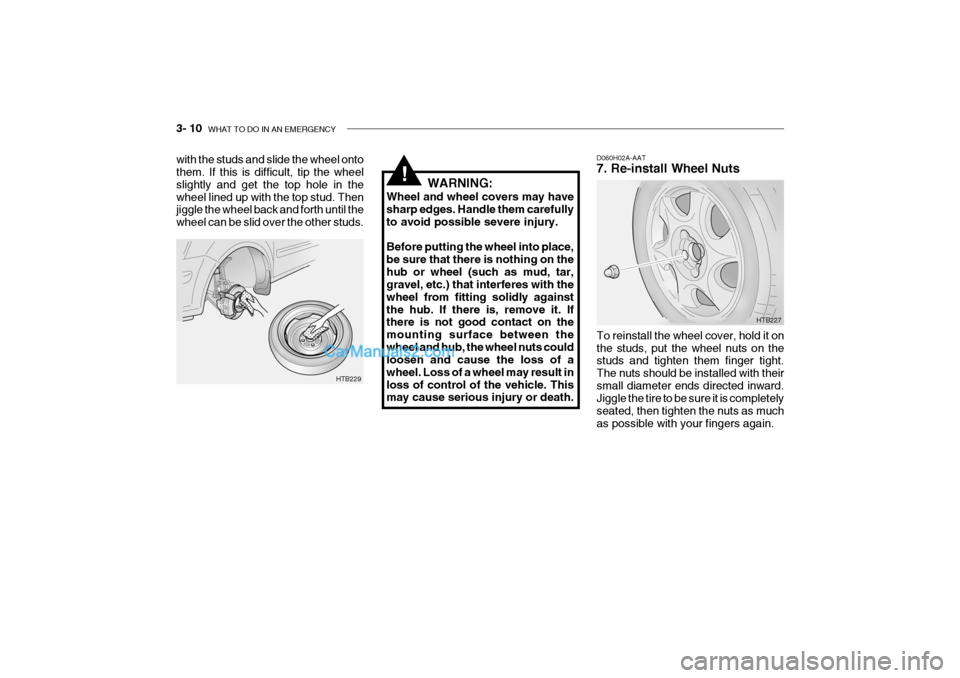
D060H02A-AAT 7. Re-install Wheel Nuts To reinstall the wheel cover, hold it on the studs, put the wheel nuts on the studs and tighten them finger tight. The nuts should be installed with theirsmall diameter ends directed inward. Jiggle the tire to be sure it is completely seated, then tighten the nuts as muchas possible with your fingers again.
WARNING:
Wheel and wheel covers may have sharp edges. Handle them carefully to avoid possible severe injury. Before putting the wheel into place, be sure that there is nothing on thehub or wheel (such as mud, tar, gravel, etc.) that interferes with the wheel from fitting solidly againstthe hub. If there is, remove it. If there is not good contact on the mounting surface between thewheel and hub, the wheel nuts could loosen and cause the loss of a wheel. Loss of a wheel may result inloss of control of the vehicle. This may cause serious injury or death.
!
HTB227
with the studs and slide the wheel onto them. If this is difficult, tip the wheel slightly and get the top hole in thewheel lined up with the top stud. Then jiggle the wheel back and forth until the wheel can be slid over the other studs.
HTB229
Page 215 of 445
6- 28 DO-IT-YOURSELF MAINTENANCE
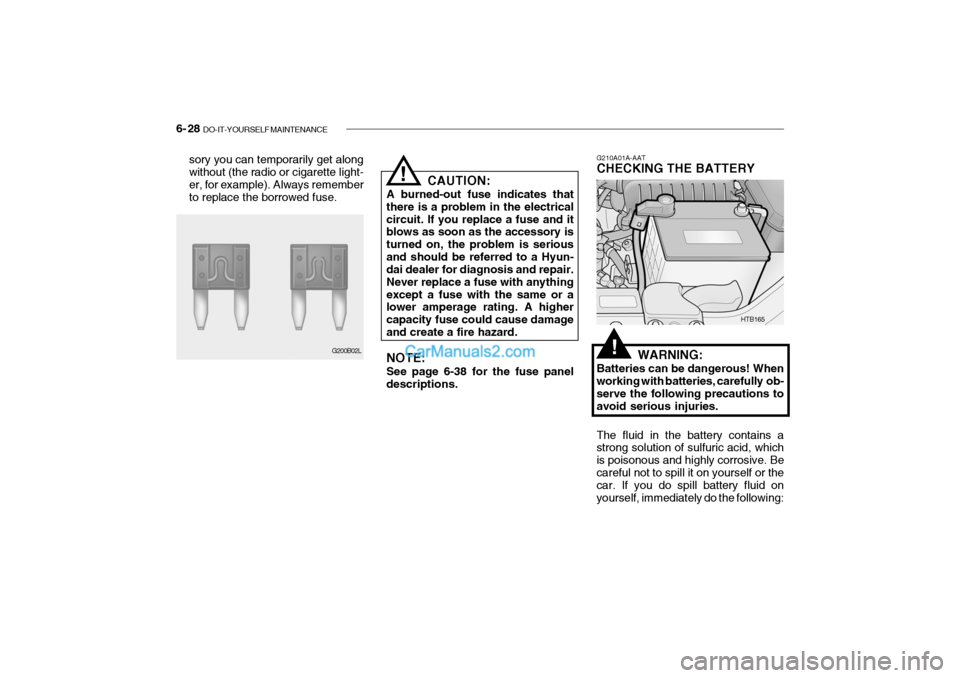
sory you can temporarily get along without (the radio or cigarette light- er, for example). Always rememberto replace the borrowed fuse. CAUTION:
A burned-out fuse indicates thatthere is a problem in the electricalcircuit. If you replace a fuse and it blows as soon as the accessory is turned on, the problem is seriousand should be referred to a Hyun- dai dealer for diagnosis and repair. Never replace a fuse with anythingexcept a fuse with the same or a lower amperage rating. A higher capacity fuse could cause damageand create a fire hazard. NOTE: See page 6-38 for the fuse panel descriptions.
! G210A01A-AAT CHECKING THE BATTERY
WARNING:
Batteries can be dangerous! When working with batteries, carefully ob-serve the following precautions to avoid serious injuries. HTB165
The fluid in the battery contains astrong solution of sulfuric acid, which is poisonous and highly corrosive. Becareful not to spill it on yourself or the car. If you do spill battery fluid on yourself, immediately do the following:
!G200B02L
Page 216 of 445

DO-IT-YOURSELF MAINTENANCE 6- 29
o If battery fluid is on your skin, flush
the affected areas with water for at least 15 minutes and then seekmedical assistance.
o If battery fluid is in your eyes, rinse
out your eyes with water and getmedical assistance as soon as pos- sible. While you are being driven to get medical assistance, continue torinse your eyes by using a sponge or soft cloth saturated with water.
o If you swallow battery fluid, drink a large quantity of water or milk fol-lowed by milk of magnesia, eat a raw egg or drink vegetable oil. Getmedical assistance as soon as pos- sible.
While batteries are being charged (ei-ther by a battery charger or by the vehicle's alternator), they produce ex-plosive gases. Always observe these warnings to prevent injuries from oc- curring:
o Charge batteries only in a well ven- tilated area.
o Do not permit flames, sparks or smoking in the area.
o Keep children away from the area. G220B01A-AAT Checking Engine Cooling Fan The engine coolant fan should come on automatically if the engine coolanttemperature is high. G220C01TB-AAT Checking Condenser Cooling Fan When the air conditioning is in opera- tion, the condenser cooling fan comes on automatically to be controlled by ECU.
G210B01A-AAT Checking the Battery Keep the battery clean. Any evidence of corrosion around the battery postsor terminals should be removed using a solution of household baking soda and warm water. After the battery ter-minals are dry, cover them with a light coating of grease. G220A01A-AAT CHECKING ELECTRIC COOL- ING FANS
WARNING:
The cooling fan is controlled by engine coolant temperature andmay sometimes operate even when the engine is not running. Use ex- treme caution when working nearthe blades of the coolant fan, so that you are not injured by a rotat- ing fan blade. As the engine cool-ant temperature decreases the fan will automatically shut off. This is a normal condition.
!
Page 217 of 445

6- 30 DO-IT-YOURSELF MAINTENANCE
HTB287
G240A01A-AAT POWER STEERING HOSES It is suggested that you check the power steering hose connections for fluid leakage at regular intervals. Thepower steering hoses should be re- placed if there is severe surface crack- ing, scuffing or worn spots. Deteriora-tion of the hose could cause prema- ture failure. G300A01TB-GAT REMOVAL OF WATER FROM THE FUEL FILTER(DIESEL ENGINE) If the fuel filter warning light illuminates during driving, it indicates that water has accumulated in the fuel filter. If this occurs, remove the water as describedbelow.
G230A03A-GAT POWER STEERING FLUID LEVEL The power steering fluid level should be checked regularly.To check the power steering fluid level, be sure the ignition is "OFF", then check to make certain that the powersteering fluid level is between the "MAX" and "MIN" level markings on the fluid reservoir. NOTE: Grinding noise from the power steering pump may be heard imme-diately after the engine is started in extremely cold conditions (below - 20°C). If the noise stops during warm
HTB163
up, there is no abnormal function in the system. It is due to a power steering fluid characteristic in ex-tremely cold conditions. Recommended Fluid Use PSF-3 type fluid NOTE: Do not start the engine when the power steering oil reservoir is empty.
Page 218 of 445

DO-IT-YOURSELF MAINTENANCE 6- 31
1. Remove the engine cover.
2. Disconnect the air intake hose from
air cleaner cover.
3. Loosen the drain plug at the bottom of the fuel filter.
4. Tighten the drain plug when water no longer comes out.
5. Check to be sure that the warning
lamp illuminates when the ignition key is turned to "ON", and that it goes off when the engine is started. If in doubt, consult your nearestauthorized HYUNDAI dealer.
NOTE: It is recommended that water accu- mulated in the fuel filter should beremoved by an authorized Hyundai dealer. G300B01FC
WARNING:
Be sure to carefully wipe away anywater drained out in this manner, because the fuel mixed in the watermight be ignited and result in a fire.
!
5. Open the hood.
6. Draw the vertical line (through the center of each headlight beam pat-tern) and the horizontal line (throughthe center of each headlight beam pattern) on the aiming screen. And then, draw the horizontal paral- lel line at 30 mm (1.18 in.) under the horizontal line.
7. Adjust each cut-off line of the low beam to the parallel line with a phillipsscrewdriver - VERTICAL AIMING.
8. Adjust each cut-off line of the low
beam to each vertical line with aphillips screwdriver - HORIZONTAL AIMING. HTB269
Horizontal Aiming
Vertical Aiming
G290A01FC-GAT HEADLIGHT AIMING ADJUST- MENT Before performing aiming adjustment, make sure of the following.
1. Keep all tires inflated to the correct pressure.
2. Place the vehicle on level ground
and press the front bumper and rear bumper down several times. Place the vehicle at a distance of 3,000 mm (118 in.) from the test wall.
3. See that the vehicle is unloaded (except for full levels of coolant,engine oil and fuel, and spare tire,jack, and tools).
4. Clean the head lights lens and turn
on the headlight (low beam).