Page 1 of 232
Introduction 4
Instrument Cluster 10
Warning and control lights 10
Gauges 14
Entertainment Systems 16
AM/FM stereo cassette 16
AM/FM stereo with CD 19
Climate Controls 34
Heater only 34
Manual heating and air conditioning 35
Rear window defroster 37
Lights 38
Headlamps 38
Turn signal control 41
Driver Controls 50
Windshield wiper/washer control 50
Steering wheel adjustment 51
Power windows 52
Mirrors 53
Speed control 54
Locks and Security 61
Keys 61
Locks 61
Anti-theft system 64
2004 Focus(foc)
Owners Guide (post-2002-fmt)
USA English(fus)
Table of Contents
Table of Contents
1
Page 9 of 232
Vehicle Symbol Glossary
Power Windows
Front/Rear
Power Window Lockout
Child Safety Door
Lock/UnlockInterior Luggage
Compartment Release
Symbol
Panic AlarmEngine Oil
Engine CoolantEngine Coolant
Temperature
Do Not Open When HotBattery
Avoid Smoking, Flames,
or SparksBattery Acid
Explosive GasFan Warning
Power Steering FluidMaintain Correct Fluid
LevelMAX
MIN
Emission SystemEngine Air Filter
Passenger Compartment
Air FilterJack
Check fuel capLow tire warning
2004 Focus(foc)
Owners Guide (post-2002-fmt)
USA English(fus)
Introduction
9
Page 52 of 232
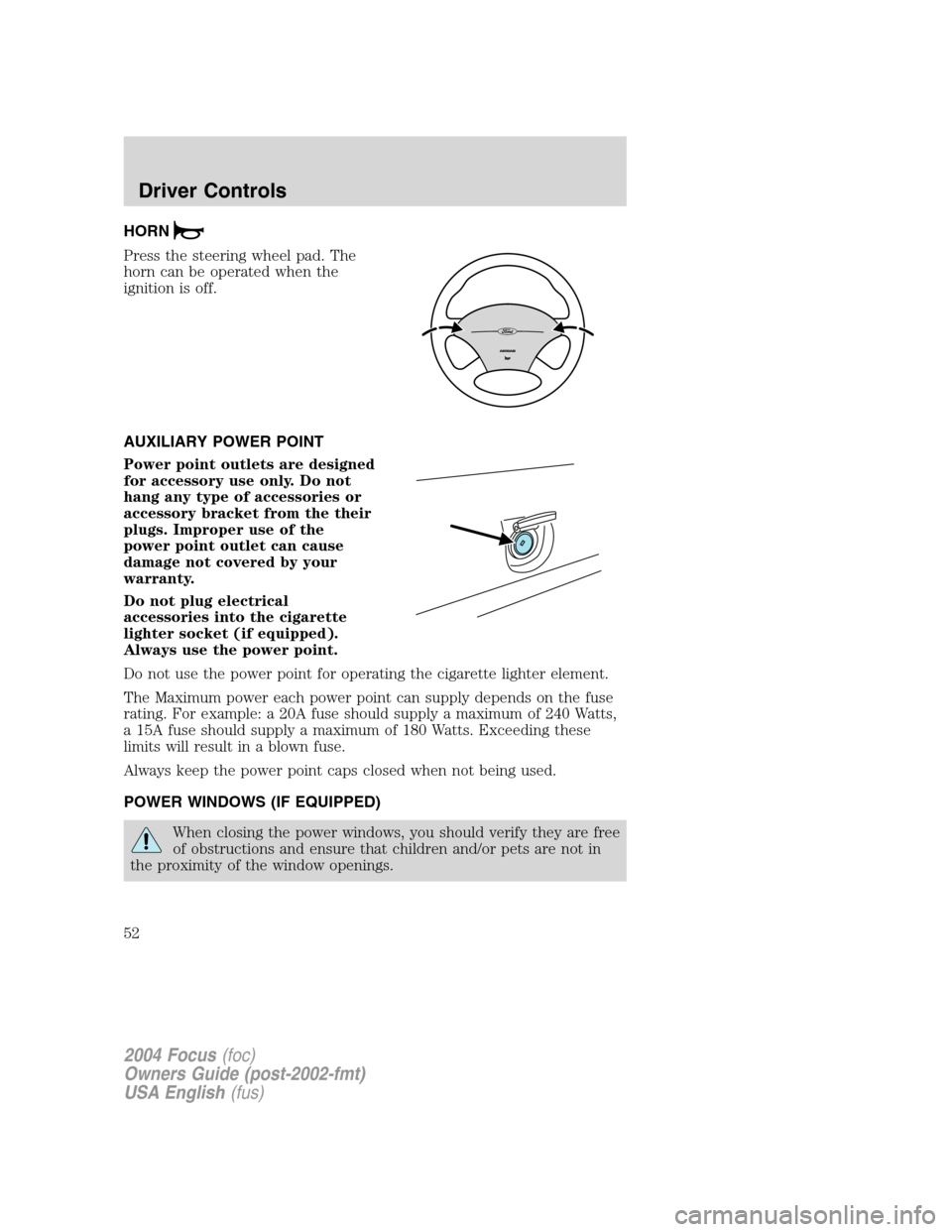
HORN
Press the steering wheel pad. The
horn can be operated when the
ignition is off.
AUXILIARY POWER POINT
Power point outlets are designed
for accessory use only. Do not
hang any type of accessories or
accessory bracket from the their
plugs. Improper use of the
power point outlet can cause
damage not covered by your
warranty.
Do not plug electrical
accessories into the cigarette
lighter socket (if equipped).
Always use the power point.
Do not use the power point for operating the cigarette lighter element.
The Maximum power each power point can supply depends on the fuse
rating. For example: a 20A fuse should supply a maximum of 240 Watts,
a 15A fuse should supply a maximum of 180 Watts. Exceeding these
limits will result in a blown fuse.
Always keep the power point caps closed when not being used.
POWER WINDOWS (IF EQUIPPED)
When closing the power windows, you should verify they are free
of obstructions and ensure that children and/or pets are not in
the proximity of the window openings.
2004 Focus(foc)
Owners Guide (post-2002-fmt)
USA English(fus)
Driver Controls
52
Page 107 of 232
STARTING
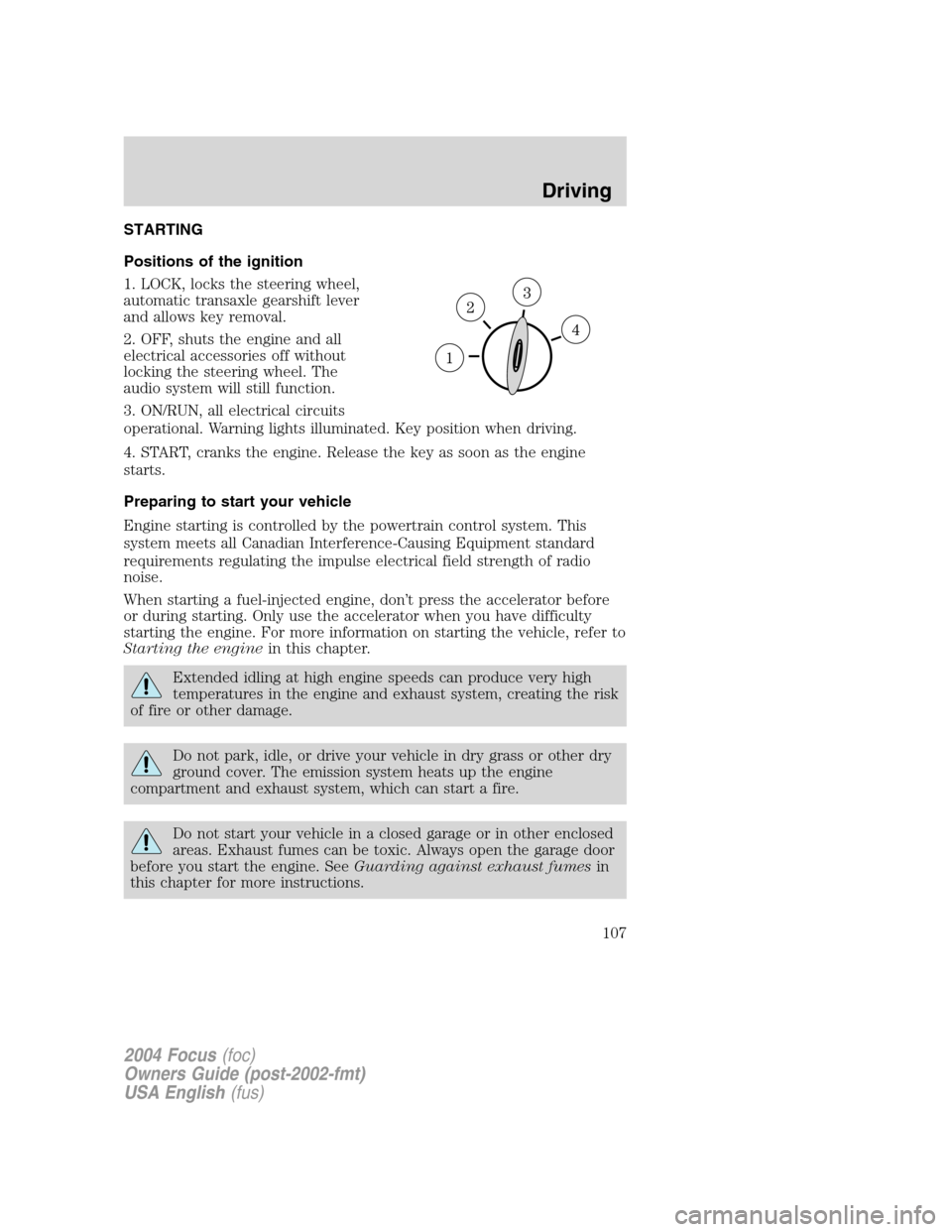
Positions of the ignition
1. LOCK, locks the steering wheel,
automatic transaxle gearshift lever
and allows key removal.
2. OFF, shuts the engine and all
electrical accessories off without
locking the steering wheel. The
audio system will still function.
3. ON/RUN, all electrical circuits
operational. Warning lights illuminated. Key position when driving.
4. START, cranks the engine. Release the key as soon as the engine
starts.
Preparing to start your vehicle
Engine starting is controlled by the powertrain control system. This
system meets all Canadian Interference-Causing Equipment standard
requirements regulating the impulse electrical field strength of radio
noise.
When starting a fuel-injected engine, don’t press the accelerator before
or during starting. Only use the accelerator when you have difficulty
starting the engine. For more information on starting the vehicle, refer to
Starting the enginein this chapter.
Extended idling at high engine speeds can produce very high
temperatures in the engine and exhaust system, creating the risk
of fire or other damage.
Do not park, idle, or drive your vehicle in dry grass or other dry
ground cover. The emission system heats up the engine
compartment and exhaust system, which can start a fire.
Do not start your vehicle in a closed garage or in other enclosed
areas. Exhaust fumes can be toxic. Always open the garage door
before you start the engine. SeeGuarding against exhaust fumesin
this chapter for more instructions.
2004 Focus(foc)
Owners Guide (post-2002-fmt)
USA English(fus)
Driving
Driving
107
Page 113 of 232
TRACTION CONTROL�(IF EQUIPPED)
Your vehicle may be equipped with a Traction Control�system. This
system helps you maintain the stability and steerability of your vehicle,
especially on slippery road surfaces such as snow- or ice-covered roads
and gravel roads. The system will allow your vehicle to make better use
of available traction in these conditions.
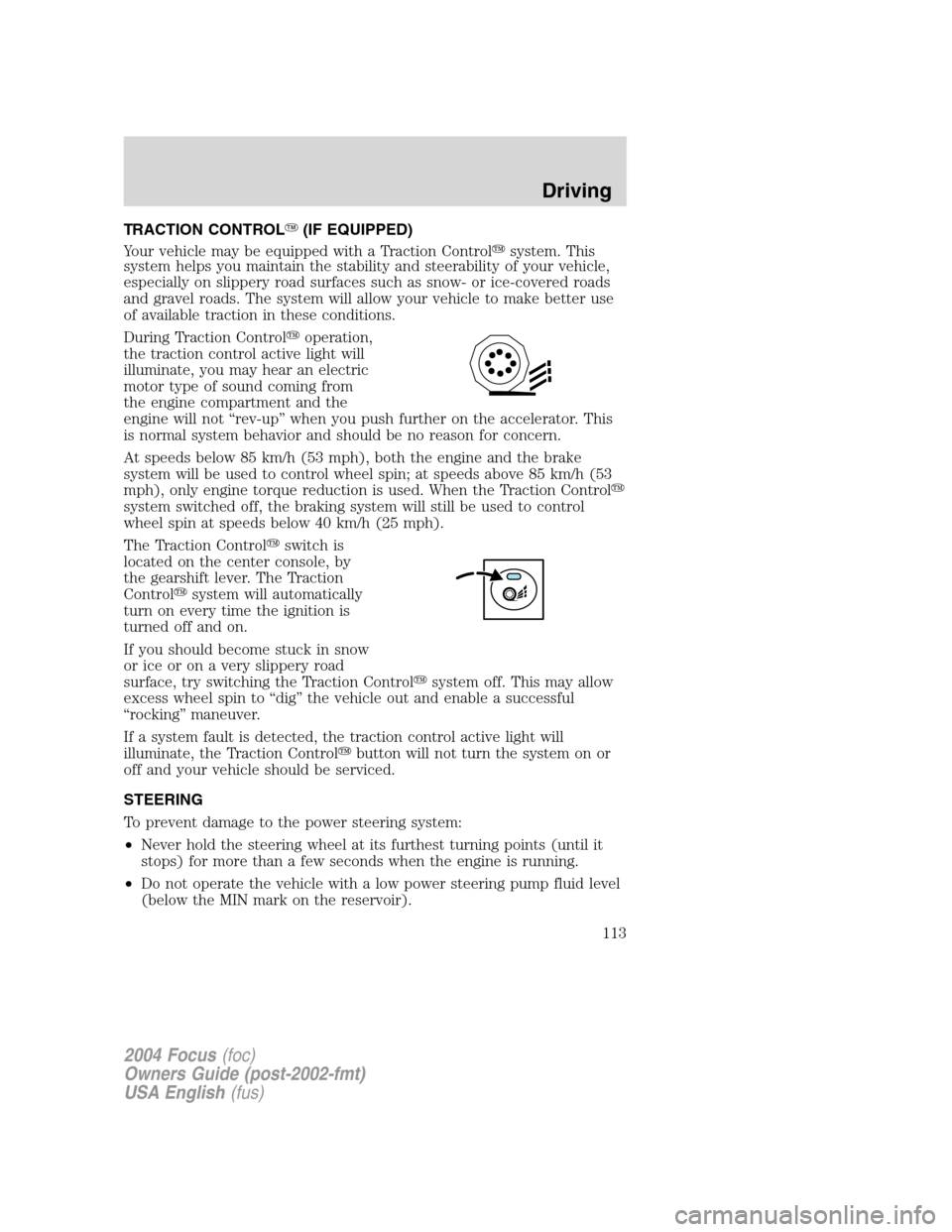
During Traction Control�operation,
the traction control active light will
illuminate, you may hear an electric
motor type of sound coming from
the engine compartment and the
engine will not“rev-up”when you push further on the accelerator. This
is normal system behavior and should be no reason for concern.
At speeds below 85 km/h (53 mph), both the engine and the brake
system will be used to control wheel spin; at speeds above 85 km/h (53
mph), only engine torque reduction is used. When the Traction Control�
system switched off, the braking system will still be used to control
wheel spin at speeds below 40 km/h (25 mph).
The Traction Control�switch is
located on the center console, by
the gearshift lever. The Traction
Control�system will automatically
turn on every time the ignition is
turned off and on.
If you should become stuck in snow
or ice or on a very slippery road
surface, try switching the Traction Control�system off. This may allow
excess wheel spin to“dig”the vehicle out and enable a successful
“rocking”maneuver.
If a system fault is detected, the traction control active light will
illuminate, the Traction Control�button will not turn the system on or
off and your vehicle should be serviced.
STEERING
To prevent damage to the power steering system:
•Never hold the steering wheel at its furthest turning points (until it
stops) for more than a few seconds when the engine is running.
•Do not operate the vehicle with a low power steering pump fluid level
(below the MIN mark on the reservoir).
2004 Focus(foc)
Owners Guide (post-2002-fmt)
USA English(fus)
Driving
113
Page 114 of 232

If the power steering system breaks down (or if the engine is turned
off), you can steer the vehicle manually, but it takes more effort.
If the steering wanders or pulls, check for:
•an improperly inflated tire
•uneven tire wear
•loose or worn suspension components
•loose or worn steering components
•improper steering alignment
A high crown in the road or high crosswinds may also make the steering
seem to wander/pull.
AUTOMATIC TRANSMISSION OPERATION (IF EQUIPPED)
Brake-shift interlock
This vehicle is equipped with a brake-shift interlock feature that prevents
the gearshift lever from being moved from P (Park) when the ignition is
in the ON position unless the brake pedal is depressed.
If you cannot move the gearshift lever out of P (Park) with ignition in
the ON position and the brake pedal depressed:
1. Apply the parking brake, turn ignition key to LOCK, then remove the
key.
When the key is in the ignition and in the OFF position, the
automatic transmission shift lever can be moved from the P
(Park) position without the brake pedal depressed. To avoid unwanted
vehicle movement, always set the parking brake.
2. Using a screwdriver (or similar
tool), remove the protective cover
to the interlock access hole on the
console. Insert the key to release
the interlock.
3. Apply the parking brake, then shift to N (Neutral).
2004 Focus(foc)
Owners Guide (post-2002-fmt)
USA English(fus)
Driving
114
Page 135 of 232
Fuse/Relay
LocationFuse Amp
RatingPower Distribution Box
Description
64 40A Heater blower motor
R1—Ignition relay
R2—Air pump motor relay (2.3L
engine only)
R3—Cooling fan (Run-on fan) relay
(2.3L engine only)
R4—Not used
R5—High beams relay
R6—Low beams relay
R7—Fuel pump relay
R8—Engine management relay
R9—Cooling fan relay (2.0L engine
only)
R10—Cooling fan 2 relay (2.0L engine
only)
R11—Air conditioning relay
R12—Daytime Running Lamps (DRL)
relay
R13—Fog lamps relay
R14—HID lamps (SVT only)
R15—Cooling fan high speed (A/C only)
relay (2.0L engine only)
R16—Cooling fan low speed relay
D1—PCM diode
D2—Cooling fan diode
D3—A/C clutch diode
CHANGING A FLAT TIRE
If you get a flat tire while driving:
•do not brake heavily.
•gradually decrease the vehicle’s speed.
•hold the steering wheel firmly.
•slowly move to a safe place on the side of the road.
2004 Focus(foc)
Owners Guide (post-2002-fmt)
USA English(fus)
Roadside Emergencies
135
Page 166 of 232
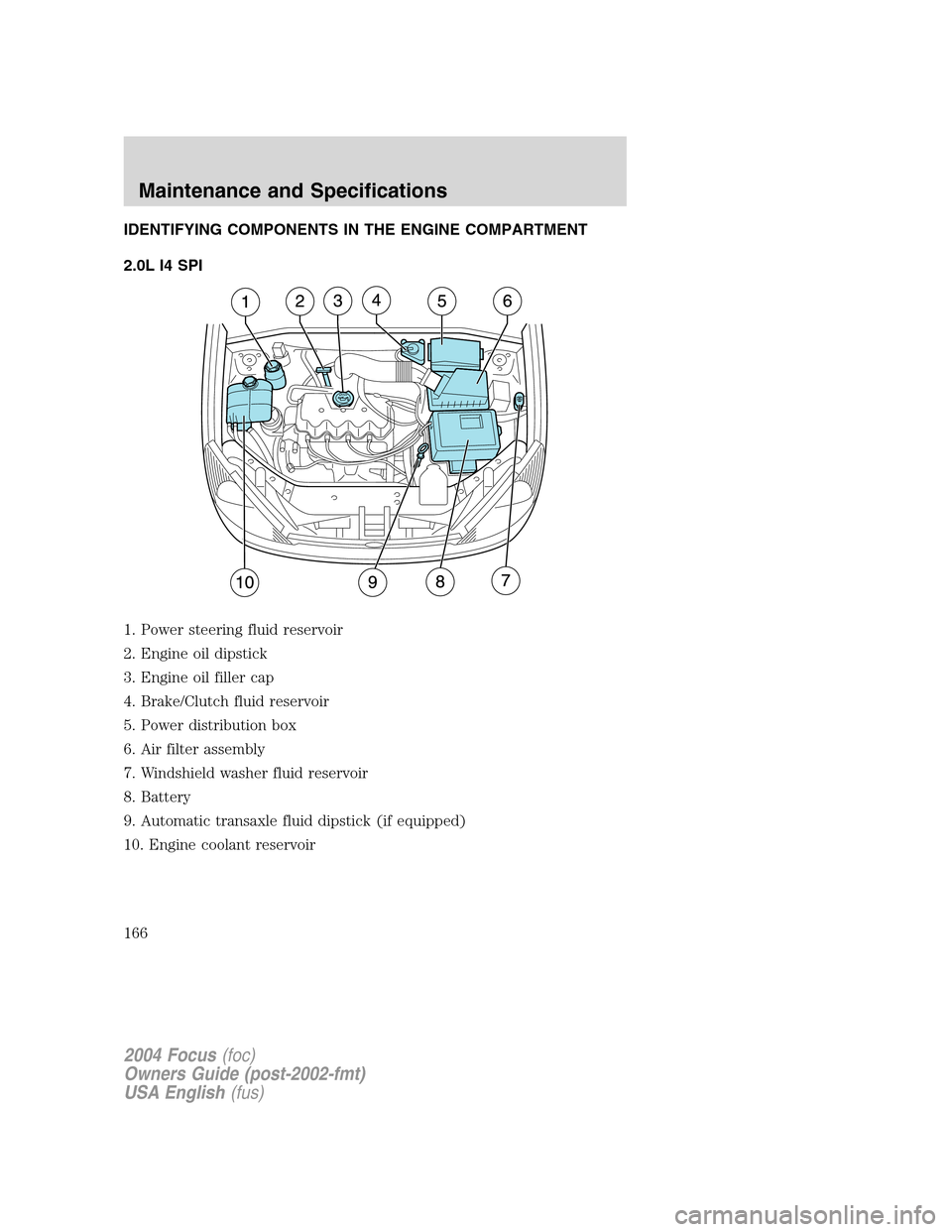
IDENTIFYING COMPONENTS IN THE ENGINE COMPARTMENT
2.0L I4 SPI
1. Power steering fluid reservoir
2. Engine oil dipstick
3. Engine oil filler cap
4. Brake/Clutch fluid reservoir
5. Power distribution box
6. Air filter assembly
7. Windshield washer fluid reservoir
8. Battery
9. Automatic transaxle fluid dipstick (if equipped)
10. Engine coolant reservoir
2004 Focus(foc)
Owners Guide (post-2002-fmt)
USA English(fus)
Maintenance and Specifications
166