2004 FORD F150 change time
[x] Cancel search: change timePage 209 of 280
In the United States, a warranty dispute must be submitted to the
Dispute Settlement Board before taking action under the Magnuson-Moss
Warranty Act, or to the extent allowed by state law, before pursuing
replacement or repurchase remedies provided by certain state laws. This
dispute handling procedure is not required prior to enforcing state
created rights or other rights which are independent of the
Magnuson-Moss Warranty Act or state replacement or repurchase laws.
FORD EXTENDED SERVICE PLAN
You can get more protection for your new car or light truck by
purchasing Ford Extended Service Plan (Ford ESP) coverage. Ford ESP
is an optional service contract which is backed by Ford Motor Company
or Ford Motor Service Company (in the U.S.) and Ford of Canada (in
Canada). It provides the following:
²Benefits during the warranty period depending on the plan you
purchase (such as: reimbursement for rentals; coverage for certain
maintenance and wear items).
²Protection against covered repair costs after your Bumper-to-Bumper
Warranty expires.
You may purchase Ford ESP from any participating Ford and Lincoln
Mercury and Ford of Canada dealer. There are several plans available in
various time, distance and deductible combinations which can be tailored
to fit your own driving needs. Ford ESP also offers reimbursement
benefits for towing and rental coverage.
When you buy Ford ESP, you receive Peace-of-Mind protection
throughout the United States and Canada, provided by a network of
more than 5,000 participating Ford or Lincoln Mercury and Ford of
Canada dealers.
If you did not take advantage of the Ford Extended Service Plan at the
time of purchasing your vehicle, you may still be eligible. Since this
information is subject to change, please ask your dealer for complete
details about Ford Extended Service Plan coverage options, or visit the
Ford ESP website at www.ford-esp.com.
THE DISPUTE SETTLEMENT BOARD (U.S. ONLY)
The Dispute Settlement Board is:
²an independent, third-party arbitration program for warranty disputes.
²available free to owners and lessees of qualifying Ford Motor Company
vehicles.
Customer Assistance
209
Page 243 of 280
5. Follow one of the simple calculations in order to determine fuel
economy:
Calculation 1:Multiply liters used by 100, then divide by total
kilometers traveled.
Calculation 2:Divide total miles traveled by total gallons used.
Keep a record for at least one month and record the type of driving (city
or highway). This will provide an accurate estimate of the vehicle's fuel
economy under current driving conditions. Additionally, keeping records
during summer and winter will show how temperature impacts fuel
economy. In general, lower temperatures give lower fuel economy.
Driving style Ð good driving and fuel economy habits
Give consideration to the lists that follow and you may be able to change
a number of variables and improve your fuel economy.
Habits
²Smooth, moderate operation can yield up to 10% savings in fuel.
²Steady speeds without stopping will usually give the best fuel
economy.
²Idling for long periods of time (greater than one minute) may waste
fuel.
²Anticipate stopping; slowing down may eliminate the need to stop.
²Sudden or hard accelerations may reduce fuel economy.
²Slow down gradually.
²Driving at reasonable speeds (traveling at 88 km/h [55 mph] uses 15%
less fuel than traveling at 105 km/h [65 mph]).
²Revving the engine before turning it off may reduce fuel economy.
²Using the air conditioner or defroster may reduce fuel economy.
²You may want to turn off the speed control in hilly terrain if
unnecessary shifting between third and fourth gear occurs.
Unnecessary shifting of this type could result in reduced fuel
economy.
²Warming up a vehicle on cold mornings is not required and may
reduce fuel economy.
²Resting your foot on the brake pedal while driving may reduce fuel
economy.
²Combine errands and minimize stop-and-go driving.
Maintenance and Specifications
243
Page 248 of 280
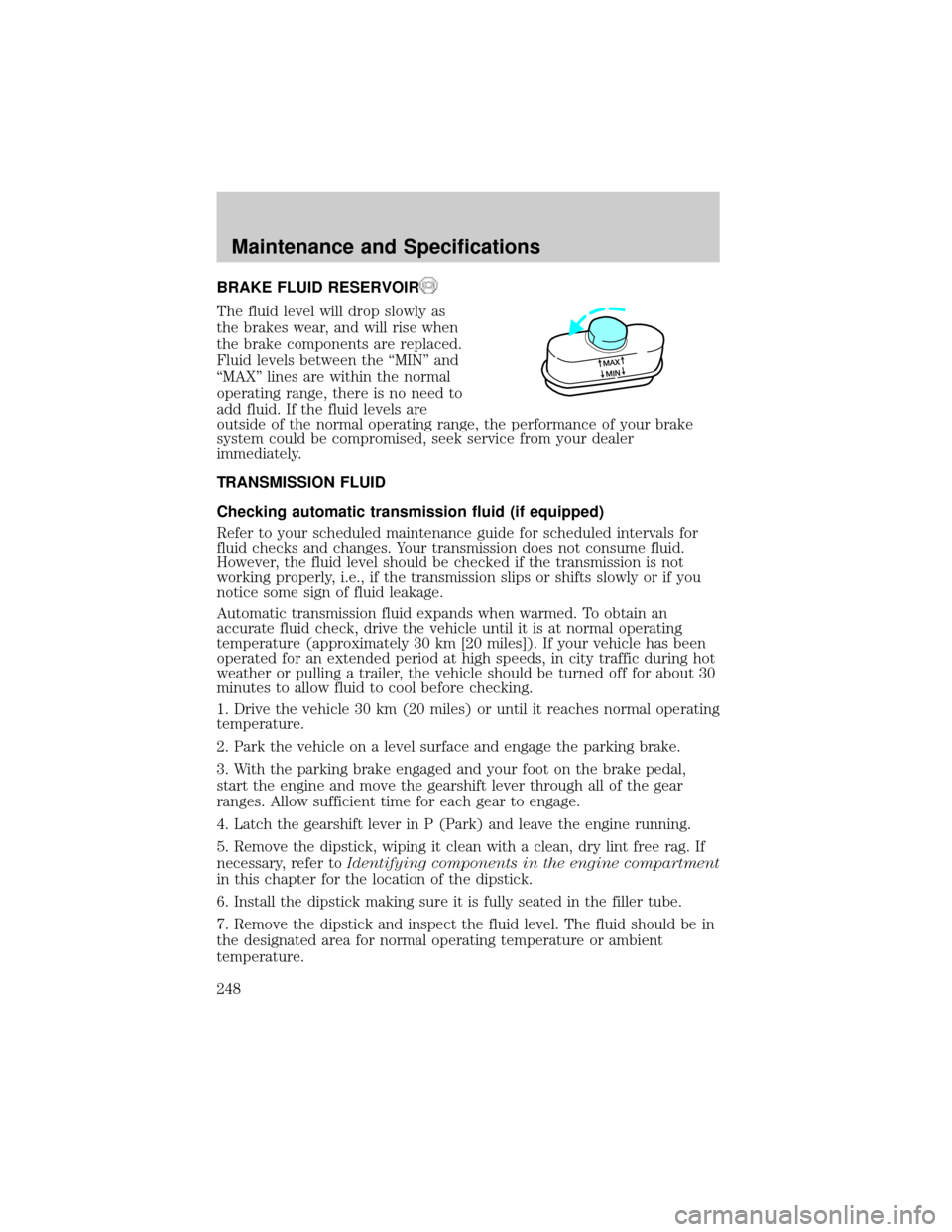
BRAKE FLUID RESERVOIR
The fluid level will drop slowly as
the brakes wear, and will rise when
the brake components are replaced.
Fluid levels between the ªMINº and
ªMAXº lines are within the normal
operating range, there is no need to
add fluid. If the fluid levels are
outside of the normal operating range, the performance of your brake
system could be compromised, seek service from your dealer
immediately.
TRANSMISSION FLUID
Checking automatic transmission fluid (if equipped)
Refer to your scheduled maintenance guide for scheduled intervals for
fluid checks and changes. Your transmission does not consume fluid.
However, the fluid level should be checked if the transmission is not
working properly, i.e., if the transmission slips or shifts slowly or if you
notice some sign of fluid leakage.
Automatic transmission fluid expands when warmed. To obtain an
accurate fluid check, drive the vehicle until it is at normal operating
temperature (approximately 30 km [20 miles]). If your vehicle has been
operated for an extended period at high speeds, in city traffic during hot
weather or pulling a trailer, the vehicle should be turned off for about 30
minutes to allow fluid to cool before checking.
1. Drive the vehicle 30 km (20 miles) or until it reaches normal operating
temperature.
2. Park the vehicle on a level surface and engage the parking brake.
3. With the parking brake engaged and your foot on the brake pedal,
start the engine and move the gearshift lever through all of the gear
ranges. Allow sufficient time for each gear to engage.
4. Latch the gearshift lever in P (Park) and leave the engine running.
5. Remove the dipstick, wiping it clean with a clean, dry lint free rag. If
necessary, refer toIdentifying components in the engine compartment
in this chapter for the location of the dipstick.
6. Install the dipstick making sure it is fully seated in the filler tube.
7. Remove the dipstick and inspect the fluid level. The fluid should be in
the designated area for normal operating temperature or ambient
temperature.
MAX
MIN
Maintenance and Specifications
248
Page 260 of 280
4Approximate dry fill capacity including transmission fluid cooling
system, actual refill capacities will vary based on vehicle application and
transmission fluid cooling system (i.e. coolers size, cooling lines. auxiliary
cooler capacities). The amount of transmission fluid and fluid level
should be set by the indication on the dipstick's normal operating range.
5Your vehicle's rear axle is filled with a synthetic rear axle lubricant and
is considered lubricated for life. These lubricants do not need to be
checked or changed unless a leak is suspected, service is required or the
axle assembly has been submerged in water. The axle lubricant should
be changed any time the rear axle has been submerged in water.
6Service refill capacity is determined by filling the axle to 6-14 mm
(1/4-9/16 inch) below the bottom of the filler hole with the vehicle on a
level surface.
Add 118 ml (4 oz.) of FEHP Friction Modifier, XL-7 or equivalent, for
complete fill of 8.8 inch and 9.75 inch Traction-Lok axles.
7Service refill capacity is determined by filling the axle to the bottom of
the filler hole with the vehicle on a level surface.
For 10.25 inch Traction-Lok axles, use 3.1L (6.5 pints) of Motorcraft SAE
75W-90 Fuel Efficient High Performance Synthetic Rear Axle Lubricant
and 118 ml (4 oz.) of FEHP Friction Modifier XL-7 or equivalent.
8Use of synthetic or synthetic blend motor oil is not mandatory. Engine
oil need only meet the requirements of Ford specification
WSS-M2C153±H and the API Certification mark.
Maintenance and Specifications
260
Page 277 of 280

heating and air conditioning
system ...........................33, 35, 37
HomeLink universal
transceiver (see Garage door
opener) ........................................69
Homelink wireless control
system ..........................................66
Hood
..........................................223
I
Ignition
...............................144, 263
Infant seats
(see Safety seats)
.....................133
Inspection/maintenance (I/M)
testing
........................................246
Instrument panel
cleaning
...................................219
cluster
........................................10
lighting up panel and
interior
.......................................43
J
Jack
............................................195
positioning
...............................195
storage
.....................................195
Jump-starting your vehicle
......201
K
Keyless entry system
.................92
autolock
.....................................90
programming entry code
.........92
Keys
.............................................95
positions of the ignition
.........144L
Lamps
autolamp system .......................41
bulb replacement
specifications chart ..................47
daytime running light ...............42
fog lamps ...................................42
headlamps .................................41
headlamps, flash to pass ..........43
instrument panel, dimming .....43
interior lamps .....................45±46
replacing bulbs ...................47±51
Lane change indicator
(see Turn signal) ........................45
Lights, warning and indicator ....10
anti-lock brakes (ABS) ..........149
Load limits .................................171
GAWR ......................................171
GVWR ......................................171
trailer towing ..........................171
Loading instructions .................172
Locks
autolock .....................................90
childproof ..................................83
Lubricant specifications ...261, 263
Lumbar support, seats ...............99
M
Message center ...........................70
english/metric button ...............74
system check button ................74
warning messages .....................75
Mirrors ...................................53, 59
automatic dimming rearview
mirror ........................................59
fold away ...................................61
programmable memory ....86, 100
side view mirrors (power) .......59
Index
277