2004 FORD F150 fuel type
[x] Cancel search: fuel typePage 243 of 280
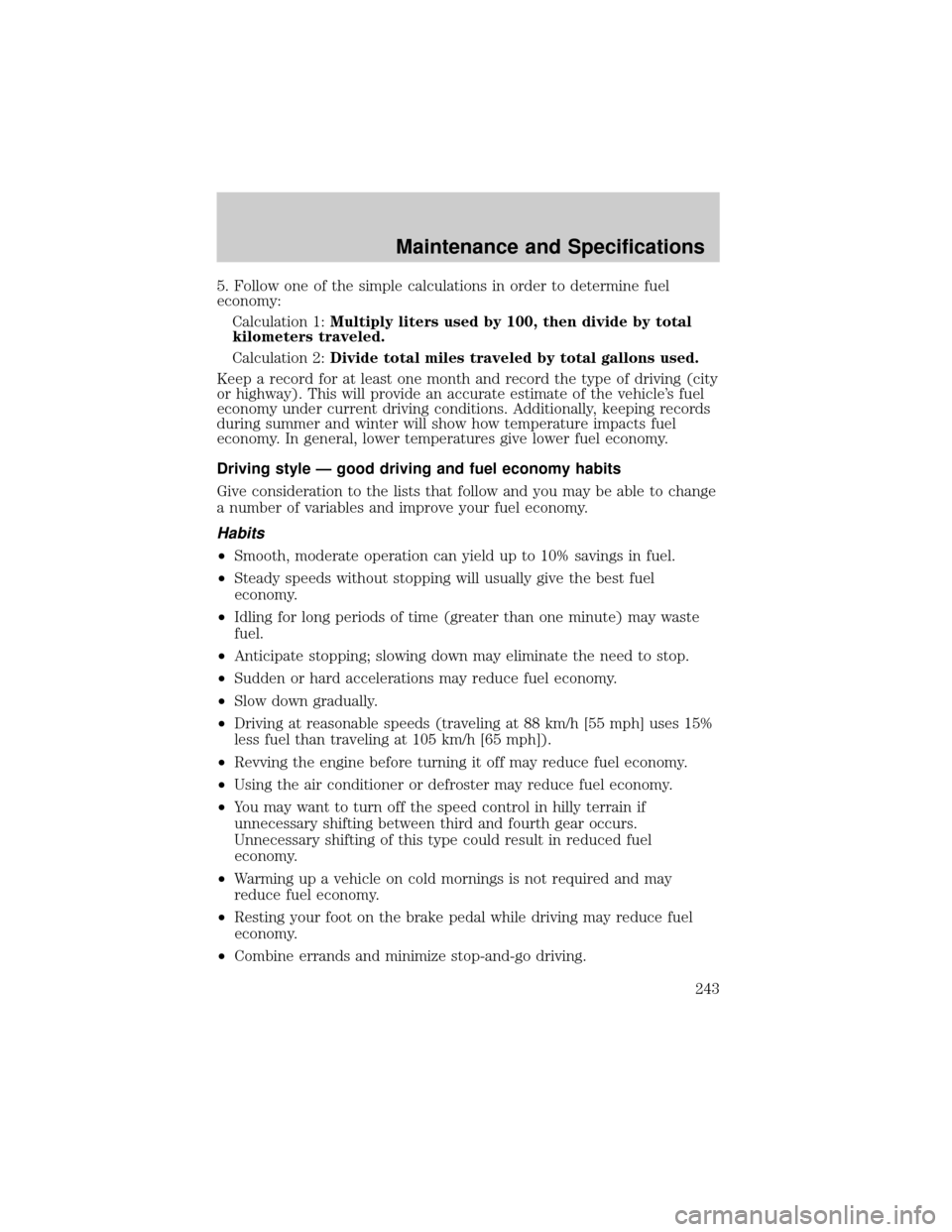
5. Follow one of the simple calculations in order to determine fuel
economy:
Calculation 1:Multiply liters used by 100, then divide by total
kilometers traveled.
Calculation 2:Divide total miles traveled by total gallons used.
Keep a record for at least one month and record the type of driving (city
or highway). This will provide an accurate estimate of the vehicle's fuel
economy under current driving conditions. Additionally, keeping records
during summer and winter will show how temperature impacts fuel
economy. In general, lower temperatures give lower fuel economy.
Driving style Ð good driving and fuel economy habits
Give consideration to the lists that follow and you may be able to change
a number of variables and improve your fuel economy.
Habits
²Smooth, moderate operation can yield up to 10% savings in fuel.
²Steady speeds without stopping will usually give the best fuel
economy.
²Idling for long periods of time (greater than one minute) may waste
fuel.
²Anticipate stopping; slowing down may eliminate the need to stop.
²Sudden or hard accelerations may reduce fuel economy.
²Slow down gradually.
²Driving at reasonable speeds (traveling at 88 km/h [55 mph] uses 15%
less fuel than traveling at 105 km/h [65 mph]).
²Revving the engine before turning it off may reduce fuel economy.
²Using the air conditioner or defroster may reduce fuel economy.
²You may want to turn off the speed control in hilly terrain if
unnecessary shifting between third and fourth gear occurs.
Unnecessary shifting of this type could result in reduced fuel
economy.
²Warming up a vehicle on cold mornings is not required and may
reduce fuel economy.
²Resting your foot on the brake pedal while driving may reduce fuel
economy.
²Combine errands and minimize stop-and-go driving.
Maintenance and Specifications
243
Page 256 of 280
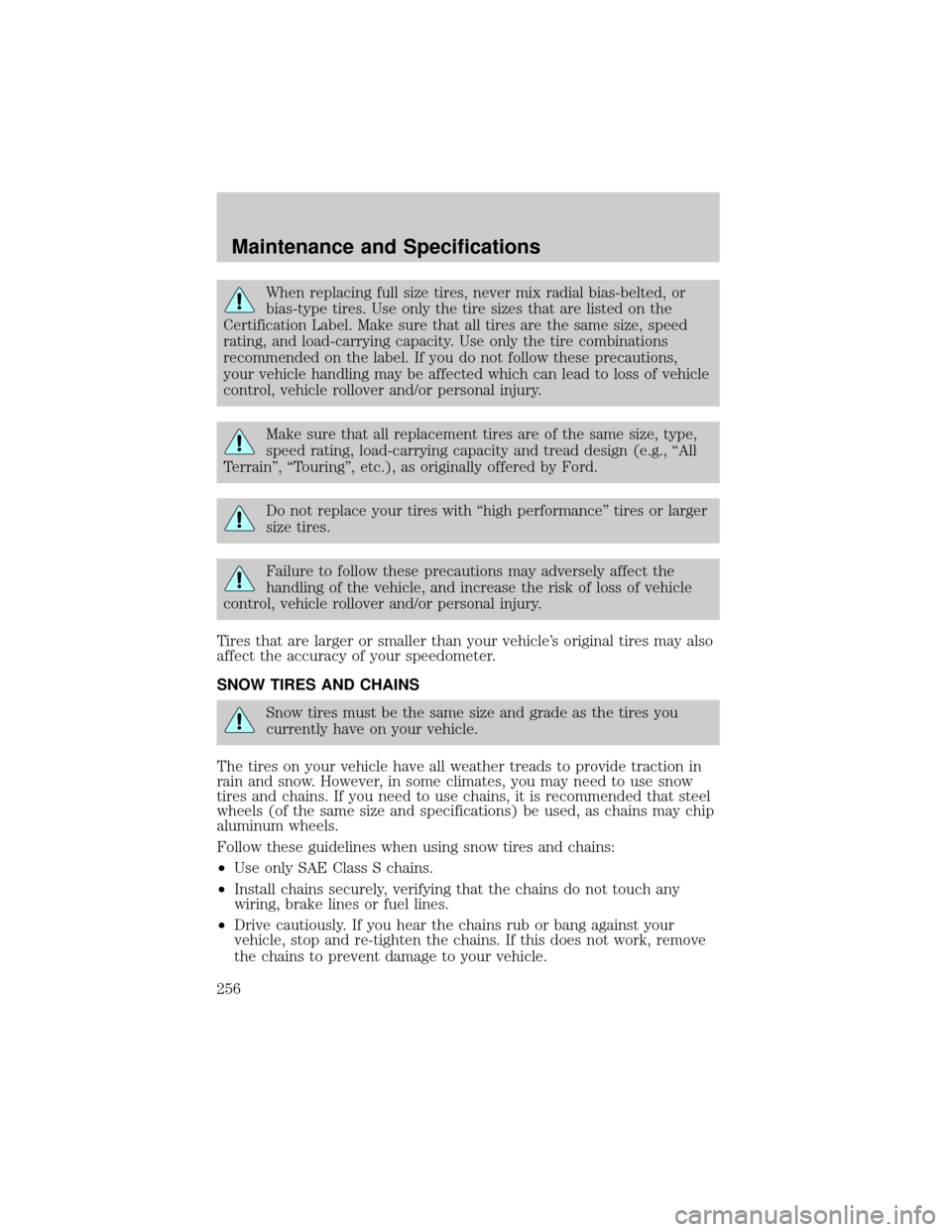
When replacing full size tires, never mix radial bias-belted, or
bias-type tires. Use only the tire sizes that are listed on the
Certification Label. Make sure that all tires are the same size, speed
rating, and load-carrying capacity. Use only the tire combinations
recommended on the label. If you do not follow these precautions,
your vehicle handling may be affected which can lead to loss of vehicle
control, vehicle rollover and/or personal injury.
Make sure that all replacement tires are of the same size, type,
speed rating, load-carrying capacity and tread design (e.g., ªAll
Terrainº, ªTouringº, etc.), as originally offered by Ford.
Do not replace your tires with ªhigh performanceº tires or larger
size tires.
Failure to follow these precautions may adversely affect the
handling of the vehicle, and increase the risk of loss of vehicle
control, vehicle rollover and/or personal injury.
Tires that are larger or smaller than your vehicle's original tires may also
affect the accuracy of your speedometer.
SNOW TIRES AND CHAINS
Snow tires must be the same size and grade as the tires you
currently have on your vehicle.
The tires on your vehicle have all weather treads to provide traction in
rain and snow. However, in some climates, you may need to use snow
tires and chains. If you need to use chains, it is recommended that steel
wheels (of the same size and specifications) be used, as chains may chip
aluminum wheels.
Follow these guidelines when using snow tires and chains:
²Use only SAE Class S chains.
²Install chains securely, verifying that the chains do not touch any
wiring, brake lines or fuel lines.
²Drive cautiously. If you hear the chains rub or bang against your
vehicle, stop and re-tighten the chains. If this does not work, remove
the chains to prevent damage to your vehicle.
Maintenance and Specifications
256
Page 259 of 280
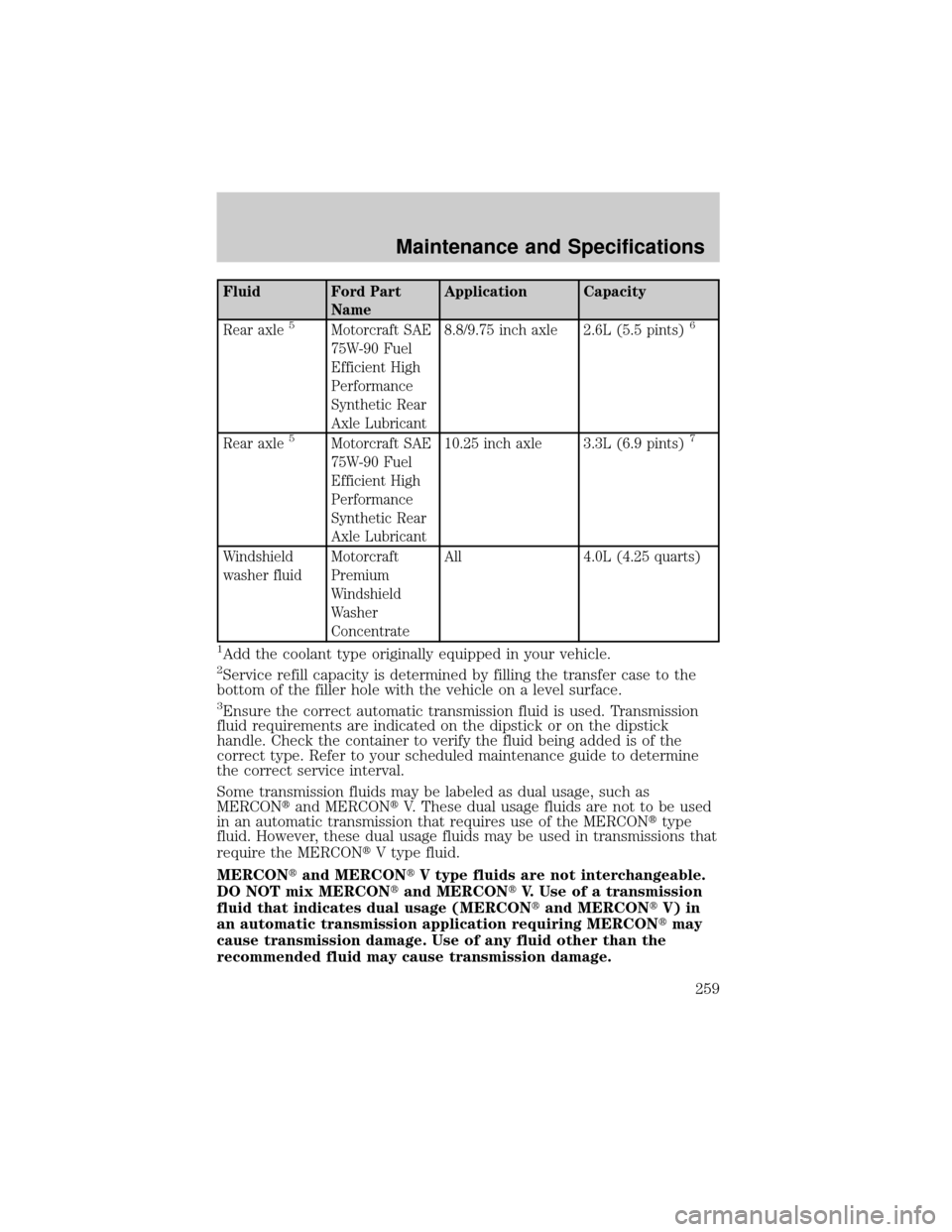
Fluid Ford Part
NameApplication Capacity
Rear axle
5Motorcraft SAE
75W-90 Fuel
Efficient High
Performance
Synthetic Rear
Axle Lubricant8.8/9.75 inch axle 2.6L (5.5 pints)6
Rear axle5Motorcraft SAE
75W-90 Fuel
Efficient High
Performance
Synthetic Rear
Axle Lubricant10.25 inch axle 3.3L (6.9 pints)7
Windshield
washer fluidMotorcraft
Premium
Windshield
Washer
ConcentrateAll 4.0L (4.25 quarts)
1Add the coolant type originally equipped in your vehicle.2Service refill capacity is determined by filling the transfer case to the
bottom of the filler hole with the vehicle on a level surface.
3Ensure the correct automatic transmission fluid is used. Transmission
fluid requirements are indicated on the dipstick or on the dipstick
handle. Check the container to verify the fluid being added is of the
correct type. Refer to your scheduled maintenance guide to determine
the correct service interval.
Some transmission fluids may be labeled as dual usage, such as
MERCONtand MERCONtV. These dual usage fluids are not to be used
in an automatic transmission that requires use of the MERCONttype
fluid. However, these dual usage fluids may be used in transmissions that
require the MERCONtV type fluid.
MERCONtand MERCONtV type fluids are not interchangeable.
DO NOT mix MERCONtand MERCONtV. Use of a transmission
fluid that indicates dual usage (MERCONtand MERCONtV) in
an automatic transmission application requiring MERCONtmay
cause transmission damage. Use of any fluid other than the
recommended fluid may cause transmission damage.
Maintenance and Specifications
259
Page 262 of 280
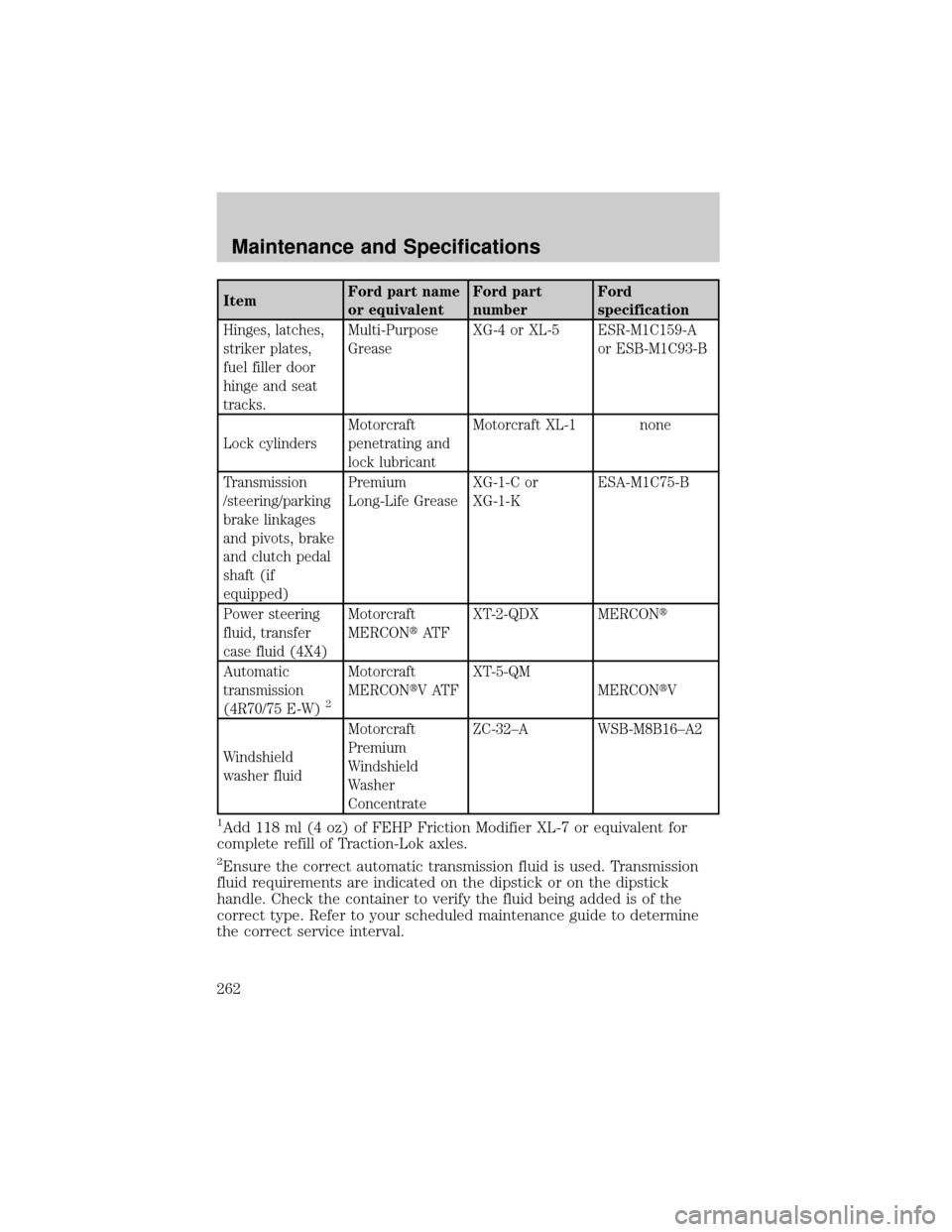
ItemFord part name
or equivalentFord part
numberFord
specification
Hinges, latches,
striker plates,
fuel filler door
hinge and seat
tracks.Multi-Purpose
GreaseXG-4 or XL-5 ESR-M1C159-A
or ESB-M1C93-B
Lock cylindersMotorcraft
penetrating and
lock lubricantMotorcraft XL-1 none
Transmission
/steering/parking
brake linkages
and pivots, brake
and clutch pedal
shaft (if
equipped)Premium
Long-Life GreaseXG-1-C or
XG-1-KESA-M1C75-B
Power steering
fluid, transfer
case fluid (4X4)Motorcraft
MERCONtAT FXT-2-QDX MERCONt
Automatic
transmission
(4R70/75 E-W)
2
Motorcraft
MERCONtVATFXT-5-QM
MERCONtV
Windshield
washer fluidMotorcraft
Premium
Windshield
Washer
ConcentrateZC-32±A WSB-M8B16±A2
1Add 118 ml (4 oz) of FEHP Friction Modifier XL-7 or equivalent for
complete refill of Traction-Lok axles.
2Ensure the correct automatic transmission fluid is used. Transmission
fluid requirements are indicated on the dipstick or on the dipstick
handle. Check the container to verify the fluid being added is of the
correct type. Refer to your scheduled maintenance guide to determine
the correct service interval.
Maintenance and Specifications
262
Page 263 of 280

Some transmission fluids may be labeled as dual usage, such as
MERCONtand MERCONtV. These dual usage fluids are not to be used
in an automatic transmission that requires use of the MERCONttype
fluid. However, these dual usage fluids may be used in transmissions that
require the MERCONtV type fluid.
MERCONtand MERCONtV type fluids are not interchangeable.
DO NOT mix MERCONtand MERCONtV. Use of a transmission
fluid that indicates dual usage (MERCONtand MERCONtV) in
an automatic transmission application requiring MERCONtmay
cause transmission damage. Use of any fluid other than the
recommended fluid may cause transmission damage.
ENGINE DATA
Engine 4.6L V8 engine 5.4L V8 engine
Cubic inches 281 330
Required fuel 87 octane 87 octane
Firing order 1-3-7-2-6-5-4-8 1-3-7-2-6-5-4-8
Spark plug gap 1.3-1.4 mm
(0.052-0.056 inch)1.016-1.21 mm
(0.040-0.050 inch)
1
Ignition system Coil on plug Coil on plug
Compression ratio 9.37:1 9.85:1
1The 5.4L 3V spark plug gap CANNOT be adjusted.
VEHICLE DIMENSIONS
Regular Cab
Vehicle
dimensionsStyleside 6.5'
box mm (in)Flareside 6.5'
box mm (in)Styleside 8.0'
box mm (in)
(1) Overall
length5371 (211.5) 5371 (211.5) 5844 (230.1)
(2) Overall
width2005 (78.9) 2005 (78.9) 2005 (78.9)
(3) Overall
height 4x2/4x41854 (73.0) /
1905 (75.0)1854 (73.0) /
1905 (75.0)1867 (73.5) /
1930 (76.0)
(4) Wheelbase
4x2/4x43195 (126) /
3203 (126)3195 (126) /
3203 (126)3668 (144) /
3675 (145)
Maintenance and Specifications
263