2004 DAEWOO LACETTI ACC
[x] Cancel search: ACCPage 2449 of 2643

DOORS 9P – 29
DAEWOO V–121 BL4
GENERAL DESCRIPTION
AND SYSTEM OPERATION
DOOR LOCK STRIKER
The front and the rear door lock strikers each consist of a
striker with two screws threaded into a floating cage plate
in the B–pillars and the C–pillars. The door is secured in
the closed position when the door lock fork snaps over and
engages the striker.
CHILDPROOF REAR DOOR LOCK
The childproof rear door locks help prevent passengers,
especially children, from opening the rear doors of the ve-
hicle from the inside.
To activate the locks, move the levers of both rear doors
to the lock position. Then, close both doors. The rear pas-
sengers will be unable to open the doors from inside of the
vehicle.
To deactivate the locks, unlock the door from the inside of
the vehicle and open the door from the outside. Move the
lever to the unlock position. The rear door will now work
normally.
POWER DOOR LOCKS
The power door locks use a solenoid that is contained in
each door lock assembly. The door locks are activated by
the actuator on the inside door handle or by the lock cylin-
der on the driver’s side door only. When the driver’s side
door is locked or unlocked by the actuator or the lock cylin-
der, all doors are locked or unlocked accordingly.
POWER WINDOWS
The power windows are controlled by electrical switches
on the door panels and are operated by a motor at each
window regulator. Each door has a switch to control its
window, and the driver’s side door has four switches to
control all door windows on the vehicle. The windows are
lowered by pressing the switch and raised by pulling up on
the switch. The window will stop movement when the
switch is released or when the window is completely open
or closed.
The driver’s side window opens automatically. By pressing
and releasing the switch, the driver ’s side window will low-
er and will stop only when the switch is activated again, or
when the window is completely open.
The driver’s side door control also contains a window lock
button that will prevent the operation of the front passen-
ger door or the rear door windows when pressed.
Page 2501 of 2643

IMMOBILIZER ANTI–THEFT SYSTEM 9T2 – 11
DAEWOO V–121 BL4
GENERAL DESCRIPTION
AND SYSTEM OPERATION
IMMOBILIZER SYSTEM
The purpose of the Immobilizer system is to provide addi-
tional theft deterrence to the vehicle in which it is installed
and to prevent it from being stolen or driven by unautho-
rized users.
The verification of the user authorization is done by an igni-
tion key with integrated transponder.
The external LED displays the Immobilizer status and has
an additional theft deterrence function.
To secure the communication, the status is exchanged be-
tween the Immobilizer and the ECM in a 5 byte of encoded
data.
These 5 bytes are composed by a mixture of random data
and two types of fixed code
S a vehicle model identification number : MIN
S a vehicle specific identification : VIN
The MIN is known from the first supply of the system.
The VIN is realized by ICU on the special order from the
key coding (reading of transponder code and storing it as
valid key code in Immobilizer EEPROM).
A different random data is computed at each key transi-
tion.
All the immobilization communication between the ECM
and ICU is made on K–line (K line : Serial data line ’7’).
Due to the learning of the Vehicle specific identification
Number, both ICU and ECM can stay in 3 stable modes
S Virgin mode (VIN not learnt)
S Learnt mode (VIN learnt)
S Neutral mode (for a new VIN learning)
In case of using valid key, the release message commu-
nication with the ECM take place and the LED displays the
Immobilizer status valid key In case of using invalid key,
the ECM disables the fuel injector circuit with coded inter-
vention and sets DTC(Diagnostic Trouble Code)
The above conditions are maintained until the ignition is
switched off.
An ECM without an immobilizer control unit cannot be in-
terchanged for an ECM that is used with an immobilizer
control unit system. The Immobilizer control unit and ECM
must have a matching ID code. ID coding and key coding
are accomplished by using Scanner–100
The Immobilizer system consists of
S a maximum or 5 ignition keys with integrated trans-
ponder
S the toroidal coil (Detection coil) for energizing and
reading the transponder mounted at the ignition
lock.S the Immobilizer control unit(ICU) with :
– power supply
– ignition input circuit
– transponder modulation and demodulation unit
– EEPROM
– driver electronic for the external status LED
– serial data link hardware
S the external status LED for displaying the Immobi-
lizer status
S the serial data link between Immobilizer and ECM
ELECTRONICALLY CODED KEYS
Each valid ignition key has an internal transponder which
is a read /write transponder.
The transponder contains an implementation of a crypto–
algorithm with 96 bits of user configurable s cret–key con-
tained in EEPROM and transmits data to the ICU by mod-
ulating the amplitude of the ele tromagnetic field, and
receives data and commands in a similar way.
DETECTION COIL
The toroidal coil is mounted at the ignition lock in front of
the key barrel.
It is connected to the ICU with a four terminal connector
fixed at the body of the coil.
The length of the connection between coil and Immobilizer
is restricted to 50cm. The correct placement on the ignition
lock and the exact electrical data is very important for the
reading distance of transponder.
he toroidal coil and receiving coil inside the transponder
built a transformer. During the readingprocess the coil in-
duces energy into the transponder. The transponder
charges the field and generates an amplitude modulated
signal with the manchester coded data. This charge of the
field is demodulated inside the Immobilizer.
The Immobilizer contains the coil driver hardware for di-
rect connection of the toroidal coil.
IMMOBILIZER CONTROL UNIT
The function of the Immobilizer System is shared between
the ICU and the ECM.
The task of the Immobilizer Electronic Control unit (ICU)
are:
S Reading of the input information ”ignition ON/OFF”
S Controlling the states LED
S Controlling the transponder read/write process
(modulation, demodulation, decoding, comparison
of the read code with the code of the valid keys).
S Communication with the ECM after ignition ON (re-
ceiving of the ECM–request and transmission of
release message).
S Special functions for calculation and handling of the
VIN–code.
The VIN code is calculated by the Immobilizer using a ran-
dom generator.
Page 2506 of 2643

NUBIRA/LACETTISERVICE NOTICE 0–3
1. HOW TO USE THIS MANUAL
.
This manual covers the repairs of NUBIRA/LACETTI
automobile which has been involved in accidents, and it
describes the work related to the replacement of dam-
aged body parts.
Please read through these instructions and familiarize
yourself with them before actually using this manual.
.
Note : Refer to NUBIRA/LACETTI Service Manual for
specifications, wire harness locations, safety stand sup-
port points, etc.
2. SPECIAL INFORMATION
.
Indicates a strong possibility of personal injury or equip-
ment damage if instructions are not followed.
.
Note : Gives helpful information.
.
CAUTION : Detailed descriptions of standard work-
shop procedures, safety principles and service op-
erations are not included. Please note that this manu-
al does contain warnings and cautions against some
specific service methods which could cause PER-
SONAL INJURY, or could damage a vehicle or make
it unsafe. Please understand that these warnings can-
not cover all conceivable ways in which service,
whether or not recommended by GM DAEWOO might
be done or of the possible hazardous consequences
of each conceivable way, not could GM DAEWOO in-
vestigate all such ways. Anyone using service proce-
dures or tools, whether or not recommended by GM
DAEWOO, must satisfy himself thoroughly that nei-
ther personal safety or tools, whether or not recom-
mended by GM DAEWOO, must satisfy himself thor-
oughly that neither personal safety or vehicle safety
will be jeopardized.
.
All information contained in this manual is based on the
latest product information available at the time of print-
ing. We reserve the right to make changes at any time
without notice. No part of this publication may be repro-
duced, stored in retrieval system, or transmitted, in any
form by any means, electronic, mechanical, photocopy-
ing, recording, or otherwise, without the prior written
permission of the publisher. This includes text, figures
and tables.
Page 2510 of 2643

1–2 GENERAL INFORMATIONNUBIRA/LACETTI
1. GENERAL INSTRUCTION
This publication is designed to help you the body repair
technician with your specialized work. Vehicle bodywork
has changed a great deal over the years. As vehicles
have developed technically, vehicle bodywork has also
had to meet new requirements with design, changes to
reconcile apparently conflicting demands to name just a
few examples:
S strength and safety ; low weight
S spaciousness ; good aerodynamices
S high quality ; low price
.
The durability and ease of repair of the bodywork also
plays an important part.
.
Nowadays, the use of highly automated production
equipment makes it possible to maintain the tightest
tolerances and thus ensure a high level of quality.
.
When bodywork is damaged, the customer rightly ex-
pects it to be expertly repaired to the same quality stan-
dards.
.
At the same time, for his safety, the customer expects
you to have comprehensive knowledge of materials,
measuring and straightening methods, possible distor-
tion, optimum corrosion prevention and much more be-
sides.
.
This publication is designed to help you update your
knowledge and give you an idea of what you require to
rectify moderate or severe accident damage, for your
own safety and for the satisfaction of your customers.
2. IMPORTANT SAFETY NOTICE
2–1. BEFORE BEGINNING WORK
S Disconnect the battery to reduce the possibility of fire
caused by electrical shorts.
S Check for fuel leaks and repair as necessary.
S Remove the fuel tank and/or fuel lines if welding equip-
ment is to be used near the fuel system.
S Before welding, sanding or cutting, protect carpets and
seats with fire–proof covers.
S Follow standard safety practices when using toxic or
flammable liquids.
S Use standard safety equipment when spraying paint,
welding, cutting, sanding or grinding. Standard safety
equipment includes.
S Respirator and filter masks: Designed to filter out toxic
fumes, mist, dust or other airborn particles. Use a respi-
rator or filter mask designed to protect you from the haz-
ards of the particular job; some respirators, for example,
are designed to filter out only dust and airborn particles,
not toxic fumes.
S Safety goggles or glasses: Designed to protect your
eyes from projectiles, dust particles or splashing liquid.
S Gloves: Rubber gloves protect against corrosive chemi-
cals. Welding gloves protect against burns and abra-
sions caused by welding, sanding or grinding.
S Safety shoes: Non–slip soles protect against slipping.
Metal toe inserts protect against falling objects.
S Ear plugs: Protect eardrums from harmful noise levels.
.
2–2. DURING WORK
S Do not smoke while working near the fuel system.
S Deposit gas or solvent–soaked shop towels in an ap-
proved container.
S Brake lining contains asbestos, which can cause cancer.
Do not use an air hose to blow off brake assemblies: use
only an approved vacuum cleaner, and wear an ap-
proved filter mask or respirator.
S Always attach a safety cable when using a hydraulic ram
or a frame straightening table: do not stand in direct line
with the chains used on such equipment.
Page 2511 of 2643
NUBIRA/LACETTIGENERAL INFORMATION 1–3
3. BODY SAFETY
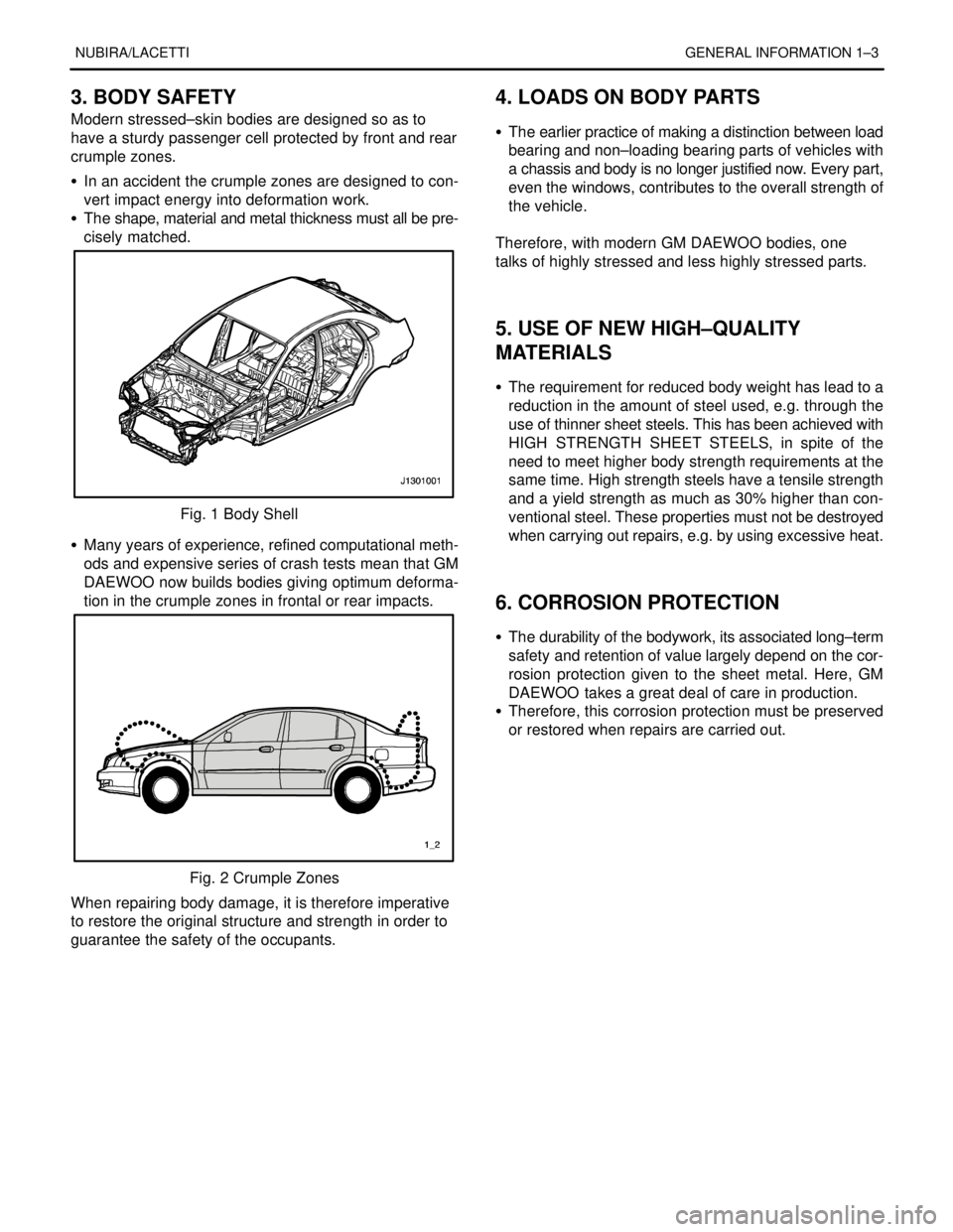
Modern stressed–skin bodies are designed so as to
have a sturdy passenger cell protected by front and rear
crumple zones.
S In an accident the crumple zones are designed to con-
vert impact energy into deformation work.
S The shape, material and metal thickness must all be pre-
cisely matched.
Fig. 1 Body Shell
S Many years of experience, refined computational meth-
ods and expensive series of crash tests mean that GM
DAEWOO now builds bodies giving optimum deforma-
tion in the crumple zones in frontal or rear impacts.
Fig. 2 Crumple Zones
When repairing body damage, it is therefore imperative
to restore the original structure and strength in order to
guarantee the safety of the occupants.
4. LOADS ON BODY PARTS
S The earlier practice of making a distinction between load
bearing and non–loading bearing parts of vehicles with
a chassis and body is no longer justified now. Every part,
even the windows, contributes to the overall strength of
the vehicle.
.
Therefore, with modern GM DAEWOO bodies, one
talks of highly stressed and less highly stressed parts.
.
.
5. USE OF NEW HIGH–QUALITY
MATERIALS
S The requirement for reduced body weight has lead to a
reduction in the amount of steel used, e.g. through the
use of thinner sheet steels. This has been achieved with
HIGH STRENGTH SHEET STEELS, in spite of the
need to meet higher body strength requirements at the
same time. High strength steels have a tensile strength
and a yield strength as much as 30% higher than con-
ventional steel. These properties must not be destroyed
when carrying out repairs, e.g. by using excessive heat.
.
.
6. CORROSION PROTECTION
S The durability of the bodywork, its associated long–term
safety and retention of value largely depend on the cor-
rosion protection given to the sheet metal. Here, GM
DAEWOO takes a great deal of care in production.
S Therefore, this corrosion protection must be preserved
or restored when repairs are carried out.
Page 2512 of 2643
1–4 GENERAL INFORMATIONNUBIRA/LACETTI
7. SUMMARY
S All GM DAEWOO vehicles are built to the highest stan-
dards in terms of styling and material properties.
S These high quality standards must be maintained when
accident repairs are carried out.
S Mistakes made when carrying out repair operations
such as straightening, welding sheet–metal parts, etc.
not only produce visible defects, but may also compro-
mise the safety of the vehicle.
S Mistakes made when restoring the corrosion protection
compromise durability.
.
.
8. ZINC TREATED STEEL PLATE
REPAIR
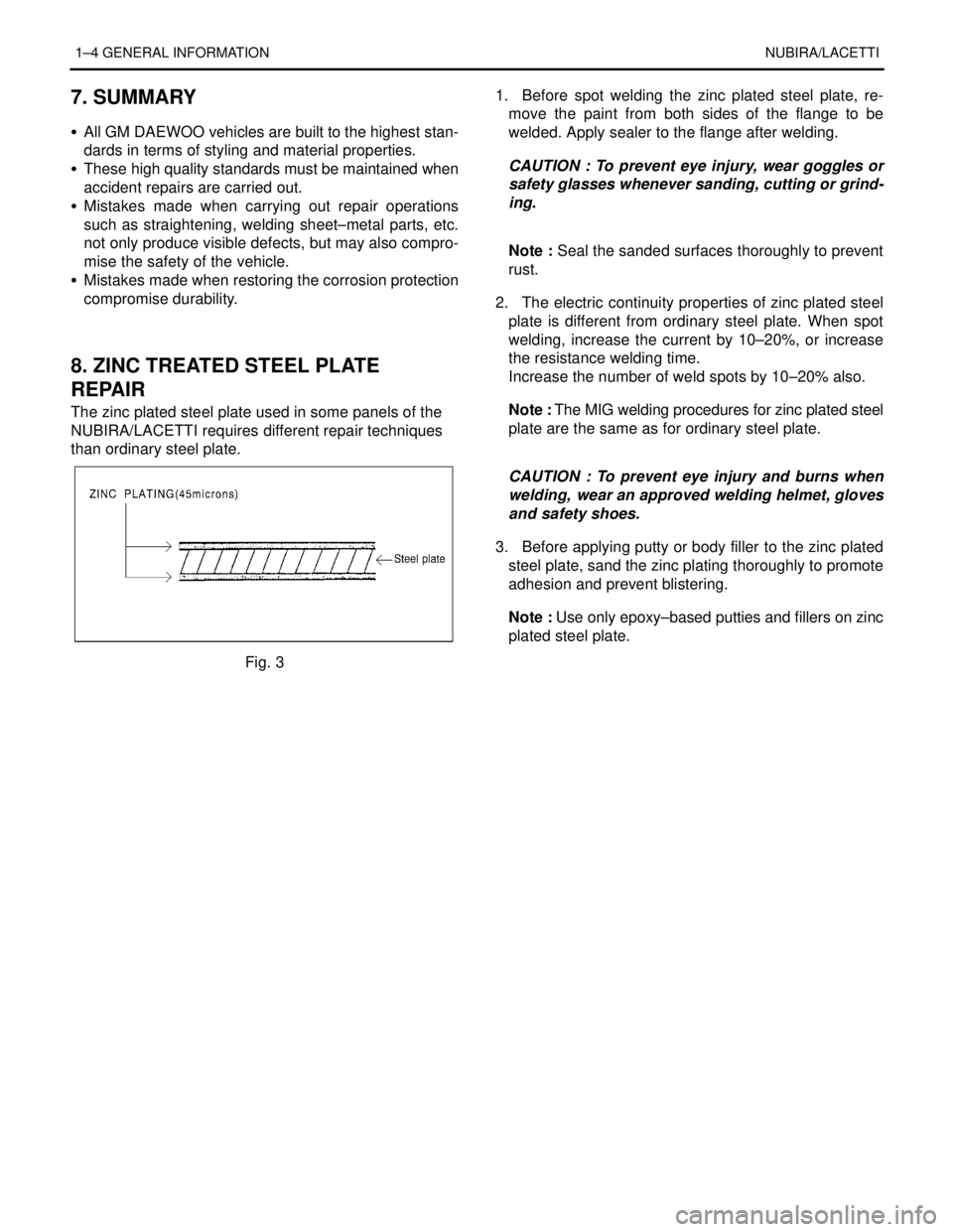
The zinc plated steel plate used in some panels of the
NUBIRA/LACETTI requires different repair techniques
than ordinary steel plate.
Fig. 31. Before spot welding the zinc plated steel plate, re-
move the paint from both sides of the flange to be
welded. Apply sealer to the flange after welding.
CAUTION : To prevent eye injury, wear goggles or
safety glasses whenever sanding, cutting or grind-
ing.
Note : Seal the sanded surfaces thoroughly to prevent
rust.
2. The electric continuity properties of zinc plated steel
plate is different from ordinary steel plate. When spot
welding, increase the current by 10–20%, or increase
the resistance welding time.
Increase the number of weld spots by 10–20% also.
Note : The MIG welding procedures for zinc plated steel
plate are the same as for ordinary steel plate.
CAUTION : To prevent eye injury and burns when
welding, wear an approved welding helmet, gloves
and safety shoes.
3. Before applying putty or body filler to the zinc plated
steel plate, sand the zinc plating thoroughly to promote
adhesion and prevent blistering.
Note : Use only epoxy–based putties and fillers on zinc
plated steel plate.
Page 2524 of 2643

2–4 PREPARATIONS OF BODYWORK NUBIRA/LACETTI
2. CHECKPOINTS
S Accurate Inspection of Damaged Parts(Visual)
.
Seat Belts
Always replace the seat belt if :
1. The belt material is cut, punctured, burned or in any
way damaged.
2. The buckle or retractor does not work properly.
3. They were being worn at the time of a collision(also
check for damage at the seat belt anchor points).
4. Their condition is questionable.
.
Front Section :
1. Is there any bending, splitting, denting or other dam-
age to the suspension and its related parts?
2. Is there any deformation of the front panel or radiator
crossmember? Have any of the connected sections
come apart?
3. Are there any creases or distortion in the front wheel-
house or side frame? Have any of the connected sec-
tions come apart?
4. Is there any bending or twisting of the whole front
area?
5. Is there any deformation like creases, bulges, or dents
in the front pillar, dash panel, floor, etc.?
6. Is there any vertical twisting or misaligned clearance
in the door?
7. Is the windshield seal broken?
8. Is there any deformation in the vicinity of the top part
of the roof panel’s center pillar?
9. Is there any damage inside the automobile(is there
any twisting of the dash panel, or anything irregular with
the clearances or sheet–mounting parts)?
10. Is there any damage to the steering wheel? Is there
any deformation in the column and the column–mounted
parts?
11. Is there any oil or water leakage and damage to the en-
gine, transmission or brakes?
12. Is there any irregular noise in the gear changing opera-
tion, engine and transmission rotation?
13. Are there any traces of contact between the engine
block and the center crossmember ?
14. Is there any damage to brake or fuel lines, or wire har-
nesses?Rear Section :
1. Is there any twisting, bulging or denting of the rear floor
any rear bolsters? Have any of the connected sections
come apart?
2. Is there any irregular bulging or denting in the rear
fender?
3. Is there any distortion in the rear inner panel? Is there
any bending and denting in the vicinity of the rear pillar?
4. Is there any distortion or creasing is the rear wheel-
house and arch sections? Have any of the connected
sections come apart?
5. Is there anything irregular in the rear glass seal clear-
ance?
6. Is there any twisting or misalignment of the clearance
of the trunk lid opening section?
7. Is there any bending, splitting, denting or other dam-
age to the suspension and its related parts?
8. Is there any deformation of the rear floor crossmem-
ber, trunk floor panel and back panel? Have any of the
connected sections come apart?
.
Impact Beam :
Always replace the door assembly if :
1. The external force makes the impact beam of door in-
ner deform.
Always replace impact beam if :
2. The external force makes the impact beam of front
bumper and rear bumper deform.
Page 2529 of 2643
NUBIRA/LACETTIWELDING AND TOOLS 3–3
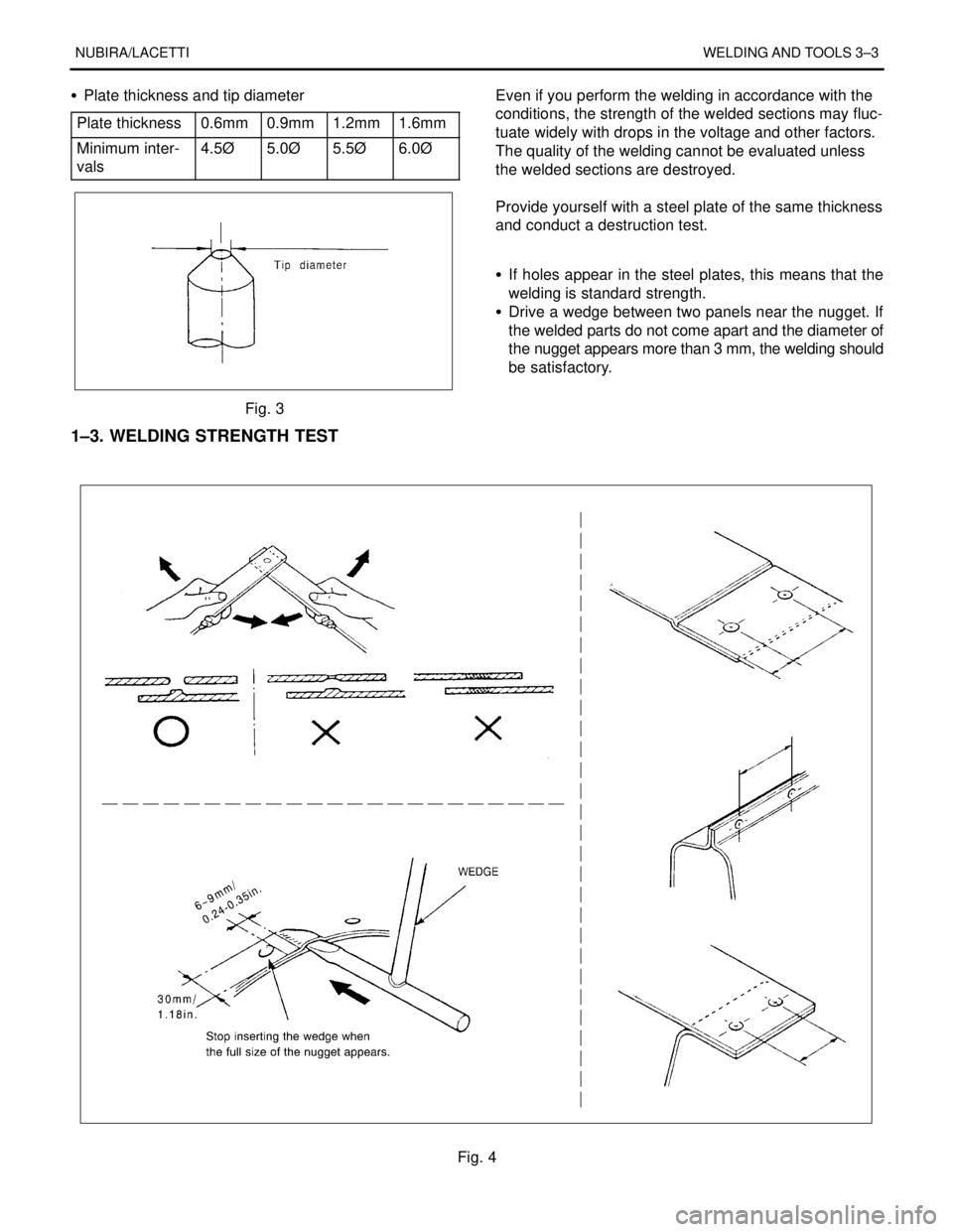
S Plate thickness and tip diameter
Plate thickness
0.6mm0.9mm1.2mm1.6mm
Minimum inter-
vals4.5Ø5.0Ø5.5Ø6.0Ø
Fig. 3
1–3. WELDING STRENGTH TEST
.Even if you perform the welding in accordance with the
conditions, the strength of the welded sections may fluc-
tuate widely with drops in the voltage and other factors.
The quality of the welding cannot be evaluated unless
the welded sections are destroyed.
.
Provide yourself with a steel plate of the same thickness
and conduct a destruction test.
.
S If holes appear in the steel plates, this means that the
welding is standard strength.
S Drive a wedge between two panels near the nugget. If
the welded parts do not come apart and the diameter of
the nugget appears more than 3 mm, the welding should
be satisfactory.
Fig. 4