2004 DAEWOO LACETTI ACC
[x] Cancel search: ACCPage 1981 of 2643

HEATING AND VENTILATION SYSTEM 7A – 7
DAEWOO V–121 BL4
StepNo Yes Value(s) Action
131. Check for the following problems:
S Restriction in the cooling system.
S Failed water pump impeller.
S Faulty thermostat.
2. Make repairs to the cooling system, as needed.
Are the repairs complete?–System OKGo to Step 14
141. Install the surge tank cap.
2. With the ignition ON, allow the engine to warm
up for about 20 minutes. Drive the vehicle at 48
km/h (30 mph).
3. Use a thermometer to measure the ambient air
temperature and the discharge air temperature
at the heater outlet.
Does the heater output meet the minimum values
given?Go to ”Heater
Temperature
Specifications”Go to Step 15Go to Step 16
151. Check the vehicle for cold air leaks at the fol-
lowing locations:
S Dash.
S Heater cases.
S Vents.
2. Check under the seat for obstructions.
3. Repair any leaks or obstructions.
Are the repairs complete?–System OK–
161. Turn the ignition OFF.
2. Turn the temperature control knob to full cold,
then rapidly to full hot.
3. Listen for the sound of the temperature door
slam just before it reaches the end of the travel
range of the control knob.
Does the door slam?–Go to Step 18Go to Step 17
171. Check the following aspects of the temperature
door:
S Travel.
S Cables.
S Linkage.
2. Verify the accuracy of the temperature controls
at full hot.
3. Verify the accuracy of the temperature controls
at full cold.
Is the repair complete?–System OK–
181. Set the temperature control knob to full hot.
2. Start the vehicle.
3. Check the temperature of the heater inlet hose
and the heater outlet hose by feel. The air tem-
perature around the hoses should be at least
29°C (84°F).
Is the heater inlet hose hot and the heater outlet
hose warm?–Go to Step 19Go to Step 22
19Check the thermostat. Refer to 2D, Engine Cooling.
Is the thermostat installed and seated properly?–Go to Step 20Go to Step 21
Page 1983 of 2643

HEATING AND VENTILATION SYSTEM 7A – 9
DAEWOO V–121 BL4
StepNo Yes Value(s) Action
341. Set the blower on maximum speed.
2. Rotate the temperature control from full hot to
full cold.
3. Listen for an airflow change.
Does the airflow change?–Go to Step 35Go to Step 36
351. Check the following aspects of the temperature
door:
S Travel.
S Cables.
S Linkage.
S Control.
2. Verify the accuracy of the temperature control
at full hot.
Is the repair complete?–Go to Step 1–
361. Check the system for any obstruction between
the blower and the system outlets.
2. Remove any obstruction.
Is the repair complete?–Go to Step 1–
BLOWER ELECTRICAL
StepActionValue(s)YesNo
1Verify the customer’s complaint.
Are the customer’s concerns verified?–Go to Step 2System OK
2Turn the blower ON.
Does the blower run at any speed?–Go to Step 14Go to Step 3
31. Disconnect the power connector from the blow-
er motor under the dashboard on the passen-
ger side of the vehicle.
2. Turn the ignition ON.
3. Turn the blower ON.
4. Test for voltage on the connector. The terminal
connected to the violet wire is positive and the
terminal connected to the black wire is nega-
tive.
Is this voltage present?11–14vGo to Step 4Go to Step 5
4Replace the blower motor.
Is the repair complete?–System OK–
5Check fuse F7 in the I/P fuse block in the engine fuse
block.
Is the fuse blown?–Go to Step 6Go to Step 7
61. Turn the ignition ON.
2. Use a short detector to locate a possible short
in the following locations:
S Fuse panel–to–blower speed switch.
S Blower speed switch–to–heater resistor
block.
S Heater resistor block–to–blower motor.
S Blower speed switch–to–blower HI relay.
3. Repair any short.
4. Replace any blown fuse.
Is the repair complete?–System OK–
Page 2013 of 2643

MANUAL CONTROL HEATING, VENTILATION AND AIR CONDITIONING SYSTEM 7B – 11
DAEWOO V–121 BL4
LEAK TESTING REFRIGERANT
SYSTEM
Test for leaks whenever you suspect a refrigerant leak in
the system. You should also test for leaks whenever you
perform a service operation which results in disturbing the
lines or the connections. Leaks are commonly found at the
refrigerant fittings or at the connections. Leaks are com-
monly caused by the following problems:
S Improper torque.
S Damaged O–ring seals.
S Dirt or lint on the O–ring seals.
Liquid Leak Detectors
Use a liquid leak detector solution on locations such as fit-
tings. Apply the solution to the area in question with the
swab that is supplied with the solution. Look for bubbles
to appear. This will indicate the existence and the location
of any leak.
For areas where this is not practical, such as sections of
the evaporator and the condenser, an electronic leak de-
tector is more useful.
Electronic Leak Detectors
Follow the manufacturer’s instructions for calibration, op-
eration, and maintenance of an electronic leak detector.
Battery condition is especially important to the accuracy
of a portable model. Set the detector to R–134a before be-
ginning the test.
Notice : Electronic leak detectors are sensitive to wind-
shield washing solutions, solvents and cleaners, and cer-
tain vehicle adhesives. Surfaces must be clean to prevent
false readings. Make sure that all surfaces are dry to pre-
vent damage to the detector.
General Testing Instructions
1. Follow the entire path of the refrigerant system.
2. Completely circle each joint at 25 to 50 mm (1 to 2
inches) per second.
3. Hold the probe tip within 6 mm (1/4 inch) of the sur-
face.4. Do not block the air intake.
5. The audible tone changes from 1 to 2 clicks per
second into a solid alarm if there is a leak. Adjust
the balance control to maintain 1 to 2 clicks per
second.
6. Test all of the following areas, even after one leak
has been confirmed:
S Evaporator inlet and outlet.
S Receiver–drier inlet and outlet.
S Condenser inlet and outlet.
S Brazed and welded areas.
S Damaged areas.
S Hose couplings.
S Compressor rear head.
S All fittings and joints.
Testing Service Ports/Access Valves
The sealing caps provide protection for the service ports.
Make sure that these caps are not missing or loose. Al-
ways use the correct cap for each port.
Testing the Evaporator Core
Leaks in the evaporator core are difficult to find. Test the
evaporator core using the following procedure:
1. Run the blower fan at the maximum speed setting
for at least 15 minutes.
2. Turn the blower OFF.
3. Wait for 10 minutes.
4. Remove the blower motor resistor. Refer to Section
7A, Heating and Ventilation System.
5. Insert the leak detector probe as close as possible
to the evaporator core. The detector will indicate a
leak with a solid alarm.
6. Use a flashlight to search for refrigerant oil on the
core surface.
Testing the Compressor Shaft Seal
1. Blow shop air behind and in front of the compressor
clutch/pulley for at least 15 seconds.
2. Wait 1 to 2 minutes.
3. Probe the area in front of the pulley. If the detector
emits a solid alarm, there is a leak.
Page 2014 of 2643

7B – 12IMANUAL CONTROL HEATING, VENTILATION AND AIR CONDITIONING SYSTEM
DAEWOO V–121 BL4
V5 SYSTEM AIR CONDITIONING DIAGNOSIS
INSUFFICIENT COOLING DIAGNOSIS
Test Description
The numbers below refer to steps on the diagnostic table.
13. See the Important below.
32. See the Important below.Important : Perform this test under garage conditions with
the air temperature at 21–32°C (70–90°F), and no sun
load. Follow this test carefully for accurate results.
Important : Perform this test exactly as described to ob-
tain accurate results.
Step
ActionValue(s)YesNo
1Record the customer’s complaint.
Can you verify the customer’s complaint?–Go to Step 2System OK
21. Check the A/C fuse.
2. Check the blower fan operation.
3. Check the engine cooling fan operation.
4. Check the A/C compressor belt.
5. Check the A/C condenser for restricted airflow.
6. Check the clutch coil connection.
7. Repair or replace any components as needed.
8. Check the discharge air temperature with the
A/C turned ON.
Is the discharge air temperature normal?At least 7°C
(12°F) below
ambient air
temperatureSystem OKGo to Step 3
31. Turn the ignition switch to LOCK.
2. Connect the high– and the low–pressure
gauges.
Are both pressures within the value specified?69–345 kPa
(10–50 psi)Go to Step 4Go to Step 5
41. Check the A/C system for leaks.
2. Repair any refrigerant leaks as needed.
3. Recover, evacuate, and recharge the A/C sys-
tem.
4. Observe the two pressure gauges.
Are both pressures above the value specified?345 kPa
(50 psi)Go to Step 7–
5Observe the two pressure gauges.
Are both pressures below the value specified?69 kPa
(10 psi)Go to Step 6Go to Step 7
61. Add 0.45 kg (1 pound) of refrigerant R–134a.
2. Check the A/C system for leaks.
3. Repair any refrigerant leaks, as needed.
4. Recover, evacuate, and recharge the A/C sys-
tem.
5. Observe the two pressure gauges.
Are both pressures above the value specified?345 kPa
(50 psi)Go to Step 7–
71. Start the engine and allow it to run at idle.
2. Set the A/C controls to the following positions:
S The A/C switch to the ON.
S The fresh air control switch to fresh air (in-
dicator lamp OFF).
S The blower motor to 4.
S The temperature to full cold.
Does the A/C compressor clutch engage?–Go to Step 8Go to Step 10
Page 2036 of 2643
7B – 34IMANUAL CONTROL HEATING, VENTILATION AND AIR CONDITIONING SYSTEM
DAEWOO V–121 BL4
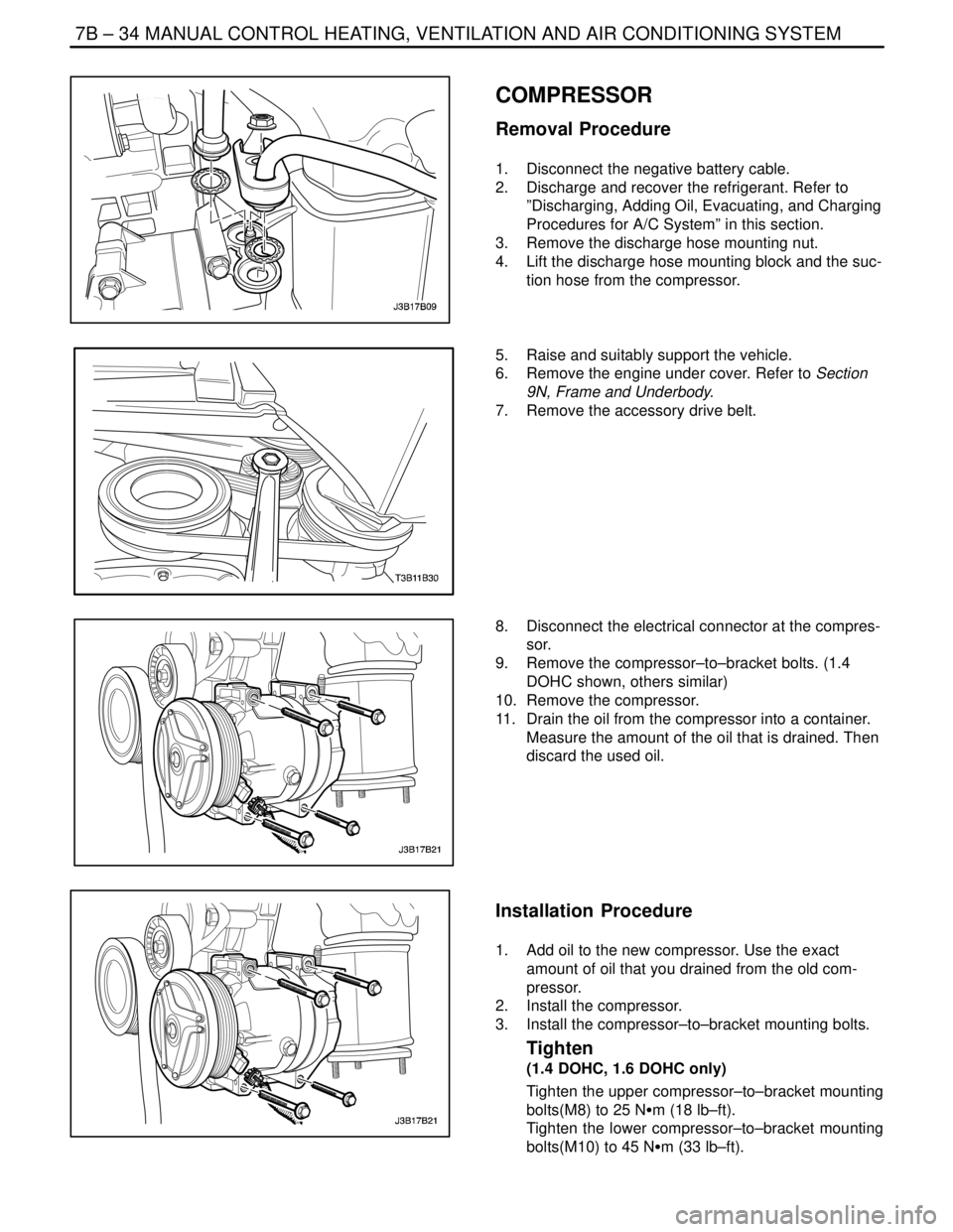
COMPRESSOR
Removal Procedure
1. Disconnect the negative battery cable.
2. Discharge and recover the refrigerant. Refer to
”Discharging, Adding Oil, Evacuating, and Charging
Procedures for A/C System” in this section.
3. Remove the discharge hose mounting nut.
4. Lift the discharge hose mounting block and the suc-
tion hose from the compressor.
5. Raise and suitably support the vehicle.
6. Remove the engine under cover. Refer to Section
9N, Frame and Underbody.
7. Remove the accessory drive belt.
8. Disconnect the electrical connector at the compres-
sor.
9. Remove the compressor–to–bracket bolts. (1.4
DOHC shown, others similar)
10. Remove the compressor.
11. Drain the oil from the compressor into a container.
Measure the amount of the oil that is drained. Then
discard the used oil.
Installation Procedure
1. Add oil to the new compressor. Use the exact
amount of oil that you drained from the old com-
pressor.
2. Install the compressor.
3. Install the compressor–to–bracket mounting bolts.
Tighten
(1.4 DOHC, 1.6 DOHC only)
Tighten the upper compressor–to–bracket mounting
bolts(M8) to 25 NSm (18 lb–ft).
Tighten the lower compressor–to–bracket mounting
bolts(M10) to 45 NSm (33 lb–ft).
Page 2037 of 2643
MANUAL CONTROL HEATING, VENTILATION AND AIR CONDITIONING SYSTEM 7B – 35
DAEWOO V–121 BL4
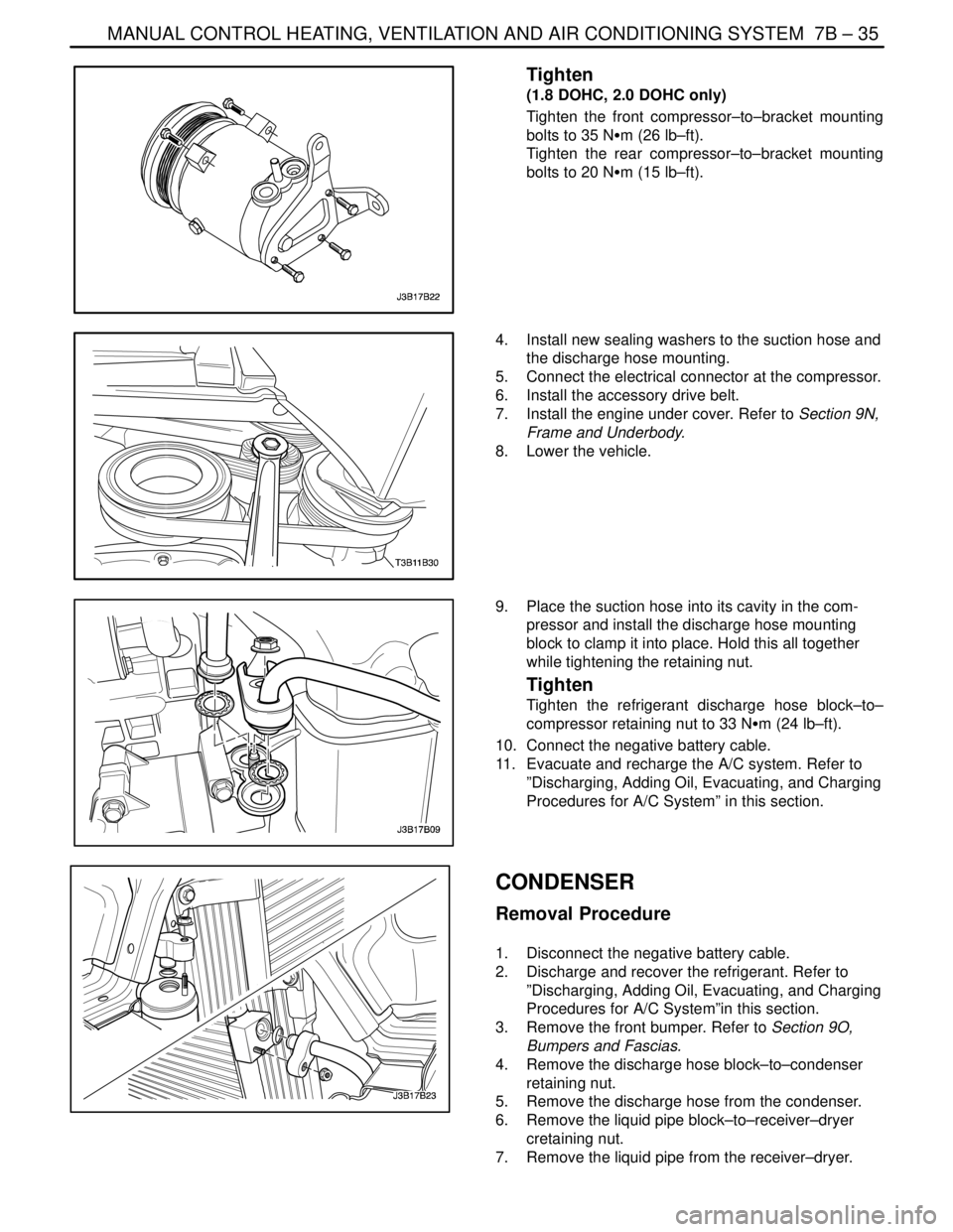
Tighten
(1.8 DOHC, 2.0 DOHC only)
Tighten the front compressor–to–bracket mounting
bolts to 35 NSm (26 lb–ft).
Tighten the rear compressor–to–bracket mounting
bolts to 20 NSm (15 lb–ft).
4. Install new sealing washers to the suction hose and
the discharge hose mounting.
5. Connect the electrical connector at the compressor.
6. Install the accessory drive belt.
7. Install the engine under cover. Refer to Section 9N,
Frame and Underbody.
8. Lower the vehicle.
9. Place the suction hose into its cavity in the com-
pressor and install the discharge hose mounting
block to clamp it into place. Hold this all together
while tightening the retaining nut.
Tighten
Tighten the refrigerant discharge hose block–to–
compressor retaining nut to 33 NSm (24 lb–ft).
10. Connect the negative battery cable.
11. Evacuate and recharge the A/C system. Refer to
”Discharging, Adding Oil, Evacuating, and Charging
Procedures for A/C System” in this section.
CONDENSER
Removal Procedure
1. Disconnect the negative battery cable.
2. Discharge and recover the refrigerant. Refer to
”Discharging, Adding Oil, Evacuating, and Charging
Procedures for A/C System”in this section.
3. Remove the front bumper. Refer to Section 9O,
Bumpers and Fascias.
4. Remove the discharge hose block–to–condenser
retaining nut.
5. Remove the discharge hose from the condenser.
6. Remove the liquid pipe block–to–receiver–dryer
cretaining nut.
7. Remove the liquid pipe from the receiver–dryer.
Page 2048 of 2643
7B – 46IMANUAL CONTROL HEATING, VENTILATION AND AIR CONDITIONING SYSTEM
DAEWOO V–121 BL4
5. Use the snap ring pliers J–5403 to install the shaft
seal retaining ring with its flat side against the seal.
6. Remove any excess oil around the shaft and the
inside of the compressor housing neck.
7. Install the clutch plate and hub assembly. Refer to
”Clutch Plate and Hub Assembly” in this section.
8. Reposition the compressor in its mounting.
9. Adjust the tension on the serpentine accessory
drive belt.
10. Connect the negative battery cable.
11. Evacuate and recharge the A/C system. Refer to
”Discharging, Adding Oil, Evacuating, and Charging
Procedures for A/C System” in this section.
12. Perform a leak test of the system. Refer to ”Leak
Testing the Refrigerant System” in this section.
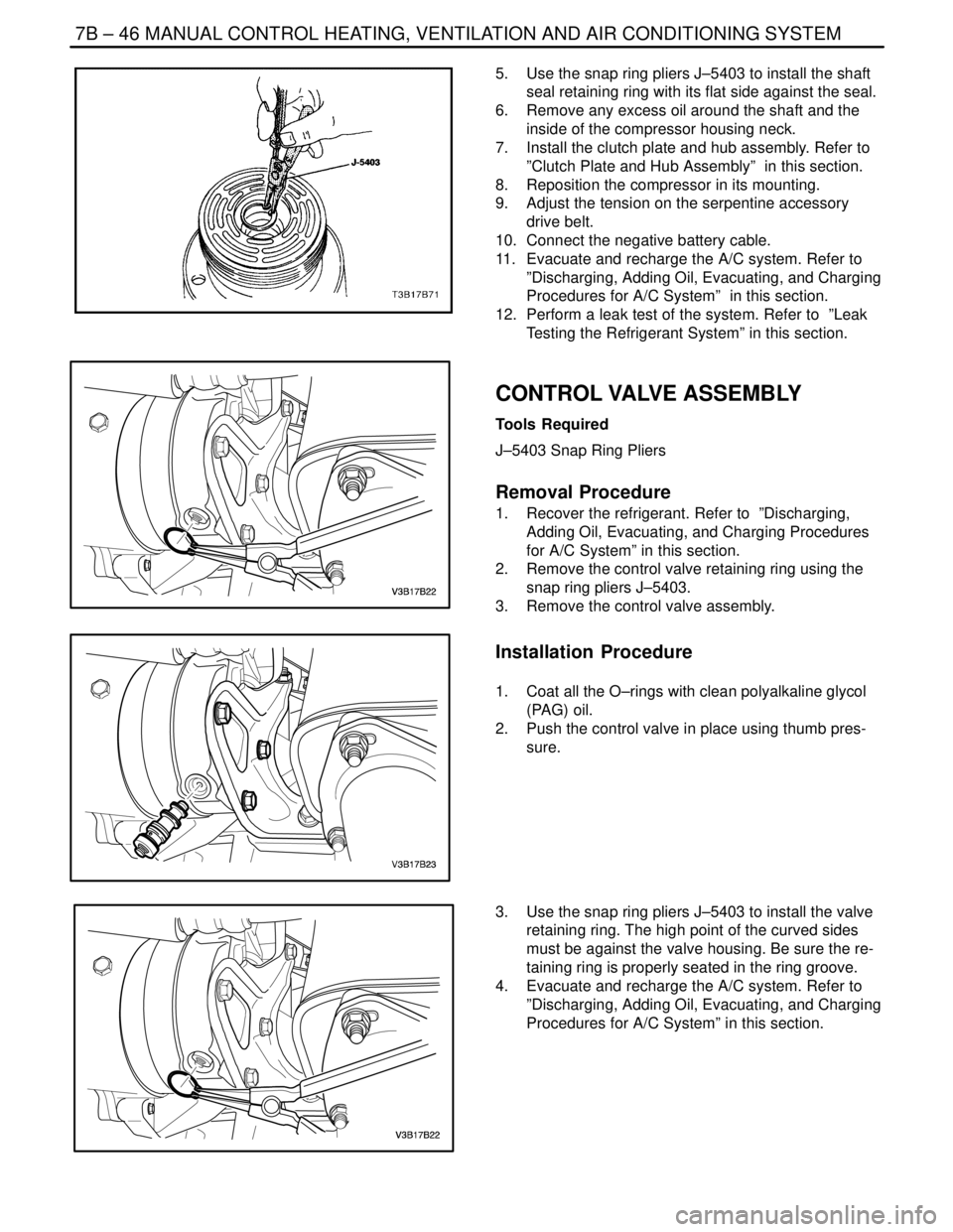
CONTROL VALVE ASSEMBLY
Tools Required
J–5403 Snap Ring Pliers
Removal Procedure
1. Recover the refrigerant. Refer to ”Discharging,
Adding Oil, Evacuating, and Charging Procedures
for A/C System” in this section.
2. Remove the control valve retaining ring using the
snap ring pliers J–5403.
3. Remove the control valve assembly.
Installation Procedure
1. Coat all the O–rings with clean polyalkaline glycol
(PAG) oil.
2. Push the control valve in place using thumb pres-
sure.
3. Use the snap ring pliers J–5403 to install the valve
retaining ring. The high point of the curved sides
must be against the valve housing. Be sure the re-
taining ring is properly seated in the ring groove.
4. Evacuate and recharge the A/C system. Refer to
”Discharging, Adding Oil, Evacuating, and Charging
Procedures for A/C System” in this section.
Page 2054 of 2643

7B – 52IMANUAL CONTROL HEATING, VENTILATION AND AIR CONDITIONING SYSTEM
DAEWOO V–121 BL4
SYSTEM COMPONENTS–CONTROL
Controller
The operation of the A/C system is controlled by the
switches and the lever on the control head. The compres-
sor clutch and the blower are connected electrically to the
control head by a wiring harness. The blower circuit is
open in the OFF mode. Airflow is provided by the four
blower speeds available in the remaining modes. Cooled
and dehumidified air is available in the MAX, NORMAL,
BI–LEVEL, and DEFROST modes.
The temperature is controlled by the position of the tem-
perature knob on the control head. A cable connects this
knob to the temperature door, which controls the airflow
through the heater core. As the temperature knob is
moved through its range of travel, a sliding clip on the
cable at the temperature valve connection should assume
a position ensuring that the temperature door will seat in
both extreme positions. The temperature door position is
independent of the mode control switch. The temperature
door on some models is controlled electrically, eliminating
the need for the temperature cable.
The electric engine cooling fan on some vehicles is not
part of the A/C control system; however, the fan is opera-
tional any time the A/C control is in the MAX, NORMAL,
or BI–LEVEL modes. Some models provide for engine
cooling fan operation when the controller is in the DE-
FROST mode. This added feature is part of the A/C con-
troller function and is aimed at preventing excessive com-
pressor head temperatures. It also allows the A/C system
to function more efficiently. On some models, the engine
cooling fan will be turned off during road speed conditions
above 56 km/h (35 mph), when the airflow though the con-
denser coil is adequate for efficient cooling. The operation
of the cooling fan is controlled by the powertrain control
module (PCM), or the engine control module (ECM),
through the cooling fan relay.
Pressure Transducer
The pressure transducer incorporates the functions of the
high–pressure and the low–pressure cutout switches
along with the fan cycling switch. The pressure transducer
is located in the high–side liquid refrigerant line near the
right front strut tower and the air filter assembly.
Wide–Open Throttle (WOT) Compressor
Cutoff
During full throttle acceleration on vehicles equipped with
multi–port injection (MPI), the throttle position sensor
(TPS) sends a signal to the PCM or the ECM, which then
controls the compressor clutch.
A/C Time Delay Relay
This relay on some vehicles controls the current to the en-
tire A/C system and provides a short delay of A/C opera-
tion upon start–up.
V5 COMPRESSOR–GENERAL
DESCRIPTION
Different vehicles with V5 compressors may exhibit differ-
ences in mounting and installation, but overhaul proce-
dures are similar.
Before removing the compressor or performing on–ve-
hicle repairs, clean the compressor connections and the
outside of the compressor.
Important : After removing a compressor from the vehicle
for servicing, drain the oil by removing the oil drain plug.
Also drain the oil from the suction and the discharge ports
to insure complete draining. Measure the amount of oil
drained, and record that amount. Discard the used oil and
add the same amount of new polyalkaline glycol (PAG) re-
frigerant oil to the compressor.
The compressor has been removed from the vehicle un-
less otherwise indicated.
Clean tools and a clean work area are important for proper
servicing. Keep dirt and foreign material from getting on or
into the compressor parts. Parts that are to be reassem-
bled should be cleaned with trichloroethane, naphtha,
stoddard solvent, kerosene, or equivalent solvents. Dry
the cleaned parts with clean dry air. Use only lint–free
cloths to wipe the parts.
V5 COMPRESSOR–DESCRIPTION OF
OPERATION
The V5 is a variable displacement compressor that can
match the automotive air conditioning (A/C) demand un-
der all conditions without cycling. The basic compressor
mechanism is a variable angle wobble–plate with five ax-
ially oriented cylinders. The center of control of the com-
pressor displacement is a bellows–actuated control valve
located in the rear head of the compressor. The control
valve senses compressor suction pressure.
The wobble–plate angle and the compressor displace-
ment are controlled by the crankcase suction pressure dif-
ferential. When the A/C capacity demand is high, the suc-
tion pressure will be above the control point. The valve will
maintain a bleed from crankcase to suction. With no
crankcase suction pressure differential, the compressor
will have maximum displacement.
When the A/C capacity demand is lower and the suction
pressure reaches the control point, the valve will bleed dis-
charge gas into the crankcase and close off a passage
from the crankcase to the suction plenum. The angle of the
wobble–plate is controlled by a force balance on the five
pistons. A slight elevation of the crankcase suction pres-
sure differential creates total force on the pistons resulting
in a movement about the wobbleplate pivot pin that re-
duces the plate angle.
The compressor has a unique lubrication system. The
crankcase suction bleed is routed through the rotating
wobble–plate for lubrication of the wobble–plate bearing.
The rotation acts as an oil separator which removes some