Page 226 of 277
CAUTION!
The use of vinyl, leather or plastic protectants may
cause excessive gloss and/or discoloration of interior
trim parts.
Leather Seat Care and Cleaning
Leather is best preserved by regular cleaning with a
damp soft cloth. Small particles of dirt can act as an
abrasive and damage the leather surface and should be
removed immediately with a damp cloth. Stubborn soils
can be removed easily with a soft cloth and Mopar Total
Clean. Care should be taken to avoid soaking the leather
with any liquid. Please do not use polishes, oils, cleaning
fluids, solvents, detergents, or ammonia based cleaners
to clean the leather. Application of a leather conditioner is
not required to maintain the original condition.
Wooden Steering Wheel Care — If Equipped
If your vehicle is equipped with a wood steering wheel,
it is finished with a clear topcoat. Please take care to
avoid scratching the surface with sharp or abrasive
materials.
Cleaning Headlights
Your vehicle has plastic headlights that are lighter and
less susceptible to stone breakage than glass headlights.
Plastic is not as scratch resistant as glass and therefore
different lens cleaning procedures must be followed.
To minimize the possibility of scratching the lenses and
reducing light output, avoid wiping with a dry cloth. To
remove road dirt, wash with a mild soap solution fol-
lowed by rinsing.
Do not use abrasive cleaning components, solvents, steel
wool or other aggressive material to clean the lenses.
Glass Surfaces
All glass surfaces should be cleaned on a regular basis
with any commercial household-type glass cleaner.
Never use an abrasive type cleaner. Use caution when
cleaning inside rear windows equipped with electric
defrosters. Do not use scrapers or other sharp instru-
ments which may scratch the elements.
Instrument Panel Cover
The instrument panel cover has a low glare surface which
minimizes reflections in the windshield. Do not use
226 MAINTAINING YOUR VEHICLE
Page 228 of 277
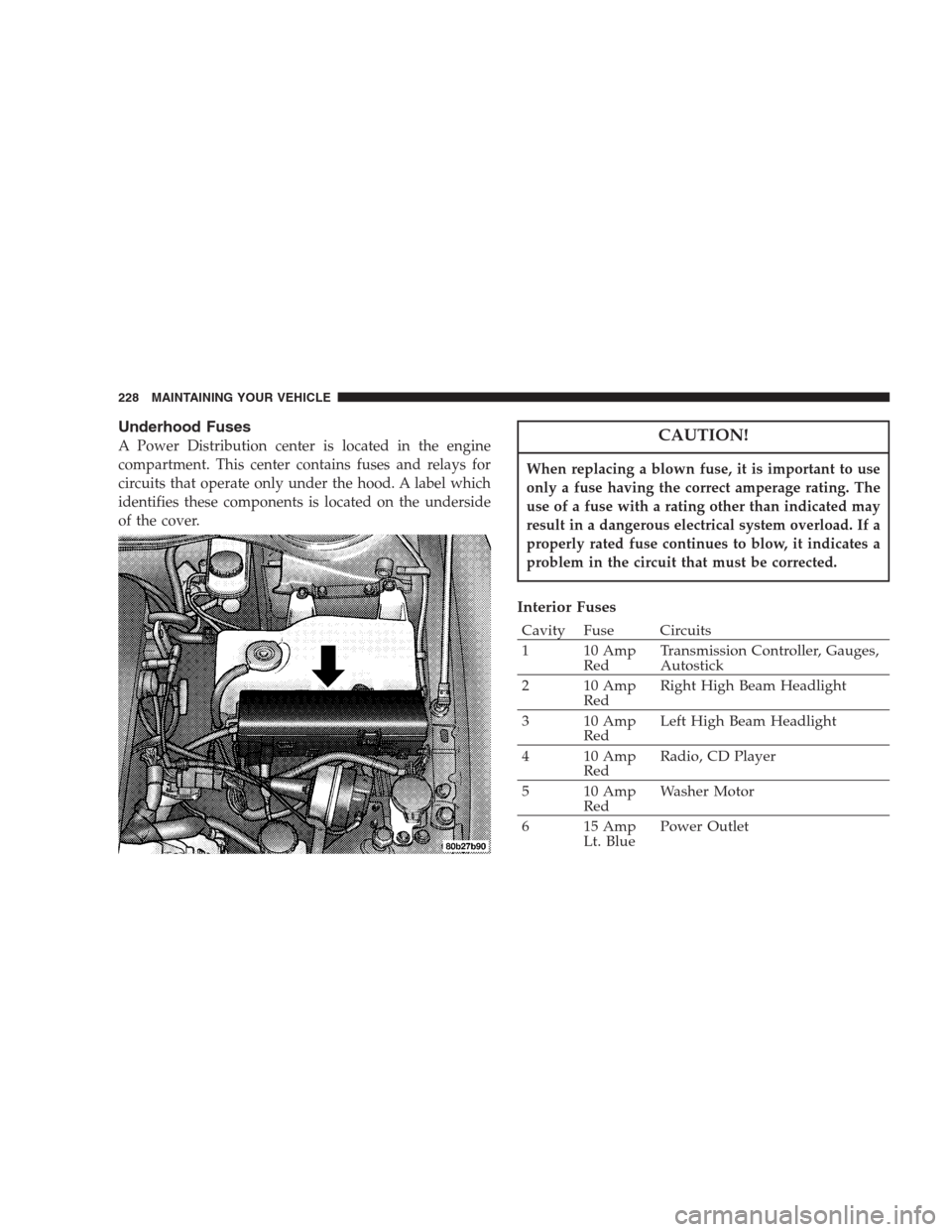
Underhood Fuses
A Power Distribution center is located in the engine
compartment. This center contains fuses and relays for
circuits that operate only under the hood. A label which
identifies these components is located on the underside
of the cover.CAUTION!
When replacing a blown fuse, it is important to use
only a fuse having the correct amperage rating. The
use of a fuse with a rating other than indicated may
result in a dangerous electrical system overload. If a
properly rated fuse continues to blow, it indicates a
problem in the circuit that must be corrected.
Interior Fuses
Cavity Fuse Circuits
1 10 Amp
RedTransmission Controller, Gauges,
Autostick
2 10 Amp
RedRight High Beam Headlight
3 10 Amp
RedLeft High Beam Headlight
4 10 Amp
RedRadio, CD Player
5 10 Amp
RedWasher Motor
6 15 Amp
Lt. BluePower Outlet
228 MAINTAINING YOUR VEHICLE
Page 229 of 277
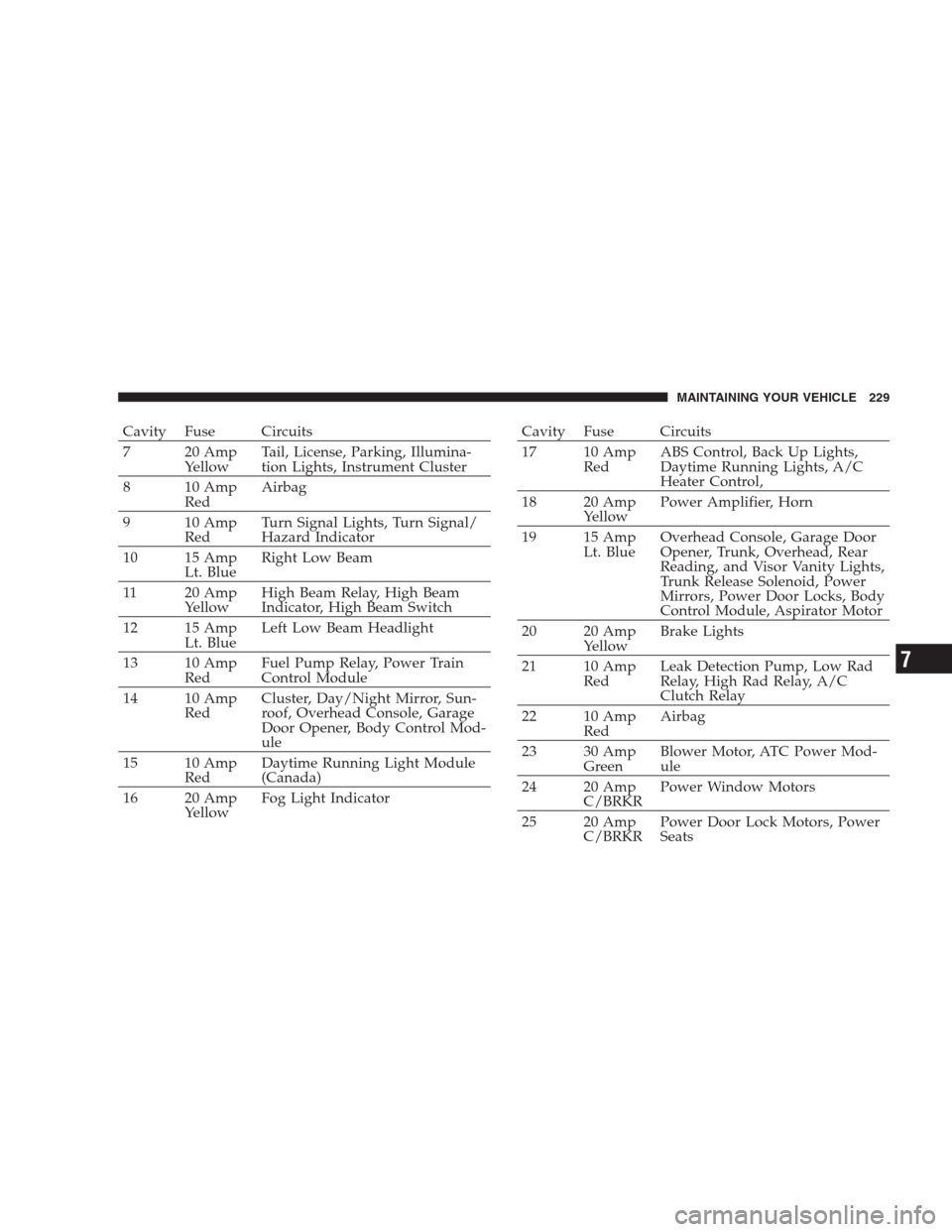
Cavity Fuse Circuits
7 20 Amp
YellowTail, License, Parking, Illumina-
tion Lights, Instrument Cluster
8 10 Amp
RedAirbag
9 10 Amp
RedTurn Signal Lights, Turn Signal/
Hazard Indicator
10 15 Amp
Lt. BlueRight Low Beam
11 20 Amp
YellowHigh Beam Relay, High Beam
Indicator, High Beam Switch
12 15 Amp
Lt. BlueLeft Low Beam Headlight
13 10 Amp
RedFuel Pump Relay, Power Train
Control Module
14 10 Amp
RedCluster, Day/Night Mirror, Sun-
roof, Overhead Console, Garage
Door Opener, Body Control Mod-
ule
15 10 Amp
RedDaytime Running Light Module
(Canada)
16 20 Amp
YellowFog Light IndicatorCavity Fuse Circuits
17 10 Amp
RedABS Control, Back Up Lights,
Daytime Running Lights, A/C
Heater Control,
18 20 Amp
YellowPower Amplifier, Horn
19 15 Amp
Lt. BlueOverhead Console, Garage Door
Opener, Trunk, Overhead, Rear
Reading, and Visor Vanity Lights,
Trunk Release Solenoid, Power
Mirrors, Power Door Locks, Body
Control Module, Aspirator Motor
20 20 Amp
YellowBrake Lights
21 10 Amp
RedLeak Detection Pump, Low Rad
Relay, High Rad Relay, A/C
Clutch Relay
22 10 Amp
RedAirbag
23 30 Amp
GreenBlower Motor, ATC Power Mod-
ule
24 20 Amp
C/BRKRPower Window Motors
25 20 Amp
C/BRKRPower Door Lock Motors, Power
Seats
MAINTAINING YOUR VEHICLE 229
7
Page 230 of 277
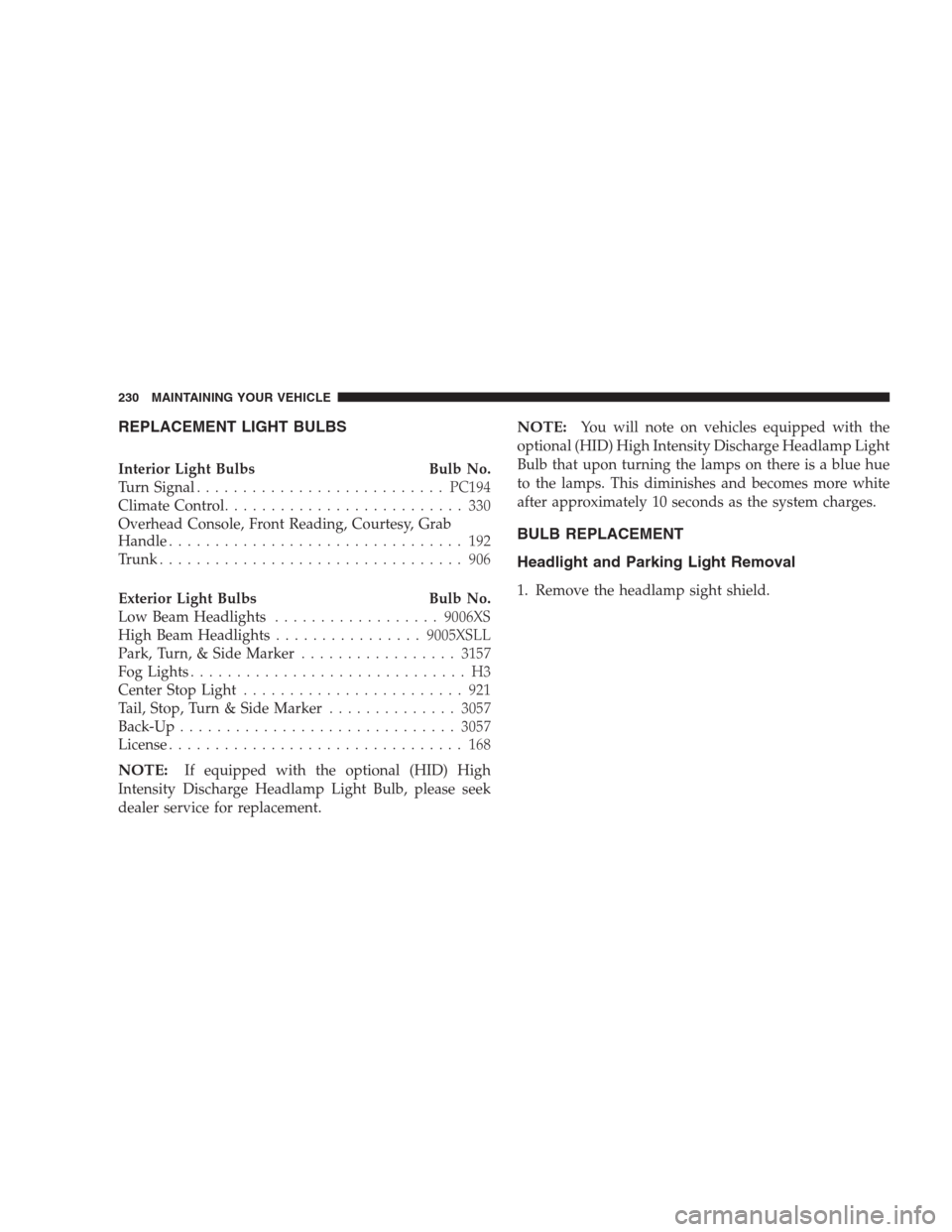
REPLACEMENT LIGHT BULBS
Interior Light Bulbs Bulb No.
Turn Signal...........................PC194
Climate Control.......................... 330
Overhead Console, Front Reading, Courtesy, Grab
Handle................................ 192
Trunk................................. 906
Exterior Light Bulbs Bulb No.
Low Beam Headlights..................9006XS
High Beam Headlights................9005XSLL
Park, Turn, & Side Marker.................3157
Fog Lights.............................. H3
Center Stop Light........................ 921
Tail, Stop, Turn & Side Marker..............3057
Back-Up..............................3057
License................................ 168
NOTE:If equipped with the optional (HID) High
Intensity Discharge Headlamp Light Bulb, please seek
dealer service for replacement.
NOTE:You will note on vehicles equipped with the
optional (HID) High Intensity Discharge Headlamp Light
Bulb that upon turning the lamps on there is a blue hue
to the lamps. This diminishes and becomes more white
after approximately 10 seconds as the system charges.
BULB REPLACEMENT
Headlight and Parking Light Removal
1. Remove the headlamp sight shield.
230 MAINTAINING YOUR VEHICLE
Page 233 of 277
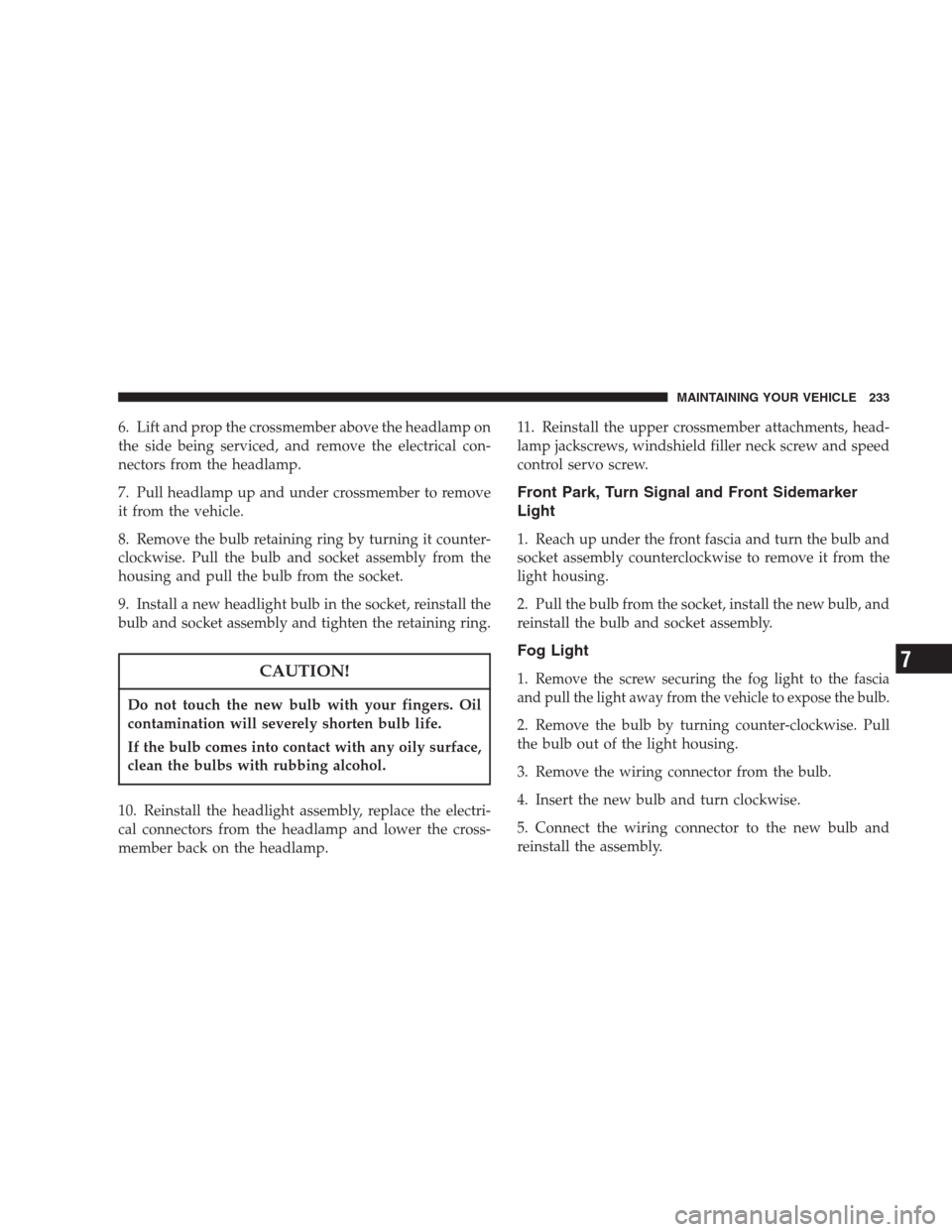
6. Lift and prop the crossmember above the headlamp on
the side being serviced, and remove the electrical con-
nectors from the headlamp.
7. Pull headlamp up and under crossmember to remove
it from the vehicle.
8. Remove the bulb retaining ring by turning it counter-
clockwise. Pull the bulb and socket assembly from the
housing and pull the bulb from the socket.
9. Install a new headlight bulb in the socket, reinstall the
bulb and socket assembly and tighten the retaining ring.
CAUTION!
Do not touch the new bulb with your fingers. Oil
contamination will severely shorten bulb life.
If the bulb comes into contact with any oily surface,
clean the bulbs with rubbing alcohol.
10. Reinstall the headlight assembly, replace the electri-
cal connectors from the headlamp and lower the cross-
member back on the headlamp.11. Reinstall the upper crossmember attachments, head-
lamp jackscrews, windshield filler neck screw and speed
control servo screw.
Front Park, Turn Signal and Front Sidemarker
Light
1. Reach up under the front fascia and turn the bulb and
socket assembly counterclockwise to remove it from the
light housing.
2. Pull the bulb from the socket, install the new bulb, and
reinstall the bulb and socket assembly.
Fog Light
1.Remove the screw securing the fog light to the fascia
and pull the light away from the vehicle to expose the bulb.
2. Remove the bulb by turning counter-clockwise. Pull
the bulb out of the light housing.
3. Remove the wiring connector from the bulb.
4. Insert the new bulb and turn clockwise.
5. Connect the wiring connector to the new bulb and
reinstall the assembly.
MAINTAINING YOUR VEHICLE 233
7
Page 234 of 277
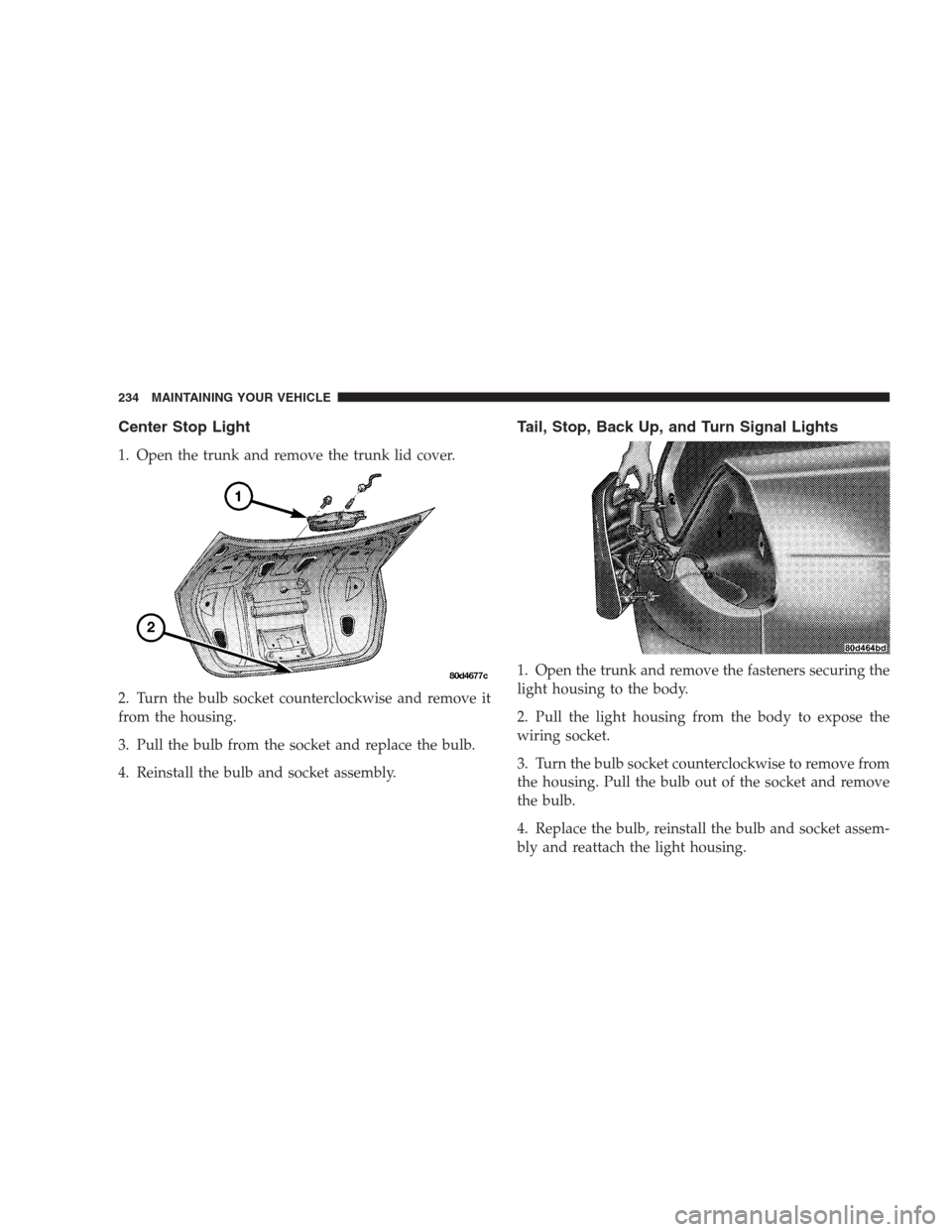
Center Stop Light
1. Open the trunk and remove the trunk lid cover.
2. Turn the bulb socket counterclockwise and remove it
from the housing.
3. Pull the bulb from the socket and replace the bulb.
4. Reinstall the bulb and socket assembly.
Tail, Stop, Back Up, and Turn Signal Lights
1. Open the trunk and remove the fasteners securing the
light housing to the body.
2. Pull the light housing from the body to expose the
wiring socket.
3. Turn the bulb socket counterclockwise to remove from
the housing. Pull the bulb out of the socket and remove
the bulb.
4. Replace the bulb, reinstall the bulb and socket assem-
bly and reattach the light housing.
234 MAINTAINING YOUR VEHICLE
Page 235 of 277
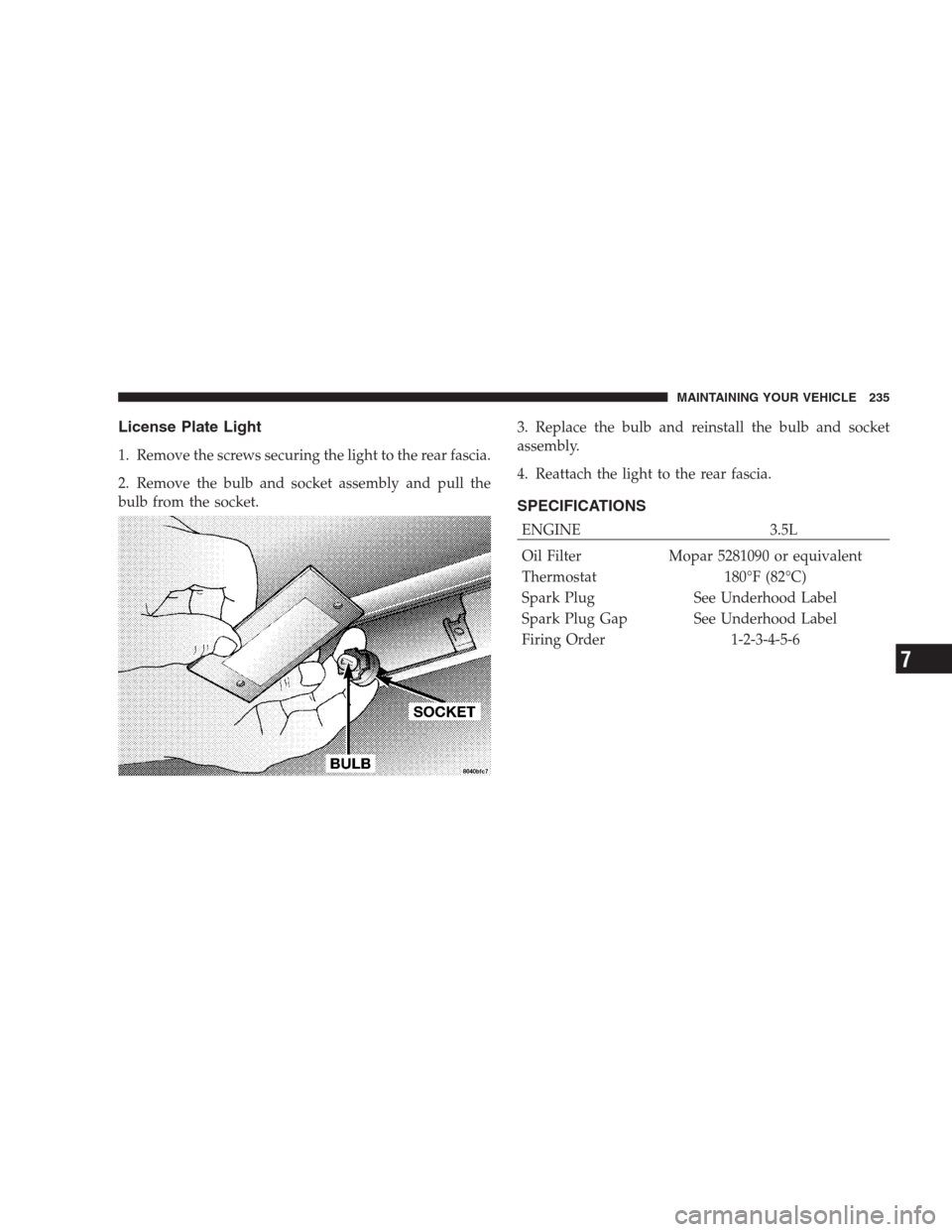
License Plate Light
1. Remove the screws securing the light to the rear fascia.
2. Remove the bulb and socket assembly and pull the
bulb from the socket.3. Replace the bulb and reinstall the bulb and socket
assembly.
4. Reattach the light to the rear fascia.
SPECIFICATIONS
ENGINE 3.5L
Oil Filter Mopar 5281090 or equivalent
Thermostat 180°F (82°C)
Spark Plug See Underhood Label
Spark Plug Gap See Underhood Label
Firing Order 1-2-3-4-5-6
MAINTAINING YOUR VEHICLE 235
7
Page 242 of 277
Once a Month
•
Check tire pressure and look for unusual wear or
damage.
•Inspect the battery and clean and tighten the terminals
as required.
•Check the fluid levels of coolant reservoir, brake
master cylinder, power steering and transaxle and add
as needed.
•Check all lights and all other electrical items for correct
operation.
•Check rubber seals on each side of the radiator for
proper fit.
At Each Oil Change
•
Change the engine oil filter.
•Inspect the exhaust system.
•Inspect the brake hoses.
•Inspect the CV joints and front and rear suspension
components.
•Check the automatic transmission fluid level.
•Check the coolant level, hoses, and clamps.
•Rotate the tires at each oil change interval shown on
Schedule “A” 6,000 miles (10 000 km) or every other
interval shown on Schedule “B” 6,000 miles (10 000
km).
242 MAINTENANCE SCHEDULES
8
M
A
I
N
T
E
N
A
N
C
E
S
C
H
E
D
U
L
E
S