2004 CHRYSLER 300 M coolant level
[x] Cancel search: coolant levelPage 147 of 277
Fan Control
Use this control to regulate the amount of air forced
through the system in any mode you select. Turn the
control clockwise to increase fan speed.
In ambient temperatures below 70°F (21°C), fan opera-
tion is delayed when the engine is first started. The fan
will automatically start when the engine coolant is warm
enough to heat the air. This feature can be defeated by
turning the fan control.
AUTO Control
Press the top of the button to turn the ATC system On.
Press the lower portion of the button to turn the entire
system Off.
Comfort Control
Use this control to regulate the comfort inside the pas-
senger compartment. Press the top of the switch to raise
the temperature selection and the bottom of the switch to
lower it. The comfort setting range is from Lo, 60, 61,....to
89,90, Hi, for automatic temperature control. You can
select a very hot or cold comfort setting by holding the
comfort control until it reaches its highest or lowest
levels.The system adjusts to bring the interior temperature to
the desired comfort level. All comfort settings are auto-
matic; even Hi and Low.
NOTE:You can change the display from U.S. to metric
units by pressing the Mix and Panel mode buttons
simultaneously or by pressing the English/Metric button
on the overhead console.
Air Conditioning Button
Press this button to turn on the air conditioning
compressor. A snow flake symbol in the display
shows that the compressor is on. Compressor
operation is automatic when you press the Auto button.
The compressor can operate at any temperature above
32°F (0°C).
With the compressor off and the temperature set at Lo, air
entering the vehicle will be slightly warmer than the air
outside the vehicle.
NOTE:The compressor will not engage until the engine
has been running for several seconds. Slight changes in
UNDERSTANDING YOUR INSTRUMENT PANEL 147
4
Page 180 of 277
adequate performance. For Example, choose “4” if the
desired speed can be maintained. Choose “3” or “2” if
needed to maintain the desired speed.
Extended driving at high RPM’s should be avoided to
prevent excess heat generation. A reduction in vehicle
speed may be necessary to avoid extended driving at
high RPMs. Return to a higher gear range or vehicle
speed when road conditions and RPM level allow.
•
The trailer tongue load must be considered as part of
the tow vehicle load capacity when loading the ve-
hicle.
•If the trailer weighs more than 1,000 lbs. (450 kg), it
should have its own brakes.
WARNING!
Connecting trailer brakes to your vehicle’s hydraulic
brake lines can overload your brake system and
cause it to fail. You might not have brakes when you
need them and could have an accident.
•Whenever you pull a trailer, regardless of the trailer
size, stop lights and turn signals on the trailer are
recommended for motoring safety.
•The automatic transmission fluid, filter, and hypoid
differential fluid should be changed per Maintenance
Schedule “B” if you tow a trailer.
•If your Engine Coolant Light comes on, see the para-
graph on Overheating in Section 6 of this manual.
NOTE:Check the automatic transmission fluid level
before all towing. Fluid discoloration, or a burnt odor,
shows the need for a transmission fluid and filter change.
180 STARTING AND OPERATING
Page 216 of 277
Higher concentrations (not to exceed 70%) may be used if
temperatures below -37°F (-38°C) are anticipated.
Use only high purity water such as distilled or deionized
water when mixing the water/antifreeze solution. The
use of lower quality water will reduce the amount of
corrosion protection in the engine cooling system.
NOTE:Mixing coolant types will decrease the life of the
engine coolant and will require more frequent engine
coolant changes.
Please note that it is the owner’s responsibility to main-
tain the proper level of protection against freezing ac-
cording to the temperatures occurring in the area where
the vehicle is operated.
Cooling System Pressure Cap
The cap must be fully tightened to prevent loss of
coolant, and to insure that coolant will return to the
radiator from the coolant reserve tank.
The cap should be inspected and cleaned if there is any
accumulation of foreign material on the sealing surfaces.
WARNING!
The warning words “DO NOT OPEN HOT” on the
cooling system pressure cap are a safety precaution.
Never add coolant when the engine is overheated.
Do not loosen or remove the cap to cool an over-
heated engine. Heat causes pressure to build up in
the cooling system. To prevent scalding or injury, do
not remove the pressure cap while the system is hot
or under pressure.
WARNING!
Do not use a pressure cap other than the one speci-
fied for your vehicle. Personal injury or engine
damage may result.
216 MAINTAINING YOUR VEHICLE
Page 217 of 277
Coolant Level
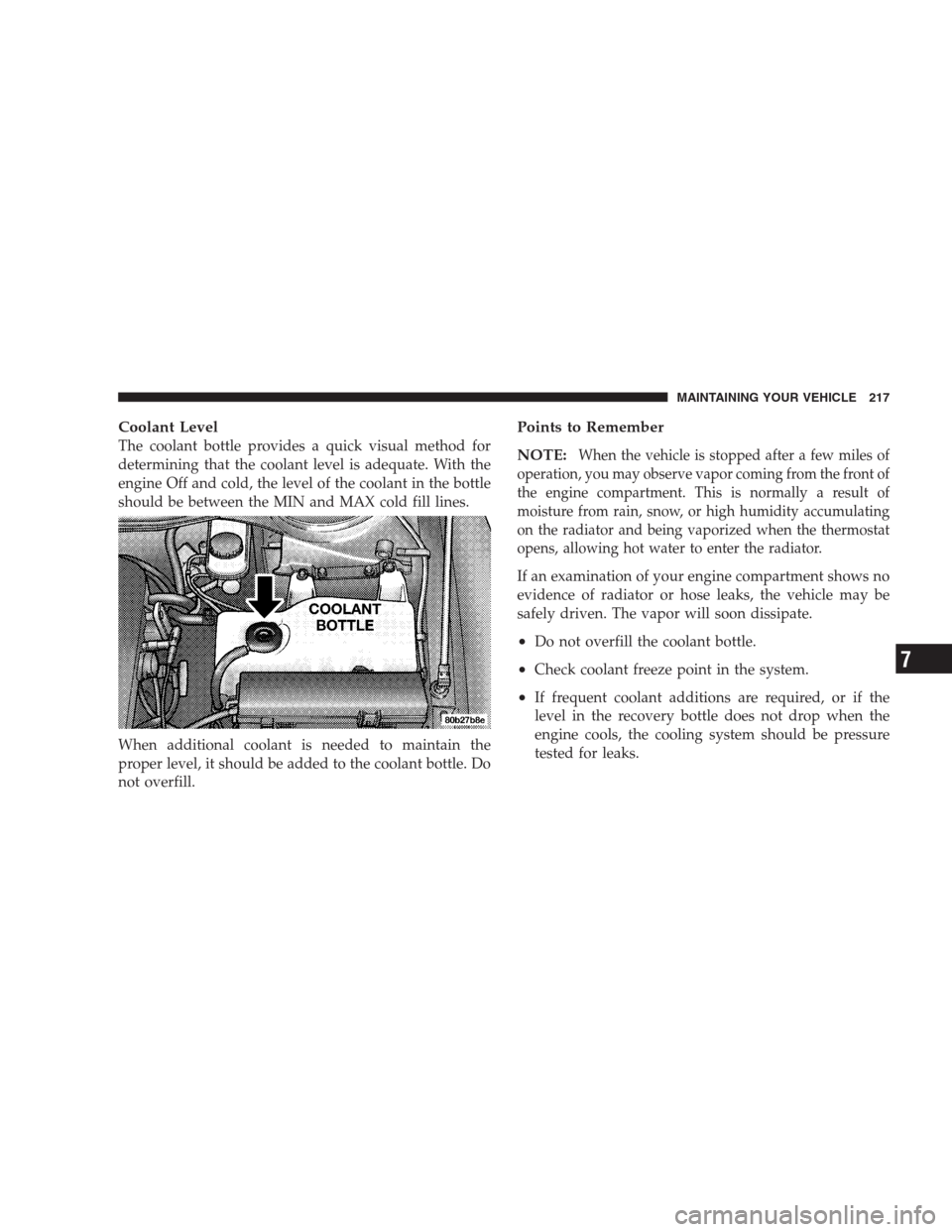
The coolant bottle provides a quick visual method for
determining that the coolant level is adequate. With the
engine Off and cold, the level of the coolant in the bottle
should be between the MIN and MAX cold fill lines.
When additional coolant is needed to maintain the
proper level, it should be added to the coolant bottle. Do
not overfill.
Points to Remember
NOTE:
When the vehicle is stopped after a few miles of
operation, you may observe vapor coming from the front of
the engine compartment. This is normally a result of
moisture from rain, snow, or high humidity accumulating
on the radiator and being vaporized when the thermostat
opens, allowing hot water to enter the radiator.
If an examination of your engine compartment shows no
evidence of radiator or hose leaks, the vehicle may be
safely driven. The vapor will soon dissipate.
•Do not overfill the coolant bottle.
•Check coolant freeze point in the system.
•If frequent coolant additions are required, or if the
level in the recovery bottle does not drop when the
engine cools, the cooling system should be pressure
tested for leaks.
MAINTAINING YOUR VEHICLE 217
7
Page 236 of 277
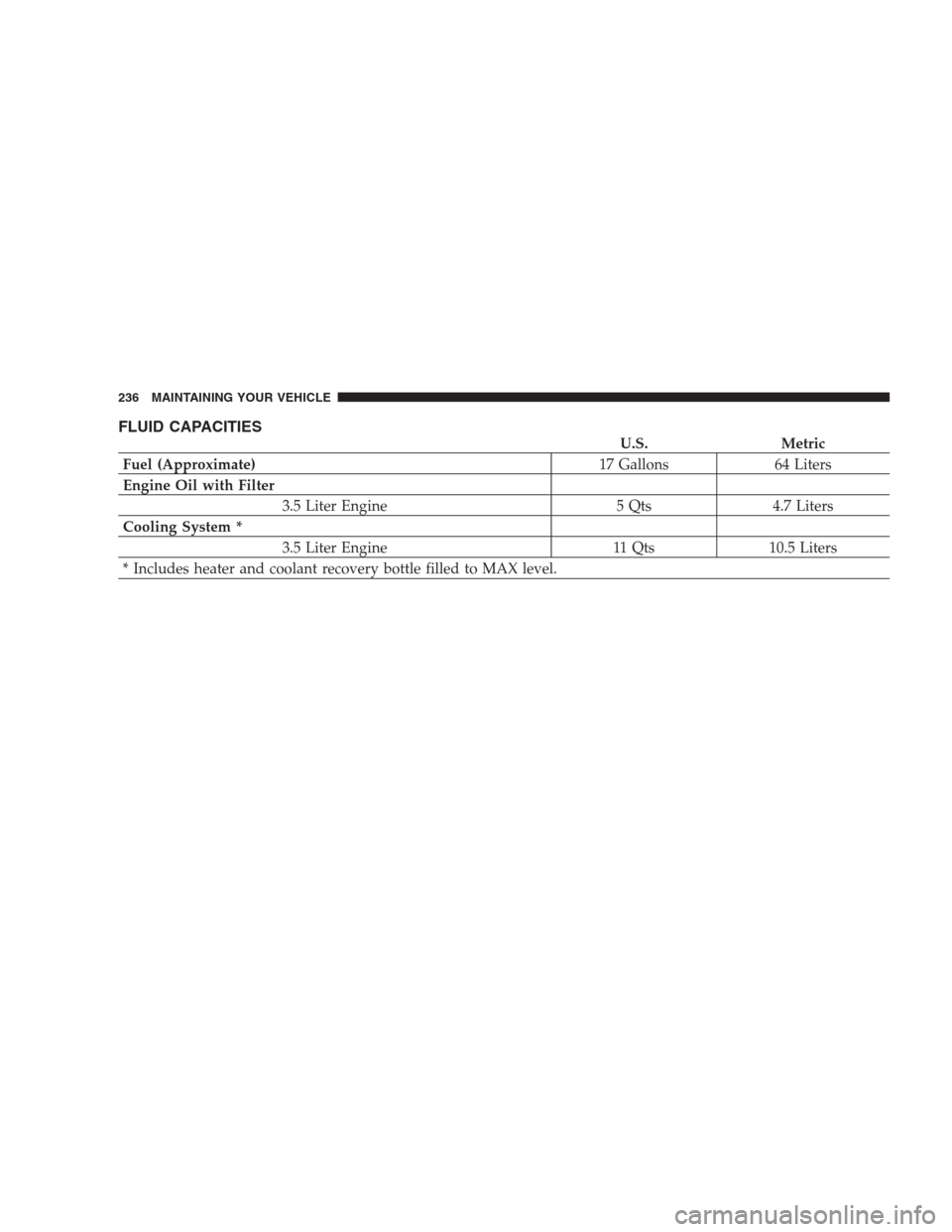
FLUID CAPACITIES
U.S. Metric
Fuel (Approximate)17 Gallons 64 Liters
Engine Oil with Filter
3.5 Liter Engine 5 Qts 4.7 Liters
Cooling System *
3.5 Liter Engine 11 Qts 10.5 Liters
* Includes heater and coolant recovery bottle filled to MAX level.
236 MAINTAINING YOUR VEHICLE
Page 242 of 277

Once a Month
•
Check tire pressure and look for unusual wear or
damage.
•Inspect the battery and clean and tighten the terminals
as required.
•Check the fluid levels of coolant reservoir, brake
master cylinder, power steering and transaxle and add
as needed.
•Check all lights and all other electrical items for correct
operation.
•Check rubber seals on each side of the radiator for
proper fit.
At Each Oil Change
•
Change the engine oil filter.
•Inspect the exhaust system.
•Inspect the brake hoses.
•Inspect the CV joints and front and rear suspension
components.
•Check the automatic transmission fluid level.
•Check the coolant level, hoses, and clamps.
•Rotate the tires at each oil change interval shown on
Schedule “A” 6,000 miles (10 000 km) or every other
interval shown on Schedule “B” 6,000 miles (10 000
km).
242 MAINTENANCE SCHEDULES
8
M
A
I
N
T
E
N
A
N
C
E
S
C
H
E
D
U
L
E
S
Page 266 of 277
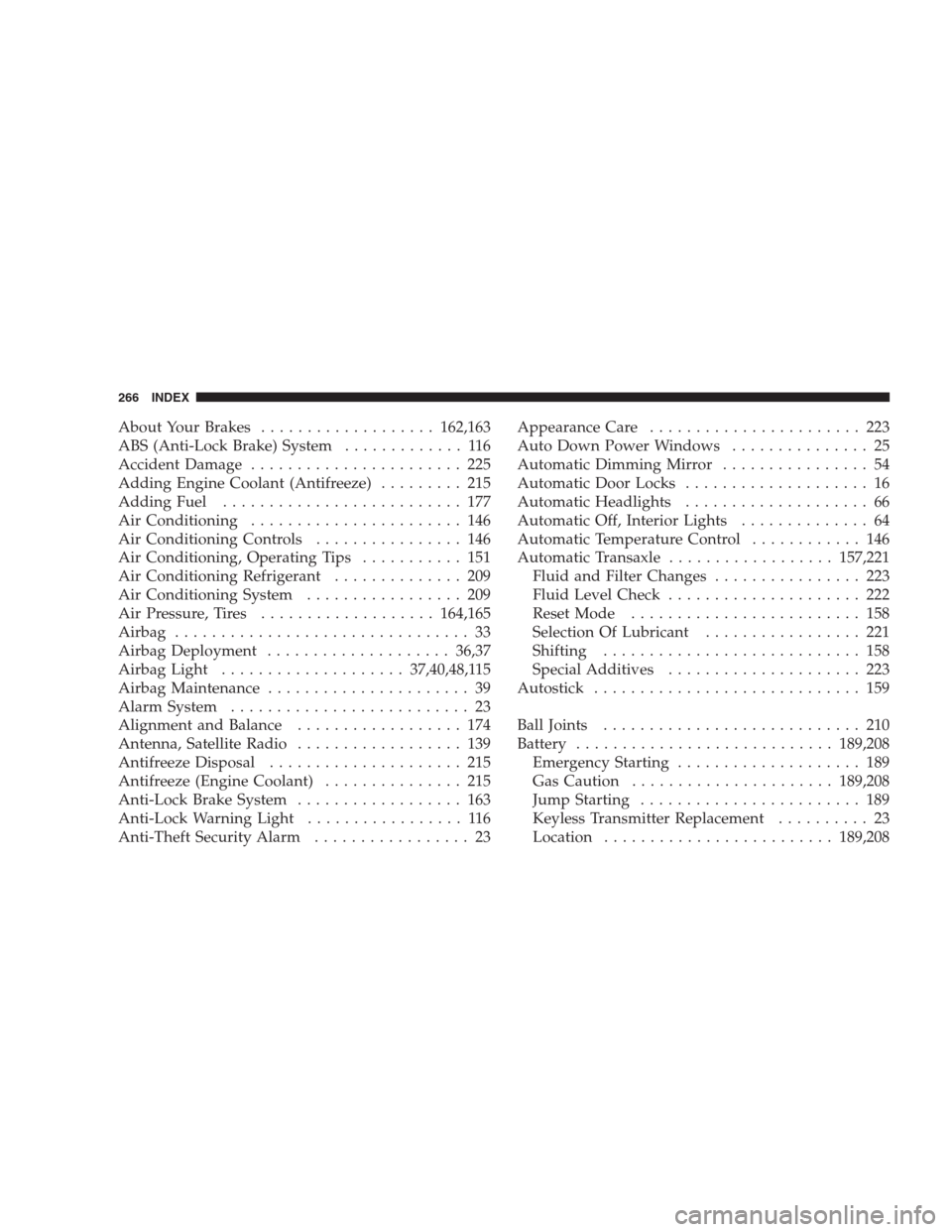
About Your Brakes...................162,163
ABS (Anti-Lock Brake) System............. 116
Accident Damage....................... 225
Adding Engine Coolant (Antifreeze)......... 215
Adding Fuel.......................... 177
Air Conditioning....................... 146
Air Conditioning Controls................ 146
Air Conditioning, Operating Tips........... 151
Air Conditioning Refrigerant.............. 209
Air Conditioning System................. 209
Air Pressure, Tires...................164,165
Airbag................................ 33
Airbag Deployment....................36,37
Airbag Light....................37,40,48,115
Airbag Maintenance...................... 39
Alarm System.......................... 23
Alignment and Balance.................. 174
Antenna, Satellite Radio.................. 139
Antifreeze Disposal..................... 215
Antifreeze (Engine Coolant)............... 215
Anti-Lock Brake System.................. 163
Anti-Lock Warning Light................. 116
Anti-Theft Security Alarm................. 23Appearance Care....................... 223
Auto Down Power Windows............... 25
Automatic Dimming Mirror................ 54
Automatic Door Locks.................... 16
Automatic Headlights.................... 66
Automatic Off, Interior Lights.............. 64
Automatic Temperature Control............ 146
Automatic Transaxle..................157,221
Fluid and Filter Changes................ 223
Fluid Level Check..................... 222
Reset Mode......................... 158
Selection Of Lubricant................. 221
Shifting............................ 158
Special Additives..................... 223
Autostick............................. 159
Ball Joints............................ 210
Battery............................189,208
Emergency Starting.................... 189
Gas Caution......................189,208
Jump Starting........................ 189
Keyless Transmitter Replacement.......... 23
Location.........................189,208
266 INDEX
Page 268 of 277
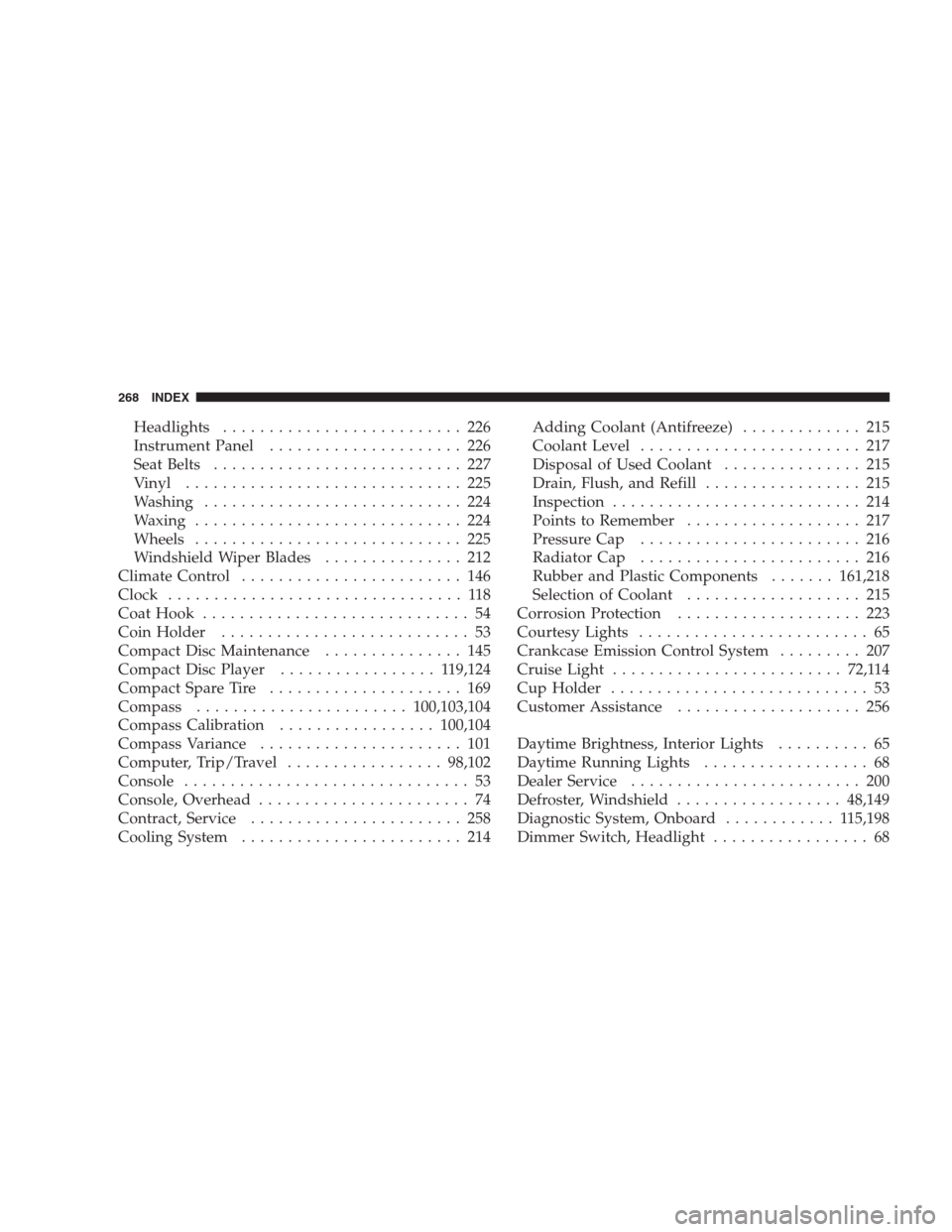
Headlights.......................... 226
Instrument Panel..................... 226
Seat Belts........................... 227
Vinyl.............................. 225
Washing............................ 224
Waxing............................. 224
Wheels............................. 225
Windshield Wiper Blades............... 212
Climate Control........................ 146
Clock................................ 118
Coat Hook............................. 54
Coin Holder........................... 53
Compact Disc Maintenance............... 145
Compact Disc Player................. 119,124
Compact Spare Tire..................... 169
Compass.......................100,103,104
Compass Calibration.................100,104
Compass Variance...................... 101
Computer, Trip/Travel.................98,102
Console............................... 53
Console, Overhead....................... 74
Contract, Service....................... 258
Cooling System........................ 214Adding Coolant (Antifreeze)............. 215
Coolant Level........................ 217
Disposal of Used Coolant............... 215
Drain, Flush, and Refill................. 215
Inspection........................... 214
Points to Remember................... 217
Pressure Cap........................ 216
Radiator Cap........................ 216
Rubber and Plastic Components.......161,218
Selection of Coolant................... 215
Corrosion Protection.................... 223
Courtesy Lights......................... 65
Crankcase Emission Control System......... 207
Cruise Light.........................72,114
Cup Holder............................ 53
Customer Assistance.................... 256
Daytime Brightness, Interior Lights.......... 65
Daytime Running Lights.................. 68
Dealer Service......................... 200
Defroster, Windshield..................48,149
Diagnostic System, Onboard............ 115,198
Dimmer Switch, Headlight................. 68
268 INDEX