Page 167 of 277

CAUTION!
The TPM system has been optimized for the original
equipment tires and wheels. TPM system pressures
have been established for the tire size equipped on
your vehicle. Undesirable operation or sensor dam-
age may result when using replacement equipment
that is not of the same size, type, and/or style.
After-market wheels can cause sensor damage. Do
not use tire sealant or balance beads if your vehicle
is equipped with TPM system as damage to the
sensors may result.
Tire Pressure Monitor System Tire/Wheel Rotation
and Sensor Replacement — If Equipped
If a road tire and wheel is replaced by the spare, the TPM
system will detect the swap automatically (after the
ignition has been cycled) and display SPARE SWAP
DETECTED along with a chime. This could take up to 10
minutes with vehicle speed above 25 mph (40 km/h).The tire pressure sensorsmustbe retrained following a
wheel rotation or sensor replacement. Refer to “Under-
standing The Features of Your Vehicle, Electronic Vehicle
Information Center (EVIC), Customer Programmable
Features, Retrain Tire Sensors” for more information. It is
necessary to program the EVIC with the new sensor(s) or
the new position of each sensor as it is rotated to a
different corner of the vehicle.
If a wheel rotation is not followed by the retrain proce-
dure, the system will not properly inform you of the
correct vehicle location of a low or high tire pressure.
The retraining procedure requires the use of a training
magnet which is located in the left, rear corner of the
spare tire well under the spare tire cover in the trunk.
STARTING AND OPERATING 167
5
Page 168 of 277

CAUTION!
After inspecting or adjusting the tire pressure al-
ways reinstall the valve stem cap. This will prevent
moisture and dirt from entering the valve stem,
which could damage the wheel rim sensor.
WARNING!
Death or serious injury can occur if magnetically
sensitive devices are exposed to this magnet. Mag-
nets can affect pacemakers.
High Speed Operation
The manufacturer advocates driving at safe speeds
within posted speed limits. Where speed limits or condi-
tions are such that the vehicle can be driven at high
speeds, correct tire inflation pressure is very important.
WARNING!
High speed driving with your vehicle under load is
dangerous. The added strain on your tires could
cause them to fail. You could have a serious accident.
Don’t drive a vehicle loaded to the maximum capac-
ity at continuous speeds above 75 mph (120 km/h).
Radial-Ply Tires
WARNING!
Combining radial ply tires with other tires on your
vehicle will cause your vehicle to handle poorly. The
instability could cause an accident. Always use ra-
dial tires in sets of four. Never combine them with
other types of tires.
Cuts and punctures in radial tires are repairable only in
the tread area because of sidewall flexing. Consult your
tire dealer for radial tire repairs.
168 STARTING AND OPERATING
Page 169 of 277

Spare Tire Usage with Directional Tread Pattern
Tires (300M Special Only)
The 300M Special model offers tires with a directional
tread pattern. These tires are designed to optimize dry
handling as well as wet performance. To obtain the full
benefits of this design, the tires must be installed so that
they rotate in the correct direction. The rotation direction
of this type of tire is indicated by arrows on the side wall
of the tire. The full size spare tire is mounted as a direct
replacement for the right side of the vehicle. For road-
side replacement of a flat tire on the left side of the
vehicle, the full size spare can be used as mounted. If this
is required, correct the rotation as soon as possible to
restore optimum wet performance.
Compact Spare Tire
Maintain the compact spare tire inflation pressure at 60
psi [4.1 bars](414 kPa). Do not exceed 50 mph (80 km/h)
while the compact spare is installed on the vehicle.
Do not install a wheel cover or attempt to mount a
conventional tire on the compact spare wheel, since the
wheel is designed specifically for the compact spare.Because of the reduced ground clearance, do not take
your vehicle through an automatic car wash with the
compact spare installed.
WARNING!
Temporary-use spare tires are for emergency use
only. With the compact spare tire assembly installed
on your vehicle, do not exceed 50 mph (80 km).
Vehicle handling and braking performance will be
reduced. Also, do not drive more than 50 mph (80
km) with the compact spare installed. Failure to
follow compact spare tire warning may result in an
accident and/or fatal injury. Temporary-use spare
tires have a total tread life of 2,000 miles (3 200 km).
Be sure to follow the warnings, which apply to your
spare. Failure to do so could result in spare tire
failure and loss of vehicle control.
STARTING AND OPERATING 169
5
Page 170 of 277

Tire Spinning
When stuck in mud, sand, snow, or ice conditions, do not
spin your vehicle’s wheels above 30 mph. (48 km/h).
See the paragraph on Freeing A Stuck Vehicle in section 6
of this manual.
WARNING!
Fast spinning tires can be dangerous. Forces gener-
ated by excessive wheel speeds may cause tire dam-
age or failure. A tire could explode and injure
someone. Do not spin your vehicle’s wheels faster
than 30 mph (48 km/h) when you are stuck. And
don’t let anyone near a spinning wheel, no matter
what the speed.
Tire Chains
Due to limited clearance, tire chains are not recom-
mended.
CAUTION!
Damage to the vehicle may result if tire chains are
used.
Snow Tires
Some areas of the country require the use of snow tires
during winter. Standard tires are of the all season type
and satisfy this requirement as indicated by the M+S
designation on the tire sidewall.
The 300M Special offers a high performance three
season tire. The performance of this type of tire on
snow and ice is not equivalent to traditional all season
tires.
170 STARTING AND OPERATING
Page 171 of 277

WARNING!
The 300M Special is equipped with tires that are
optimized for driving in dry and wet weather con-
ditions. However, these tires have reduced traction
capability in snow and ice. When driving a 300M
Special in these conditions with these tires, you must
take special care to maintain control and avoid
accidents. We recommend that you equip your ve-
hicle with “SNOW” or “ALL SEASON” tires on all
four wheels for driving in snowy and icy conditions.
It is necessary to select tires equivalent in size and
load rating to the original equipment tires. “SNOW”
tires may have lower speed rating than factory
equipped tires and may not match the maximum
vehicle speed. Do not use tires or wheels other than
the size recommended by the manufacturer for this
vehicle.
If you need snow tires, select tires equivalent in size and
load rating to the original equipment tires. Refer to the
tire pressure label for inflation pressure.Snow tires may have a lower speed rating than factory
equipped tires and may not match the maximum vehicle
speed.
Snow tires should not be operated at sustained speeds
over 75 mph (120 km/h).
Tread Wear Indicators
Tread wear indicators are in the original equipment tires
to help you in determining when your tires should be
replaced.
STARTING AND OPERATING 171
5
Page 172 of 277

These indicators are molded into the bottom of the tread
grooves and will appear as bands when the tread depth
becomes 1/16 inch (2 mm). When the indicators appear
in 2 or more adjacent grooves, the tire should be replaced.
Many states have laws requiring tire replacement at this
point.
Replacement Tires
The tires on your new vehicle provide a balance of many
characteristics. They should be inspected regularly for
wear and correct inflation pressure. The manufacturer
strongly recommends that you use tires equivalent to the
originals in size, quality and performance when replace-
ment is needed (see the paragraph on tread wear indica-
tors). Failure to use equivalent replacement tires may
adversely affect the safety, handling, and ride of your
vehicle. We recommend that you contact your original
equipment dealer on any questions you may have on tire
specifications or capability.
WARNING!
•Do not use a tire, wheel size or rating other than
that specified for your vehicle. Some combina-
tions of unapproved tires and wheels may change
suspension dimensions and performance charac-
teristics, resulting in changes to steering, han-
dling, and braking of your vehicle. This can cause
unpredictable handling and stress to steering and
suspension components. You could lose control
and have an accident resulting in serious injury or
death. Use only the tire and wheel sizes with load
ratings approved for your vehicle.
•Never use a tire smaller than the minimum tire
size listed on your vehicle’s tire label located on
the driver’s door. Using a smaller tire could result
in tire overloading and failure. You could lose
control and have an accident.
•Failure to equip your vehicle with tires having
adequate speed capability can result in sudden
tire failure and loss of vehicle control.
•Overloading your tires is dangerous. Like under
inflation, overloading can cause tire failure. Use
tires of the recommended load capacity for your
vehicle and never overload them.
172 STARTING AND OPERATING
Page 174 of 277

of this type of tire is indicated by arrows on the side wall
of the tire.
The required rotation method for directional tires is to
swap the front tire with the rear on the same side of the
vehicle. Do not cross switch tires without dismounting
the tires and re-mounting them in the correct rotational
direction.Alignment And Balance
The suspension components of your vehicle should be
inspected and aligned when needed to obtain full tire
tread mileage.
Poor suspension alignment may result in:
•fast tire wear;
•uneven tire wear, such as feathering and one-sided
wear;
•vehicle pull to right or left.
Tires may also cause vehicle to pull to the left or right.
Alignment will not correct this condition. See your dealer
for proper diagnosis.
Improper alignment will not cause vehicle vibration.
Vehicle vibration may be a result of tire and wheel
out-of-balance. Proper balancing will reduce vibration
and avoid tire cupping and spotty wear.
300M Special Only
174 STARTING AND OPERATING
Page 181 of 277
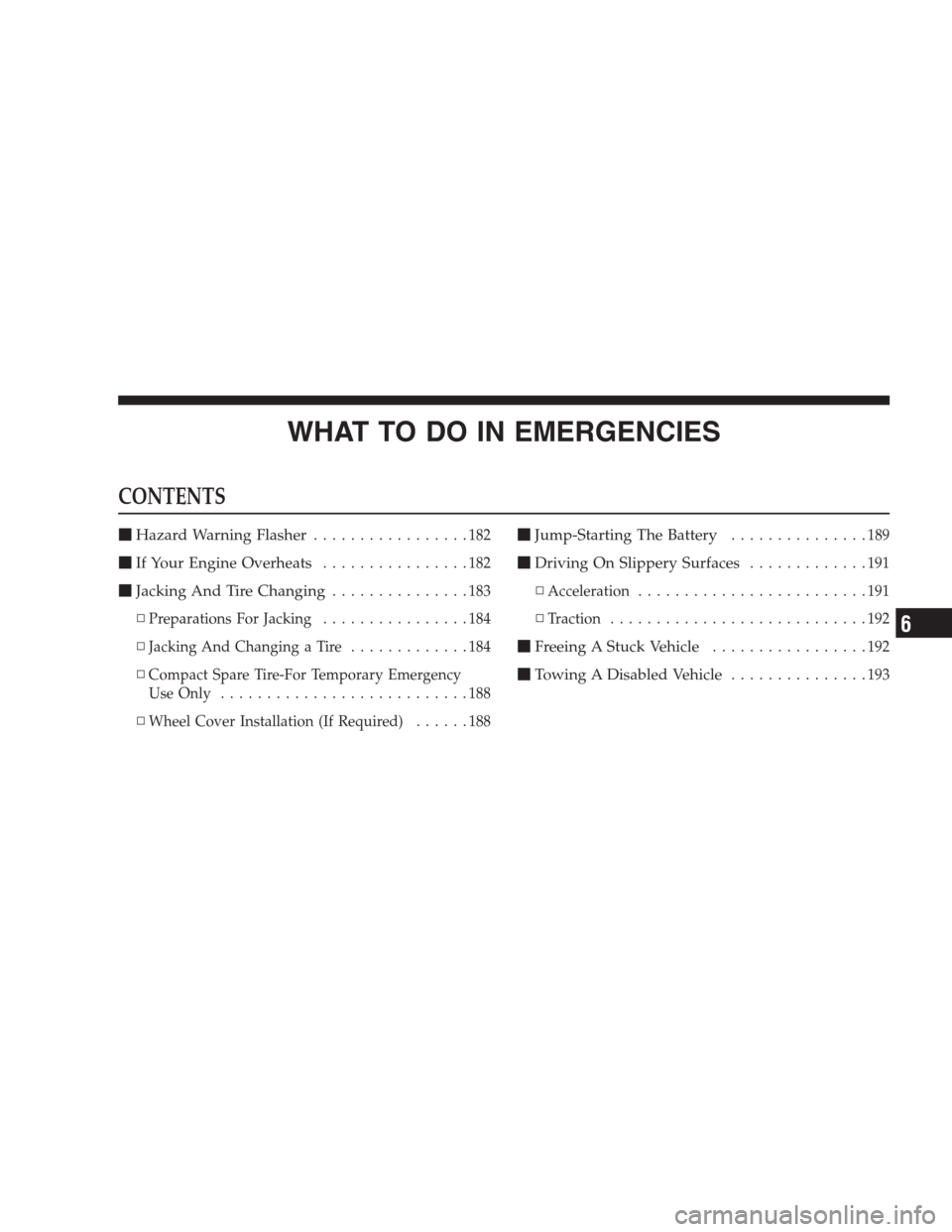
WHAT TO DO IN EMERGENCIES
CONTENTS
�Hazard Warning Flasher.................182
�If Your Engine Overheats................182
�Jacking And Tire Changing...............183
▫Preparations For Jacking................184
▫Jacking And Changing a Tire.............184
▫Compact Spare Tire-For Temporary Emergency
Use Only...........................188
▫Wheel Cover Installation (If Required)......188
�Jump-Starting The Battery...............189
�Driving On Slippery Surfaces.............191
▫Acceleration.........................191
▫Traction............................192
�Freeing A Stuck Vehicle.................192
�Towing A Disabled Vehicle...............193
6